
Sujata’s Grade 7 class has a box of solids on the teacher’s desk: a die from a ludo set, a wooden pyramid, a triangular block shaped like a tent, and some cardboard models the class built last week. The teacher picks up the die.
“Count three things on it,” she says. “The corners, the edges where two faces meet, and the flat faces. Then do one simple sum with the three numbers, using only adding and taking away, and you will get 2. Now do the same with any other solid in the box, or any one you can make. You will get 2 again. Every time.”
Sujata counts the die: 8 corners, 12 edges, 6 faces. The sum isn’t hard to find for one solid. The puzzle is to find the one sum that works for all of them. Count a few solids yourself.
Guess first. For the cube, 8 corners, 12 edges and 6 faces, several sums give 2. Count at least two more solids, then pick the sum that gives 2 for every solid.
Pick an answer to see why.
Count more solids
Here is what you should have found, with a few solids added. In Grade 7 the corners are called vertices (one vertex); we use both words.
| Solid | Corners | Edges | Faces | Corners − edges + faces |
|---|---|---|---|---|
| Tetrahedron (4 triangles) | 4 | 6 | 4 | 2 |
| Cube | 8 | 12 | 6 | 2 |
| Triangular prism | 6 | 9 | 5 | 2 |
| Square pyramid | 5 | 8 | 5 | 2 |
| Pentagonal prism | 10 | 15 | 7 | 2 |
| Hexagonal pyramid | 7 | 12 | 7 | 2 |
| Octahedron (8 triangles) | 6 | 12 | 8 | 2 |
| Dodecahedron (12 pentagons) | 20 | 30 | 12 | 2 |
| Icosahedron (20 triangles) | 12 | 30 | 20 | 2 |
Look along the rows: the corners and the faces together are always 2 more than the edges. The cube: 8 + 6 = 14 = 12 + 2.
Prisms and pyramids
A prism has two copies of the same polygon, one above the other, joined by rectangles. If the polygon has n sides, there are n corners at the bottom and n at the top; n edges round the bottom, n round the top and n going up; and n rectangles plus the top and bottom faces.
A pyramid has a polygon of n sides at its base and one more corner, the apex, joined to every corner of the base.
| Corners | Edges | Faces | |
|---|---|---|---|
| Prism, n-sided | 2n | 3n | n + 2 |
| Pyramid, n-sided | n + 1 | 2n | n + 1 |
For the prism, 2n − 3n + (n + 2): the n’s cancel (2 − 3 + 1 = 0) and 2 is left. For the pyramid, (n + 1) − 2n + (n + 1) = 2 the same way. However many sides the base has, the answer is 2.
Counting without counting
The dodecahedron has 12 faces, each a pentagon. Counting its 30 edges one by one on a turning solid is slow. There is a quicker way.
Count the sides of all the faces: 12 × 5 = 60. Every edge is the side of exactly two faces, so each edge was counted twice: there are 60 ÷ 2 = 30 edges. In the same way, at every corner of a dodecahedron three faces meet, so the 60 corners of the faces, counted face by face, are each corner of the solid three times over: 60 ÷ 3 = 20 corners.
The icosahedron has 20 faces, all triangles, and 5 of them meet at every corner. How many corners does it have?
Pick an answer to see why.
Why it is always 2
The rule is called Euler’s formula for solids (or Euler’s polyhedron formula). A polyhedron is a solid whose faces are all flat polygons, meeting along straight edges. For any polyhedron without holes, with V vertices (corners), E edges and F faces,
Nine solids, or even a hundred, aren’t a proof: a pattern that works many times can still fail (as you can see in Is a Pattern That Works Ten Times Always True?). Here is an argument that works for all of them at once. It has two steps.
Step 1: make the solid flat
Imagine the solid is made of thin rubber. Cut away one face, say the top of the cube. What is left is an open box. Now stretch the open box out flat on a table, pulling the rim wide.
Stretching doesn’t change how many corners, edges or faces there are: each corner becomes a dot, each edge a line (bent or stretched, never cut), each face a region of the paper. The face we cut away is not lost either: we count the paper outside the drawing as one region, standing for it. So the flat drawing in Figure 23.1 has 8 dots, 12 lines and 6 regions, the same numbers as the cube.
Why do no two lines cross? For a solid with no dents, like every solid in the table, picture it made of wire, the wires of one face taken away, and a small lamp just outside that open face, close to its middle. Each ray from the lamp goes in through the open face and comes out through the rest of the surface at exactly one point, because a solid with no dents can’t be gone in and out of twice. So the wires’ shadow on the floor is the flat drawing, with no crossings: where two shadows met, one ray would come out through two points. (A solid with dents but no holes can be stretched flat too, but the proof is harder.)
So now we only need to show that a flat drawing like this always has dots − lines + regions = 2.
Step 2: draw it one line at a time
Start with a single dot on a sheet of paper. There is 1 dot, no lines, and 1 region: the whole sheet. 1 − 0 + 1 = 2.
Now draw the rest of the drawing one line at a time, each new line starting from a dot already drawn, so the drawing stays in one piece. A new line can do only one of two things:
- It reaches a new dot. Then the dots go up by 1 and the lines go up by 1. No region is cut. The +1 and the −1 cancel: dots − lines + regions doesn’t change.
- It joins two dots already drawn. Then the lines go up by 1. The drawing is in one piece, so the two dots were already joined by a path of lines; the new line closes that path into a loop, and a loop drawn on paper always cuts the region it runs through in two, an inside and an outside: the regions go up by 1. The −1 and the +1 cancel again.
The total starts at 2 and never changes, so when the whole drawing is finished it is still 2. Try it.
That proves it: every polyhedron without holes has V − E + F = 2 (for a solid with dents, take step 1 on trust). Notice what step 2 never used: lengths, angles, flat faces, straight edges. Only how the corners, edges and faces are joined. That is why the rule is so stubborn, and also, as you’ll see, where it can break.
The football’s secret
Look at an old-style football: black pentagons and white hexagons, sewn together so that three panels meet at every corner. Count: 12 pentagons and 20 hexagons, 32 panels.
The edges, counting without counting: the panels have 12 × 5 + 20 × 6 = 180 sides between them, and each edge joins two panels, so there are 180 ÷ 2 = 90 edges. Three panels meet at every corner, so there are 180 ÷ 3 = 60 corners. And 60 − 90 + 32 = 2. The ball is a polyhedron blown round.
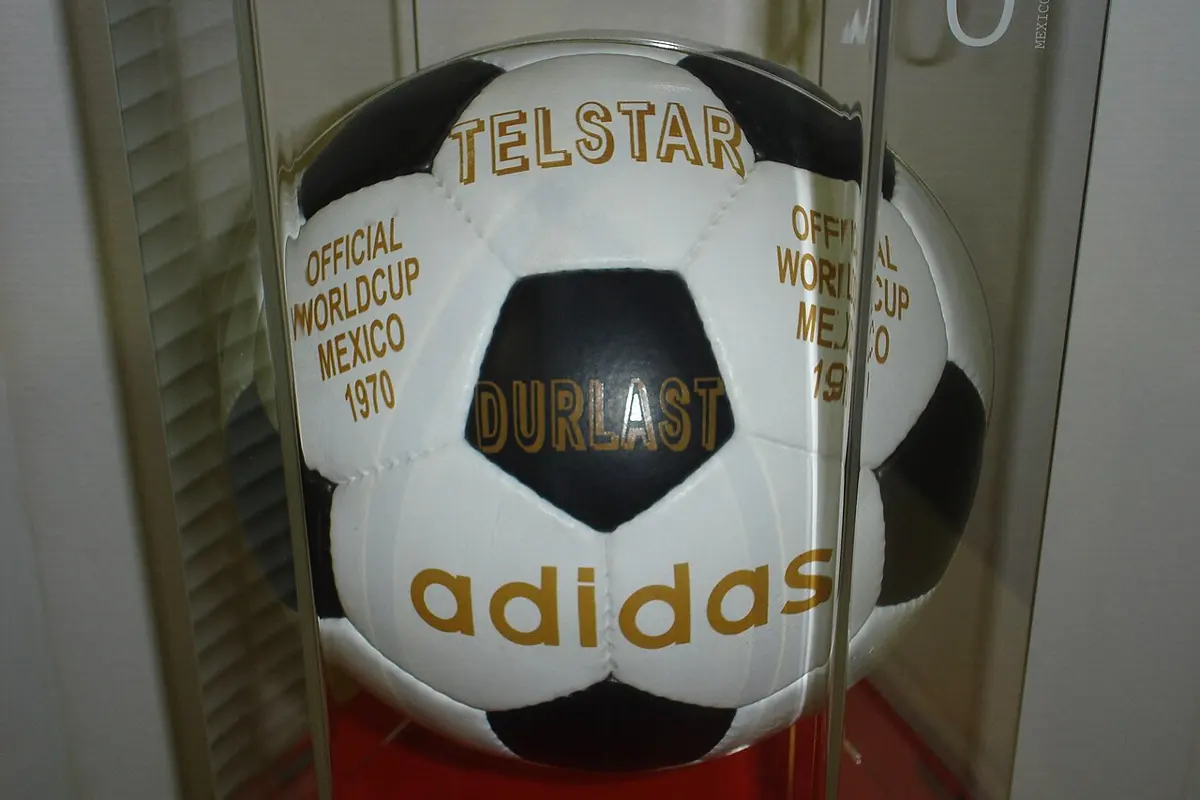
Now a harder question. Could a ball like this, three panels at every corner, use more hexagons and still close up? Say 30 hexagons. How many pentagons would it need?
Suppose it has p pentagons and h hexagons. The panels have 5p + 6h sides between them. Then:
- edges = (5p + 6h) ÷ 2, because each edge joins two panels;
- corners = (5p + 6h) ÷ 3, because three panels meet at each corner;
- faces = p + h.
Each hexagon brings 6 sides: that is 6 ÷ 3 = 2 corners and 6 ÷ 2 = 3 edges, and 1 face. In corners − edges + faces, one hexagon adds 2 − 3 + 1 = 0. Hexagons make no difference at all to the sum!
Each pentagon brings 5 sides: 5 ÷ 3 corners, 5 ÷ 2 edges, and 1 face, adding 5/3 − 5/2 + 1 = 10/6 − 15/6 + 6/6 = 1/6. So the whole sum is p ÷ 6. Euler’s formula says it must be 2, so p ÷ 6 = 2:
A ball like this always has exactly 12 pentagons, however many hexagons it has. With 0 hexagons it is the dodecahedron. With 20, the football. With 30 hexagons, still 12 pentagons. (The count allows any number of hexagons, but one combination can’t actually be built: 12 pentagons with exactly one hexagon.)
The same reasoning works for balls made of triangles. A geodesic sphere, a ball built of triangles (a geodesic dome, the kind of round building made of steel triangles, is part of one), has 6 triangles meeting at most of its corners and 5 at exactly 12 of them. Six triangles round a corner lie almost flat; the 12 corners with 5 are where the ball bends round. Euler’s formula says there must be exactly 12 of them, however many triangles the sphere has.
Where the rule breaks
Every proof rests on something. Ours rested on being able to cut away one face and stretch the rest flat in one piece. What if a solid won’t do that?
Think of a wooden picture frame lying on a table: a square bar going round a square hole. Its top is a square ring, and a ring isn’t a polygon, so let us cut the top into four trapezoids, and the bottom too, to make every face a proper polygon.
The frame gives 0. Its hole is the trouble: cut away any face and the frame still has a loop of wood going round the hole, so it can’t be stretched flat into a drawing on paper without tearing. A solid with two holes, like a block with two square tunnels through it, gives −2, and one with three holes −4: every hole takes away 2. This number, corners − edges + faces, became one of the first ways mathematicians had to count holes without looking. It is now called the Euler characteristic of a shape.
The cube on a cube gives 3, and here the trouble is subtler. The top of the big cube is a square with a square hole in the middle, where the small cube stands. That face isn’t a polygon: it is a ring, like the frame’s top before we cut it. Draw two lines across the ring, each from a corner of the small cube to the nearest corner of the big one, and the ring splits into two proper polygons: two more edges and one more face, and 16 − 26 + 12 = 2. The rule is safe again. (Lhuilier mended such faces the same way, with lines drawn across them.)
A wooden cube has a cube-shaped hollow sealed inside it, like a box with a smaller box trapped inside. Count the outside surface and the inside surface together. What is corners − edges + faces?
Pick an answer to see why.
Where this is used
Questions
★ A solid has 6 corners and 9 edges. How many faces does it have?
Pick an answer to see why.
Find the number of corners, edges and faces of a hexagonal prism and of an octagonal pyramid (an 8-sided base). Check Euler’s formula for each.
Answer
★★ A solid has 7 corners and 7 faces. How many edges does it have?
Pick an answer to see why.
A solid is made only of triangles, and 4 triangles meet at every corner. Without drawing it, find how many faces, edges and corners it has. Which solid is it?
Hint
Answer
A football-like ball has pentagons and hexagons, with three panels at every corner, and 14 panels in all. How many hexagons does it have? How many edges and corners?
Hint
Answer
Predict corners − edges + faces for a wooden block with two square tunnels drilled straight through it, side by side. Then predict it for a pretzel-shaped solid with three holes.
Answer
Prove that no polyhedron has exactly 7 edges.
Hint
Answer
Saw off every corner of a cube with a flat cut, so that each corner is replaced by a small triangle. How many corners, edges and faces does the new solid have? Then explain why cutting off any corner of any polyhedron never changes corners − edges + faces.
Hint
Answer
Where to go next
- Can You Cross Every Bridge Just Once? Dots and lines again, and the other famous puzzle Euler solved by caring only about what is joined to what.
- Can Three Houses Reach Three Wells Without Paths Crossing? Euler’s formula for flat drawings proves that one famous drawing is impossible.
- Why Are There Only Five Perfect Dice? (Math, Going Further 9–12) Solids whose faces are all the same regular polygon, and why Euler’s formula leaves room for only five.
- Can Four Colors Paint Any Map of Nepal? (Computing, Going Further 6–8) A map is a flat drawing of regions, like a flattened solid.
Where these facts come from
- Descartes’s note (about 1630), his death in Stockholm on 11 February 1650, his papers reaching Paris in bad condition, Leibniz copying part of the note in 1676 and the copy found in Hanover about 200 years later; Descartes’s count of plane angles, 2 × faces + 2 × corners − 4, and four plane angles to every edge; Euler’s letter to Goldbach of 14 November 1750, his letters S, H and A for solid angles, hedra and acies, S + H = A + 2, and Euler as the first to speak of a polyhedron’s edges; the paper printed only in 1758: G. M. Ziegler and C. Blatter, “Euler’s polyhedron formula – a starting point of today’s polytope theory”, Elemente der Mathematik 62 (2007) 184–192, read October 2026.
- The ship carrying Descartes’s papers wrecked in the Seine, the papers soaked for three days; Leibniz’s copy found in Hanover about 1860; Federico’s conclusion, and Senechal’s and Coxeter’s, that Descartes probably did not have Euler’s formula, lacking any idea of edges: Wikipedia, “Descartes on Polyhedra” (on P. J. Federico’s book, Springer, 1982), read October 2026.
- Euler’s paper Elementa doctrinae solidorum (written 1750, published 1758): its record at the Euler Archive (E230), read October 2026.
- Euler’s attempts at a proof being flawed, and Legendre’s proof of 1794 as the first rigorous one: Wikipedia, “Euler’s Gem” (on David Richeson’s book, Princeton, 2008), read October 2026.
- Lhuilier’s three kinds of exception (a hollow inside, sum 4; a ring with a hole through it, faces + corners = edges; a ring-shaped face, as when two solids are joined by unequal faces), Lhuilier’s mending of a ring-shaped face with lines drawn across it as new edges, Gergonne’s remark that Lhuilier was the first to notice the third, and the crystal groups of calcite in Pictet’s collection, retold in our words: S. Lhuilier and J. D. Gergonne, “Mémoire sur la polyédrométrie”, Annales de mathématiques pures et appliquées 3 (1812–1813) 169–189, read October 2026.
- The Euler characteristic, 0 for a solid with one hole and 2 − 2g for g holes, the football’s 12 pentagons for any number of hexagons except one, and Lakatos’s Proofs and Refutations (1976): Wikipedia, “Euler characteristic”, read October 2026.
- The Telstar of 1970, 12 black pentagons and 20 white hexagons: Wikipedia, “Adidas Telstar”, read October 2026.
- The discovery of the 60-carbon molecule in 1985 (Kroto of Sussex with a team at Rice), its name after Buckminster Fuller’s geodesic domes, the 1996 Nobel Prize to Kroto, Curl and Smalley, its football shape, and every fullerene having exactly 12 pentagons: Wikipedia, “Fullerene”, read October 2026.
- Icosahedral virus shells with 12 pentamers plus hexamers by size, after Caspar and Klug (1962): Wikipedia, “Capsid”, read October 2026.
- Geodesic domes and their 12 corners where 5 triangles meet: Wikipedia, “Geodesic polyhedron”, read October 2026.
- The Euler number of a binary image (objects minus holes) and MATLAB’s
bweuler: MathWorks, “bweuler”, read October 2026. - Every count in the topic (the widgets’ solids, built from their corners, and checked to be closed and consistently faced; the prisms and pyramids; counting without counting; the balls with 0 to 30 hexagons; geodesic spheres; only-triangle solids; which numbers of edges are possible; the frame, the cube on a cube (and mended with two lines) and the hollow cube; the cylinder; the cut-off corners) was computed in
checks/textbooks/math-further-6-8/23/tmp/solids_numbers.py, and every step of the flattened solids in the second widget innets.tsbeside it.