
On the last day before the winter holidays, Anisha’s class is making snowflakes to stick on the windows. Most people fold paper and snip. Anisha’s maths teacher draws a different kind of snowflake on the board, with a rule.
Start with a triangle whose three sides are each 9 cm. Cut every side into three equal parts, and on each middle part build a smaller triangle pointing outward. Now the shape is a six-pointed star with 12 sides. Do the same to all 12 sides: cut each into three, and build a little triangle on each middle part. Then again, and again.
“If we could go on for ever,” the teacher asks, “how long would the edge of the snowflake be? And how much of the board would it cover?”
Build it yourself before you guess.
Guess first. If the steps went on for ever, what would happen to the length of the edge?
Pick an answer to see why.
Try it
Step by step
Each step does the same thing to every piece of the edge: one straight piece becomes four pieces, each a third as long. Our script worked out the first steps for the 9 cm triangle.
| Step | Sides | Each side | Edge |
|---|---|---|---|
| 0 | 3 | 9 cm | 27 cm |
| 1 | 12 | 3 cm | 36 cm |
| 2 | 48 | 1 cm | 48 cm |
| 3 | 192 | 3.3 mm | 64 cm |
| 4 | 768 | 1.1 mm | 85.3 cm |
| 5 | 3,072 | 0.37 mm | 113.8 cm |
| 6 | 12,288 | 0.12 mm | 151.7 cm |
Look at the edge column. From 27 to 36 is ×4/3: four pieces, each a third as long, are 4/3 as long as the one piece they replace. From 36 to 48 is ×4/3 again, and so on all the way down.
Use the pattern. How long is the edge after step 7?
Pick an answer to see why.
How far can it go?
Growing by a third each time is like the rice on the chessboard doubling in topic 1, only more slowly: slow at first, then unstoppable. Our script found the first step at which the edge of the 9 cm snowflake passes each length:
| The edge passes | at step |
|---|---|
| 1 m | 5 |
| 10 m | 13 |
| 1 km | 29 |
| 100 km | 45 |
At step 29 the snowflake still fits on the same page, but its edge is over a kilometer long, in 8.6 × 10¹⁷ pieces each about a ten-trillionth of a centimeter. No pencil could draw them, but the rule never runs out of steps.
And the area?
Now look at what each step adds. At step 1, three triangles are added, each with sides 3 cm, a third of the big triangle’s. A triangle with sides a third as long is a ninth of the area (nine of them tile the big one, three by three), so step 1 adds of the triangle.
At step 2, every one of the 12 sides gets a new triangle, each a ninth of the area of a step-1 triangle. That is 4 times as many triangles, each 1/9 as big: step 2 adds 4/9 of what step 1 added. And step 3 adds 4/9 of what step 2 added, and so on: 4 times as many triangles every time, each 1/9 as big.
| Step | Triangles added | Area added (× the big triangle) | Area so far |
|---|---|---|---|
| 0 | 1 | ||
| 1 | 3 | 1/3 | 1.333 |
| 2 | 12 | 4/27 | 1.481 |
| 3 | 48 | 16/243 | 1.547 |
| 4 | 192 | 64/2,187 | 1.577 |
| 5 | 768 | 256/19,683 | 1.590 |
| 6 | 3,072 | 1,024/177,147 | 1.595 |
The edge column ran away; this one is slowing down, and it looks as if it is heading somewhere a little above 1.5. Where, exactly? And how can we be sure it never runs away too?
What’s going on
An edge that grows for ever
Every step multiplies the edge by 4/3, and you can always take another step. Multiply any length by 4/3 enough times and it passes any length you name, just as the table showed: a thousand times as long by step 25, a million times by step 49. So if we imagine all the steps done, the edge isn’t just very long. Its length has no end: no number of centimeters, however big, is enough to measure it. Mathematicians say its length is infinite.
The shape with all the steps done, every one of them, is called the Koch snowflake, after the Swedish mathematician Helge von Koch, who described its curve in 1904 (see the story below). Its edge is the Koch curve.
An area that can’t run away
Press Show the hexagon in the widget. The hexagon has its six corners at the triangle’s three corners and the three outer tips of the star of step 1. Move the slider through every step: the snowflake never leaves the hexagon.
Here is why. Look at one side of the triangle. Everything ever built on that side stays inside a flat “tent” on it: a triangle whose base is the side and whose top is the tip of step 1’s triangle. At the next step, the side’s four pieces each get their own small tent, a third the size, and the four small tents fit inside the big tent (two of them just touch its sloping sides). The same is true of their pieces, and their pieces’ pieces, at every step. So nothing built on a side ever pokes out of its tent, and the triangle with its three tents is exactly the hexagon.
How big is the hexagon? Its three tents together are as big as the triangle. Join the triangle’s center to its corners, cutting it into three equal pieces: each tent is the mirror image of one piece across their shared side (step 1’s tip is as far outside the side as the center is inside), so it is a third of the triangle. So the hexagon is twice the triangle, and the snowflake’s area, at every step, is less than twice the triangle’s, however far the steps go.
Exactly 8/5
Now the exact answer. Call the area that will ever be added, at all the steps together, the future. It is what step 1 adds, plus everything after step 1. The hexagon showed that the future is a definite area, less than one more triangle, so we can name it and work with it like any number.
And everything after step 1 is the whole future again, only shrunk to 4/9 of it, because each step adds 4/9 of what the step before it added. Say the future is some area F, measured in triangles:
That is an equation you can solve (Grade 8’s linear equations). Take from both sides: , so .
The whole snowflake is the triangle plus its future: of the triangle. For the 9 cm triangle, whose area is about 35.1 cm², that is about 56.1 cm².
So both answers to the teacher’s question are true at once. The edge gets longer by folding into smaller and smaller wiggles, and wiggles take length but almost no room.
Look closer
What does the finished edge look like close up? Zoom in on one side of the snowflake, with every step done.
At ×3 you see exactly what you saw at ×1: the first third of the side, 3 cm long, is the whole side in miniature. At ×9 the same again, 1 cm across. However far you zoom in, the edge never flattens into a straight line. That is why its length has no end: the usual way to measure a curved line is to zoom in until it looks straight and add up the straight bits, and here that never happens.
A shape like this, which shows new detail however closely you look, and in which a small part looks like the whole, is called a fractal. When the small part is an exact copy of the whole, shrunk, the shape is self-similar. The Koch curve is both.
Copies inside copies
Here is another way to see that the Koch curve is a strange kind of line. Shrink a shape to a third of its size and count how many copies of the small one make the whole.
A line gives 3 copies; a square, 3 × 3 = 9; a cube would give 3 × 3 × 3 = 27. A line is one-dimensional, a square two-dimensional, a cube three, and the number of copies is 3 to that power. The Koch curve gives 4 copies: more than a line, fewer than a square. In this sense it is somewhere between a line and an area: too wiggly to be an ordinary line, too thin to cover any room.
Now shrink to half size. A line is 2 copies of half its length, a square 4 copies. The Sierpiński triangle, below, is made of 3 half-size copies of itself. Where does that put it?
Pick an answer to see why.
A triangle full of holes
The Koch snowflake keeps adding. Here is a fractal that keeps taking away. Start with a filled triangle. Join the midpoints of its sides and cut out the upside-down triangle in the middle: three triangles are left, each half as wide. Do the same to each of them, and again.
The middle triangle is a quarter of the triangle it is cut from (the four triangles you get by joining the midpoints are all the same), so each step keeps 3/4 of the area. Our script followed it:
| Step | Triangles left | Area left | Holes |
|---|---|---|---|
| 0 | 1 | 100% | 0 |
| 1 | 3 | 75% | 1 |
| 2 | 9 | 56.3% | 4 |
| 3 | 27 | 42.2% | 13 |
| 4 | 81 | 31.6% | 40 |
| 5 | 243 | 23.7% | 121 |
| 6 | 729 | 17.8% | 364 |
After 17 steps less than 1% of the area is left, and taking 3/4 again and again, the area left goes to nothing. But the edges go the other way. Each step turns one triangle into three, each with half its edge, so the edges of all the triangles together grow 3/2 times at each step: for a 9 cm triangle, 27 cm, then 40.5 cm, 60.75 cm, past 1 m at step 4 and past 1 km at step 21. The finished shape, called the Sierpiński triangle after the Polish mathematician Wacław Sierpiński, who described it in 1915, has an area of zero, and its edges together are longer than any length you can name. It is the snowflake turned inside out.
Out of chaos
Here is a game that seems to have nothing to do with it. Mark the three corners of a triangle. Start with a dot anywhere. Choose a corner at random, and put the next dot halfway between your dot and that corner. Choose again, jump halfway again, and again, thousands of times.
You might expect a random smudge. Instead the dots draw the Sierpiński triangle. Why?
Take any dot inside the triangle and jump halfway towards the top corner. Wherever it started, it lands in the top half-size triangle, the one touching that corner: halfway to the corner shrinks the whole big triangle to half its size, towards the corner. The same for the other two corners. So after one jump the dot is in one of the three half-size corner triangles, never in the middle hole. After two jumps, it is in one of the nine quarter-size ones, never in a hole of step 2. After many jumps it is as close as you like to the Sierpiński triangle, wherever it began. (The very first dots, from the starting point, can be in the holes; the widget counts the dots in the big hole only after the first 12.)
And now the twist. With a square, halfway to a corner lands in that corner’s quarter of the square. But the four quarters cover the whole square: there is no gap between them for a hole. So nothing is ever left out, and the dots fill the square. The rule leaves holes, and makes a fractal, only when the shrunken copies leave gaps between them.
Fractals in nature
Real things are never true fractals: their copies inside copies stop after a few levels, when the pieces reach the size of cells or crystals. But many come close, because they grow by repeating one rule at smaller and smaller sizes.
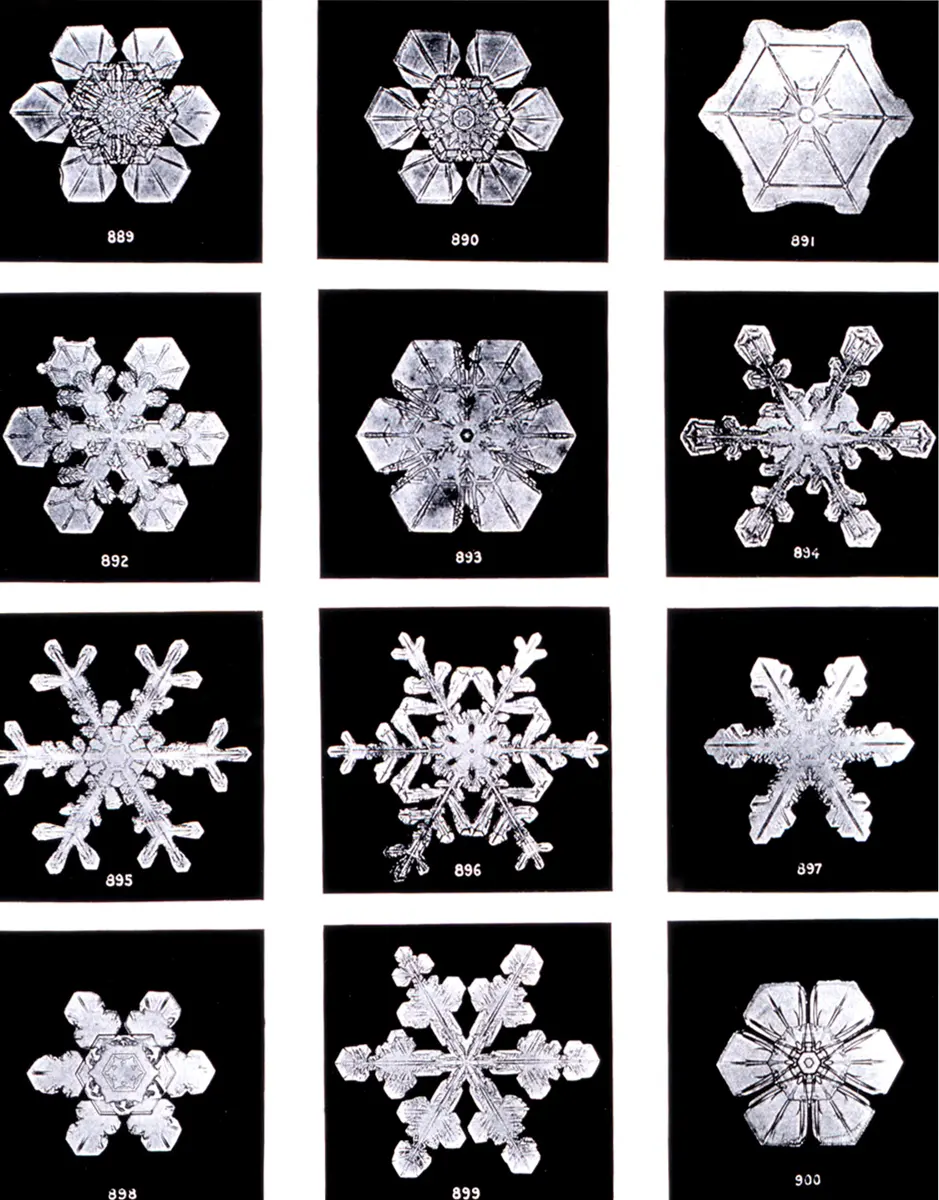
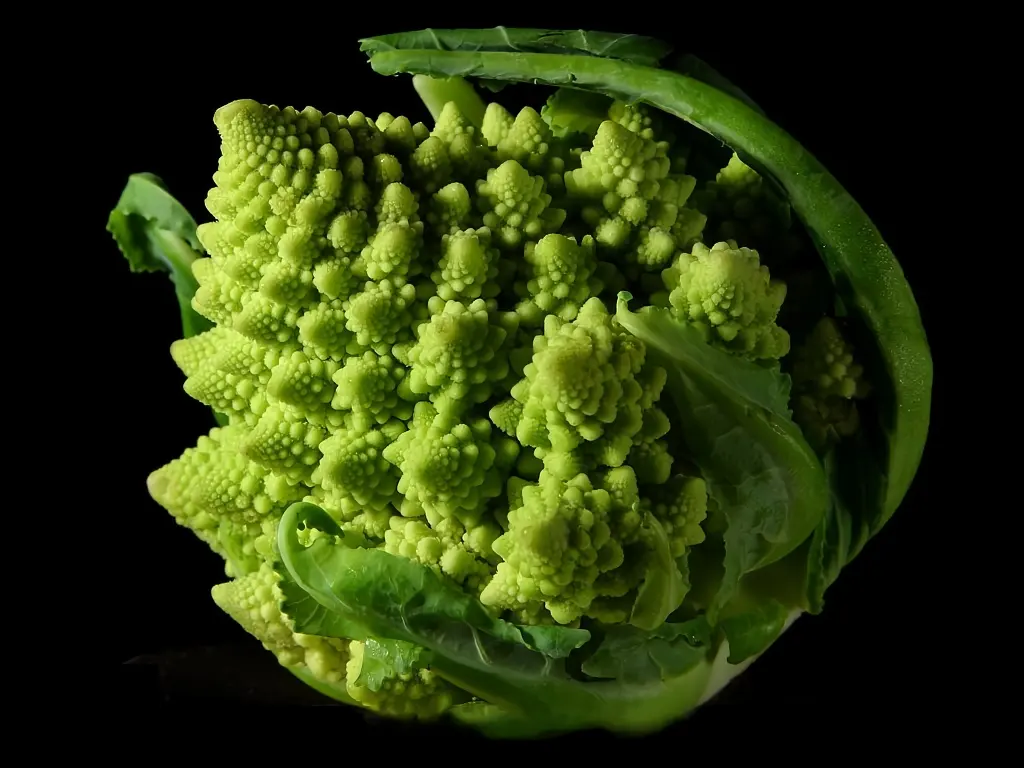
Ferns are leaves made of leaflets shaped like small ferns. Rivers split into streams that split into smaller streams. At Science Playground, the Fractal-Like Tree Root shows large roots dividing into smaller roots, which divide again into finer ones.
People have built fractal-like shapes too, long before the word existed.
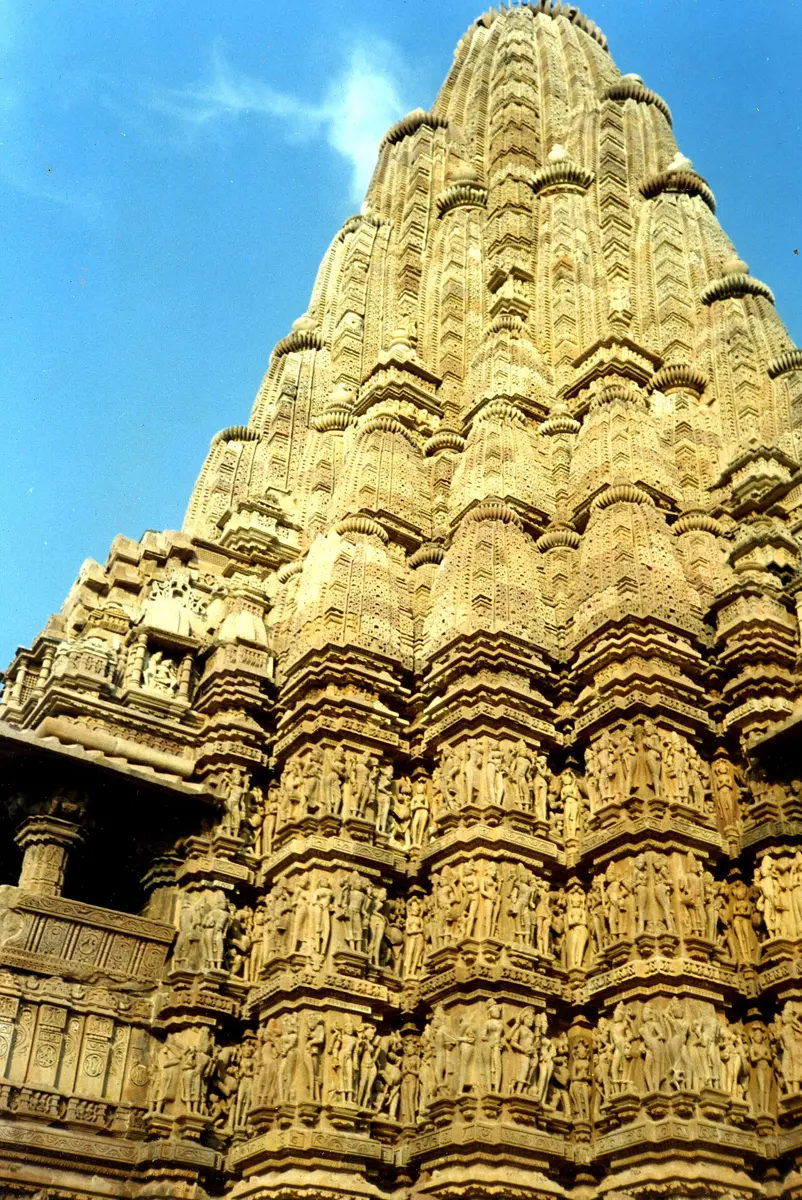
Where this is used
Questions
A Koch snowflake is built on a triangle with sides 27 cm. How many sides does it have after 3 steps, and how long is its edge?
Answer
★ After 5 steps, how many sides does a Koch snowflake have?
Pick an answer to see why.
The finished snowflake on the 27 cm triangle covers 8/5 of its triangle. The triangle’s area is about 315.7 cm². How much area does the snowflake cover, and what fraction of that was added after step 1?
Answer
The anti-snowflake follows the same rule, but every new triangle points inward, cut out of the shape instead of added. What happens to its edge, and what fraction of the triangle is left at the end?
Hint
Answer
Sierpiński’s carpet: cut a square into 9 equal squares and remove the middle one; do the same to each of the 8 left, and so on. After how many steps is less than half the square left? How many square holes are there then?
Answer
★★ Shrink the Sierpiński carpet to a third of its size. How many copies of the small carpet make the whole one, and where does that put it?
Pick an answer to see why.
The Cantor set: draw a line 9 cm long, rub out its middle third, then the middle third of each piece left, and so on for ever. How much length is rubbed out altogether? Use the “future” trick of this topic, then say what is left.
Hint
Answer
Show that in the Koch snowflake each step adds 4/9 of what the step before added, and use it to explain why the area at step n is of the triangle. Check it for step 2.
Answer
Where to go next
- How Long Is Nepal’s Border? (Grades 9–12) Real borders and coastlines wiggle at every scale too: why their length depends on your ruler, and fractal dimension worked out.
- Can You Add Halves Forever and Still Get One? Endless sums that add up to something, like the snowflake’s area.
- Why Do Sunflowers Count in Fibonacci Numbers? The spirals on a sunflower, a pine cone and a pineapple.
- How Much Rice Is on the Chessboard? Growth by multiplying, as the snowflake’s edge grows.
- How Many Ways Can You Walk to School? Pascal’s triangle, and the Sierpiński triangle hidden in its odd numbers.
- Where Did the Missing Square Go? The staircase that looks like the diagonal and isn’t as long.
- Grade 11 Computing, Fractals: pictures made of smaller copies: draw fractals with a program that calls itself.
Where these facts come from
- The Koch curve and snowflake: Koch’s 1904 paper (“Sur une courbe continue sans tangente, obtenue par une construction géométrique élémentaire”, Arkiv för matematik, astronomi och fysik 1), the edge growing without end, the area 8/5 of the triangle, the dimension log 4 ÷ log 3 ≈ 1.26: Wikipedia, “Koch snowflake”, read October 2026.
- Helge von Koch’s life (Stockholm, 1870–1924), his aim of a continuous curve with no tangent, Weierstrass’s earlier analytic example, the 1906 proof: J. J. O’Connor and E. F. Robertson, “Helge von Koch”, MacTutor History of Mathematics, read October 2026.
- The Sierpiński triangle: described in 1915, 3/4 of the area kept at each step, 13th-century Cosmatesque inlay, Pascal’s triangle’s odd numbers, the chaos game: Wikipedia, “Sierpiński triangle”, read October 2026.
- Wacław Sierpiński’s life (Warsaw, 1882–1969): J. J. O’Connor and E. F. Robertson, “Wacław Sierpiński”, MacTutor, read October 2026; the carpet in 1916 and its area: Wikipedia, “Sierpiński carpet”, read October 2026.
- The Cantor set, Smith 1874 and Cantor 1883: Wikipedia, “Cantor set”, read October 2026.
- The word fractal (Mandelbrot, 1975, from fractus), approximate fractals in nature (ferns, Romanesco, river networks, blood vessels), fractal antennas and computer graphics among the uses: Wikipedia, “Fractal”, read October 2026.
- Benoît Mandelbrot (Warsaw 1924 – 2010), at IBM’s research center in New York from 1958, and his “Clouds are not spheres, mountains are not cones, coastlines are not circles”, from the introduction to The Fractal Geometry of Nature (1982): Wikipedia, “Benoit Mandelbrot”, read October 2026.
- Cosmatesque work: medieval Italy, especially Rome and its surroundings, most often church floors, the Cosmati family in the 12th and 13th centuries: Wikipedia, “Cosmatesque”, read October 2026.
- Richardson’s border lengths (Portugal 987 km, Spain 1,214 km) and the shorter ruler measuring a longer border: Wikipedia, “Coastline paradox”, read October 2026; Weierstrass’s example of 1872: Wikipedia, “Weierstrass function”, read October 2026.
- Mandelbrot’s “How long is the coast of Britain?”, Science 156, 636–638 (5 May 1967), Richardson and the Spain–Portugal border, the shorter ruler measuring a longer border: Wikipedia, “How Long Is the Coast of Britain? Statistical Self-Similarity and Fractional Dimension”, read October 2026.
- Fractal antennas: Nathan Cohen, then a professor at Boston University, from 1988, published 1995, compact and multiband because a motif repeats at two or more sizes, used in cell phones, microwave communications and RFID: Wikipedia, “Fractal antenna”, read October 2026.
- Romanesco broccoli as self-similar and only approximately fractal; Azpeitia et al., “Cauliflower fractal forms arise from perturbations of floral gene networks”, Science, 9 July 2021: Wikipedia, “Romanesco broccoli”, read October 2026.
- Wilson Bentley (1865–1931), his first snowflake photo in 1885 and over 5,000 photos: Wikipedia, “Wilson Bentley”, read October 2026.
- The Kandariya Mahadeva temple, built about 1025–1050, its shikhara with 84 miniature spires: Wikipedia, “Kandariya Mahadeva Temple”, read October 2026; Kirti Trivedi, “Hindu temples: models of a fractal universe”, The Visual Computer 5(4), 243–258 (1989), its title and details from Crossref, read October 2026 (the paper itself not read).
- The Fractal-Like Tree Root at Science Playground: the exhibit’s own description, Fractal-Like Tree Root (this site).
- The photos: Wilson Bentley (public domain); Jon Sullivan (public domain); Antorjal, on Wikimedia Commons (CC BY 2.5).
- Every number in the topic (the tables of sides, edges and areas, the steps at which the edges pass 1 m to 100 km, the 8/5 and its gaps, the hexagon’s area and that every step of the snowflake stays inside it, the anti-snowflake, the Sierpiński triangle and carpet, the Cantor set, the questions) was computed by a script of our own, which also built the snowflake as a polygon to step 6 to measure its edge and area another way.