
कुटकी: the bitter root of the high slopes
कुटकी · Picrorhiza scrophulariiflora · A small alpine herb with a bitter rhizome, plantain family
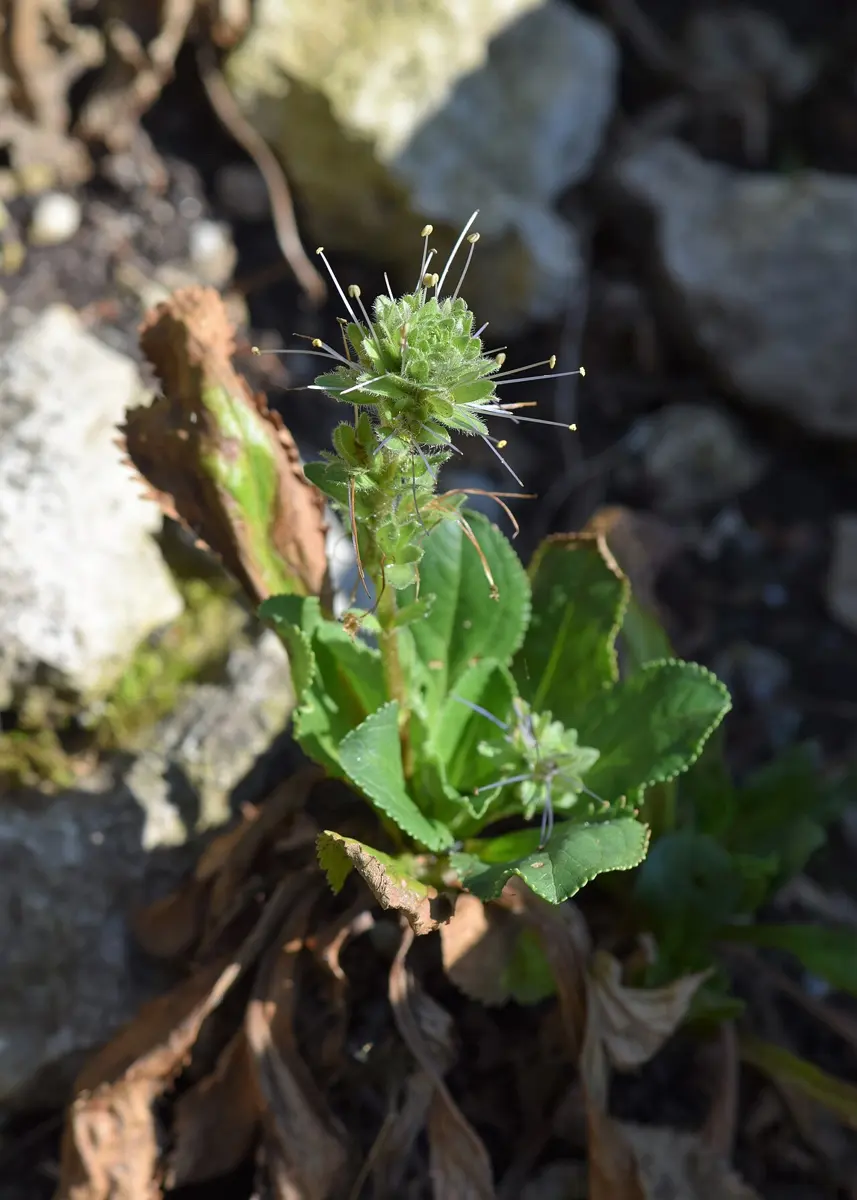
Think of the most bitter thing you have ever tasted, the kind of taste that makes your whole face scrunch up. In the high villages of Solukhumbu, Rasuwa and Kaski, people keep a medicine famous for that taste: a small, creeping root called कुटकी (kutki). Its scientific name says the same thing: Picrorhiza is Greek for ”bitter root”.
How to know it
कुटकी is a small perennial herb, coming back each year from its underground stem, and only up to about 15 cm tall. Botanists now put it in the plantain family (Plantaginaceae); older books, and some of Nepal’s lists, put it in the figwort family (Scrophulariaceae). Look for:
- the leaves: up to 6 cm long, spoon-shaped to oval, with toothed edges, in a low clump;
- the flowers: a short spike, 1 to 2 cm long, of dark purple, hairy flowers, each with two lips, the upper one much longer than the lower; they open from late June to early August, and insects pollinate them;
- the fruits: narrow capsules 8 to 10 mm long, full of tiny seeds that ripen in September and October and blow away on the wind;
- the rhizome: long and creeping, 10 to 20 cm, sending up new shoots along its length. This is the bitter part, and the part that is traded.
Few of its seeds grow into new plants. Most new plants come from pieces of rhizome that break off and take root.
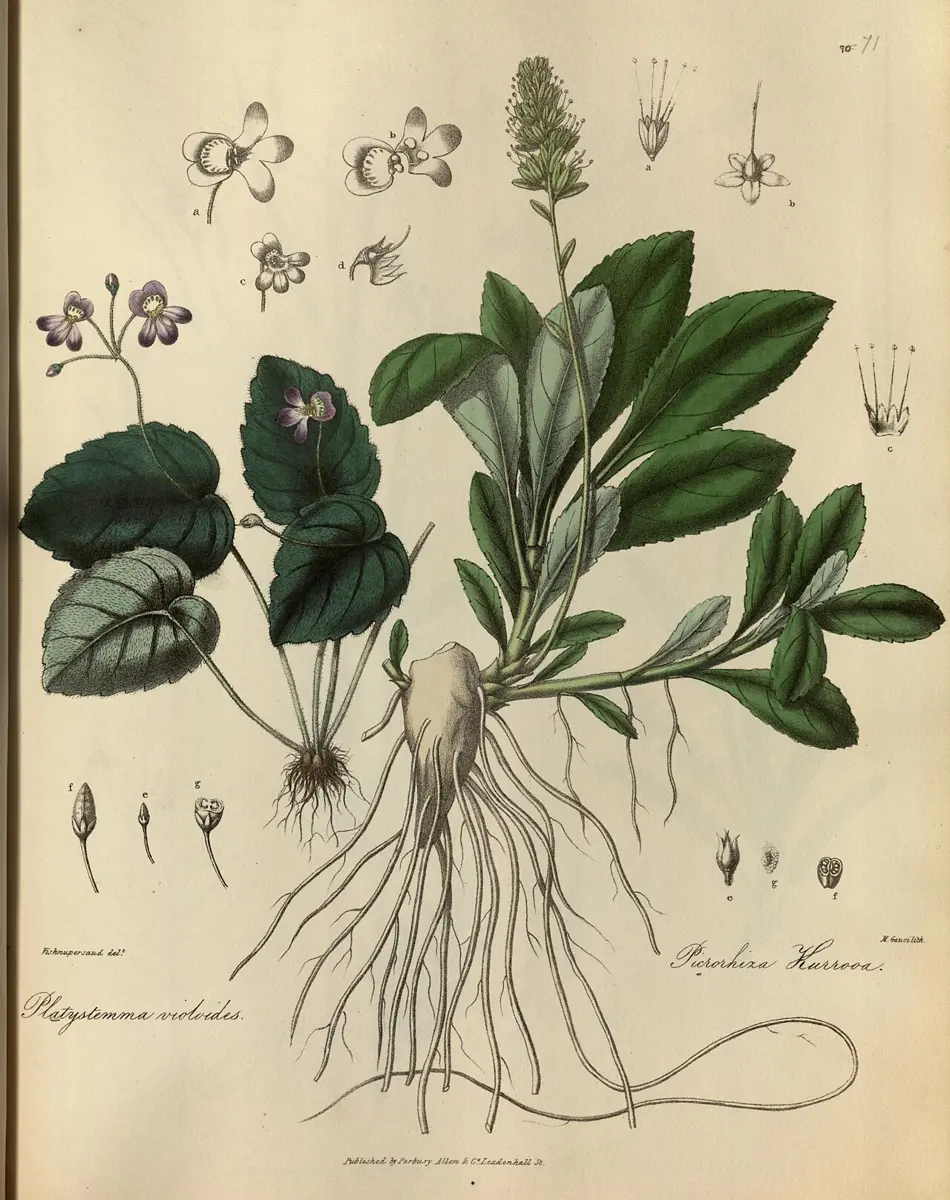
Two kutkis
The name कुटकी covers two very similar plants:
- Picrorhiza scrophulariiflora, Nepal’s कुटकी, of the central and eastern Himalaya: Nepal, Sikkim, Bhutan and China. Some botanists put it in a genus of its own, as Neopicrorhiza scrophulariiflora, and Nepal’s government documents use that name;
- Picrorhiza kurrooa, of the western Himalaya, India’s main kutki.
Their rhizomes look so alike that they are traded together, without being told apart. That matters for the law, as we’ll see below.
Where it grows
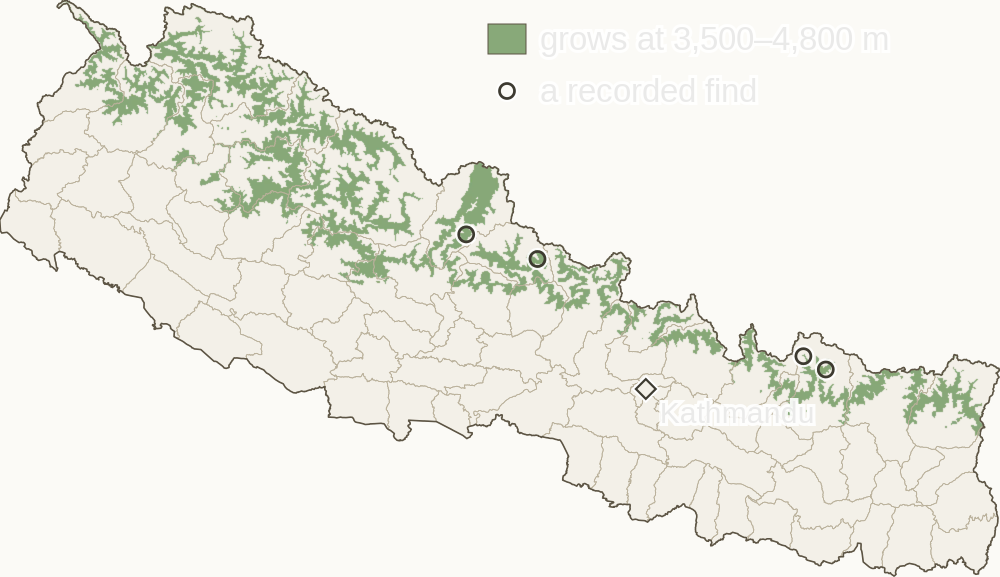
In Nepal, कुटकी grows between about 3,500 and 4,800 meters, in the subalpine and alpine zones: in alpine grassland and gravelly ground, among shrubs, on meadows, cliffs and screes. It likes moist, north-facing slopes with rich soil and some shade.
The bitter chemicals, and the two look-alikes
The bitterness comes from chemicals called iridoid glycosides, such as picroside I, picroside II and kutkoside (picro- is the same Greek word for bitter), found in the rhizome of Nepal’s कुटकी. These are why Nepal’s herbal companies use it.
Here is the “really?” part. The two kutkis look the same, and the trade rules are tangled:
- In 1997 CITES, the world agreement on trade in endangered species, listed the western Picrorhiza kurrooa in its Appendix II, so it may cross borders only with permits.
- Nepal’s Picrorhiza scrophulariiflora is not listed by CITES.
- Yet Nepal’s own rules treat कुटकी as a CITES-listed plant: since 2003, every export must first be identified by the Department of Plant Resources; only then does the Department of Forests permit it, after checking how much is available, and the exporter pays a royalty for a CITES certificate.
Traditional uses
China’s official book of medicines lists its rhizome for fever and jaundice in Chinese and Tibetan medicine, and in Sanskrit it is called कटुका (katuka). Studies of the herbs people use in Nepal record its rhizome:
- in Kaski, for stomach problems and fever: people there ranked it among their most useful plants;
- in Khumbu, among Sherpa families, mainly for coughs and colds, stomach troubles, diabetes and high blood pressure, usually boiled in water;
- in Rasuwa, for body pain;
- across Nepal, also for common cold, headache, sore throat, indigestion, jaundice, liver trouble and bile disorders.
In Nepal it also goes into factory-made Ayurvedic medicines: in 2015–16, 23 herbal companies used it in 45 products, 17 of them for the liver.
What science has tested
- Nepal’s कुटकी (P. scrophulariiflora): its chemicals have been studied in the laboratory. It has not been tested in people.
- The western kutki (P. kurrooa): more studied. A few small trials in people, mostly of Ayurvedic mixtures in which it was one of several herbs, for liver problems; they were small, some without a comparison group, and they don’t show that it works. Its traditional preparations can cause diarrhea and stomach cramps.
- How strong the evidence is: not tested in people for Nepal’s species; only small, weak trials for its cousin.
Trade: from the high slopes to India
कुटकी is collected wild and sold, mostly to India. Nepal is thought to supply about two-thirds of the world’s कुटकी. Some figures:
| Used by Nepal’s own herbal companies, 2015–16 | 6,076 kg of dried rhizome |
| Exported to India with certificates, 2015–16 (government records) | about 28 tons |
| Estimated exports from Nepal, 1998–99 (an older study) | 100 to 400 tons a year |
| Price paid by Nepal’s companies, 2015–16 | Rs 1,150 to 1,600 a kilogram, Rs 1,411 on average |
| Government royalty, since 2015 | Rs 15 a kilogram |
So far more is harvested than Nepal itself uses: much of it leaves the country, a lot of it unrecorded.
Banned, unbanned, and picked too early
Nepal’s rules for कुटकी have changed:
- in 2001 (2058 BS) a government notice banned its collection, use, sale, transport and export;
- in 2003 (2060 BS) the ban was lifted, with the condition on exports described above;
- a national conservation assessment rated it Vulnerable in Nepal. We found no category for it on the IUCN Red List.
How it is picked matters. In open-access areas where it is dug for trade, households collected 35 to 465 kg of dried rhizome a year each, and the plants there grew far fewer. In Rasuwa, researchers found plants pulled up whole, with nothing left to regrow.
In Khumbu, older harvesters say to dig only at the end of the growing season, in September and October, after the plants have fruited and dropped their seeds. Many young harvesters dig in June to August, when the monsoon makes the soil soft and the roots come out easily. Around Gokyo, the most was dug during जनैपूर्णिमा (Janai Purnima), when thousands of people used to visit the sacred Gokyo Lake.
Which plan keeps कुटकी on a slope for the next generation?
Pick an answer to see why.
See it at the Science Playground
Our exhibit Medicinal and Culinary Herbs of Nepal shows dried herbs and spices used in Nepal. More plants in Herbs of Nepal.
Where these facts come from
- Ghimire N.P. et al., Traditional socio-cultural utilization and harvesting practices of an alpine medicinal herb, Neopicrorhiza scrophulariiflora in Khumbu Valley, Nepal, Ethnobotany Research and Applications, 2023.
- Kafle G. et al., Demand, end-uses, and conservation of alpine medicinal plant Neopicrorhiza scrophulariiflora (Pennell) D. Y. Hong in Central Himalaya, Evidence-Based Complementary and Alternative Medicine, 2018.
- Poudeyal M.R. et al., Harvest effects on density and biomass of Neopicrorhiza scrophulariiflora vary along environmental gradients in the Nepalese Himalayas, Ecology and Evolution, 2019.
- Almeleebia T.M. et al., Pharmacological and clinical efficacy of Picrorhiza kurroa and its secondary metabolites: a comprehensive review, Molecules, 2022.
- Khakurel D. et al., Diversity, distribution, and sustainability of traditional medicinal plants in Kaski district, western Nepal, Frontiers in Pharmacology, 2022.
- Uprety Y. et al., Indigenous use and bio-efficacy of medicinal plants in the Rasuwa District, Central Nepal, Journal of Ethnobiology and Ethnomedicine, 2010.
- Department of Plant Resources, Plants of Nepal: fact sheet, Government of Nepal, 2012 (archived copy).
- Picrorhiza kurrooa, Species+ (CITES listings), checked November 2026.
- कुटकी in the Nepali Brihat Shabdakosh (Nepal Academy).