
गुर्जो: the vine that roots in the air
गुर्जो · Tinospora sinensis, T. cordifolia · A thick-stemmed climber of the moonseed family
During the COVID-19 pandemic, a herb called giloy was promoted across India as an “immune booster”, boiled into drinks and sold as syrups and tablets. In Nepal, giloy and its close cousin are called गुर्जो (gurjo), and many families already knew it: a vine with heart-shaped leaves, whose bitter stem is boiled into a drink in tradition.
But in 2021 and 2022, liver doctors in India began writing about patients who had become seriously ill. This page is about the vine behind both stories: how to know it, which species it is, its strange way of growing, its place in tradition, what science has found, and the warning that every reader should know.
Which गुर्जो?
गुर्जो comes from the Sanskrit गुडूची (guduchi). It is also called अमृता (amrita), from अमृत (amrit), “the nectar of immortality”. The Nepali Brihat Shabdakosh describes गुर्जो as a thick-stemmed climber used in Ayurvedic medicine.
Two species of Tinospora have been reported in Nepal, and both are called गुर्जो:
- Tinospora sinensis: this is the name the Department of Plant Resources uses for गुर्जो, and the name given in a 2020 study of plants used in Kavre;
- Tinospora cordifolia: the species of India’s Ayurveda, sold as giloy, and the name used in a 2019 study of गुर्जो in Ilam.
The two look alike. One difference botanists give: T. sinensis is softly hairy, with fine hairs on its young stems and leaves, while T. cordifolia is smooth (hairless). A third species, Tinospora crispa, with big blunt bumps on its old stems, is mentioned below because of the liver warnings.
How to know it
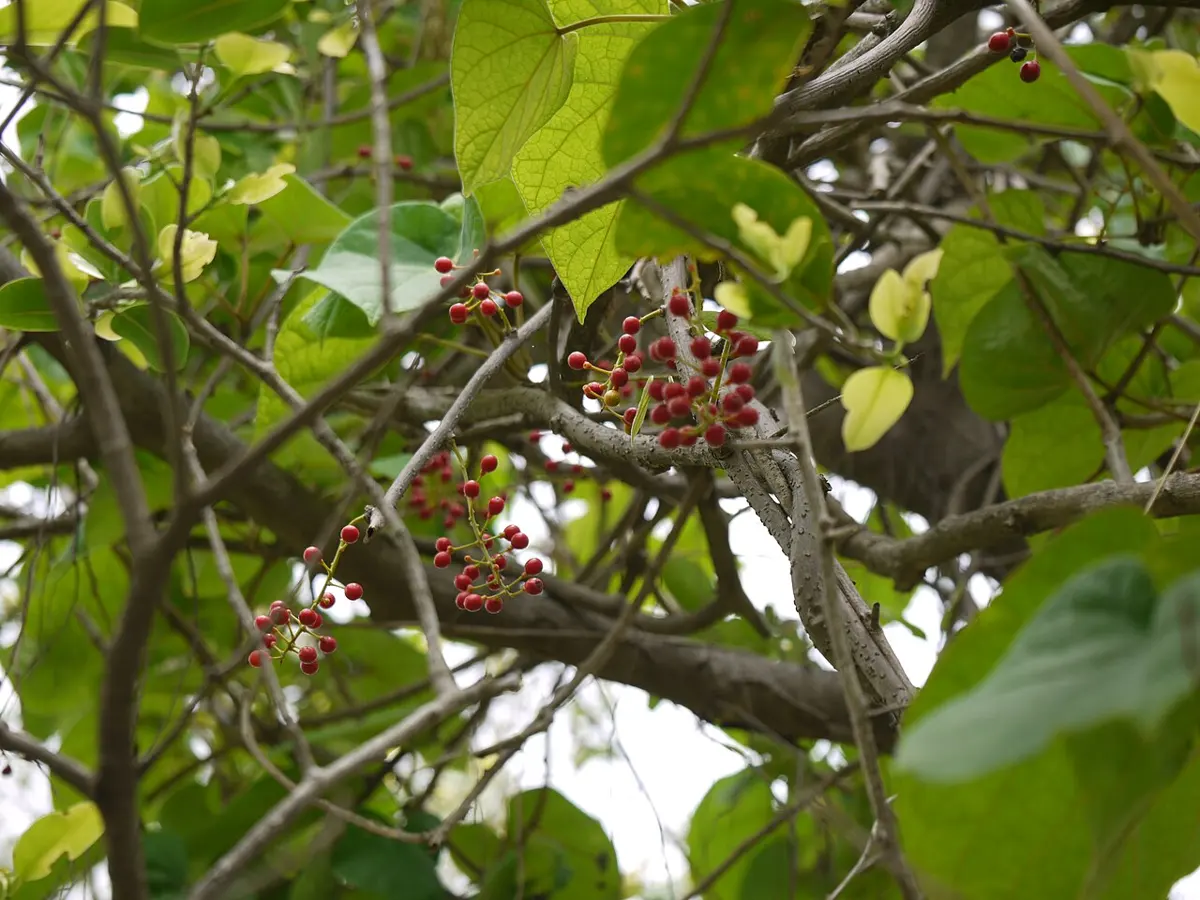
गुर्जो is a climbing vine that drops its leaves in the dry season. T. sinensis can climb 20 meters or more into trees. Look for:
- heart-shaped leaves, with a long stalk, the base deeply notched, and five main veins spreading from the base (T. cordifolia’s leaves are about 5 to 10 cm long; T. sinensis’s can reach 14 cm);
- thick, slightly fleshy stems, green when young; older stems have a papery brownish bark and small raised, warty pores;
- long roots hanging in the air from the branches, often very long;
- flowers in thin sprays, coming out when the vine has no leaves;
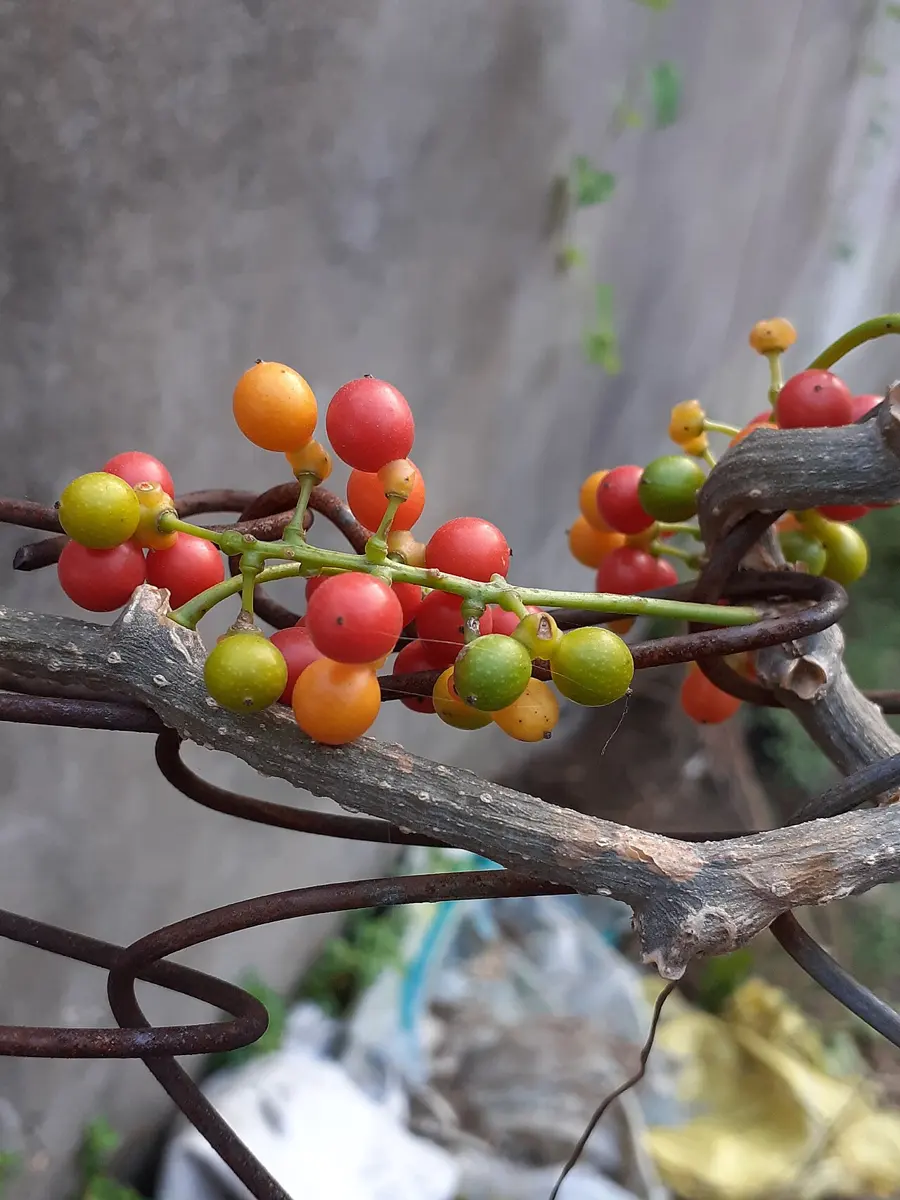
- small fruits, red when ripe.
Where it grows
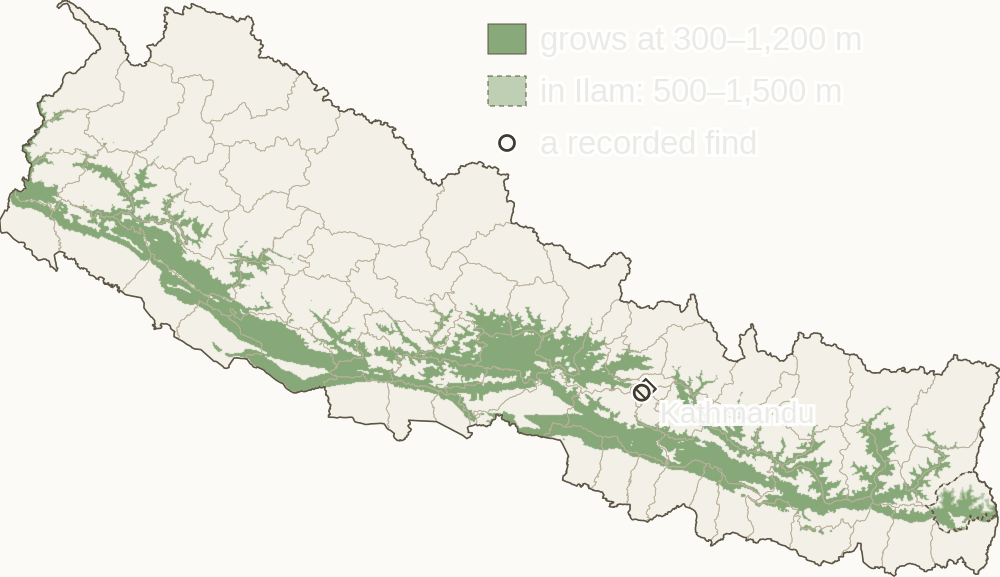
In Nepal गुर्जो grows in the warm lowlands and lower hills. One study gives its range as about 300 to 1,200 meters, in the tropical belt. People interviewed in Ilam said they find it from about 500 to 1,500 meters, both wild and planted. It climbs into the trees of forests, and is also planted.
A vine that grows from a cut piece
Here is the really odd thing about गुर्जो. The species that drop their leaves, like T. sinensis, can grow into a new vine from a piece of stem broken off the plant. The stem is fleshy and holds water and food, and from it the vine sends out roots into the air, hanging down until they reach the ground.
Botanists who wrote the Flora of China noticed a side effect: because a broken piece can grow, these vines often do better when a forest is cleared. Cutting can scatter pieces of stem, and each can start again in the sunlight.
Traditional uses
गुर्जो has a long history in tradition in Nepal and India. In Ayurveda its bitter stem goes into preparations for weakness, indigestion, fever and urinary disease. Studies in Nepal record:
- in Ilam, गुर्जो used for fever, diabetes, urinary tract infections and piles, alone or with other plants;
- in Kavre, the stem’s juice, or pieces of the stem, taken for piles, and also for cancer.
That last use needs a plain word: no study has shown that गुर्जो treats cancer. Cancer needs a doctor, and the sooner the better.
What science has tested
- In the laboratory and in animals: a great deal. Reviews list many chemicals in the stem and many effects in cells and animals, for example on the immune system and on blood sugar in animals.
- In people: the reviews we read describe mainly laboratory and animal studies, not large, well-done trials in people. So for its traditional uses, the honest answer is: not proven in people.
- Harm in people: this has been studied, because of what doctors saw after 2020.
Trade and protection
गुर्जो is one of the Department of Plant Resources’ 30 medicinal plants prioritized for research and development, and one of 12 prioritized for developing farming methods. It is collected from the wild in Kavre, and T. sinensis is among the herbs sold in the streets of the Kathmandu valley; in Ilam, people said in 2019 that it was not easy to find but had not been made into a trade there. We found no reliable price for it in Nepal.
The IUCN Red List has not evaluated either Tinospora sinensis or T. cordifolia.
A neighbor says gurjo juice is “natural, so it can’t hurt” and wants to drink it every day for months. What does the evidence say?
Pick an answer to see why.
See it at the Science Playground
Our exhibit Medicinal and Culinary Herbs of Nepal shows dried herbs and spices used in Nepal. More plants in Herbs of Nepal.
Where these facts come from
- Tinospora, Flora of China vol. 7, 2008.
- Modi B., Timilsina H. and Basnyat R.C., Ethnobotanical studies and biological screening of Tinospora cordifolia, Our Nature, 2019.
- Ambu G. et al., Traditional uses of medicinal plants by ethnic people in the Kavrepalanchok District, Central Nepal, Plants, 2020.
- Saha S. and Ghosh S., Tinospora cordifolia: one plant, many roles, Ancient Science of Life, 2012.
- Nagral A. et al., Herbal immune booster-induced liver injury in the COVID-19 pandemic: a case series, Journal of Clinical and Experimental Hepatology, 2021.
- Kulkarni A.V. et al., Tinospora cordifolia (Giloy)-induced liver injury during the COVID-19 pandemic: multicenter nationwide study from India, Hepatology Communications, 2022.
- Department of Plant Resources, Plants of Nepal: fact sheet, 2012.
- Tinospora sinensis: IUCN Red List category and Tinospora cordifolia, GBIF (from the IUCN Red List), checked November 2026.
- गुर्जो in the Nepali Brihat Shabdakosh (Nepal Academy).