
पदमचाल: the wild rhubarb of the Himalaya
पदमचाल · Rheum australe · A tall alpine herb with huge leaves, buckwheat family
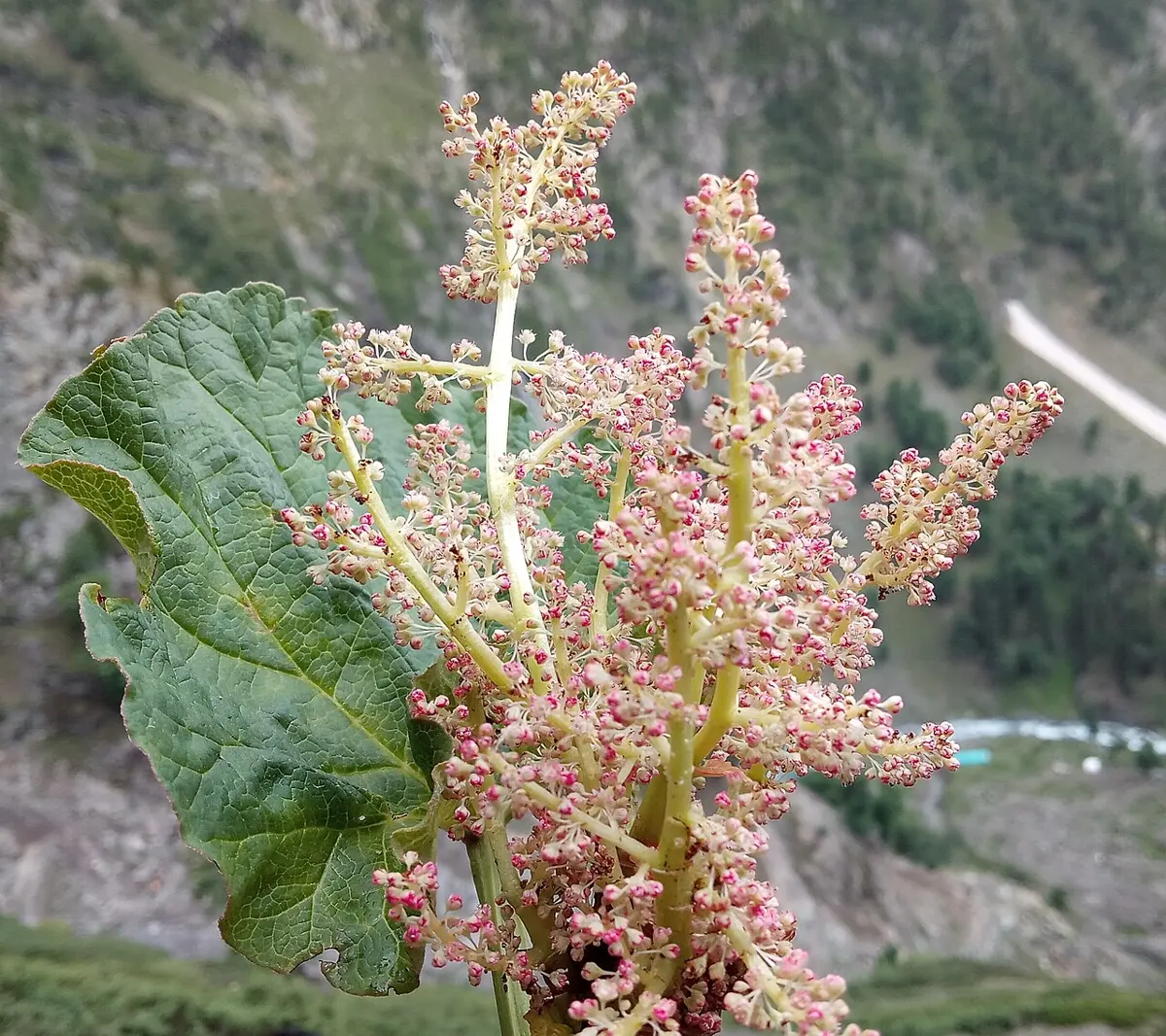
Think of the sourest अचार (achar, pickle) you have ever tasted. In Nepal’s high mountains, one sour pickle is made from the leaf stalks of a plant that looks far too big for its cold home. Its leaves are huge, its stalks are streaked with red, and from June a tall, branched spike of tiny dark red flowers rises above them. It is पदमचाल (padamchal), the Himalayan rhubarb.
Its thick root is dug and sold by the ton. And it is a cousin of the garden rhubarb grown in Europe, which has the same surprise: a stalk you can eat on a leaf you shouldn’t.
How to know it
पदमचाल is Rheum australe, a perennial herb, living for many years, of the buckwheat family (Polygonaceae). Look for:
- the size: 1.5 to 1.8 meters tall when in flower;
- the leaves: huge and broad, rising from the ground on long leaf stalks (petioles) 30 to 45 cm long;
- the flowers: small and dark reddish purple, in long, much-branched, upright clusters, from June to September (असार, Asar, to भदौ, Bhadau);
- the fruits: purple and oblong, each with three wings that help the wind carry it;
- the rhizome: thick, woody and brown, with a sour taste. The rhizome and roots are the parts traded.
The leaves are the surprise. Many alpine herbs have small leaves, but पदमचाल has broad ones, which scientists studying it call exceptional for an alpine herb.
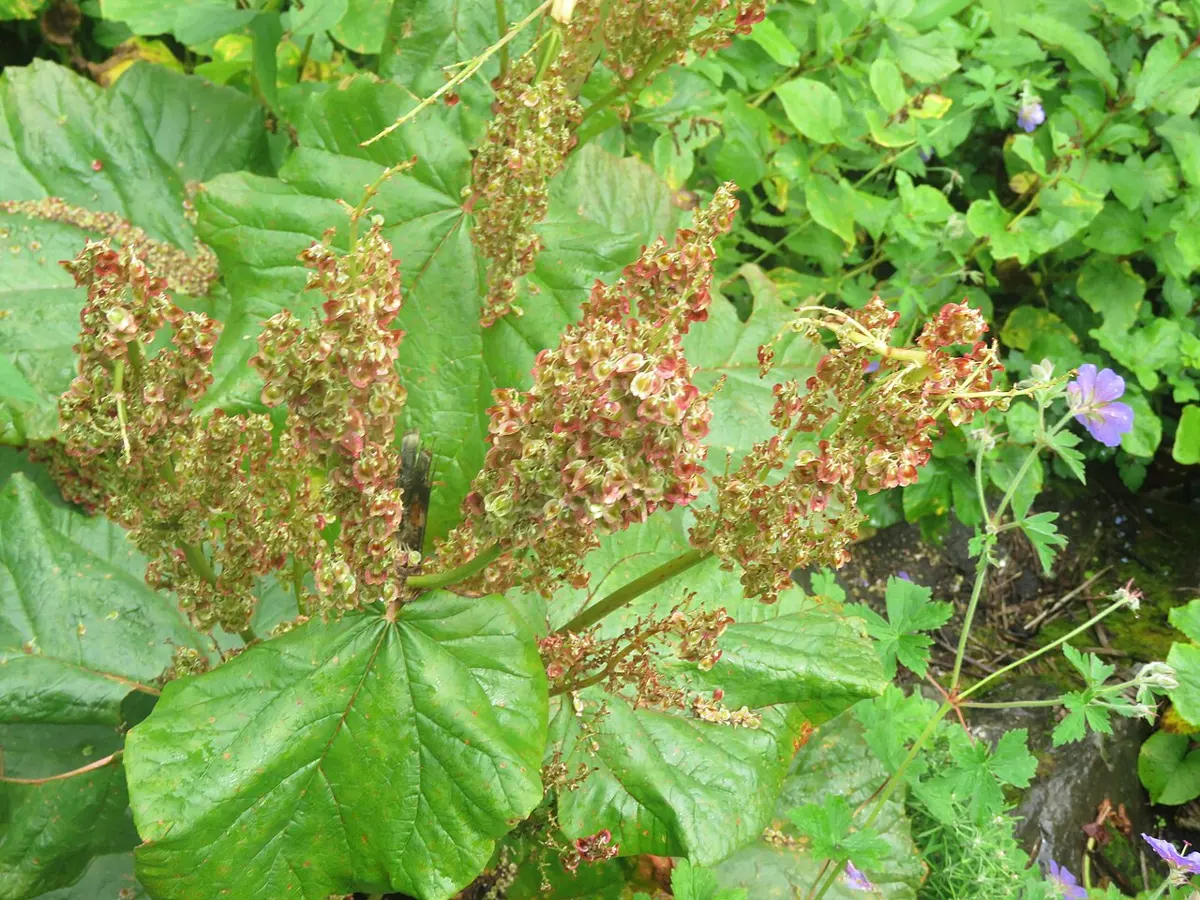
Which plant is this?
The page is about Rheum australe, the species the Asia Network for Sustainable Agriculture and Bioresources (ANSAB) calls पदमचाल. Nepal has other wild rhubarbs too, such as Rheum nobile, R. moorcroftianum and R. acuminatum; government lists sometimes group R. moorcroftianum with R. australe. Its English names include Himalayan rhubarb and “red-veined pie plant”. The garden rhubarb of Europe is a different species of the same genus.
Where it grows
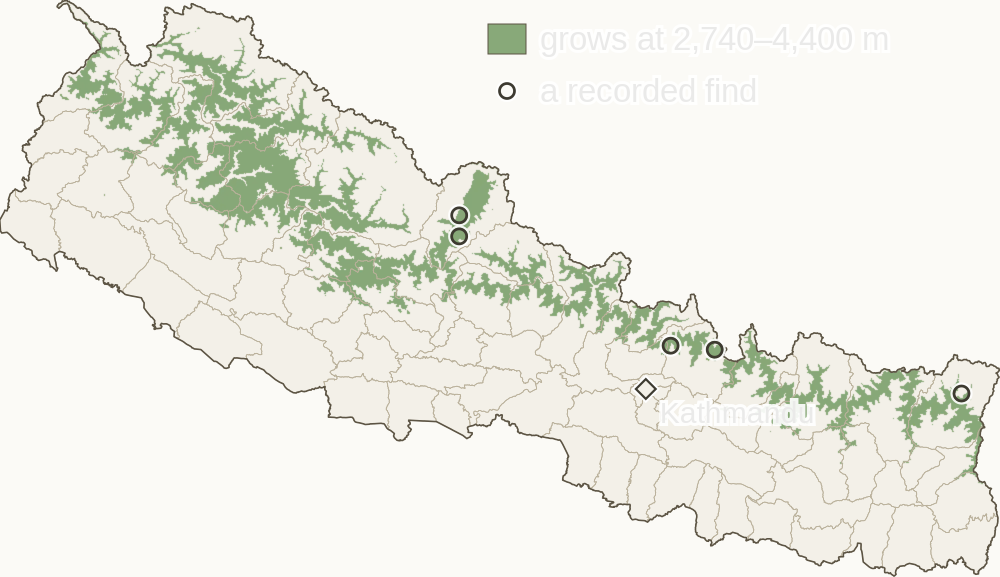
पदमचाल is found only in the Himalaya and the mountains around it: Nepal, India, Bhutan, China, Myanmar and Pakistan. It grows from about 2,740 to 5,200 meters; in Nepal, between about 2,740 and 4,400 meters, across the whole country. It likes grassy or rocky slopes, cracks between boulders, the edges of forests, and the banks of streams.
Sour stalks, poisonous leaves
Here is the “really?” part: one plant, one part to eat and one not to.
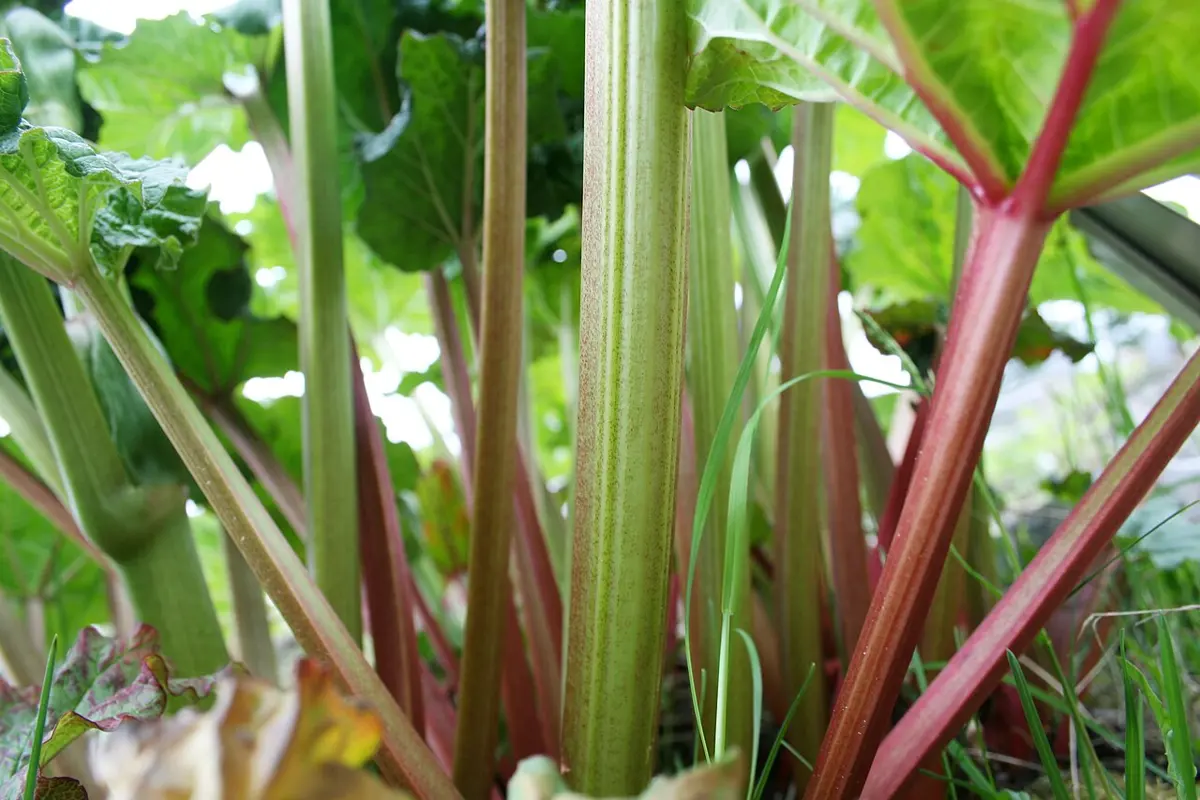
- The stalks (petioles) of पदमचाल are sour and eaten as pickles. The stalks of garden rhubarb, a different species, are eaten too.
- The leaves of garden rhubarb are poisonous. The United States’ National Library of Medicine says the poisons, oxalic acid and possibly chemicals called anthraquinone glycosides, are in the leaf blade, while the stalk can be eaten. Eating the leaves can cause burning and blisters in the mouth and throat, vomiting, stomach pain and kidney stones. Britain’s Royal Horticultural Society marks Rheum australe as harmful if eaten.
The plant is also a source of chemicals called anthraquinones (emodin, chrysophanol, physcion, aloe-emodin and rhein), and of stilbenoids such as resveratrol. These are what scientists study when they test its extracts.
Traditional uses
In Nepal, people use पदमचाल in tradition:
- in Rasuwa, its roots for fever, indigestion, diarrhea and stomach ache;
- in Kaski, a paste of its stem with other plants for broken bones;
- its sour stalks as food, pickled.
What science has tested
- Himalayan rhubarb (Rheum australe): its chemicals have been studied in the laboratory, for example on cancer cells in dishes. We found no trials in people.
- Medicinal rhubarb root (from two other species, Rheum palmatum and R. officinale): the European Medicines Agency accepts its well-established use as a laxative, for occasional constipation only, for a short time, in adults and children over 12. It warns that using it for a long time can discolor the lining of the bowel and upset the body’s balance of salts and water, and that it shouldn’t be used in pregnancy or while breastfeeding.
- How strong the evidence is: for Himalayan rhubarb, only in the laboratory; for its cousins’ roots as a laxative, long-established use accepted by regulators.
Trade and a warming future
About 400 tons of roots and stalks of पदमचाल are traded from Nepal each year, worth about US$740,000: about 12% of the money from Nepal’s trade in medicinal plants. The wild plants are said to be decreasing because so much is dug.
| IUCN Red List | Data Deficient: not enough is known to judge |
| CITES | not listed |
| Nepal | rated Vulnerable in a national conservation assessment; one of 30 medicinal plants the government chose for research and development |
A study published in 2025 modelled where पदमचाल could grow as Nepal’s climate warms. Its suitable area shrinks in every scenario, most of all in the north-west. But four districts of Karnali, Jumla, Kalikot, Dolpa and Jajarkot, are expected to gain suitable land, and the authors suggest their forests and pastures between 3,300 and 4,400 meters as places to farm it and to keep its seeds and plants safe.
Why do scientists suggest farming पदमचाल in Jumla, Kalikot, Dolpa and Jajarkot, between 3,300 and 4,400 meters?
Pick an answer to see why.
See it at the Science Playground
Our exhibit Medicinal and Culinary Herbs of Nepal shows dried herbs and spices used in Nepal. More plants in Herbs of Nepal.
Where these facts come from
- ANSAB, Padamchal, पदमचाल, NTFPs information sheets, checked November 2026.
- Paudel B. et al., Impacts of climate change on the distribution pattern of Himalayan rhubarb (Rheum australe D. Don) in Nepal Himalaya, PLOS One, 2025.
- Mala D. et al., Comparative transcriptome analysis of Rheum australe, an endangered medicinal herb, growing in its natural habitat and those grown in controlled growth chambers, Scientific Reports, 2021.
- Royal Horticultural Society, Rheum australe, Himalayan rhubarb, plant profile, checked November 2026.
- European Medicines Agency, Rhei radix (rhubarb root), herbal medicine summary and EU herbal monograph, 2020.
- MedlinePlus, Rhubarb leaves poisoning, US National Library of Medicine, reviewed 2025.
- Uprety Y. et al., Indigenous use and bio-efficacy of medicinal plants in the Rasuwa District, Central Nepal, Journal of Ethnobiology and Ethnomedicine, 2010.
- Khakurel D. et al., Diversity, distribution, and sustainability of traditional medicinal plants in Kaski district, western Nepal, Frontiers in Pharmacology, 2022.
- Department of Plant Resources, Plants of Nepal: fact sheet, Government of Nepal, 2012 (archived copy).
- Species+ (CITES listings): no species of Rheum listed, checked November 2026.
- Rheum australe: IUCN Red List category, GBIF (from the IUCN Red List), checked November 2026.
- पदमचाल in the Nepali Brihat Shabdakosh (Nepal Academy).