
मजिठो: the climber with red roots
मजिठो · Rubia manjith · A prickly climbing herb of the madder family
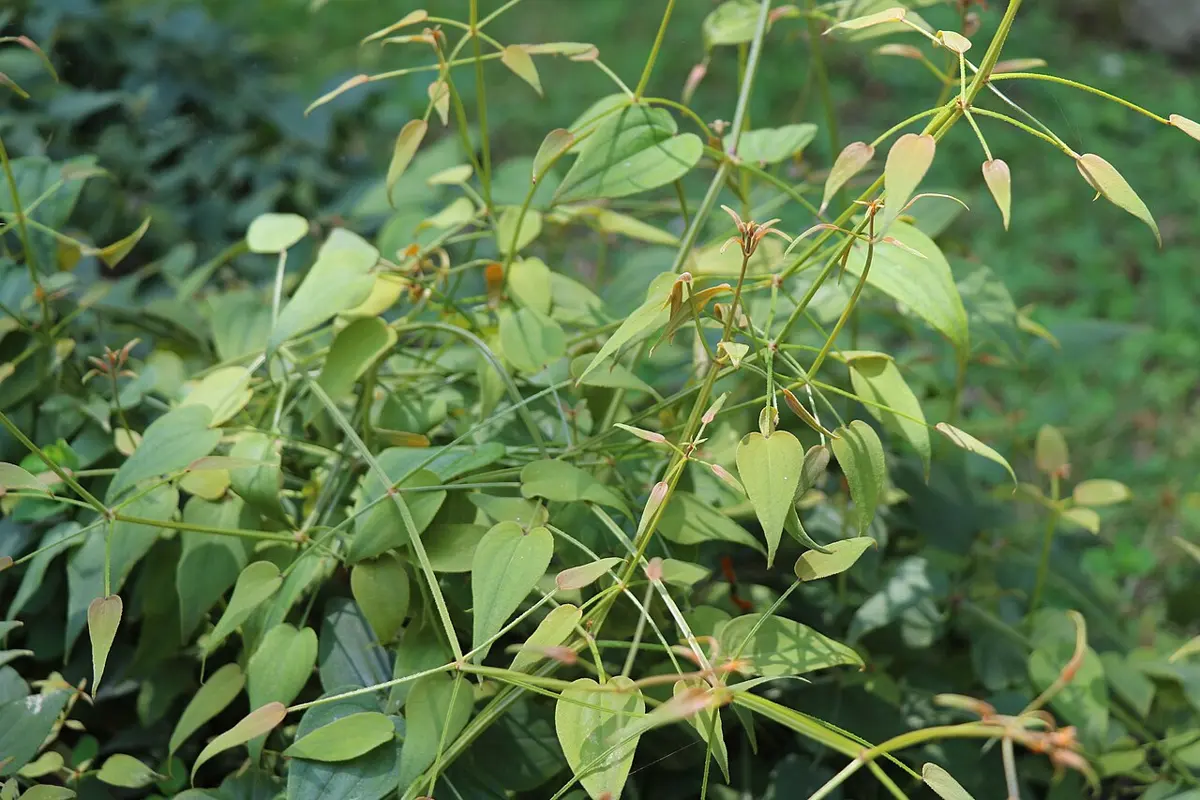
Look at an old Nepali carpet, or a hand-dyed red shawl, and ask where the red came from. Today the answer is usually a factory-made dye. But for hundreds of years, across Asia and Europe, a deep red came from the roots of climbing plants of the genus Rubia. In Nepal’s forests one of them still grows: मजिठो (majitho).
This page is about that climber: how to find it in a hedge, where it grows, the chemistry of its red, the strange story of the red bones it gave to scientists, what tradition uses it for, and why there is less of it in the wild every year.
How to know it
मजिठो is a climbing herb: its stems scramble over bushes and up to about 3 meters, but they never become woody like a tree’s. Look for:
- square stems: roll a stem between your fingers and you feel four corners;
- tiny hooked prickles: the stems and leaf edges carry very small prickles that point backward, so the stem catches on other plants (and on your sleeve) as it climbs;
- leaves in rings of four around the stem, pointed, with five veins spreading from the base like the fingers of a hand;
- a red cast: the undersides of the leaves are often purplish red, and the whole plant turns reddish when it dries;
- small star-shaped flowers, red, purplish red or orange, in July and August;
- small round berries, dark red, about 4 mm across, in October.
If you could cut a stem, you would see red pith in the middle. The root is red too.
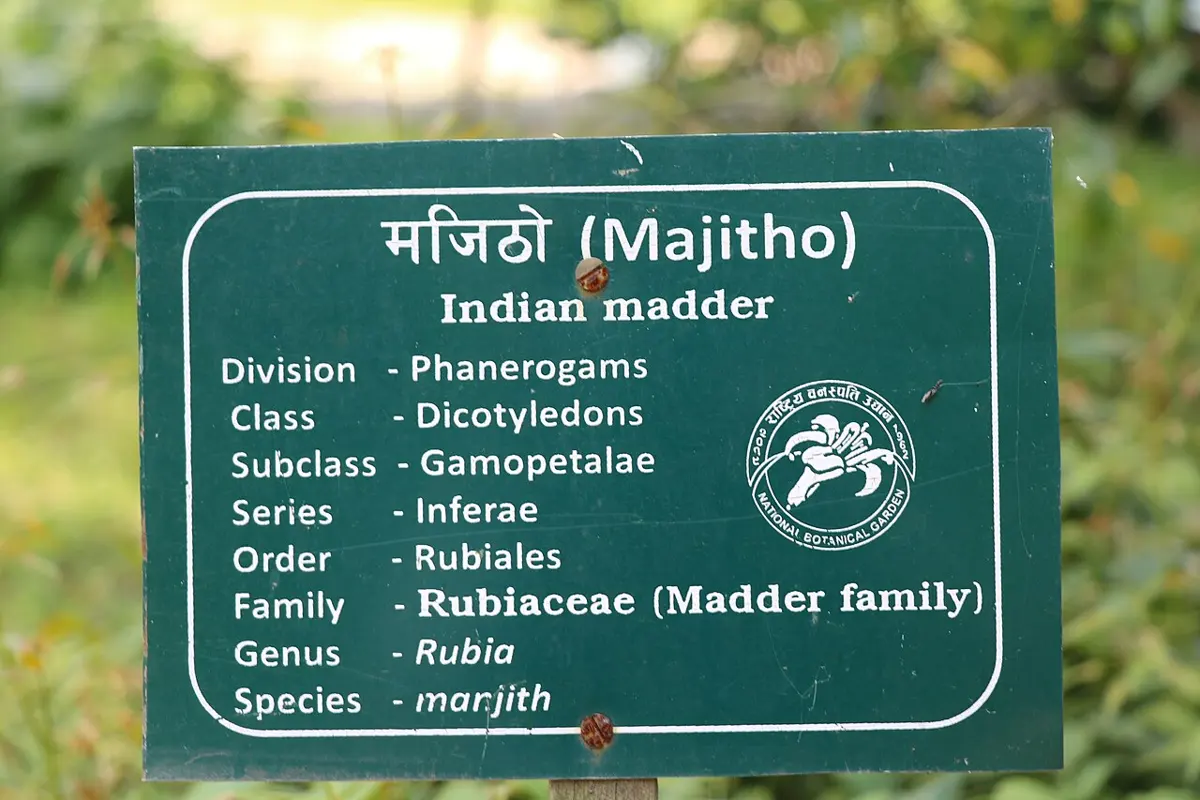
The name comes from Sanskrit मञ्जिष्ठा (manjishtha). The Nepali Brihat Shabdakosh describes मजिठो as a climber used for making dye and in herbal medicine.
Where it grows
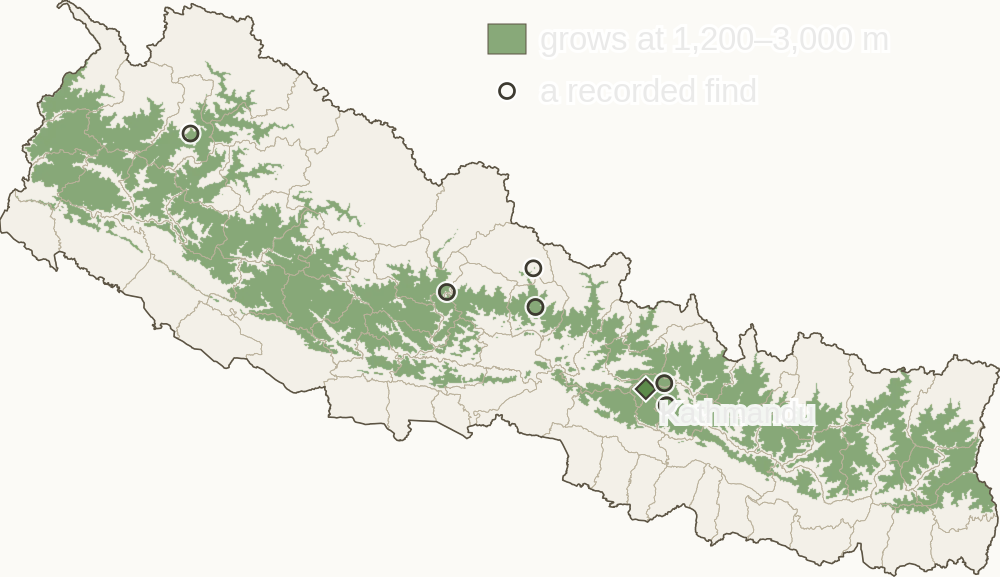
In Nepal मजिठो grows in the subtropical and temperate belts, usually from about 1,200 to 3,000 meters. Across its whole range, from India, Nepal and Bhutan into western China, it has been recorded from 700 to 3,600 meters, in broad-leaved forests, pine forests and thickets, where it can climb over shrubs.
The red that stained bones
Why is the root red? It is full of chemicals called anthraquinones. The two that matter most for color are alizarin and purpurin. They give a red that does not easily wash out, which is exactly what a dyer wants.
Alizarin has another trick: it sticks to newly made bone. That fact led to one of the odd stories in the history of science.
Traditional uses
In Nepal, मजिठो is both a dye and a medicine in tradition:
- the roots and stems of plants two to three years old are used to dye cloth, clothes and carpets in Nepal;
- in Rasuwa, a paste of the root is put on scabies and other skin diseases;
- the Newar community of Pharping uses it as an antiseptic and for rheumatism (painful joints);
- the Chepang community uses the root and the whole plant for fever, diarrhea and burns;
- more widely in South Asia it is used in tradition for ulcers, swellings and skin disorders, and it has a place in Ayurveda.
These are the uses people have handed down; they are not proof that the plant cures these illnesses.
What science has tested
- The dye: well understood. Chemists know which molecules give the red (alizarin, purpurin and their relatives).
- Health effects of मजिठो: only in the laboratory. For example, an extract slowed the growth of skin cells grown in a dish, a test related to its use on skin diseases. That is a long way from showing it helps a person. It has not been tested in people as a medicine.
Trade, protection, farming
मजिठो is one of the plants that the Department of Plant Resources lists among Nepal’s 30 medicinal plants prioritized for research and development. Its dried roots and stems are the parts most traded, for dyes, cosmetics and medicine.
Nepal sells a lot of it. Figures gathered in a 2025 study:
| Years | Exported | Worth |
|---|---|---|
| 2011 to 2015 (five years together) | 61.6 tonnes | NRs 9.2 million |
| 2018/19 (one year) | 219.4 tonnes | NRs 52.4 million |
Most of it goes to India and Bangladesh, and Nepal is said to be the third-largest exporter of मजिठो in the world, after India and Afghanistan.
All that trade has a cost. Collectors often cut the stems right down to the ground, which leaves the plant little chance to grow back. In Nepal’s own assessment (2001) मजिठो was listed as Vulnerable, and wild plants are becoming fewer. The IUCN’s worldwide Red List has not evaluated it, and it is not among the Nepali plants listed under CITES.
The answer, researchers say, is to grow it. In 2025 botanists at Tribhuvan University grew new मजिठो plants from small pieces of stem in tissue culture (in jars of jelly with plant food, under lamps), so that young plants could be planted out to farm it and to restore wild populations.
A collector wants to sell मजिठो every few years from the same forest. What is the best way?
Pick an answer to see why.
See it at the Science Playground
Our exhibit Medicinal and Culinary Herbs of Nepal shows dried herbs and spices used in Nepal. More plants in Herbs of Nepal.
Where these facts come from
- Nagarkoti S. and Pant K.K., In vitro morphogenesis and callus induction from nodal explants of Rubia manjith Roxb. ex Fleming, Botanica Orientalis, 2025.
- Chen T. and Ehrendorfer F., Rubia, Flora of China vol. 19, 2011.
- Bartoníček J. and Naňka O., Early history of the study of bone growth (1722–1875), International Orthopaedics, 2024.
- Uprety Y. et al., Indigenous use and bio-efficacy of medicinal plants in the Rasuwa District, Central Nepal, Journal of Ethnobiology and Ethnomedicine, 2010.
- Food Safety Commission of Japan, Evaluation report: madder color (provisional translation), 2004.
- Department of Plant Resources, Plants of Nepal: fact sheet, 2012.
- Rubia manjith: IUCN Red List category, GBIF (from the IUCN Red List), checked November 2026.
- मजिठो in the Nepali Brihat Shabdakosh (Nepal Academy).