
कुश: a tough grass with a sharp tip
कुश · Desmostachya bipinnata · A tough perennial grass, grass family (Poaceae)
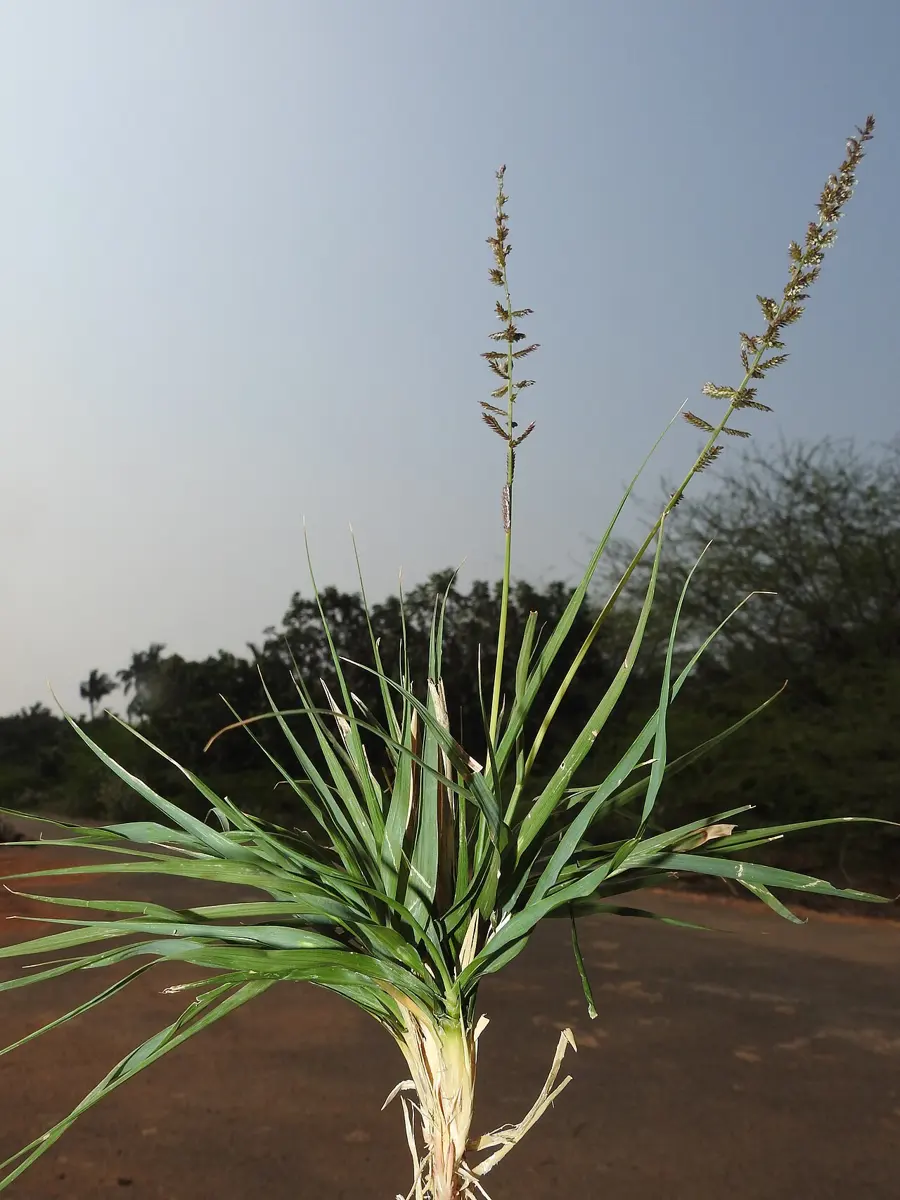
Your Nepali teacher hands back the essays and reads one of them aloud. “This one,” she says, “is कुशाग्र बुद्धि (kushagra buddhi): a mind as sharp as the tip of कुश.” Later, at home, you notice a small bundle of dry grass tucked beside the family’s पूजा (puja, worship) things. Pull out one blade carefully and look at its end: it really is stiff and sharp. The Nepali dictionary explains the old phrase the same way: कुशाग्र means “sharp like the tip of कुश”.
That grass is कुश (kush). This page is about the living plant: how to know it, where it grows, how it survives places where few plants can, what tradition uses it for, and what science has tested.
How to know it
The Nepali dictionary describes कुश as a grass held sacred and needed in religious work and यज्ञ (yajna, fire rituals), and gives दर्भ (darbha) as another name for it. Botanists call it Desmostachya bipinnata. In English it is sometimes called sacrificial grass. Look for:
- a tough tuft: a clump up to about 1 meter tall, its base wrapped in yellow, fibrous remains of old leaf sheaths;
- the leaves: mostly at the base, 6 to 25 cm long and about 4 to 10 mm wide, narrow, rigid, and often ending in a sharp, stiff point;
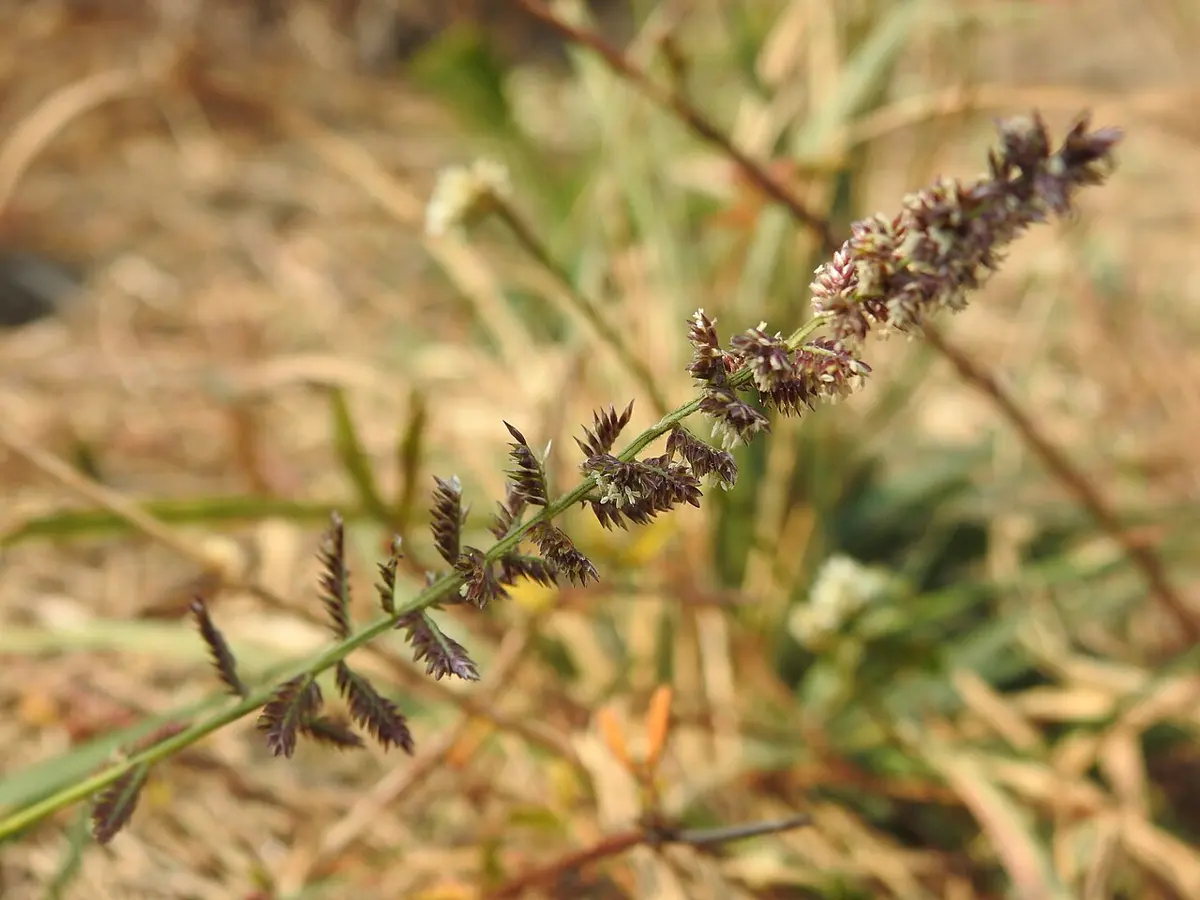
- the flower spikes: a long, very narrow spike, 30 to 50 cm long, made of many short side branches packed with small spikelets;
- underground: thick, scaly stems (rhizomes) that creep out in all directions and send up new tufts.
A database of the region’s plants kept by ICIMOD gives its flowering time as July to November.
Where it grows
कुश is a grass of hot, dry places. It grows wild from North Africa and Arabia to India: one review describes it across India “in hot and dry places”, along river beds and plains.
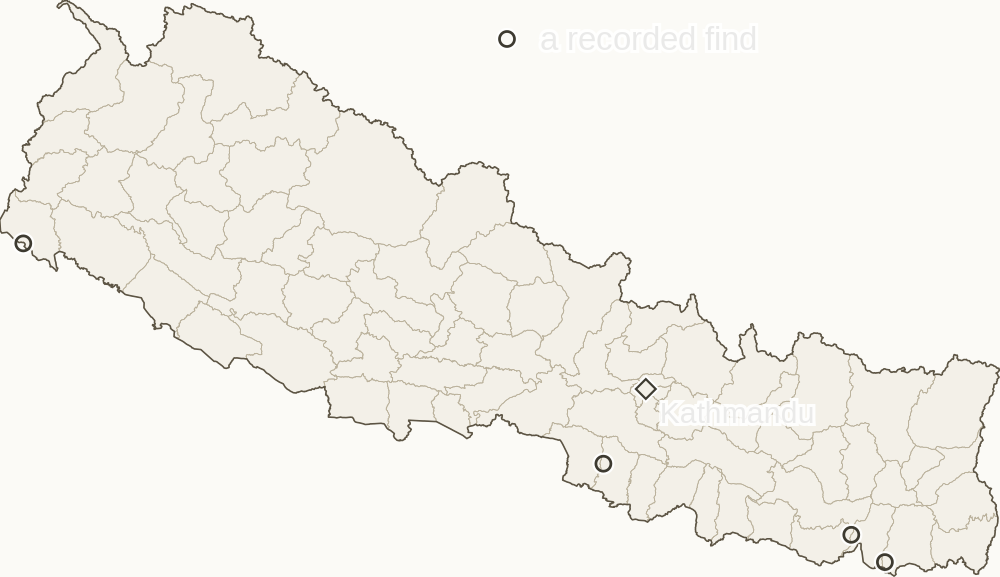
In Nepal, it is a grass of the Tarai and inner Tarai. GBIF, which gathers the records of the world’s herbariums, has 16 records of it from Nepal, nearly all pressed specimens, and every one that says where it was found is from the lowlands: near Biratnagar at 80 meters, at Simara, in Dang at 150 meters, in Chitwan and in Shuklaphanta. In the grasslands of Bardia National Park, a 2024 study found it among the most common grasses, growing with cogongrass, vetiver and wild sugarcane (Saccharum).
Why fire, salt and drought can’t beat it
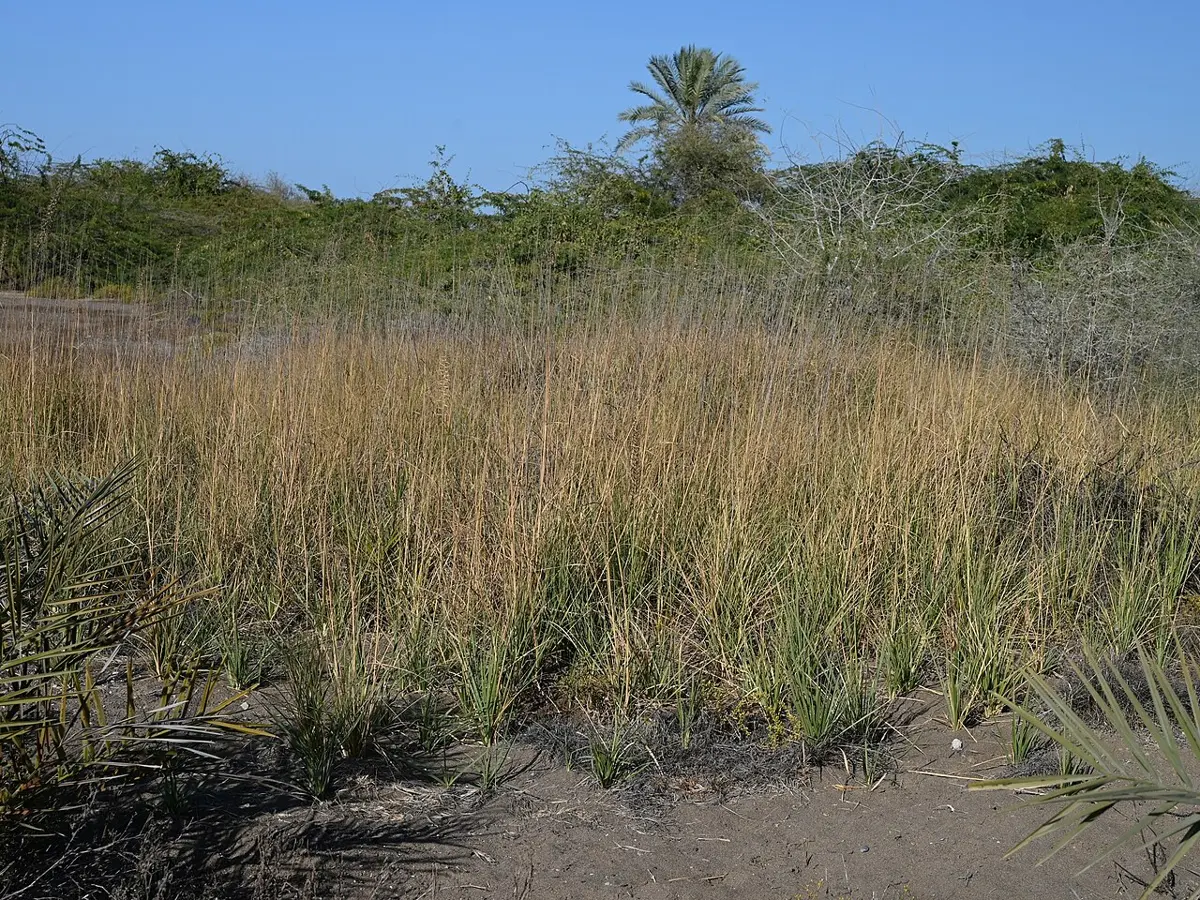
कुश lives in places where few plants can.
Drought. In 2012, botanists studied it on the Sistan plain in south-eastern Iran, a desert plain. The rain there is only about 60 mm in a whole year, and the soil is salty and alkaline. Yet कुश grew there, with a root system reaching about 2 meters deep.
Salt. Plant scientists call a plant that can live through its whole life in salty soil a halophyte. A review of these salt-tolerant grasses lists कुश among them. Such plants, the review explains, manage to hold on to water and keep the balance of salts in their cells, in soil that would dry out most plants.
Fire. In Bardia, park staff burn some patches of grassland and cut others, to keep fresh grass for grazing animals. In the burned plots, कुश was among the grasses that became more common. A fire burns the leaves, but the rhizomes are underground, out of the flames’ reach, and can send up new shoots.
In rituals
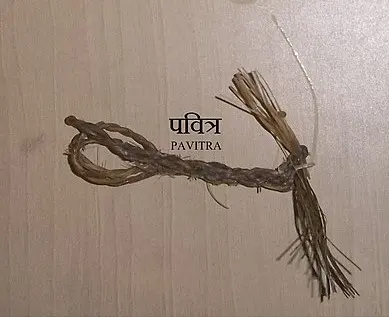
कुश is used in rituals across South Asia. A review of the sacred grasses of India says almost every Vedic ritual includes it: the mat or seat for the ritual is made of it, and a ring of कुश is worn on the ring finger during the ritual. The Nepali dictionary has words for each of these:
- कुशासन (kushasan): a seat of कुश, to sit on during worship;
- पवित्री (pavitri): a ring of कुश, worn on a finger;
- मुद्रिका (mudrika): a ring of कुश worn while offering water to one’s ancestors (तर्पण, tarpan).
In Nepal the grass has its own day: कुसेऔँसी (Kushe Aunsi), the new moon of भदौ (Bhadau), which is also Father’s Day. Households bring home कुश brought by priests and blessed with mantras, in the belief that it brings the family well-being. The dictionary adds that कुश cut on that day is not considered stale for a whole year, so it can be kept and used until the next one.
Traditional uses as medicine
कुश is also a medicine in Ayurveda: one study calls it “an official drug of the Ayurvedic pharmacopoeia”. In Indian traditional medicine, the roots are described as cooling and astringent, and are used for dysentery, diarrhea, painful urination, kidney and bladder stones, and skin diseases; the stems are said to increase urine. It is also part of old Ayurvedic mixtures, among them one made with ghee.
These are uses in tradition, recorded in old texts and passed down. Whether they work in the body is a question only careful trials in people can answer.
What science has tested
- In dishes: in a study in Nepal (2019), an extract of कुश leaves, collected in Birgunj, held back the growth of two kinds of bacteria (Salmonella and Staphylococcus) in laboratory dishes. In another laboratory study, an extract protected yeast cells and DNA from chemical damage.
- In animals: a review of salt-tolerant grasses lists tests of कुश extracts in animals, mostly rats: for example, less swelling, lower blood sugar, and fewer kidney stone deposits.
- In people: the studies and reviews we read describe no trials in people.
- How strong the evidence is: only in the laboratory and in animals. Not tested in people as a medicine.
Is it in danger?
No. The IUCN Red List rates Desmostachya bipinnata Least Concern: it grows across a huge range, from North Africa to India, and in Nepal’s Tarai grasslands it is one of the common grasses.
A family in Bhaktapur buys a bundle labelled कुश at the market. What can they be sure of?
Pick an answer to see why.
See it at the Science Playground
Our exhibit Medicinal and Culinary Herbs of Nepal shows dried herbs and spices used in Nepal. More plants in Herbs of Nepal.
Where these facts come from
- Subramaniam S. and Sivasubramanian A., Tradition to therapeutics: sacrificial medicinal grasses Desmostachya bipinnata and Imperata cylindrica of India, Boletín Latinoamericano y del Caribe de Plantas Medicinales y Aromáticas, 2015.
- Desmostachya bipinnata, Gramineae of Northern and West Tropical Africa, Naturalis Biodiversity Center.
- Desmostachya bipinnata, ICIMOD plant database.
- Fakhireh A. et al., The autecological characteristics of Desmostachya bipinnata in hyper-arid regions, Turkish Journal of Botany, 2012.
- Faustino M.V., Faustino M.A.F. and Pinto D.C.G.A., Halophytic grasses, a new source of nutraceuticals? A review on their secondary metabolites and biological activities, International Journal of Molecular Sciences, 2019.
- Bhusal N., Bhusal B. and Pokharel B., Effects of fire and cutting on vegetation physical properties and herbivorous foraging behavior in the grassland of Bardia National Park, Nepal, Journal of Forest and Natural Resource Management, 2024.
- Nepal P. et al., Comparative antioxidant, antimicrobial and phytochemical assessments of leaves of Desmostachya bipinnata, Hordeum vulgare and Drepanostachyum falcatum, Nepal Journal of Biotechnology, 2019.
- Golla U. and Bhimathati S.S.R., Evaluation of antioxidant and DNA damage protection activity of the hydroalcoholic extract of Desmostachya bipinnata, The Scientific World Journal, 2014.
- Desmostachya bipinnata: occurrences in Nepal and occurrences above 900 m, GBIF (herbarium specimens), checked November 2026.
- Eragrostis cynosuroides, a synonym of Desmostachya bipinnata, GBIF Backbone Taxonomy, checked November 2026.
- Desmostachya bipinnata: IUCN Red List category, GBIF (from the IUCN Red List), checked November 2026.
- Kushe Aunshi, Father’s Day, observed across Nepal, Rastriya Samachar Samiti in Onlinekhabar, 2024.
- Father’s Day being observed across Nepal today, The Himalayan Times, 2026.
- कुश, दर्भ, कुशाग्र, कुशासन, पवित्री, मुद्रिका, कुसेऔँसी, काँस, बाबियो and सिरु in the Nepali Brihat Shabdakosh (Nepal Academy).