
ज्वानो: the seeds that are really fruits
ज्वानो · Trachyspermum ammi · An annual herb of the carrot family, Apiaceae
Rub a pinch of ज्वानो (jwano) between your fingers and smell it: sharp, warm, a little like a medicine cupboard. In many Nepali homes it goes into food as a spice, and into ज्वानोको झोल (jwano ko jhol, jwano soup), the soup given to mothers after a baby is born.
Those little grey-brown grains look like seeds. They aren’t, quite. This page is about what they are, the plant that makes them, the chemical behind the smell, and what science has and hasn’t found.
How to know it
ज्वानो is an annual herb: it grows from seed, flowers, fruits and dies in less than a year. It branches a lot and grows 60 to 90 cm tall. Look for:
- the leaves: divided into leaflets: about 7 pairs and one at the tip;
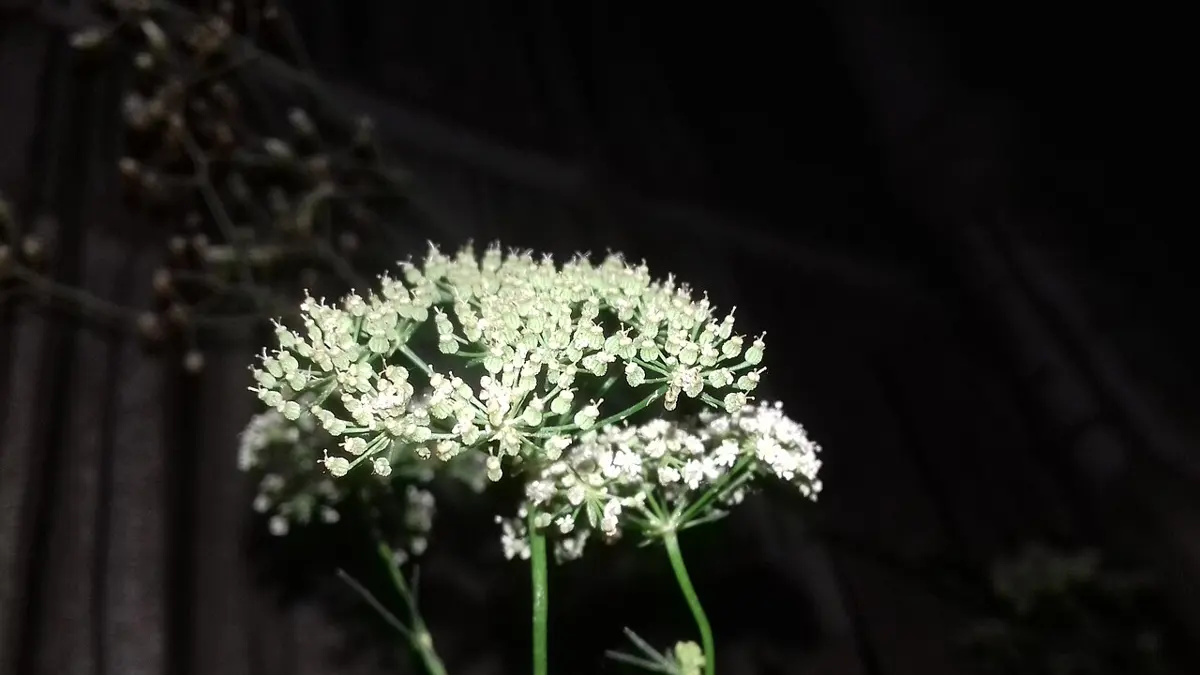
- the flowers: tiny and white, in an umbrella-shaped head (an umbel) made of many small umbrellas, each with up to 16 flowers;
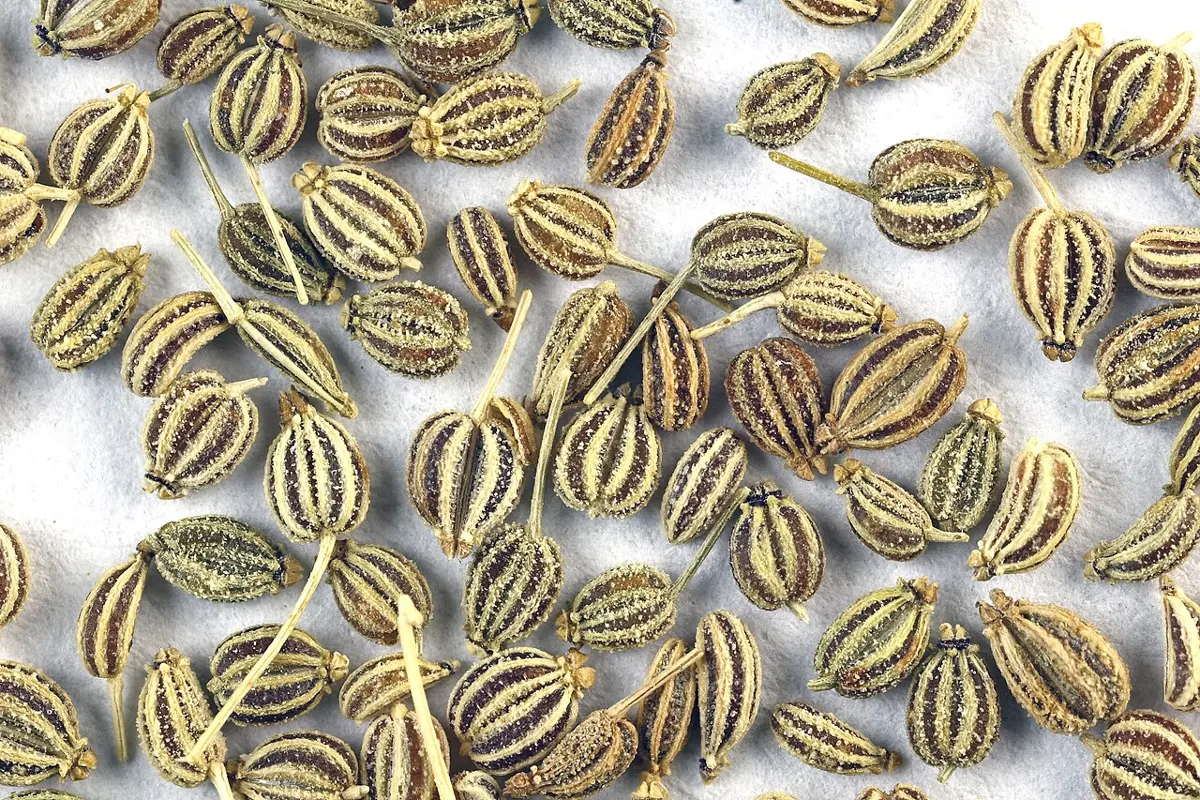
- the “seeds”: grey-brown, egg-shaped, about 2 mm long, with fine ridges along them, and a strong smell when crushed.
Which plant is “jwano”?
This page is about Trachyspermum ammi, of the carrot family (Apiaceae); older books call it Carum copticum. In India and in English it is called ajwain, and also bishop’s weed. The Nepali name comes from the Sanskrit यवानी (yavani). Don’t confuse it with ज्वानेझार (jwanejhar), a low weed found mostly in rice fields, whose leaves look like ज्वानो’s.
In Nepal it is sometimes called ”thyme seed” in English. It is not thyme, which is a different plant.
Where it grows
Where ज्वानो first came from is not settled: one review says it is native to Egypt, while Indian spice researchers call it a plant of Indian origin. It is grown in Iraq, Iran, Afghanistan, Pakistan and India, mostly in dry and semi-dry regions. India grew about 28,000 tonnes of its seed in 2017/18, more than a third of it in Rajasthan.
In India it is a rabi (winter-season) crop. At India’s National Research Centre on Seed Spices, at Ajmer in Rajasthan, it was sown in mid-October and harvested from mid-April to early May, after 183 to 198 days. It grows slowly at first, and its seeds take 15 to 18 days to sprout. The studies we read give no figures for how much is grown in Nepal. In Nepal it is grown in home gardens: botanists’ photo records show it cultivated in Kathmandu and Lalitpur, and studies of plant use record it in Sindhuli.
Seeds that are really fruits
Here is the surprise. What we call a ज्वानो “seed” is a fruit, or rather half of one.
A ज्वानो flower makes a tiny dry fruit called a cremocarp, made of two halves, each called a mericarp. When it is ripe, the halves come apart. Each half carries a seed inside its thin fruit wall. So every grain in the jar is half a fruit, with its seed hidden inside.
The smell: thymol
Crush ज्वानो and the smell comes from an essential oil. Its fruits contain 2 to 4% of this oil, and 35 to 60% of the oil is one chemical: thymol.
Thymol is a phenol, a ring of six carbon atoms with an –OH group attached, and it is volatile: it escapes easily into the air, so your nose picks it up. In the laboratory, ज्वानो oil and extracts have killed or slowed many bacteria and fungi, and worms. Not every sample is the same: one oil, from northeast India, was mostly carvone and limonene instead of thymol, so ज्वानो from different places can differ.
Traditional uses
ज्वानो is a spice first. In tradition it is used:
- for the stomach: gas, indigestion, diarrhea and stomach ache, and for poor appetite;
- for asthma, chest troubles and piles; in Lalitpur, warmed in mustard oil with garlic for colds and coughs;
- in Nepal, as ज्वानोको झोल for new mothers: a Kathmandu doctor told the Kathmandu Post (2019) that new mothers are given it “to increase their breast milk supply”. Studies of plant use in Sindhuli record it to increase breast milk, for period pain and measles, and as a tonic in pregnancy.
What science has tested
- In the laboratory and in animals: many effects reported: against germs, worms and gut spasms, on blood pressure and on the liver.
- In people: the review we read describes no clinical trials. Whether ज्वानोको झोल really increases breast milk has not been tested; it is a tradition.
- How strong the evidence is: not tested in people as a medicine. Enjoy it as a spice.
A grain of ज्वानो has ridges running from end to end. What is it, botanically?
Pick an answer to see why.
See it at the Science Playground
Our exhibit Medicinal and Culinary Herbs of Nepal shows dried herbs and spices used in Nepal. Look at a few grains of ज्वानो under a magnifying glass at home. More plants in Herbs of Nepal.
Where these facts come from
- Bairwa R., Sodha R.S. and Rajawat B.S., Trachyspermum ammi, Pharmacognosy Reviews, 2012.
- Singh R. et al., Weed competition affecting growth and yield in ajwain (Trachyspermum ammi), Indian Journal of Agricultural Sciences, 2021 (ICAR National Research Centre on Seed Spices).
- Trachyspermum ammi, eFlora of India (botanists’ photo records from Kathmandu, Lalitpur and central Nepal).
- Gurung S., Debunking maternal healthcare myths, The Kathmandu Post, 27 June 2019.
- Subedi D. et al., Current outlook of ethnobotany in Bagmati Province, central Nepal, Journal of Plant Resources (Department of Plant Resources), 2025.
- ज्वानो in the Nepali Brihat Shabdakosh (Nepal Academy).