
A pipe has sprung a leak 5 m up the side of Sunmaya’s house, and the family has a 6 m ladder. Will it reach? It depends on how steeply the ladder leans: stand it nearly upright and it reaches high but can tip backwards; lean it far out and its foot can slide away. Safety rules say to put the foot a quarter of the ladder’s length from the wall.
So how high does a ladder reach at a given angle? Play with the ladder below, and watch the number “height ÷ ladder”. Then change the ladder’s length without changing the angle.
At one angle, every ladder reaches the same fraction of its own length up the wall. That fraction belongs to the angle, and it has a name: the sine of the angle. This unit is about that fraction and its five relatives, the trigonometric ratios, and by Back to the ladder you will answer Sunmaya’s question with them.
The ladder rule: the US Occupational Safety and Health Administration (Sources).
20.0 Review
Work in a group. Look at the two right-angled triangles below, measure all their sides and angles, and talk about these questions: Which angles are equal? Are the sides equal? Are △ABC and △PQR similar?
Then find the ratios , and in △ABC, and , and in △PQR. Which of them are equal?
That last line is the seed of the whole unit. Two right-angled triangles with one more angle the same are similar, and in similar triangles the sides are in the same proportions. So in a right-angled triangle, the ratio of two sides depends only on the angle, not on how big the triangle is.
The sides of a right-angled triangle have names that depend on the angle you look from. Seen from the angle at A:
- the hypotenuse h is the longest side, opposite the right angle: AC;
- the perpendicular p is the side opposite the angle at A: BC;
- the base b is the third side, the one next to the angle at A: AB.
So the three ratios above are , and , the same in both triangles.
20.1 Trigonometric ratios
These fixed ratios are the trigonometric ratios. Trigonometry (from the Greek for “triangle measuring”) studies how the sides and angles of triangles are related. It lets you find a height, a length or an angle you can’t measure directly: how tall a tree is, how wide a river is, how steep a road climbs. Surveyors, builders, engineers, pilots and astronomers use it every day, and physics and engineering couldn’t do without it.
Naming the sides
In the right-angled triangle ABC, with the right angle at B, take ∠ACB = θ as the angle we are looking from. It is called the reference angle. From θ:
- AB, opposite θ, is the perpendicular p (also called the opposite side);
- BC, next to θ, is the base b (the adjacent side);
- AC, opposite the right angle, is the hypotenuse h.
Now the three ratios get their names:
They are read “sine theta”, “cosine theta” and “tangent theta”. These three, sin θ, cos θ and tan θ, are the fundamental trigonometric ratios.
Turn each one upside down and you get the other three, the reciprocal ratios:
read “cosecant”, “secant” and “cotangent”. So , and .
Angles are usually named with Greek letters. These are the ones you will meet:
| Letter | Name | Say it |
|---|---|---|
| α | alpha | AL-fuh |
| β | beta | BAY-tuh (or BEE-tuh) |
| γ | gamma | GAM-uh |
| δ | delta | DEL-tuh |
| θ | theta | THAY-tuh (or THEE-tuh) |
| φ | phi | fy (or fee) |
| π | pi | pie |
| ψ | psi | sy (or psy) |
| λ | lambda | LAM-duh |
In △ABC, right-angled at B, the reference angle is ∠BAC. Which side is the perpendicular?
Pick an answer to see why.
In a right-angled triangle, is which ratio of the reference angle?
Pick an answer to see why.
Examples
Two rules that always hold
A second rule comes from dividing two ratios:
So , and turned upside down, .
Exercise 20.1
Question 1
In the right-angled triangle ABC, and ∠BAC = β.
Name the perpendicular, the base and the hypotenuse, taking as the reference angle.
Answer
Write the six trigonometric ratios of .
Answer
Name the perpendicular, the base and the hypotenuse, taking β as the reference angle.
Answer
Write the six trigonometric ratios of β.
Answer
Question 2
In the right-angled triangle PQR, PQ = 6 and QR = 8.
Find sin β, cos β and tan β.
Answer
Find , and .
Answer
Find sin α, cos α, tan α, , and .
Answer
Question 3
If and h = 20, find b.
Answer
If , find
- i.h;
- ii.sin θ and cos θ.
Answer
If , find sin θ and tan θ.
Answer
Question 4
Find the value of each, using the trigonometric ratios.
Answer
Answer
sin θ ÷ cos θ
Answer
Answer
cos θ ÷ sin θ
Answer
Answer
Question 5
Prove, using the trigonometric ratios:
Answer
Answer
Answer
Answer
Answer
Question 6
An inclined plane 29 ft long is built to carry goods up to the top of a building 20 ft high.
How far is the foot of the inclined plane from the building?
Answer
The inclined plane makes the angle θ with the ground. Find tan θ, sin θ and cos θ.
Answer
Question 7
In the figure, AB is a lamp post and C is the foot of a tree. AC is the distance from the foot of the tree to the top of the lamp post, and BC the distance between the post and the tree.
If BC = 24 m and AC = 40 m, find the height of the lamp post.
Answer
Taking ∠ACB = θ as the reference angle, find tan θ, sin θ and cos θ.
Answer
20.2 Trigonometric ratios of special angles
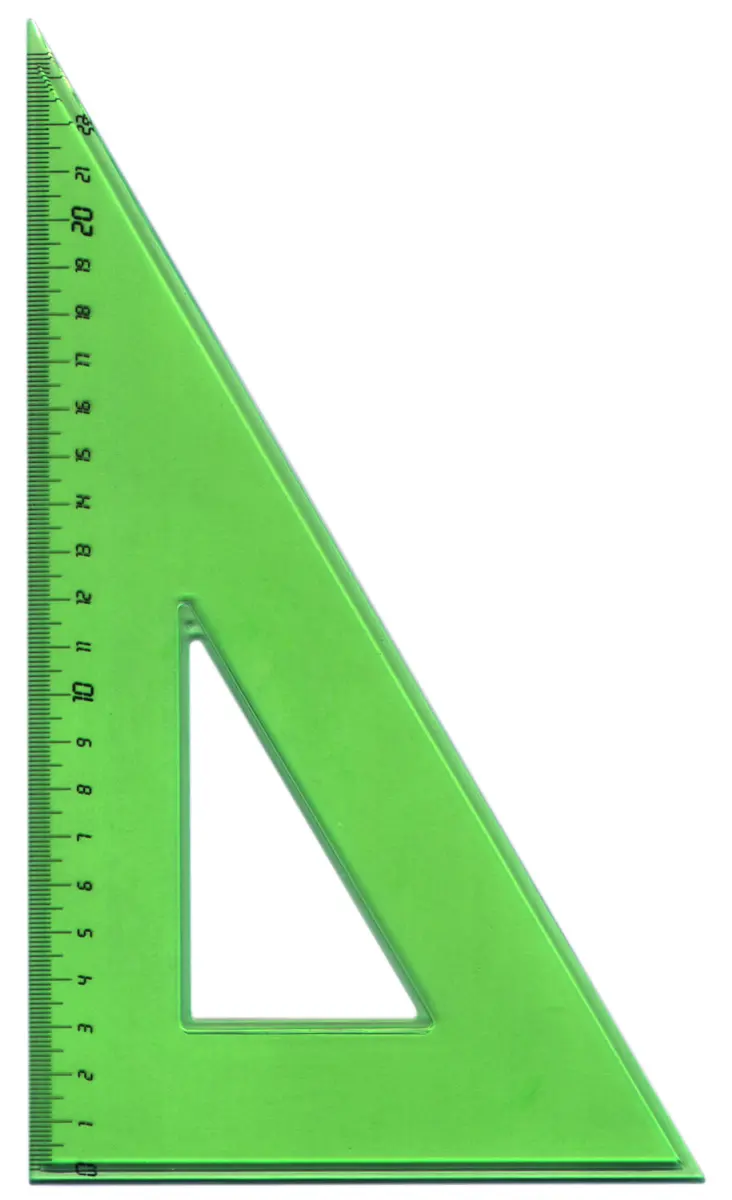
Most angles have untidy ratios ( is about 0.6018…), but five angles, 0°, 30°, 45°, 60° and 90°, have exact values you can work out with nothing but Pythagoras’ rule. Three of them, 30°, 45° and 60°, are the angles of your geometry box’s two set squares, and exam questions are built on all five.
a. The ratios of 45°
In △OQP, and , so the third angle is 45° too, and the triangle is isosceles: OQ = PQ. Call each x. By Pythagoras’ rule,
From the 45° angle at O: p = PQ = x, b = OQ = x, . So
and upside down, , , . The x always cancels: any 45° right-angled triangle, a set square or a field cut corner to corner, gives the same values.
b. The ratios of 30° and 60°
For 30° and 60° we need a right-angled triangle with those angles. Take an equilateral triangle PQR: all its angles are 60° and all its sides are equal, say x. Draw . It cuts the base into two equal halves, , and the angle at P into two halves of 30°.
In the right-angled △PMR, , , so . By Pythagoras’ rule:
From 30° (at P): , , h = PR = x.
and upside down, , , .
From 60° (at R), the perpendicular and the base swap: , , h = x.
and upside down, , , .
c. The ratios of 0° and 90°
A right-angled triangle can’t really have a second angle of 0° or 90°, but we can see what the ratios approach as the angle gets close to them. Take △PQR, right-angled at Q, with θ = ∠PRQ.
Shrink θ to 0°. Turn RP down towards RQ. The perpendicular PQ gets shorter and shorter, until P lands on Q: then PQ = 0, and PR lies along QR, so PR = QR. Call that length x. So
Grow θ to 90°. Now keep P where it is and slide R towards Q. The angle at R grows and the base QR gets shorter, until at 90° it is 0 and PR lies along PQ: PR = PQ = x. So
and , which is not defined: no number times 0 gives x.
Here are all the values in one table:
| θ | 0° | 30° | 45° | 60° | 90° |
|---|---|---|---|---|---|
| sin θ | 0 | 1 | |||
| cos θ | 1 | 0 | |||
| tan θ | 0 | 1 | not defined |
Which of these is equal to ?
Pick an answer to see why.
In a right-angled triangle, the hypotenuse is twice the perpendicular. What is the reference angle?
Pick an answer to see why.
Examples
Exercise 20.2
Question 1
Find the value of each trigonometric ratio.
Answer
Answer
Answer
Answer
Answer
Question 2
Find the reference angle of each right-angled triangle.
p = 4 cm and cm
Answer
ft and h = 14 ft
Answer
b = 5 cm and cm²
Answer
p = x inch and b = x inch
Answer
Question 3
Find the remaining sides of each right-angled triangle.
The hypotenuse is 10 cm and the reference angle is 60°.
Answer
The perpendicular is 15 ft and the reference angle is 45°.
Answer
The base is 36 inches and the reference angle is 30°.
Answer
Question 4
Find the value of each expression.
Answer
Answer
Answer
Answer
Question 5
Prove that:
Answer
Answer
Answer
Answer
Question 6
A ladder 60 ft long leans against a wall and reaches ft up it. Find the angles the ladder makes with the ground and with the wall.
Answer
A clock tower is 36 m high. From a point on the ground m from its foot, find the angle of elevation of its top: the angle the line to the top makes with the ground.
Answer
In the figure, VS = 40.5 ft and the tree SJ is x ft tall.
- i.What must x be for both acute angles to be 45°?
- ii.How long is VJ then?
Answer
A ladder reaches the top of a wall 12 ft high and makes an angle of 60° with the ground. Find the length of the ladder.
Answer
Back to the ladder
Yes: Sunmaya’s 6 m ladder reaches 5.81 m at the safe angle, 0.81 m above the leak.
The rule puts the foot a quarter of the ladder’s length from the wall: m. The ladder is the hypotenuse and the foot’s distance the base, so
That is the safe angle for every ladder, whatever its length: about 75.5° (a calculator’s cos⁻¹ button gives it). The height on the wall is the perpendicular:
and : at the safe angle, a ladder reaches about 97% of its length up the wall. That is the number the opening widget shows as “height ÷ ladder” at 75° or 76°, for the 3 m ladder as much as the 6 m one.
What if they lean it at 60°, so it feels less steep? Then the top reaches only m, still above the leak, but the foot is m out, twice the safe distance, and much more likely to slide.
How the exam asks it
Grade 9’s final exam is set to CDC’s specification grid for Compulsory Mathematics, Grades 9–10. There, Trigonometry is 4 marks in one question; in the grid’s model paper it is question 16:
| Part | Level | Marks | What it asks |
|---|---|---|---|
| a. | knowledge | 1 | which ratio a given pair of sides makes |
| b. | understanding | 1 | a value from Pythagoras’ rule, such as |
| c. | application | 1 | a side from one ratio and one side |
| d. | higher ability | 1 | an angle from how two sides compare |
Here is one of our own in that shape.
Mixed exercise
Question 1
In the figure, △CAB is right-angled at A, and ∠B = θ.
Name the perpendicular, the base and the hypotenuse, taking ∠B as the reference angle.
Answer
Write the six trigonometric ratios of ∠B.
Answer
If h = 20 and b = 12, find tan B.
Answer
Using c, find , and .
Answer
Question 2
In the right-angled triangle XYZ, , and YZ = 8 cm.
Find XY and ZX.
Answer
Show that .
Answer
Find sin Z, cos Z and tan Z.
Answer
Using c, find , and .
Answer
Question 3
From a point on level ground 30 ft from the foot of a bamboo, the angle of elevation of its top (the angle the line to the top makes with the ground) is 30°.
How tall is the bamboo?
Answer
How far towards the bamboo must you walk for its top to be at an angle of 45°?
Answer
After 4 days the bamboo has grown to ft. What angle does its top make now, seen from the first point?
Answer
Practice every question in the book, and keep track of the ones you miss →
Where these facts come from
- The ladder rule: “Non-self-supporting ladders shall be used at an angle such that the horizontal distance from the top support to the foot of the ladder is approximately one-quarter of the working length of the ladder”: US Occupational Safety and Health Administration, 29 CFR 1926.1053(b)(5)(i), read November 2026.
- The word sine from Sanskrit jyā/jīvā, through Arabic jība and jayb to Latin sinus (Gerard of Cremona, 12th century), and cosine from complementi sinus: Wikipedia, “Sine and cosine”, Etymology and History, read November 2026.
- Aryabhata’s half-chord, ardha-jyā, shortened to jyā: Wikipedia, “Jyā, koti-jyā and utkrama-jyā”, read November 2026.
- A road’s grade as rise over run, the tangent of its angle: Wikipedia, “Grade (slope)”, read November 2026.
- Bamboo growing up to 91 cm in 24 hours: Wikipedia, “Bamboo”, read November 2026.
- Ramps not steeper than 1:12: US Access Board, 2010 ADA Standards for Accessible Design, 405.2.
- The exam’s question (For the exam, How the exam asks it): CDC, Specification Grid, Compulsory Mathematics, Grades 9–10 (Trigonometry 4 marks in one question, 1K 1U 1A 1H) and its model question 16; our question is our own.
- Every answer: worked out here; every figure drawn from its stated or computed measures (
trig-ratio-figures.ts). - Photos: Wikimedia Commons, credited under each.
A companion to your textbook, not a replacement for it: study from the book your school uses, and where the two differ, follow your teacher. Found a mistake? Please tell us.