
Drop a stone into a pond and it sinks. Drop a leaf and it floats. Why? You could just guess. Or you could do what scientists do: guess, then test your guess, look carefully at what happens, and find out for sure.
And when you test something, you usually have to measure it: how long, how heavy, how hot, how much. But how long is “a bitta”? Your bitta and your father’s bitta are not the same! This unit shows you how scientists learn, and why the whole world agreed to measure things in the same units.
1.1 Introduction to scientific learning
What is science? How is it studied, and why? Is learning science different from learning other subjects? Think about it with your friends, and share your ideas in class.
Science is the careful, step-by-step study of objects, materials and events. Studying science needs special skills, called scientific skills: observing, classifying, measuring, predicting, experimenting, concluding and communicating.
| Skill | What it means | An example |
|---|---|---|
| Observing | looking carefully, using all your senses | noticing that a mango turns yellow as it ripens |
| Classifying | putting things into groups by what they share | sorting fruits into sweet and sour |
| Measuring | finding how much, using a tool and a unit | finding that a pencil is 15 cm long |
| Predicting | saying what will happen, before it happens | “the ice will melt in the sun” |
| Experimenting | testing an idea by doing something | putting the ice in the sun and watching |
| Concluding | deciding what the results show | “heat makes ice melt” |
| Communicating | telling others what you found | writing a report, or showing a chart in class |
When we study the things we see, hear and feel in an orderly way, step by step, it is called a scientific study. Observing, asking questions, guessing, experimenting, analyzing the results and drawing conclusions are all part of scientific learning.
Many great discoveries began with an ordinary event. Isaac Newton saw an apple fall from a tree and asked why things always fall down. His answer explained gravity, the pull that holds us on the Earth and keeps the Moon going round it. James Watt watched how the steam from boiling water pushed up the lid of a kettle, and he went on to make the steam engine much better. These discoveries became possible because of careful scientific study. If we study steadily and patiently in a scientific way, we can discover new things too.
Scientific learning process
In this activity you did what scientists do. You observed things around you, asked whether they would sink, guessed, tested, recorded the results, concluded, and told others. This is called the scientific learning process: learning about the objects and events around us by observing, guessing, testing, discussing and explaining them, then drawing a conclusion and sharing it in a report.
Steps of the scientific learning process
The scientific learning process goes in steps, one after another.
1. Study of surrounding objects or events
Scientific learning begins when we study the things and events around us that we see, hear or feel. Collecting the objects in Activity 1.2 was this step. Seeing a fruit fall from a tree, seeing snow fall, or feeling cold in winter are also first steps of this kind.
2. Questioning about objects or events
The second step is to ask questions. Wondering whether the objects in Activity 1.2 would sink or float was this step. Newton asking why the apple fell, and Watt asking why steam lifted the kettle’s lid, were also questions of this kind.
3. Guessing the probable answer
In the third step we guess the possible answer, or the possible cause, of what we saw. A good guess shows us what to test, so the facts are easier to find. Guessing which objects would sink or float, before testing them, was this step in Activity 1.2. A guess like this, one that can be tested, is called a hypothesis.
4. Testing
In the fourth step, we test our guess with a suitable method. Testing shows what is really true, so this is the most important step of the scientific learning process. Dropping the objects into water one by one, in Activity 1.2, was the testing step.
5. Accumulating the data from testing
The results of the test are written down. These results are called data. In Activity 1.2, the names of the objects that sank and floated were written in the table.
6. Concluding after analyzing the data
Next we study the data carefully (we analyze them) and decide what they show. This is the conclusion. The conclusions of Activity 1.2 are:
- i.An iron nail, a stone, a brick, a spoon and a rubber stopper sink, because they are denser than water: each is heavier than the same amount of water.
- ii.A page of paper, leaves, pieces of plastic and ice float on water, because they are less dense than water.
7. Presenting a report
This is the last step. The conclusion is shared with others, by speaking or in writing. A report lets other people check our work, and even repeat it.
Rita guesses that a bigger stone will sink faster than a small one. Which step of the scientific learning process is she doing?
Pick an answer to see why.
Why is testing said to be the most important step?
Pick an answer to see why.
Let us practice the scientific learning process
1.2 Measurement and unit
At first we did not know the volume of the water in the glass. A measuring cylinder is a tall glass or plastic jar with marks on its side, used to measure the volume of a liquid. We read the level of the water against the marks, and that tells us the volume. The marks show standard amounts, the same on every measuring cylinder. So in this activity, we compared the unknown volume of water with the standard volumes marked on the cylinder.
Volume is a physical quantity. A physical quantity is anything that can be measured and written as a number: length, mass, time, temperature, area, volume. (Beauty or kindness can’t be measured with a number, so they are not physical quantities.)
Measurement is comparing an unknown quantity with a standard, known quantity of the same kind. In Activity 1.6, the unknown volume of water in the glass was compared with the standard volumes marked on the measuring cylinder.
The standard quantity used to measure a physical quantity is called a unit. Different physical quantities have different units: length is measured in meters, mass in kilograms, time in seconds and temperature in degrees Celsius.
The amount of a physical quantity is written as a number with a unit. For example, the length of a table may be 2 m. Here, length is the physical quantity, m (meter) is the unit, and 2 tells us that the table is two times as long as one meter.
Why is measurement necessary?
Look at the two lines in Figure 1.3. Which one is longer? Decide without measuring. Then measure both with a ruler. Was your guess right?
Probably your guess was wrong. Our eyes can be fooled, so a guess made just by looking is not always right. Testing is the most important step of scientific learning, and testing usually means measuring. If a measurement is wrong, the conclusion of the test will be wrong too. So measurement is very important in the study of science.
Measurement matters in daily life too. We buy rice, dal, sugar, oil and ghee from the shop, and they are measured. When we make tea, we decide how much sugar, tea leaves, milk and water to put in. The salt in a curry must be measured, or the curry is spoiled. Clothes sewn without measuring the body don’t fit. We need measurement to know the correct amount of things.
Which of these is not a physical quantity?
Pick an answer to see why.
1.3 Local and standard units of measurement
Long ago, people measured with what they always had with them: their own bodies. In many places in Nepal, a haat (from the elbow to the tip of the middle finger), a bitta (the span of the hand), a foot and an angul (the width of a finger) are still used to measure length.
In the same way, mana, pathi and muri are used in our country to measure grains, oil and ghee. Fields have long been measured in muri, hal or ropani: by how much grain a field gives (muri), or by how much land a pair of oxen can plow in a day (hal). These are not standard units. Units that are used only in a local area are called local units. Some of them are still used in many places.
Local units are not standard. A bitta, a mana or a pathi is a little different from place to place and from person to person. So measurements made in different places don’t agree. This causes problems when people buy and sell things, within a country and between countries. People felt the need for units that everyone could trust and that were accepted all over the world.
So in 1960, scientists from many countries met at a conference in France and agreed on a set of standard units. These units, recognized all over the world, are called SI units. (SI is short for the French words Système International, the International System.) The system of measurement agreed at that conference is the SI system. Here are some SI units:
| No. | Physical quantity | SI unit | Symbol |
|---|---|---|---|
| 1 | Length | meter | m |
| 2 | Mass | kilogram | kg |
| 3 | Time | second | s |
| 4 | Temperature | kelvin | K |
| 5 | Electric current | ampere | A |
| 6 | Area | square meter | m² |
| 7 | Volume | cubic meter | m³ |
| 8 | Force | newton | N |
| 9 | Energy | joule | J |
| 10 | Power | watt | W |
| 11 | Speed (velocity) | meter per second | m/s |
As in Activities 1.9 and 1.10, local units can be compared with SI units, and then written in SI units. But not every local unit can be changed into SI units exactly. For example, nobody can say exactly how many centimeters there are in a haat, because the length of the arm is different for each person.
On the basis of these activities, make a table like this to show how local units and SI units differ.
Why were SI units developed?
Pick an answer to see why.
1.4 Multiple and submultiple units
Suppose you have to measure the distance from the Earth to the Sun, the length of a field, and the length of a pen. Can you measure all of them in meters? Why or why not?
All three are the same physical quantity: length. But their sizes are very different. It makes sense to measure the length of a field in meters. The distance to the Sun needs a much bigger unit (it is about 150 million kilometers!), and a pen needs a smaller unit (about 14 centimeters). So large amounts of a quantity are written in bigger units, called multiples, and small amounts in smaller units, called submultiples. Although units are big and small, they can always be changed into one another.
Each tool is made for its job. A short ruler measures short lengths, and a long tape measures long ones. A long tape is rolled up so that it is easy to carry. A small, stiff scale from the geometry box helps us draw straight lines. In a cloth shop, a stiff iron scale makes measuring cloth easy.
Unit of length
How far is your school from your home? How tall are you? How long is the bench? All these questions are about length. Length is the distance between two points. For example, a person’s height is the distance from the top of the head to the soles of the feet.
The SI unit of length is the meter (m). There are units bigger and smaller than the meter:
| Unit | Is equal to |
|---|---|
| 10 millimeters (mm) | 1 centimeter (cm) |
| 10 centimeters | 1 decimeter (dm) |
| 10 decimeters (100 cm) | 1 meter (m) |
| 1000 meters | 1 kilometer (km) |
To change a bigger unit into a smaller one, multiply; to change a smaller unit into a bigger one, divide.
Unit of mass
The bucket of water is heavier because it holds much more water than the glass. The amount of matter (stuff) in an object is called its mass. A glass of water has less mass than a bucket of water. An object with more mass is heavier, and one with less mass is lighter. That is why the glass is easier to lift.
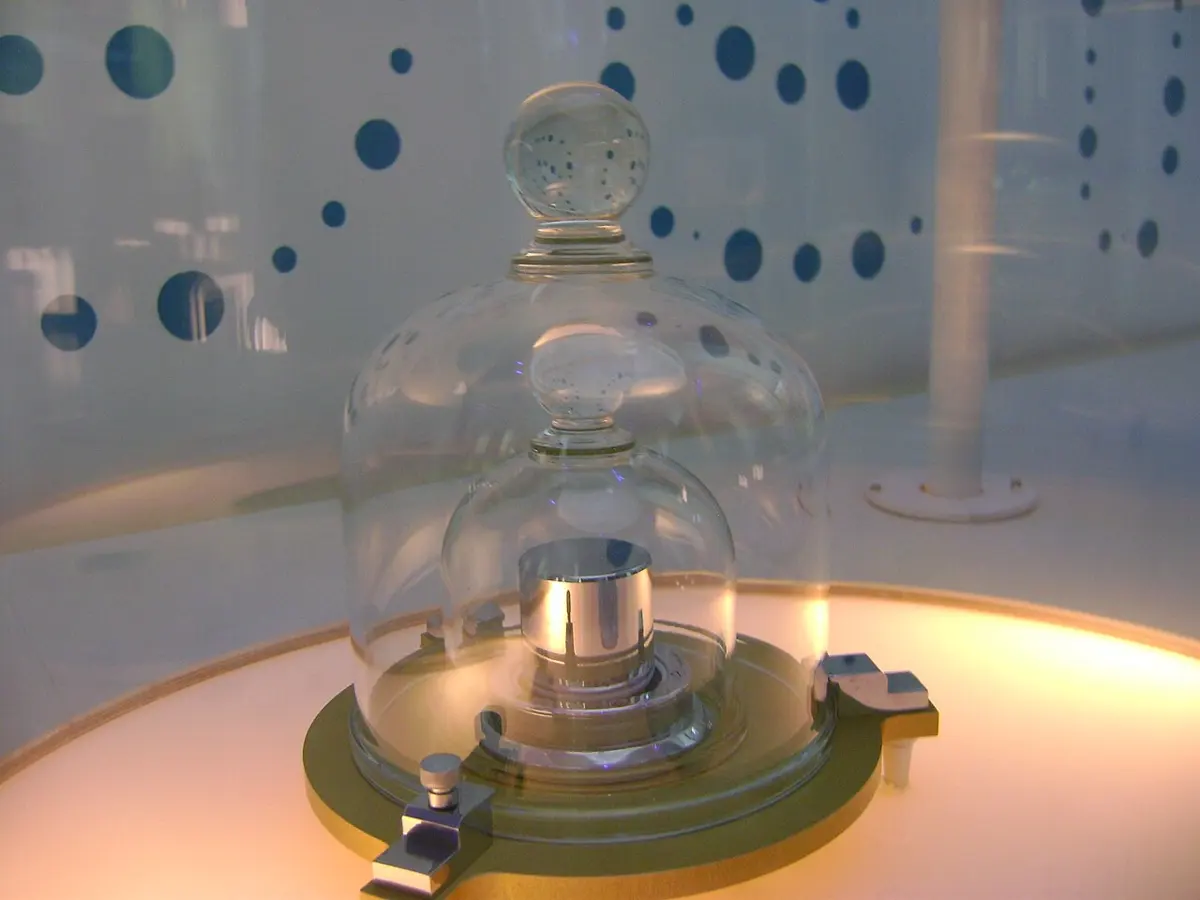
Every object has mass: soil, stone, wood, paper, water, even air. A physical balance (beam balance) is used to measure mass. The SI unit of mass is the kilogram (kg). There are smaller and bigger units too:
| Unit | Is equal to |
|---|---|
| 1000 milligrams (mg) | 1 gram (g) |
| 1000 grams | 1 kilogram (kg) |
| 100 kilograms | 1 quintal |
| 1000 kilograms | 1 tonne (also called a metric ton) |
Unit of time
How long does it take you to reach school from home? To know exactly, we must measure the time. Leaving home is one event, and reaching school is another. The interval between these two events is the time taken to reach school. The interval between two events is called time.
Many kinds of clocks and watches are used to measure time: wall clocks, table clocks, pendulum clocks, wristwatches and digital watches. The SI unit of time is the second (s). Minutes, hours, days, weeks, months, years, decades and centuries are bigger units of time.
| Unit | Is equal to |
|---|---|
| 60 seconds | 1 minute |
| 60 minutes | 1 hour |
| 24 hours | 1 day |
| 7 days | 1 week |
| 12 months | 1 year |
| 365 days | 1 year (366 days in a leap year) |
| 10 years | 1 decade |
| 100 years | 1 century |
Unit of temperature
Ice is cold and boiling water is hot. How cold or how hot something is, is its temperature. The SI unit of temperature is the kelvin (K). In daily life, temperature is also measured in degrees Celsius (°C) and degrees Fahrenheit (°F).
Have you seen someone’s temperature taken when they have a fever? What was it measured with?
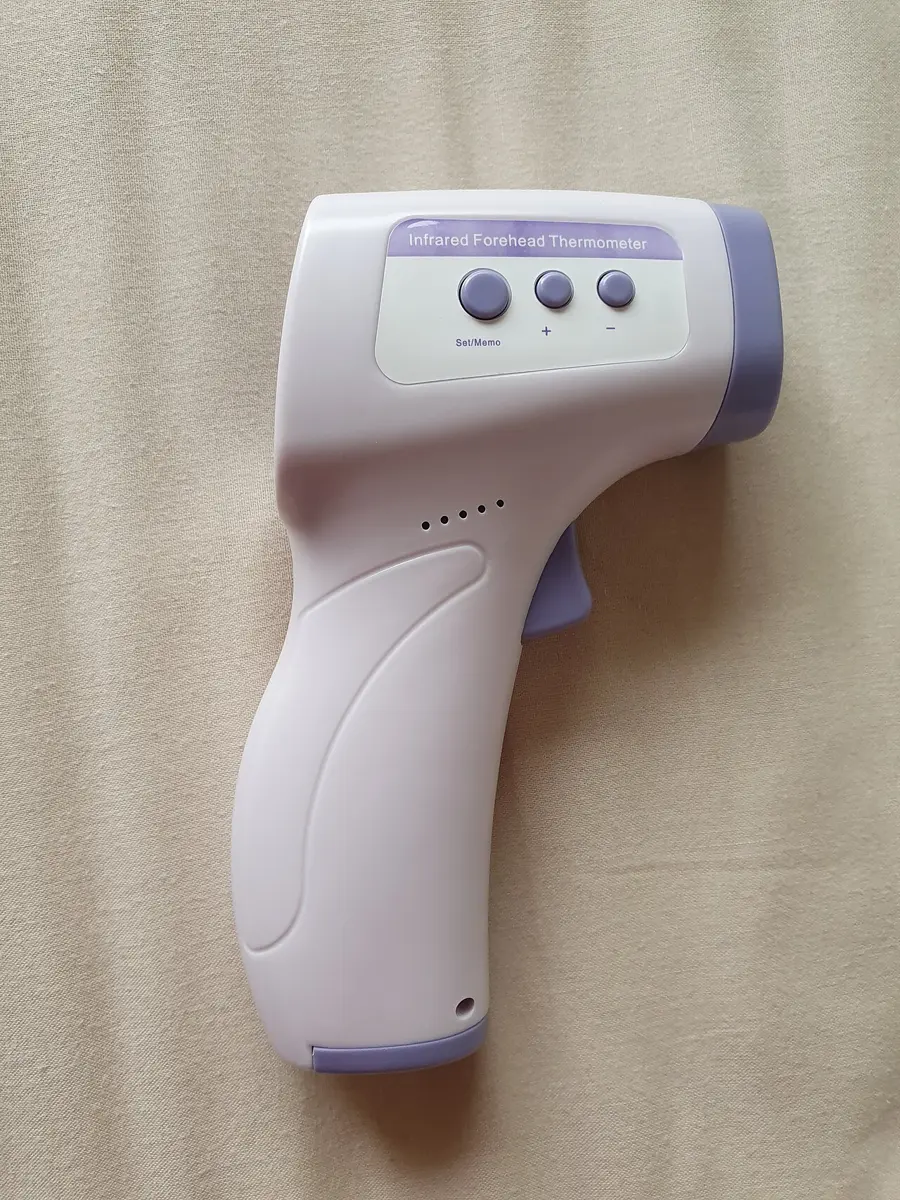
Temperature is measured with a thermometer. There are different kinds. A laboratory thermometer is used to measure temperature in the laboratory. A clinical thermometer is used to measure the temperature of the human body. A digital thermometer shows the temperature as numbers on a small screen, and an infrared thermometer (thermal gun) measures it without touching, from the heat that the forehead gives out.
At sea level, pure ice melts at 0 °C and pure water boils at 100 °C. The temperatures of other things are measured by comparing them with these two fixed temperatures. The normal temperature of the human body is about 37 °C.
Unit of area
The space the coin covered on the paper is its area. In the same way, the space our foot covers on the ground is the area of our foot. The space covered by the surface of an object is called its area. The SI unit of area is the square meter (m²): the area of a square 1 m long and 1 m wide.
Some solid objects around us have a fixed geometric shape. They are called regular objects. Books and exercise books are rectangles. The area of the flat surface of a regular object can be found with a formula. For a rectangle:
The area of a piece of land, which is rarely a neat rectangle, is found by dividing it into triangles. The area of each triangle is worked out, and all the areas are added together.
Unit of volume
We use liquids like milk, kerosene and petrol every day. How are they measured? Have you gone to a shop to buy oil or kerosene? What did the shopkeeper measure it with? In the past, these liquids were measured with a mana and pathi, but now vessels marked in liters and milliliters are used. Why do you think this changed?
When a liquid is poured into a measuring vessel, it takes up space. The space taken up by an object is called its volume. All matter has volume. Solids and liquids have a fixed volume, but a gas does not: it spreads out to fill whatever container it is in.
In the SI system, volume is measured in cubic meters (m³): the space inside a box 1 m long, 1 m wide and 1 m high. The volume of a liquid is usually measured in liters (l).
| Unit | Is equal to |
|---|---|
| 1 m³ | 1000 l |
| 1 l | 1000 milliliters (ml) |
| 1 l | 1000 cm³ |
| 1 ml | 1 cm³ |
A cm³ (cubic centimeter) is also written cc.
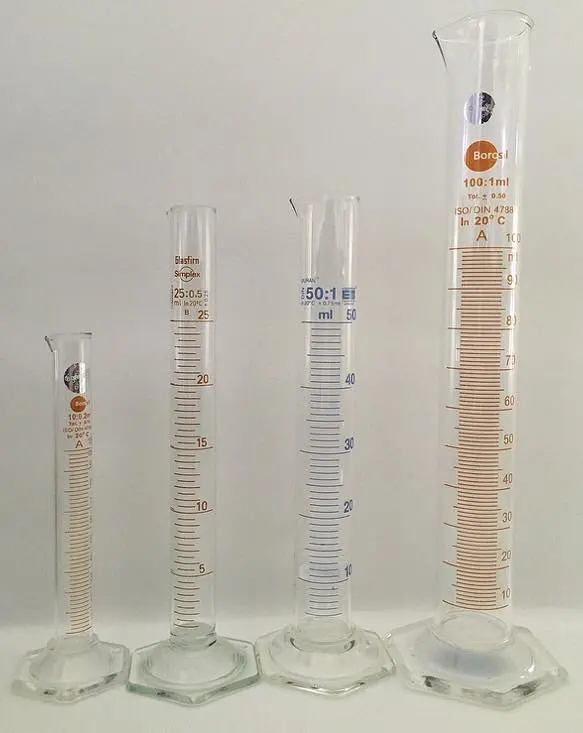
In a science laboratory, the volume of a liquid is measured with a measuring cylinder. Measuring cylinders that hold 10 ml, 25 ml, 50 ml, 100 ml, 250 ml, 500 ml and 1000 ml are available. Your school probably has some. Draw them, showing the marks and units on them clearly.
Exercise
1. Fill in the blanks with suitable words
Use these words: area, volume, length, time, measurement, square meter, conclusion. (One word is not needed.)
We need to take ……… of a body to know its exact quantity.
Answer
measurement
The interval between any two events is called ……… .
Answer
time
The distance between any two points is called ……… .
Answer
length
The SI unit of area is ……… .
Answer
square meter (m²)
The ……… of a liquid is measured using a measuring cylinder.
Answer
volume
A ……… is drawn after the analysis of data.
Answer
conclusion. (The word “area” is not used.)
2. Choose the correct answer
a. How many seconds are there in an hour?
Pick an answer to see why.
b. What is the SI unit of mass?
Pick an answer to see why.
c. What is the SI unit of electric current?
Pick an answer to see why.
3. Match the following
Match each physical quantity with its SI unit.
| Physical quantity | SI unit |
|---|---|
| Length | kilogram |
| Mass | second |
| Time | meter |
| Area | cubic meter |
| Volume | square meter |
Answer
| Physical quantity | SI unit |
|---|---|
| Length | meter (m) |
| Mass | kilogram (kg) |
| Time | second (s) |
| Area | square meter (m²) |
| Volume | cubic meter (m³) |
4. Convert the following
2 hours into seconds
Answer
1 hour = 60 × 60 s = 3600 s, so
2 hours = 2 × 3600 s = 7200 s.
15 kg into grams
Answer
1 kg = 1000 g, so
15 kg = 15 × 1000 g = 15,000 g.
2 m² into cm²
Answer
1 m² = 100 cm × 100 cm = 10,000 cm², so
2 m² = 2 × 10,000 cm² = 20,000 cm².
4 m³ into cm³
Answer
1 m³ = 100 cm × 100 cm × 100 cm = 1,000,000 cm³, so
4 m³ = 4 × 1,000,000 cm³ = 4,000,000 cm³ (forty lakh cm³).
5. Answer the following questions
What is measurement?
Answer
Measurement is the process of comparing an unknown quantity with a standard, known quantity of the same kind. For example, the volume of water in a glass is measured by pouring it into a measuring cylinder and comparing it with the standard volumes marked on the cylinder.
What is an SI unit?
Answer
An SI unit is a standard unit of measurement accepted all over the world. SI units were agreed at a conference of scientists in France in 1960. Examples: the meter (m) for length, the kilogram (kg) for mass and the second (s) for time.
Why was the SI system developed?
Answer
Local units such as the haat, bitta, mana and pathi are not the same in every place or for every person, so measurements made with them don’t agree. This caused problems in trade within a country and between countries, and in science. The SI system was developed so that everyone in the world could use the same reliable, accurate units.
What is volume?
Answer
The space taken up by an object is called its volume. Its SI unit is the cubic meter (m³); the volume of a liquid is usually measured in liters (l) and milliliters (ml).
What kinds of problems would people face if the SI system had not been introduced?
Answer
- The same thing would measure differently in different places, because local units differ.
- Buying and selling would be unfair and full of arguments: a pathi of rice in one village would not equal a pathi in another.
- Trade between countries would be very hard, as each country would use its own units.
- Scientists in different countries could not compare or check each other’s results.
- Machines and their parts made in different places would not fit together.
- Mistakes would happen when changing between units, which can even be dangerous (in medicine doses or aircraft fuel, for example).
What improvements were seen in measurement after standard units were developed?
Answer
- Measurements became uniform: the same everywhere in the world.
- They became reliable: anyone measuring the same thing gets the same result.
- They became accurate, because standard tools such as rulers, measuring cylinders and balances could be made.
- Trade, within a country and between countries, became easier and fairer.
- Scientists everywhere could share and check each other’s work.
- Changing between big and small units became easy, because SI units go up and down in tens, hundreds and thousands.
A father bought a vest and a pair of trousers for his son from the nearby market. When the son tried them on, the vest was too long and the waist of the trousers was a bit tight. State the cause of this problem, and write the solution.
Answer
Cause: the clothes were bought without measuring the son’s body. The father guessed the size just by looking, or by an unreliable measure, and a guess made by looking is often wrong.
Solution: measure the son’s chest, the length of the vest needed, his waist and the length of his legs with a tailor’s tape in a standard unit (cm or inch), and buy clothes of that size. Better still, take the son along and let him try the clothes on before buying, or have them sewn to his measurements.
Show the phases of the scientific learning process in a flow chart. Mention the main features of each phase in the chart.
Answer
Study of surrounding objects or events → Questioning → Guessing the probable answer → Testing → Accumulating the data → Concluding after data analysis → Presenting a report
| Phase | Main feature |
|---|---|
| 1.Study of objects or events | Learning begins by observing the things and events around us that we see, hear or feel (an apple falling). |
| 2.Questioning | Asking what, why or how about them (why did the apple fall?). |
| 3.Guessing the probable answer | Making a guess (hypothesis) that can be tested (which objects will sink?). |
| 4.Testing | Checking the guess by a suitable method; the most important phase. |
| 5.Accumulating the data | Writing down the results of the test, often in a table. |
| 6.Concluding | Analyzing the data and deciding what they show. |
| 7.Presenting a report | Sharing the conclusion with others, by speaking or in writing. |
Practice every question in the book, and keep track of the ones you miss →