
Stir a spoon of sugar into a glass of water. The sugar disappears, yet every sip tastes sweet. Stir a spoon of sand into another glass. The sand swirls round, then sinks to the bottom. Where did the sugar go, and why didn’t the sand go with it?
Your morning tea is a mixture of water, milk, tea leaves and sugar. The air you breathe is a mixture of gases. Muddy river water, the soil in a field and the rice before it is cleaned are mixtures too. In this unit you will learn the kinds of mixtures, and the clever ways people separate them: drying salt out of sea water, catching pure water from steam, letting colors race up a strip of paper, and spinning blood so fast that it splits into layers.
Pure substances and mixtures
Look around you. Soil, salt, water, wood, iron and air all have weight, and all take up space. Anything that has weight (mass) and takes up space is called matter.
Some kinds of matter are pure. A pure substance is made of only one kind of matter, the same all the way through. Water, salt, sugar, iron and copper are pure substances.
Other kinds of matter are impure: two or more substances mixed together. Clay, milk and air are impure. An impure substance is called a mixture.
Which of these is a pure substance?
Pick an answer to see why.
9.1 Mixture
Think of the things you see every day: soil, rice, milk, curd, tea and air. Is each made of one substance, or of several mixed together?
To make tea, we mix water, milk, tea leaves and sugar. Muddy water has soil, sand and bits of rubbish mixed in it. Air is nitrogen, oxygen, carbon dioxide and other gases mixed together.
A mixture is two or more substances mixed together physically: they are just mixed, and they don’t join to make a new substance. Each one keeps its own properties. The sugar in tea is still sweet, and the water is still wet.
The substances that make up a mixture are called its components (or ingredients). Water, milk, tea leaves and sugar are the components of tea.
Types of mixture
Dirty rice may have small stones, bits of brick and glass, unhusked grains (dhan) and husk mixed in it. You can see and pick out each of these. But you can’t see the nitrogen, oxygen and carbon dioxide mixed in air. So mixtures are of two types, by how well their components are mixed:
- a.homogeneous mixtures
- b.heterogeneous mixtures
Salt and water mix evenly, and you can’t see or pick out the salt with your eyes. Sand and water don’t mix evenly, and you can see the sand.
A mixture in which the components are mixed evenly all through, so that they can’t be seen or told apart with the naked eye, is a homogeneous mixture. Every part of it is the same. Examples: salt water, sugar water, soda water, clear fruit drinks (sarbat) and air.
A mixture in which the components are not mixed evenly, so that they can be seen and told apart with the naked eye, is a heterogeneous mixture. Its parts differ from place to place. Examples: sandy water, muddy river water, and rice mixed with stones or husk.
Which of these is a heterogeneous mixture?
Pick an answer to see why.
In a homogeneous mixture, the components are…
Pick an answer to see why.
Forms of mixture
Each component of a mixture can be a solid, a liquid or a gas. So mixtures come in six forms:
| S.N. | Mixed together | Examples |
|---|---|---|
| 1. | solid and solid | soil; rice with stones and husk; sand with iron filings |
| 2. | solid and liquid | salt water; sugar water; muddy water |
| 3. | solid and gas | dust or smoke in the air |
| 4. | liquid and liquid | milk and water; kerosene and water |
| 5. | liquid and gas | soda water and other fizzy drinks (carbon dioxide gas in water) |
| 6. | gas and gas | air |
Notice that the two liquid mixtures behave differently. Milk and water mix evenly, but kerosene doesn’t mix with water at all: it floats on top in a layer of its own.
Soda water is a mixture of…
Pick an answer to see why.
Not every mixture can be separated in the same way. We pick a method that suits the properties of the substances in it: their size, how heavy they are, whether they dissolve, and the temperature at which they boil. Mixtures can be separated by filtering, decantation, evaporation, distillation and other methods, as you will see next.
Methods of separating mixtures
Every mixture holds two or more components, and we may not want all of them. So we separate out the part we need. Stones, husk, unhusked grains and bits of brick or glass in rice are unwanted, so we pick them out to get clean rice. Separating a mixture to get the pure, useful substances from it is called separation of mixtures.
You already use several methods at home:
| Method | How it works | Example |
|---|---|---|
| hand-picking | pick out the bits you can see | stones from rice or lentils |
| winnowing | toss in the wind or fan; the light part blows away | husk from rice with a nanglo |
| sieving | the small bits fall through the holes | flour through a chalni |
| decantation | let the heavy bits settle, then gently pour off the liquid above | muddy water left to stand |
| filtering | pour through cloth or filter paper; the solid bits stay on it | tea leaves in a strainer; sand from water |
None of these can take salt out of salt water: it is dissolved, and its particles are far too small to catch. For mixtures like that we need the methods below.
Evaporation
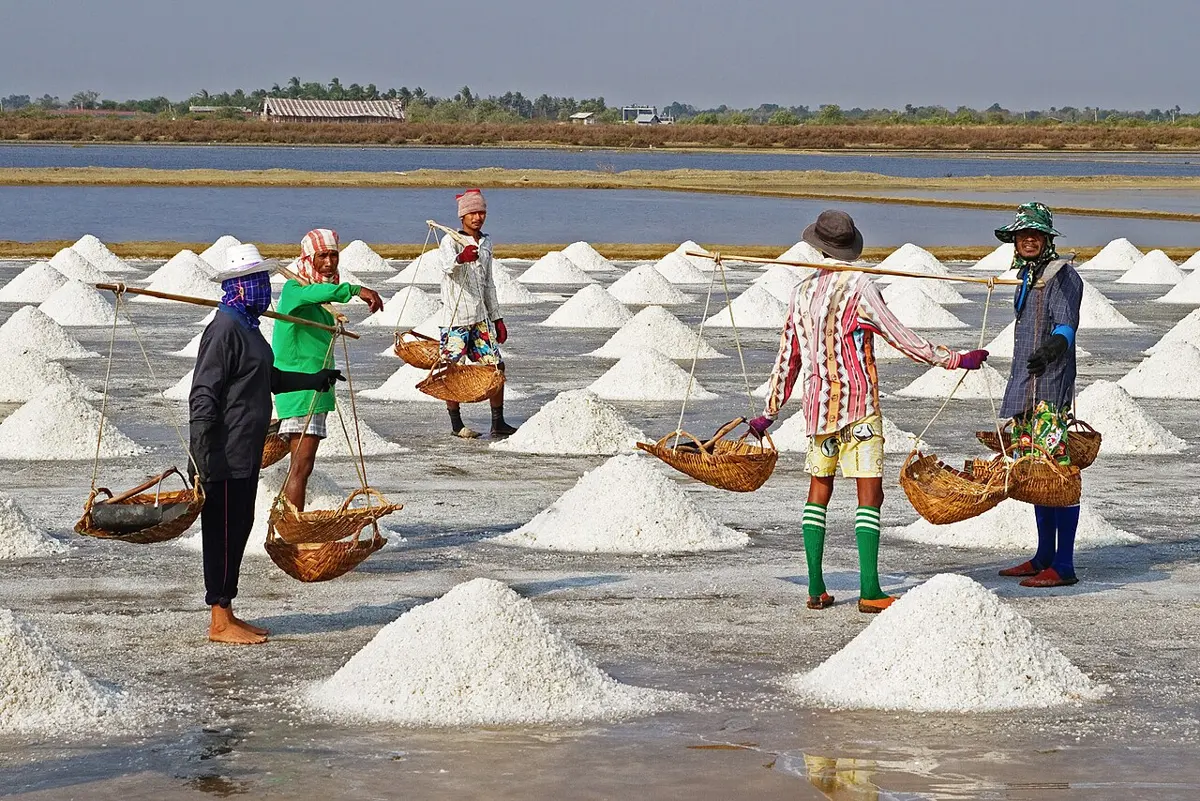
Evaporation is the method of separating a dissolved solid from a liquid by heating the mixture, so that the liquid turns into vapor and goes off, and the solid is left behind. The mixture is heated slowly. The water goes off as vapor, and the salt stays in the pan. This is how salt is made from sea water, in shallow ponds where the Sun and wind do the heating.
Distillation
Heat water, and at a certain temperature it boils and turns into steam. Cool the steam, and it turns back into water. So water can be taken out of a mixture as steam, and the steam cooled back into water in another vessel.
Salt water can be separated this way. Salt needs a very high temperature to boil, so when the mixture is heated, the water turns into steam long before the salt. The steam is led away and cooled, and it turns back into pure water.
Distillation is the method of separating a liquid from a mixture by heating it until it turns into vapor, then cooling the vapor so that it turns back into liquid, and collecting it in another vessel. In the laboratory, the steam is cooled in a special glass tube with cold water flowing round it, called a condenser.
Use of distillation as a local technology
In some communities, people make raksi, a strong alcoholic drink, at home by distillation. Cooked millet (or rice) is mixed with marcha, a starter cake full of yeasts and molds, and left for some days to ferment: the molds and yeasts slowly turn the grain’s starch into alcohol. Then the fermented mash is heated in a home still (Figure 9.4). The alcohol turns into vapor sooner than the water does. The vapor meets the cold bottom of a pot of cold water, turns back into liquid, and is collected separately as raksi. As the mash gets hotter, more and more water vapor comes over too, so raksi is never pure alcohol.
Distillation is also used to take sweet-smelling oils out of plants: steam is passed through the leaves or roots, and the oil comes over with it. Nepal makes such oils from lemongrass, wintergreen (dhasingre) and jatamansi. And in some dry places by the sea, distillation turns sea water into drinking water.
How is salt obtained from sea water?
Pick an answer to see why.
In distillation, what does the condenser do?
Pick an answer to see why.
Chromatography
Have you ever spilled a drop of water on a page written with a fountain pen or felt pen? The ink spreads and blurs, and the letters can’t be read. Look closely and you may see rings of different colors at its edges.
Many inks and colored substances are mixtures of several colors (dyes). When water moves through paper, cloth or chalk, it carries the dyes along with it. But some dyes travel quickly and others slowly, so they come apart. Separating the colors in a mixture by letting a liquid carry them through paper, each at its own speed, is called paper chromatography. It is used to separate and identify colored substances.
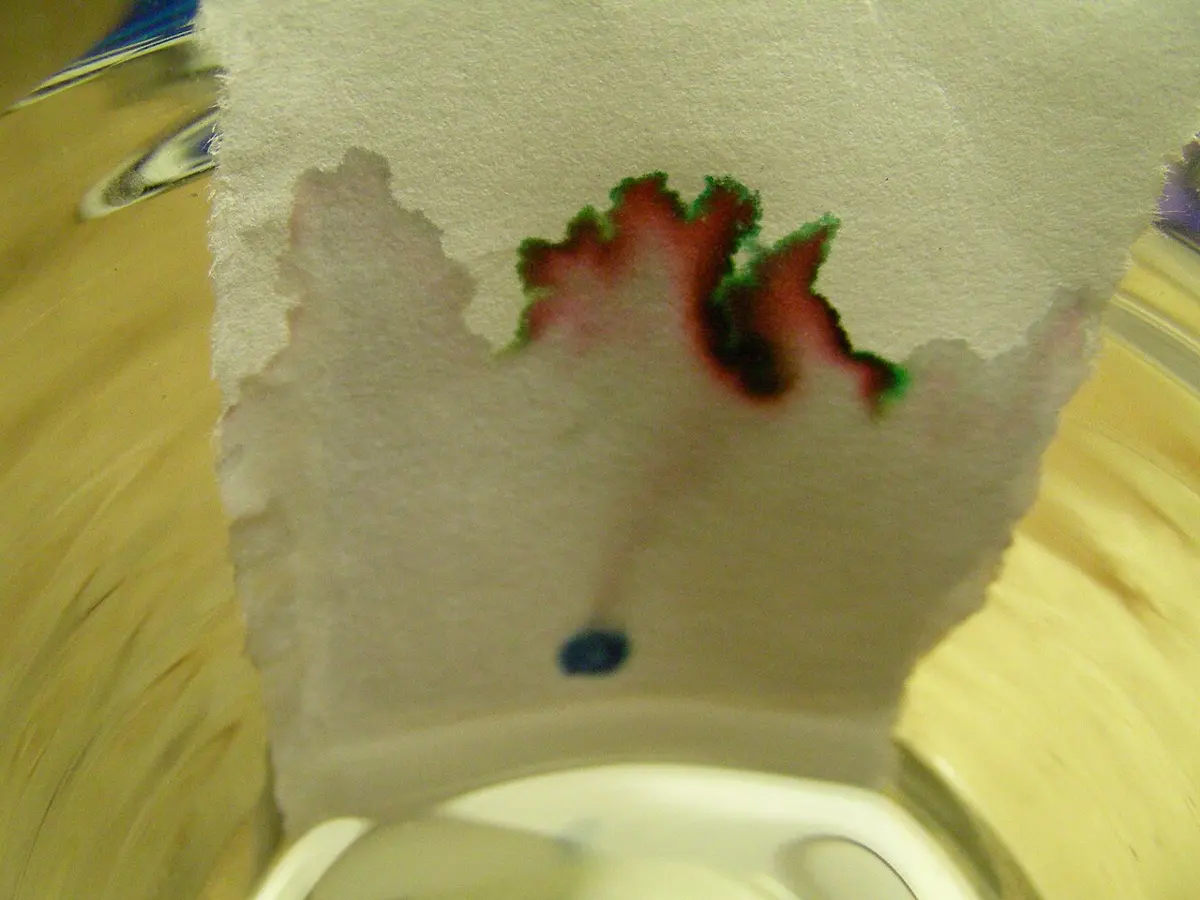
Application of chromatography. Chromatography is used in hospitals, laboratories and research centers:
- In laboratories and research centers, to separate and identify many kinds of chemicals.
- In hospitals, to separate and identify the chemicals in urine and blood (for example, to find a medicine or a poison).
- To separate and identify the colors (dyes) in a mixture, such as the colors added to sweets and drinks.
Paper chromatography works because…
Pick an answer to see why.
Centrifuging
A mixture may contain both heavy and light substances that don’t dissolve. Spun round very fast, the heavier parts move to the bottom (the outside of the circle), and the lighter parts stay above them. Separating a mixture by spinning it very fast is called centrifuging. It is used to separate cream and butter from milk and curd, and to test blood in laboratories.
Leave muddy water to stand and the mud settles in time. Spinning does the same job, but much faster and much better.
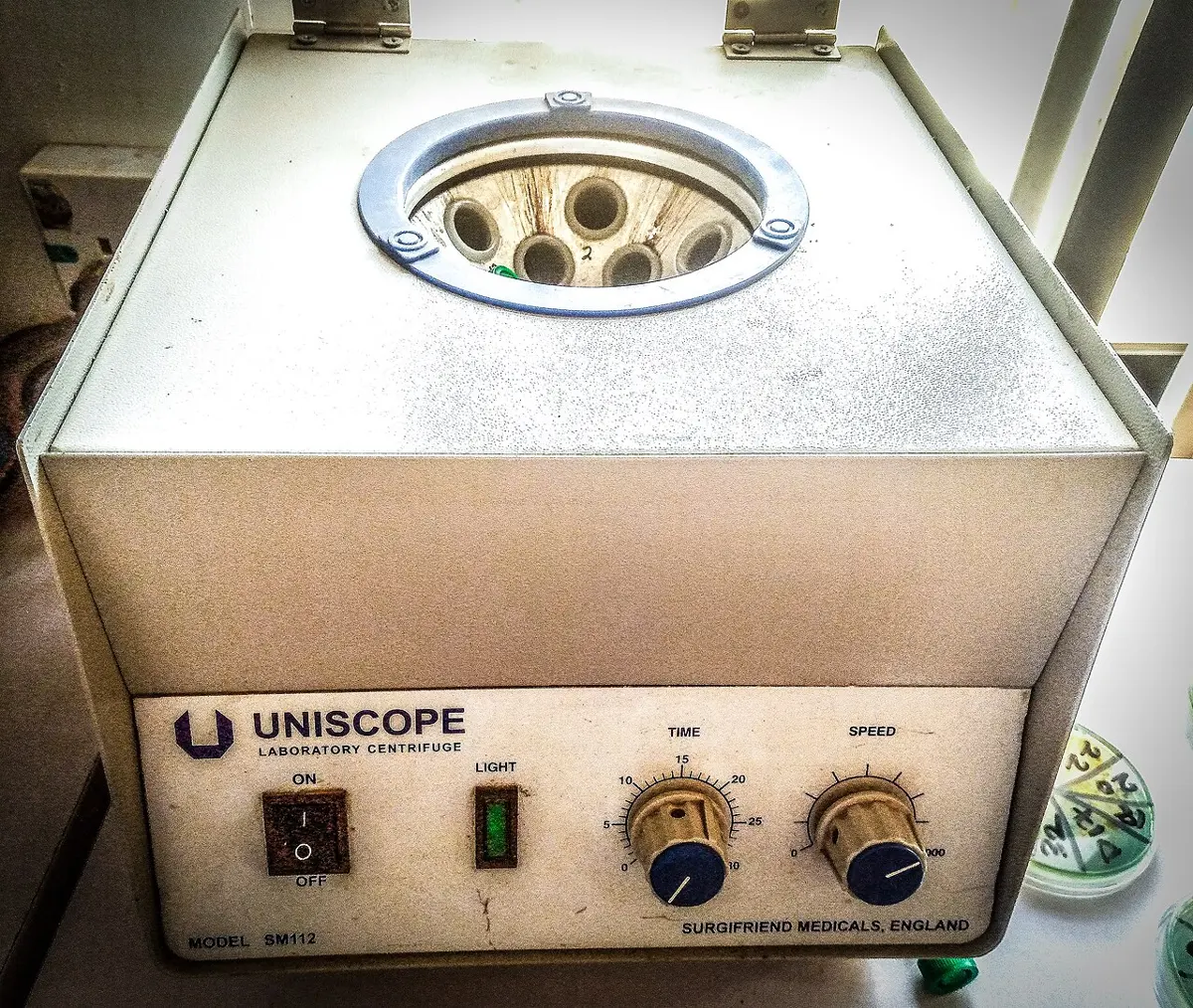
Today, laboratories use machines called centrifuges, spun by an electric motor. The mixture is put in test tubes, and the tubes are placed in special holders inside. The motor spins them very fast, thousands of turns a minute. Afterwards, the heavy substances are at the bottom of each test tube, and the light ones at the top.
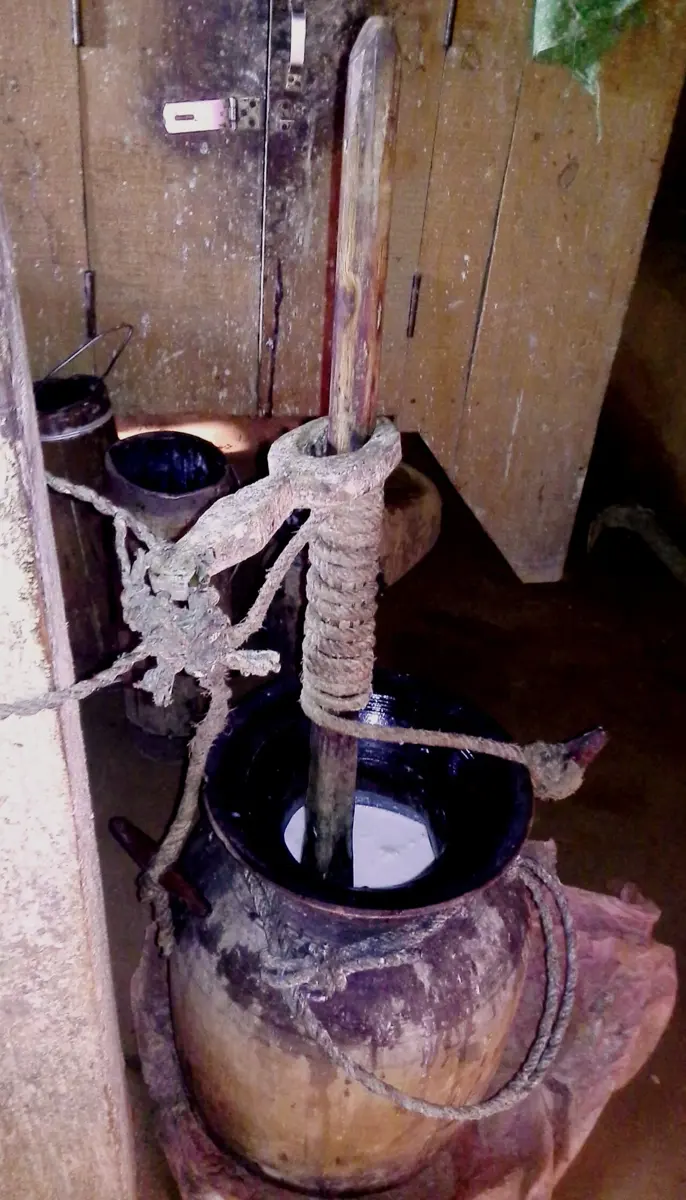
Have you seen curd churned in a village, with a theki and a madani? Churning is the simplest local way to get butter from curd. Curd is put in a wooden pot, the theki. A wooden churning stick, the madani, stands in it. A rope (neti) is wound round the stick, and pulling its two ends in turn spins the stick fast, one way and then the other. After a while, lumps of butter appear. Water is added and the butter floats up; it is then lifted out by hand. The liquid left behind is buttermilk (mohi). Heating the butter turns it into ghee.
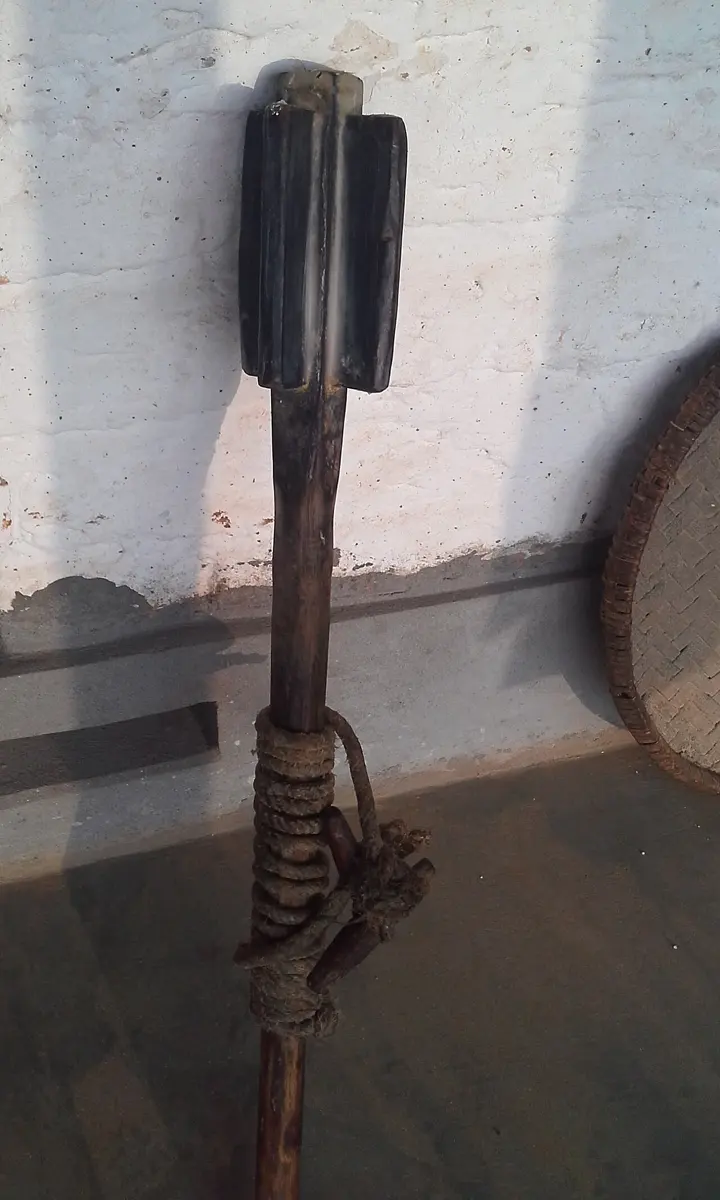
Today, in towns, butter is also made by shaking milk or curd in machines with electric motors, such as electric churners and blenders.
In a centrifuge, where do the heavier substances collect?
Pick an answer to see why.
Which method is used to separate blood cells from the rest of the blood?
Pick an answer to see why.
Draw it: Simple distillation of salt water
9.2 Solution, colloid and suspension
The three mixtures differ because their particles are of different sizes. By the size of their particles, mixtures are of three types: solution, colloid and suspension.
Solution
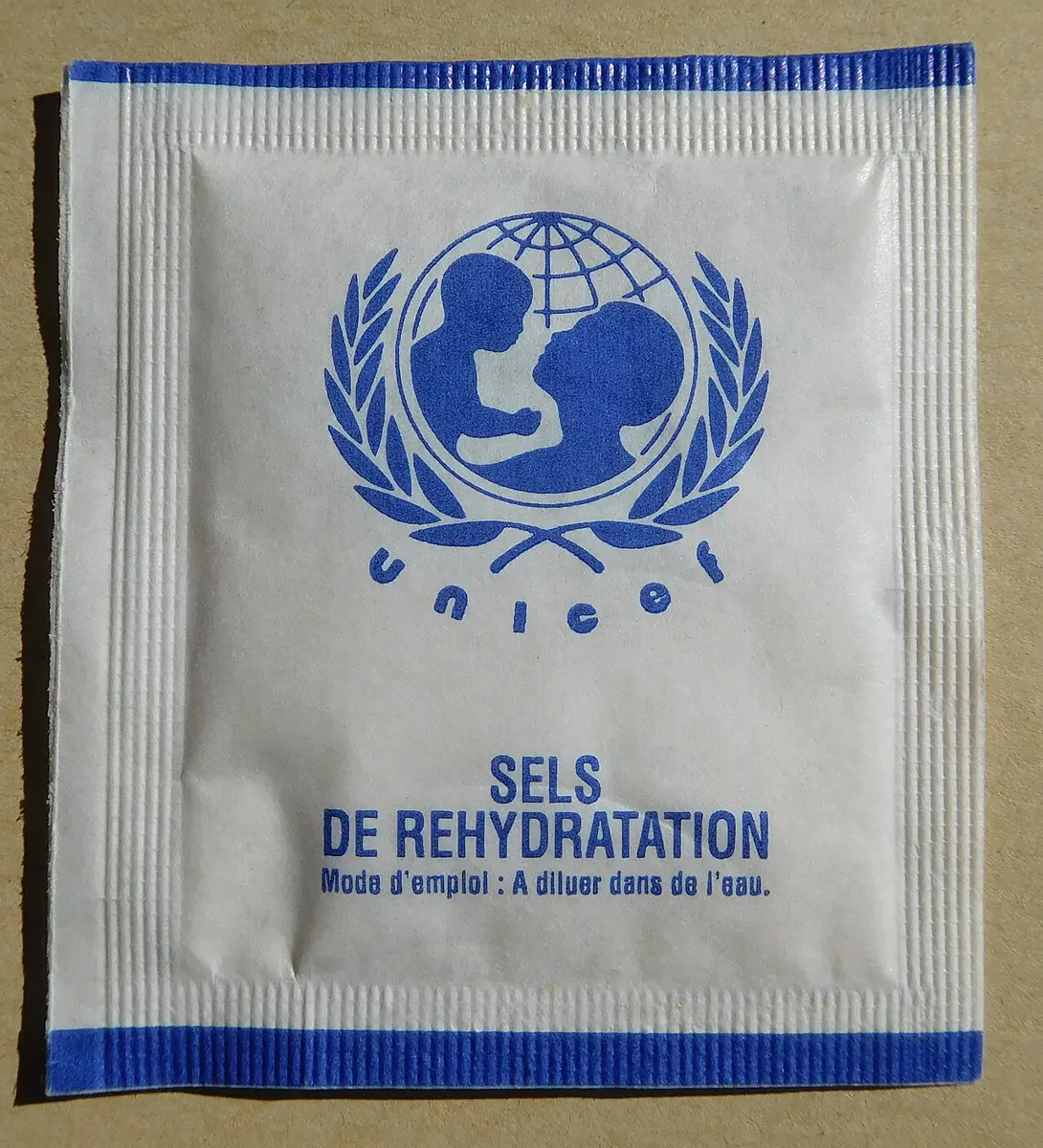
Have you ever drunk Jeevan Jal when you had diarrhea? What is it made of? Can you see what is in it? Discuss with your friends.
A solution is a mixture of two or more substances mixed evenly (homogeneously). The substances in it can’t be seen or told apart. In sugar water, for example, you can’t see the sugar.
A solution is made of a solute and a solvent:
- The solute is the substance that dissolves. In sugar water, sugar is the solute.
- The solvent is the substance in which the solute dissolves, making an even mixture. In sugar water, water is the solvent.
Solution = Solute + Solvent
A solution can have more than one solute in the same solvent. In lemon water (nimbu pani), made of water, lemon juice and sugar, water is the solvent, and the lemon juice and sugar are both solutes. Jeevan Jal has several solutes, salts and glucose, all dissolved in clean water.
| S.N. | Solution | Solute | Solvent |
|---|---|---|---|
| 1. | sugar solution | sugar | water |
| 2. | salt solution | salt | water |
| 3. | raksi | alcohol | water |
| 4. | copper sulphate solution | copper sulphate | water |
In a glass of salt water, which is the solute?
Pick an answer to see why.
Which is correct?
Pick an answer to see why.
Colloid
Milk, gum and blood are mixtures of another kind, called colloids.
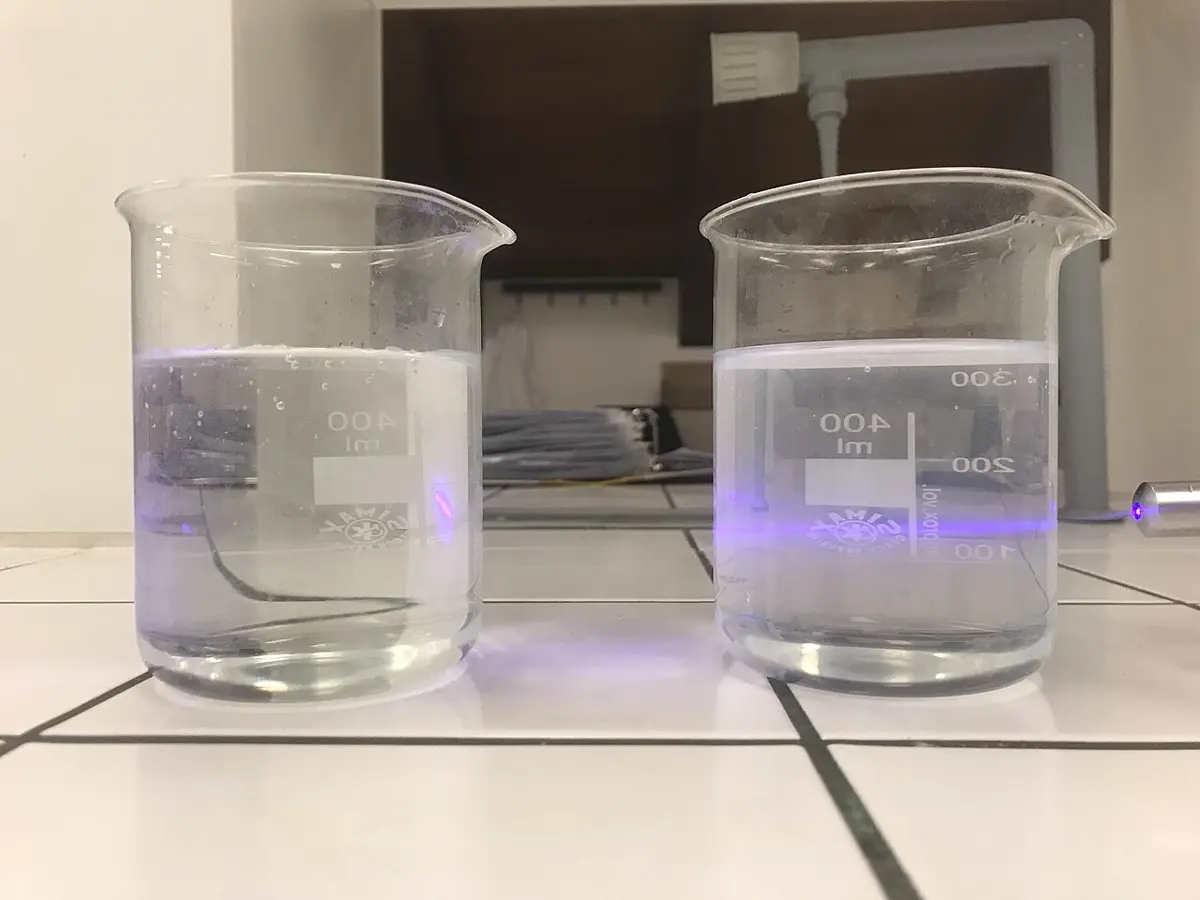
How big are the particles? In a solution, the dissolved particles are tiny: less than 10⁻⁷ cm in diameter (one ten-millionth of a centimeter across). In a colloid, they are a little bigger: from 10⁻⁷ cm to 10⁻⁵ cm across. That is still far too small to see, even with a hand lens, and too small to be caught by filter paper. From outside, a colloid looks like a solution, evenly mixed. But its particles are big enough to scatter light, so it is counted as a kind of heterogeneous mixture.
Suspension
Fill a beaker half full of water. Stir in some chalk powder, flour (maida) or lime (chuna), and keep stirring for a while. What kind of mixture do you get, homogeneous or heterogeneous? Discuss.
It is heterogeneous: it looks cloudy, you can see bits in it, and if you leave it, the bits slowly settle on the bottom. Such a mixture is called a suspension. Its particles are bigger than a colloid’s: more than 10⁻⁵ cm across. They can be caught by filter paper, and many of them can be seen.
| Solution | Colloid | Suspension | |
|---|---|---|---|
| particle size | less than 10⁻⁷ cm | 10⁻⁷ cm to 10⁻⁵ cm | more than 10⁻⁵ cm |
| seen with the naked eye? | no | no | yes, often |
| caught by filter paper? | no | no | yes |
| settles when left? | no | no | yes |
| light | passes straight through | scattered: the beam’s path shows | mostly blocked |
| type of mixture | homogeneous | heterogeneous (looks even) | heterogeneous |
| examples | salt water, sugar water | milk, gum, blood | muddy water, chalk in water |
A mixture looks evenly mixed, can’t be separated by filter paper, but makes a torch beam’s path glow. What is it?
Pick an answer to see why.
Which of these is a suspension?
Pick an answer to see why.
Use of solution in our daily life
We see farmers putting manure on their fields to help plants grow. But do plants eat manure, as we eat rice? Of course not. Plants take in their nutrients through their roots, dissolved in water as solutions. People and animals also take in many of the substances they need as solutions. In short, solutions are useful in our daily life in these ways:
- Plants take in, through their roots, the water and the mineral salts they need to make their food, as a solution.
- The food we eat is digested, and medicines dissolve; both are taken into the blood as solutions.
- Animals and plants that live in water breathe the oxygen dissolved in it.
- Many medicines, drinks and juices are sold as solutions.
Exercise
1. Fill in the blanks with suitable words from the box
homogeneous · distillation · bottom · evaporation · mixture · components
A substance made of two or more substances mixed physically is called a __________.
Answer
The substances that make up a mixture are called the __________ of the mixture.
Answer
The components are mixed evenly in a __________ mixture.
Answer
Raksi is made in villages by the __________ method.
Answer
In the centrifuging method, the heavy substances collect at the __________ of the test tube.
Answer
2. Choose the correct answer
a. In which mixture are the components mixed evenly?
Pick an answer to see why.
b. Which of these is a heterogeneous mixture?
Pick an answer to see why.
c. Which method is used to get butter from curd?
Pick an answer to see why.
d. Which method is used in hospitals to separate and identify the chemicals mixed in urine and blood?
Pick an answer to see why.
3. Write true or false
Air is a mixture of different gases.
Answer
A solution of salt water is a heterogeneous mixture.
Answer
Colors can’t be separated by the centrifuging method.
Answer
Alcohol can be made by the distillation method.
Answer
Centrifuging is used to separate blood cells.
Answer
4. Differentiate between
Homogeneous mixture and heterogeneous mixture
Answer
Solvent and solute
Answer
5. Give reasons
Sugar water is called a homogeneous (uniform) mixture.
Answer
A mixture of different colors is separated by chromatography.
Answer
The centrifuging method is used to separate light and heavy substances in a mixture of a liquid and solids.
Answer
The evaporation method is used to separate salt from salt water.
Answer
6. Answer the following questions
What is a mixture?
Answer
What kind of mixture is called a uniform (homogeneous) mixture? Give two examples.
Answer
Which of muddy river water and salt water is a heterogeneous mixture? Give your reason.
Answer
What kind of mixture can be separated by distillation? Write its properties.
Answer
Explain where and why the centrifuging method is used.
Answer
Which method would you use to separate the different chemicals in blood? Give a reason.
Answer
Discuss the uses of solutions in our daily life.
Answer
You are given salt water in one glass and pure water in another. Without tasting them, how can you find which is pure water? Use a method of separating mixtures.
Answer
Quiz yourself: Matter, Atoms and Reactions, Grades 5–10 →
Practice every question in the book, and keep track of the ones you miss →
A companion to your textbook, not a replacement for it: study from the book your school uses, and where the two differ, follow your teacher. Found a mistake? Please tell us.