
Late one night, a ruler walks alone through the dark streets of his city, dressed like an ordinary man. Nobody knows who he is. He hears children crying in a hut, and he goes in to find out why. What he finds there is a mother cooking a pot of stones.
This unit is about narrating a sequence of events: telling what happened, one thing after another, in the right order. You will read that story about a ruler in disguise, and a girl’s account of a Kirat festival at Tundikhel. You will listen to someone making black tea, tell what you did yesterday, write a story from an outline, and learn when to use the past simple and the past continuous. In the Extra bit you will meet the 24 consonant sounds of English.
Getting started
A. What happened?
The unit opens with four pictures.
- A smiling boy holds up a gold trophy and raises his other fist.
- A row of factories with tall chimneys puffs out smoke, and a car drives past.
- Four people stand behind four stands, talking and pointing at each other.
- A tall, snowy mountain with a small flag on its top.
Look at the pictures and say what happened.
Model answers
B. Listen and sing
The poem is The Song of the Old Mother, by the Irish poet W. B. Yeats (1865–1939). It came out in his book The Wind Among the Reeds in 1899.
What it says. An old mother tells us about her day. She gets up at dawn, the first light, kneels at the fireplace and blows on the last hot bits of last night’s fire until they flicker and glow again. Then she must scrub, bake and sweep all day, until the stars come out. Meanwhile the young people of the house lie in bed late, dreaming of pretty ribbons for their clothes and hair. Their young days pass in idleness, doing nothing, and they sigh if the wind only moves a lock of their hair. But she must work, because she is old, and the little flame of her own life grows weaker and colder.
How it sounds. Tired and steady, like the same jobs done day after day. The lines come in rhyming pairs: blow and glow, sweep and peep, bed and head, idleness and tress, old and cold.
C. A memorable event
A memorable event is one you remember well, because it was special, happy, funny or frightening.
Remember a memorable event of your life and tell it to your friends.
A model answer
Reading I: Umar in Disguise
Before you read
The first picture shows a tall man in long white robes walking alone at night, under a crescent moon, towards a few houses. The second shows a woman sitting by a fire with a pot on it and two small children beside her. The third shows the man handing something to the woman.
Who are the people in the second picture?
A model answer
Are they Hindus or Muslims?
A model answer
What is the man in the third picture doing?
A model answer
To be in disguise is to dress or act so that other people don’t know who you really are.
The story, part by part
The story comes from a book called Stories from Early Islam. A Khalifah (also spelled caliph) was a ruler who led the Muslims after the Prophet Muhammad died. Umar was the second.
1. What kind of ruler he was. When the first Khalifah, Abu Bakr, died, Umar was chosen to rule a huge empire. He was tall and strong, with a light complexion (the color of the skin of the face). He spoke well, he was fair to everyone, and he was strict about rules. He lived simply, even though great treasures of gold, silver and jewels passed through his hands. He set up a proper system for running the country. He even looked after the families of men who were away serving their faith: he brought them what they needed, wrote their letters for them, and carried their letters himself.
2. Walking alone at night. Umar was anxious (worried, eager) to know how his people were really living. So he walked through the dark streets unattended, with no guards or servants, to find out their plight (a bad, difficult situation). One night, he heard children crying and followed the sound to a hut. Inside, a woman sat by a fire with a pot on it, while her small children cried. It was long past their mealtime.
3. The pot of stones. Umar asked what was in the pot. The woman said she had no food at all. She had filled the pot with water and stones and put it on the fire, so the children would think dinner was coming, and perhaps fall asleep while they waited.
4. Umar carries the load. Umar was distressed (very upset). He hurried back to the State Store, the government’s storehouse, and took flour, meat and cooking oil. His servant begged to carry the heavy bag for him, but Umar said no: it was his own duty, and nobody else could carry his burden (a heavy load, or a hard duty) for him.
5. The meal. At the hut, he gave the food to the woman and asked her to cook. By then the tired children had fallen asleep. Umar waited until the meal was ready and the children were woken up and fed.
6. The twist. The woman, not knowing who he was, thanked him. She said it would be far better if he were the Khalifah, instead of that wretched (miserable, worthless) Umar who didn’t know how his people lived. Umar only answered that perhaps Umar wasn’t so bad after all, and went away.
Why was the woman cooking stones?
Pick an answer to see why.
What is funny, and a little sad, about the end of the story?
Pick an answer to see why.
Words from the story
| Word | Meaning |
|---|---|
| disguise | clothes or a way of acting that hides who you are |
| complexion | the natural color of the skin of your face |
| treasure | gold, silver, jewels or other valuable things |
| anxious | worried; also, very eager to do or know something |
| unattended | alone, with nobody to guard or help |
| plight | a bad or difficult situation |
| inquire | to ask |
| distressed | very upset and worried |
| burden | a heavy load to carry; a hard duty |
| wretched | very unhappy; or bad and worthless |
A. Umar’s character map
A character map is a picture of what a person in a story is like. The name goes in the middle, and words that describe the person go in boxes around it, joined by arrows. The first box is filled in for you: tall, well-built.
Complete the character map of Umar.
Some answers
B. Who said it to whom?
Who said these to whom? Write.
- a.“What is in the pot on the fire?”
- b.“You would not carry my burden on the Day of Judgment.”
- c.“It would be far better if you were the Khalifah of the Muslims.”
- d.“Umar may not be so bad after all.”
Answer
C. Answer the questions
What did he manage after becoming the ruler?
A model answer
What did he do to know the condition of his people?
A model answer
Why were the children in the hut crying?
A model answer
Why was the woman cooking stones?
A model answer
Why did Umar return to the state store?
A model answer
D. A good ruler?
Do you think Umar is a good ruler? Why? Give your reasons.
A model answer
Speaking: what did you do yesterday?
A. Sumi and Saroj
In the conversation, Saroj asks Sumi what she did the evening before. She visited a park. He asks who she went with, and she says with her parents. Then she asks him the same question, and he says he only watched a movie, which was interesting.
Look at the questions they use. To talk about yesterday, both the question and the answer are in the past:
| Question | Answer |
|---|---|
| What did you do yesterday evening? | I visited a park. |
| Who did you go there with? | I went with my parents. |
| Didn’t you do anything yesterday? | I just watched a movie. |
B. Ask and answer
Work in pairs. Take turns to ask and answer about what you did the day before. You can use the following clues.
- a.went to a stationery shop and bought some balloons and chart paper / with brother
- b.completed a project / alone
- c.played football / with friends
- d.drew a picture of a mountain / with sister
- e.went to the theater / with friends
- f.worked in the field / with father
- g.did a painting / alone
- h.drew a picture / alone
- i.went to the cinema / with my sister
Model answers
Which question is correct?
Pick an answer to see why.
Listening: making black tea
A. Before you listen
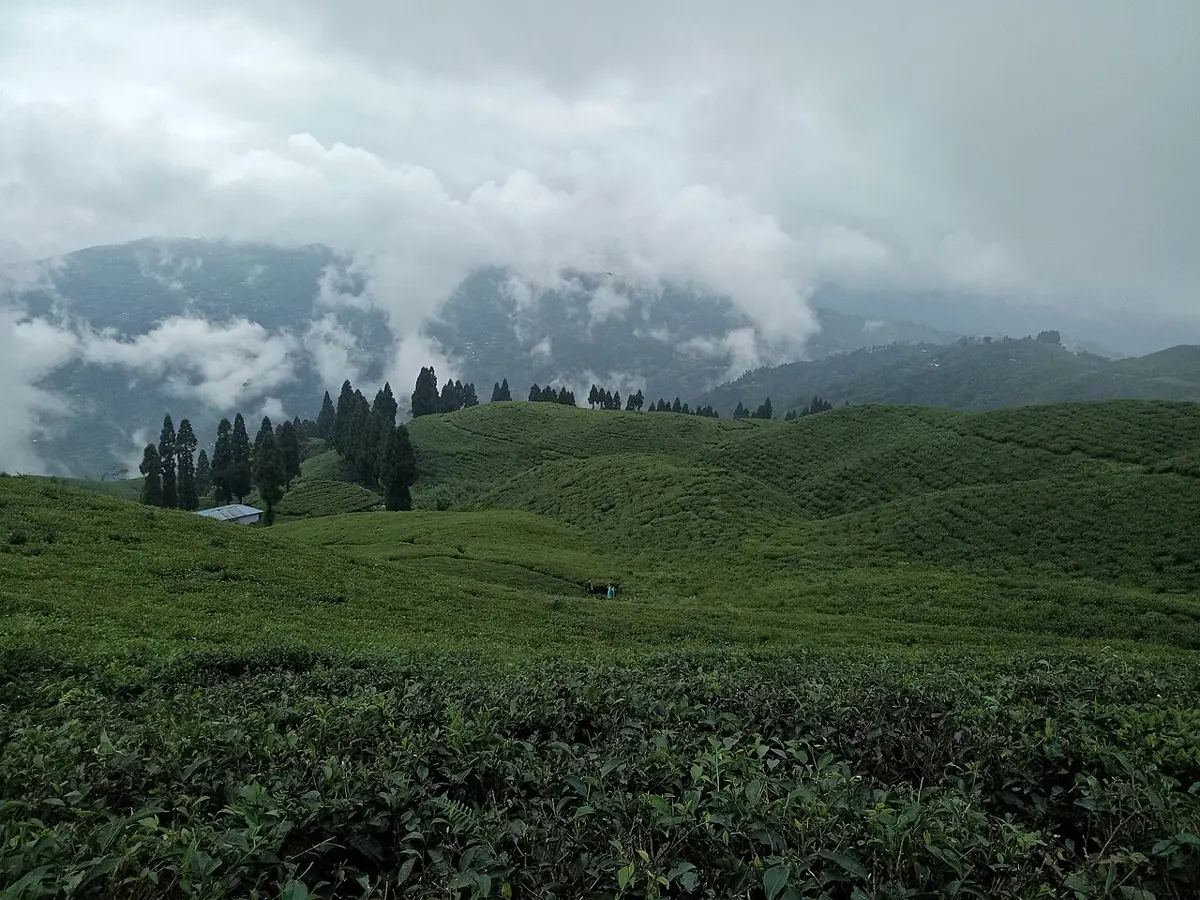
The picture shows two women picking leaves from low green bushes on a hillside, with baskets on their backs.
- a.What are the women doing?
- b.Which place in Nepal is famous for it?
- c.How often do you drink tea at home?
Model answers
The recording
A teacher tells the class how to make traditional black tea. The steps come one after another, each starting with an order word: first, then, after that, next, finally. These words help you follow a process, and they help you tell one too.
B. Number the pictures
The six pictures, in the order they are printed, show:
- a spoon putting sugar into the pan
- water boiling in the pan, with steam rising
- tea leaves being poured in from a packet
- tea being poured from the pan into two cups
- brown tea boiling in the pan
- water being poured from a jug into the pan
Listen to the recording and write 1–6 to show the process of preparing black tea.
Answer
Put the steps in order here. The order words will help.
C. How your brother made tea
To tell what someone did, change the orders into the past: Boil the water becomes He boiled the water.
Your brother followed the same process to prepare tea yesterday. Now, tell your friends how he prepared the tea.
A model answer
Grammar: the past simple and the past continuous
A. Study the sentences
Here are six sentences about the past. Three kinds of verb are in them.
| Sentence | Verb | What it tells |
|---|---|---|
| I bought a storybook last week. | past simple | a finished action |
| They played well and won the match yesterday. | past simple | finished actions, one after the other |
| She was drawing a picture when I met her. | past continuous + past simple | a longer action going on, cut by a short one |
| They were dancing beautifully when we reached there. | past continuous + past simple | a longer action going on, cut by a short one |
| She had gone home before I reached there. | past perfect + past simple | one past action before another |
| The children had gone to sleep before the meal. | past perfect | the earlier of two past actions |
1. The past simple tells a finished action. Most verbs add -ed (play → played, reach → reached). Many common verbs are irregular: buy → bought, win → won, meet → met, go → went. A story is mostly told in the past simple, one action after another.
2. The past continuous, was / were + -ing, tells an action that was going on at a time in the past. It is the background, and a short action in the past simple often cuts into it: I was walking home when it started to rain.
3. The past perfect, had + the past participle (had gone, had eaten), tells which of two past actions came first. You will learn it fully in the next unit.
Try the past simple and the past continuous on a line of time. A long action is a bar; a short one is a dot.
Shital ______ to music when her phone rang.
Pick an answer to see why.
B. Find the verbs
Read the story Umar in Disguise and underline all the verbs in simple past, past continuous and past perfect.
Answers
C. Past simple or past continuous?
Ask yourself: was it a finished action, or was it going on when something else happened?
Complete the following sentences using the simple past or past continuous form of the verbs in brackets.
- a.The teacher ……… (tell) us a story yesterday.
- b.They saw me while I ……… (come) home from school.
- c.My sister ……… (give) me a color box yesterday.
- d.Manju ……… (watch) a movie when I reached her house.
- e.Suman ……… (say) that he was not feeling well yesterday.
- f.Phurba ……… (start) studying in this school last year.
- g.We ……… (play) table tennis when there was a heavy rainfall yesterday.
- h.Can you tell me how many of you ……… (be) there?
Answer
Reading II: Sakela Sili at Tundikhel
Before you read
What are the people in the picture doing?
A model answer
Can you guess the name of the festival?
A model answer
The text, part by part
This is a first-person account: the writer, Shital, tells it as I and we, and she tells what happened in order, from morning to evening.
- The phone call. Early one morning in Mangsir, Shital’s friend Binda calls to ask what time she will be ready, so that they can go together. Shital answers nine, without thinking much. She is very excited: it is her first time at the Sakela festival at Tundikhel, the big open ground in the middle of Kathmandu.
- Arriving. The two girls reach Tundikhel at exactly 9:30. The ground is beautifully decorated. Sakela is a festival of the Kirat people (also spelled Kirant), but people of many communities have come to watch. In the middle stands a shrine, a small holy place, decorated with traditional objects.
- The ritual. The chief priest, the Nakso, makes an offering, a hen, at the Sakela Than, the sacred place, which is usually set up under a holy tree.
- The dance. After the puja, the Nakso gives the sign to begin and starts dancing himself. Hundreds of people of all ages, in traditional dress, dance together in a circle. A man, the Silimangpa, and a woman, the Silimangma, lead the dance, to the beat of the dhol (a drum) and the jhyamta (cymbals).
- The story in the dance. The Nakso recites verses from the Mundhum, the holy book of the Kirat people, and the dance tells how their ancestors (the people of long ago from whom they come) traveled along the Dudh Koshi, the Sun Koshi and the Tama Koshi rivers, and settled on the bank of the Bhote Koshi. The dancers copy the movements of a duck, a river bird, a blackbird, a deer and a musk deer.
- What it means to her. Shital has moved to Kathmandu, and this is her first Sakela there. She dances almost all day, because it is her own culture: Sakela shows the history, culture and identity (who a people are) of the Kirat people. She is proud to be part of it.

In the text, what does Silimangma mean?
Pick an answer to see why.
Words from the text
| Word | Meaning |
|---|---|
| Sakela | a festival of the Kirat Rai people; Sakela Sili is its dance |
| Ubhauli | Sakela in spring, at the full moon of Baisakh (Udhauli is the one in Mangsir) |
| Nakso | the chief priest of the ritual |
| Silimangpa | the man who leads the dance |
| Silimangma | the woman who leads the dance |
| dhol | a drum played with sticks or hands |
| jhyamta | a pair of cymbals |
| Mundhum | the holy book and oral history of the Kirat people |
| Sakela Than | the sacred place of the ritual, often under a holy tree |
| ancestor | a person in your family from long, long ago |
| identity | who a person or a people are |
A. Match the words
What do the words in Column A refer to? Match them with the definitions in Column B.
Column A: a. Ubhauli · b. Nakso · c. Silimangpa · d. Silimangma · e. Dhol · f. Mundhum · g. Sakela Than
Column B: i. the main priest · ii. a holy book · iii. a festival of Kirat community · iv. a sacred place · v. the male leader · vi. the female leader · vii. a musical instrument
Answer
B. Answer the questions
What time did Binda and Shital reach Tundikhel?
A model answer
What is the name of the sacred place?
A model answer
Which musical instruments are played during the dance?
A model answer
Who controls the dance?
A model answer
C. Talk about Sakela
What do you think are the interesting features of Sakela Sili? Talk to your friends.
Some ideas
Writing
A. My last birthday
A good account of a day goes in order, morning to night, uses the past simple for each event, and says how you felt.
How did you celebrate your birthday last time? Try to recall and write a short paragraph on what happened on the day.
A model answer
B. A story from an outline
An outline gives only the main points of a story. To write it, turn each point into one or two sentences in the past simple, join them with order words (one day, first, then, next, at last), add a title, and end with the moral, the lesson.
The outline: an old man · three sons · about to die · calls his sons to give advice · asks them to bring sticks · gives them sticks · asks the eldest son to break them · unable · asks another son · unable · asks the third son · unable · asks them to work together and try once · they break it easily · Moral: Unity is strength.
Fill in the verbs of the story first. Then write your own version.
Write a short story using the outline. Suggest a suitable title too.
A model answer
Project work
Extra bit: consonants
A consonant sound is made by stopping or squeezing the air with your lips, tongue or teeth: try saying p, s and m, and feel where your mouth closes. Most English accents have 24 consonant sounds, but the alphabet has only 21 consonant letters. So some sounds are written with two letters, such as ch, sh and th.
Sounds are written between slashes in special symbols, the International Phonetic Alphabet (IPA), which dictionaries use to show how a word is said. Here are all 24, with a word that has the sound at the start, in the middle and at the end (a dash where English has no word with the sound there).
| Sound | Examples | Sound | Examples |
|---|---|---|---|
| /p/ | pair, appear, stop | /ʃ/ | shoes, machine, cash |
| /b/ | black, about, cab | /ʒ/ | genre, pleasure, garage |
| /t/ | tea, stale, rent | /h/ | horse, behind, — |
| /d/ | drink, reading, need | /tʃ/ | church, teacher, speech |
| /k/ | car, ranks, pack | /dʒ/ | job, wages, page |
| /g/ | game, agree, bag | /m/ | mat, camera, rum |
| /f/ | phone, afford, stuff | /n/ | nose, honey, cone |
| /v/ | van, fever, pave | /ŋ/ | —, think, sing |
| /θ/ | throne, anything, moth | /l/ | lanky, selfish, school |
| /ð/ | this, mother, breathe | /r/ | rat, carrot, — |
| /s/ | state, mistake, yes | /w/ | water, underwear, — |
| /z/ | zoo, easy, choose | /j/ | yellow, kayak, — |
Four sounds that many learners in Nepal mix up, because Nepali has none of them quite the same: /θ/, /ð/, /ʃ/ and /ʒ/. Listen to each word and sort it.
Exercise
Practice the whole unit. Try each one, then open the answer.
Write the past simple: go, buy, eat, give, see, tell, hurry, stop, think, sit.
Answer
Past simple or past continuous?
- a.While Dawa ……… (cook) dinner, the lights went out.
- b.Rojina ……… (find) a hundred-rupee note on the road yesterday.
- c.It ……… (rain) when we left the school.
- d.The children ……… (sleep) when Umar came back with the food.
Answer
Put the story in order: a. The children woke up and ate. · b. Umar heard children crying. · c. He fetched food from the State Store. · d. He saw a pot of stones on the fire.
Answer
Write three sentences about what you did yesterday, using first, then and finally.
Model answers
Which consonant sound is at the start of each word? ship, this, think, judge, yellow
Answer
Printable PDFs
- Study notes 2 pages
- Harder practice questions 2 pages Answer key
Practice every question in the book, and keep track of the ones you miss →
A companion to your textbook, not a replacement for it: study from the book your school uses, and where the two differ, follow your teacher. Found a mistake? Please tell us.