
A ripe orange sits on the table. You want to know about it. So you look at it. You touch it. You smell it. Maybe you taste it. Then a question pops up. Is it heavier than an apple? You can’t tell just by looking. You need a balance.
Wanting to know is called curiosity. Every scientist starts there. In this unit you will learn how scientists find answers. They look carefully, test things and ask questions. You will meet the tools they use in a laboratory. And you will learn to measure length, mass, time and volume, just as they do.
Scientific learning
When we see something new, we want to touch it, look at it and ask about it. This wish to know is curiosity. While we look for an answer, we learn something new.
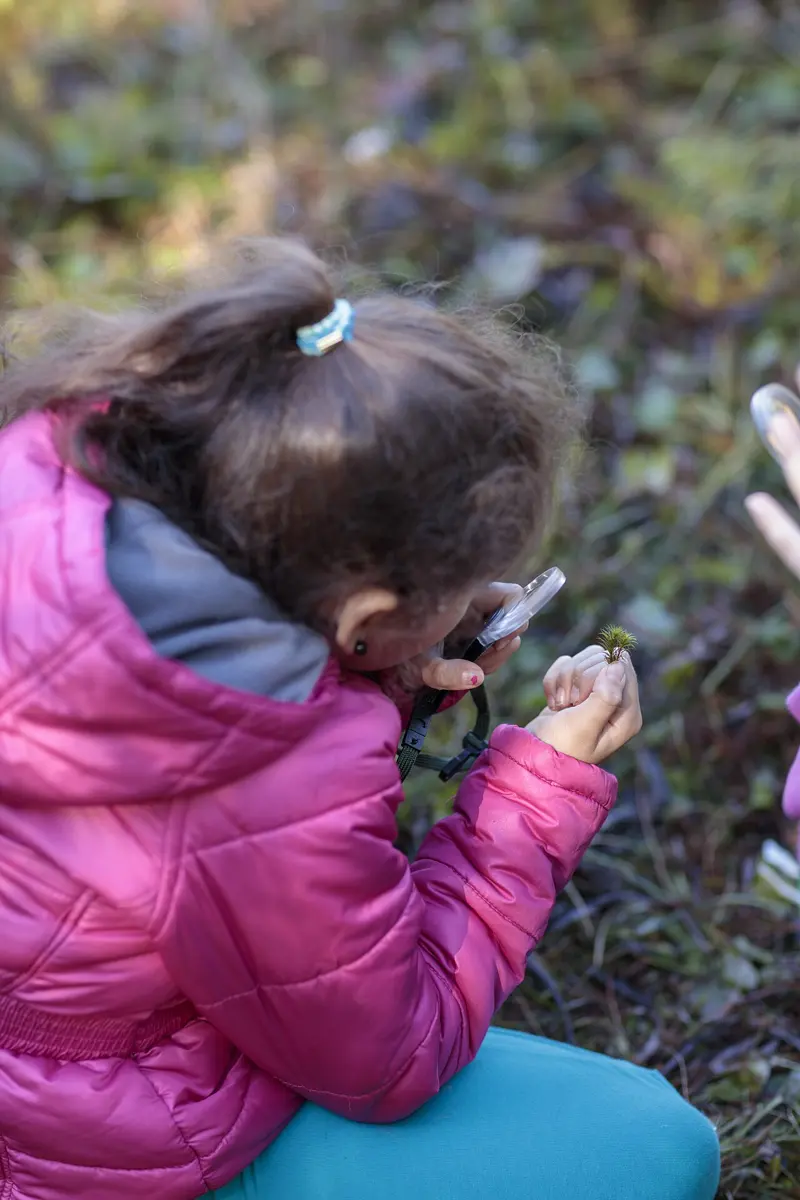
To answer our questions, we do these things:
- observe: look carefully, using our senses;
- measure: find out exactly how long, how heavy or how much;
- classify: put things into groups;
- estimate: make a sensible guess;
- test: try something out to see what happens.
These are the skills of science. Scientists use them every day.
Scientific learning starts with observation: finding out about things around us with our sense organs.
Some things we learn at once. A hot cup is hot the moment you touch it. Other things take more work. We need to try again and again, do experiments, ask questions and gain experience.
To know the exact amount of something, we measure it. We use different instruments for different things: a ruler for length, a balance for mass, a clock for time.
We also do experiments and ask questions to find out why things happen. Reaching an answer in this way is the scientific learning process. It uses observing, estimating, asking, comparing, testing, classifying and experimenting. When people keep doing this, they make discoveries.
Which of these is not a skill of science?
Pick an answer to see why.
Observation, experiment and inquiry
Things around us look different from one another. A stone is hard and gray. Milk is white and runny. Each thing has its own properties: its color, shape, smell, taste, hardness and so on. We find out about properties in three ways: by observation, by experiment and by inquiry.
Observation
How did you fill in the table? You used your sense organs: the eyes, ears, nose, tongue and skin.
- With our eyes we see color, shape and size.
- With our ears we hear sounds.
- With our nose we smell.
- With our tongue we taste.
- With our skin we feel whether a thing is hard or soft, rough or smooth, hot or cold.
Finding out the properties of things with our sense organs is called observation. It is the first step of scientific learning. It tells us how a thing looks from outside: its shape, color, taste and so on.
When we observe something carefully and closely, we learn a lot about it. What we learn is called information.
Some instruments help us observe better. A hand lens and a microscope make small things look bigger. A doctor’s stethoscope lets her hear your heartbeat clearly.
But our senses can’t tell us the exact amount of anything. Your hand can tell that tea is hot. It can’t tell you how hot. For exact amounts, we use measuring instruments: a pan balance for mass, a thermometer for temperature, a clock for time and a scale (ruler) for length.
A guess made by looking and lifting is called an estimate. Pasang made a good estimate. But only the balance could say for sure.
With which sense organ do we find out whether a thing is rough or smooth?
Pick an answer to see why.
Experiment
Observation tells us color, roughness and shape. But some properties can’t be found by observation:
- the exact volume of a thing;
- whether it dissolves in water;
- its exact weight (mass);
- whether it burns or not.
For these, we have to do an experiment. An experiment is an important step of scientific learning. It is also called learning by doing.
Experiments tell us more about a thing. They also let us give its properties as numbers. “The stone has a mass of 250 g” says much more than “the stone is heavy”. Numbers are easy to tell others, and others can check them. To find a thing’s length, its mass, or what is inside it, we have to do something: measure it, weigh it or open it.
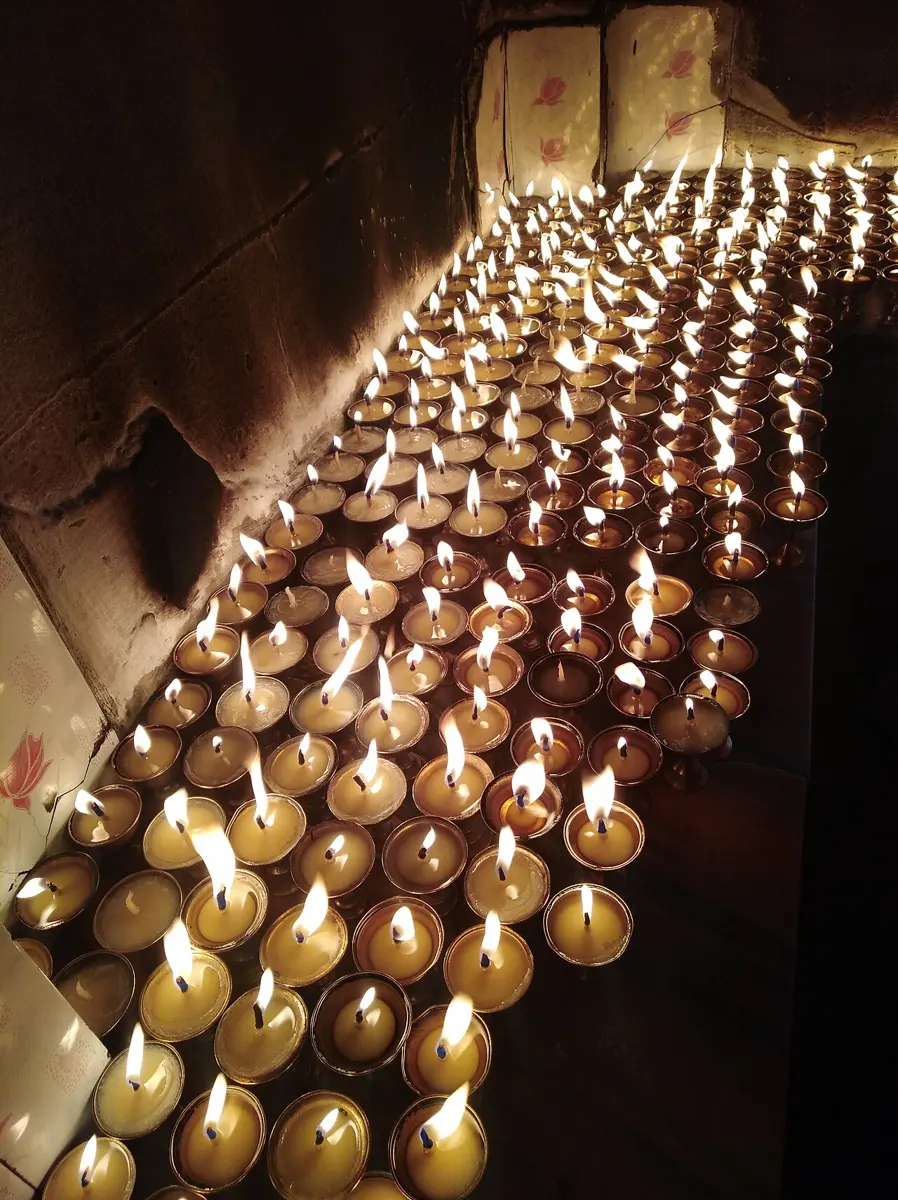
An experiment tells us whether our guess is right or wrong. But it may not tell us the reason. To find the reason, we need to study more and ask more.
Which property of a thing can you not find by just looking at it?
Pick an answer to see why.
Inquiry
Finding out by asking questions, reading and searching is called inquiry. Inquiry helps us find answers to our curiosity. It helps us find the reasons for things that happen in nature.
Great discoveries come from inquiry and research. A new thing is rarely made in one try. It takes many questions and many tries.
We draw a conclusion, our final answer, from what we learn by observation, experiment and inquiry. Making new things after long tests and research in a laboratory is also scientific learning.
Scientific learning is not only for scientists. Everyone can use it.
- Shyam’s neighbor is a hard-working farmer. He wants better crops than anyone in the village. He asks questions, reads, watches his fields and tries out new seeds and manure. That is scientific learning.
- Sita’s mother cooks delicious food. She wants it tastier and healthier. She has visited places to watch others cook. She reads newspapers and searches the internet for ideas. That is scientific learning too.
Exercise (Scientific learning)
1. Choose the best answer
a. What do we need for observation?
Pick an answer to see why.
b. Which property of a thing can’t be found by observation?
Pick an answer to see why.
c. Which of these is part of the scientific learning process?
Pick an answer to see why.
d. Why is the scientific learning process important?
Pick an answer to see why.
2. Is it correct (✓) or wrong (✗)?
a. Feeling a thing to find out how rough it is, is an example of observation.
Pick an answer to see why.
b. We can find the exact amount of a thing by observation.
Pick an answer to see why.
c. A guess (hypothesis) must be tested to find out whether it is right or wrong.
Pick an answer to see why.
d. To find the reason for what we observe and test, we must do inquiry.
Pick an answer to see why.
e. We need a modern laboratory for scientific learning.
Pick an answer to see why.
3. Fill in the blanks
information, sense organs, properties, estimation, conclusion
Observation is done with the help of ______.
Answer
Observation is done with the help of sense organs.
The result we reach at the end of an experiment is called a ______.
Answer
The result we reach at the end of an experiment is called a conclusion.
The knowledge collected from a test or an experiment is called ______.
Answer
The knowledge collected from a test or an experiment is called information.
The ______ of a thing can be found through observations, tests and experiments.
Answer
The properties of a thing can be found through observations, tests and experiments. (“Estimation” is not needed.)
4. Answer these questions
What is observation? List the properties of things that can be found, and that can’t be found, by observation.
Answer
Observation is finding out the properties of things with our sense organs.
- Can be found: color, shape, size (roughly), smell, taste, sound, roughness or smoothness, hardness or softness, hot or cold.
- Can’t be found: exact length, mass, volume and temperature; whether it dissolves in water; whether it burns.
List any four properties of a thing that can only be found by testing and experimenting, not by observing.
Answer
Any four:
- its exact mass (weight);
- its exact volume;
- whether it dissolves in water;
- whether it burns;
- its exact length;
- its exact temperature.
To know the weight of a thing, we must weigh it. Is this observation, experiment or inquiry? Why?
Answer
It is an experiment. We can’t find the exact weight by looking or lifting: that gives only a guess. We have to do something: put the thing on a balance and measure it. Finding out by doing is experiment.
You are given some table salt and some cooking oil. How would you compare their properties? Which ways of scientific learning would you use, and how?
Answer
- Observation: look at them (salt is white and grainy; oil is yellow and runny), smell them, touch them, taste a tiny bit. Salt is a solid. Oil is a liquid.
- Experiment: put each into water. Salt dissolves; oil floats on top and doesn’t mix. Measure the same amount of each with a spoon and weigh them on a balance. With a teacher, dip a cotton wick in oil and try to light it, as in a lamp: oil burns. Salt doesn’t burn.
- Inquiry: ask a teacher, read or search why salt dissolves and oil floats.
Then write a conclusion from all of these.
How does inquiry help us learn? Explain with examples.
Answer
Inquiry helps us find the reasons behind what we observe and test.
- Example 1: Ayusha saw that a lamp doesn’t burn with milk. By asking and reading, she can learn why: milk is mostly water, and water doesn’t burn.
- Example 2: a farmer sees that his crop is poor. He asks other farmers and experts, and reads. He learns which seeds and manure suit his field. Next year, his crop is better.
So inquiry turns “what happens” into “why it happens”. It helps us make discoveries.
Scientific apparatus
In science we observe, measure and test. For this we need instruments, called apparatus (say: a-pa-RAY-tus).
Think of your kitchen. To cook food we need heat. It comes from firewood, gas or electricity. We cook in pots and pans. We keep the pot up over the fire on a stand: a ring of bricks or stones, an iron odaan (tripod), or the top of a gas stove. A science laboratory works the same way. It has its own heater, stands and pots.
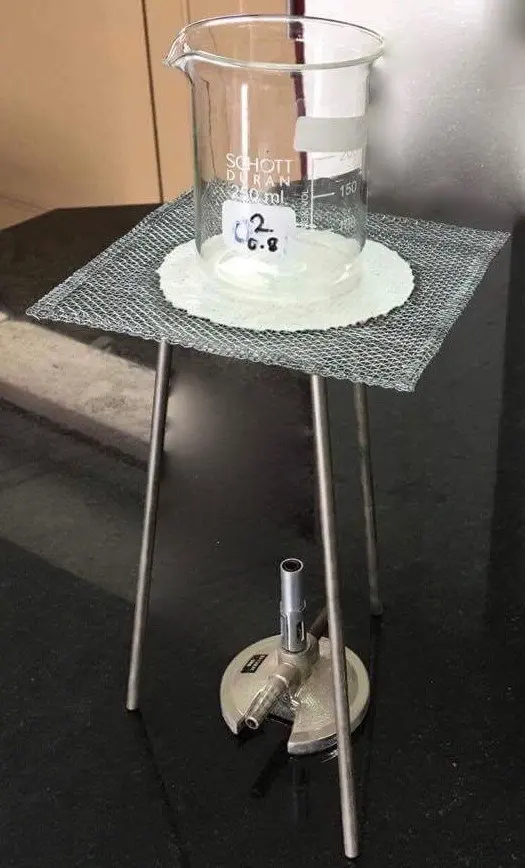
Apparatus like this are used for observing, testing and experimenting. In a laboratory, we use only small amounts of chemicals, called samples. So lab apparatus is small. Many have a scale marked on them, to measure how much is inside.
Some apparatus used often in a laboratory
| No. | Apparatus | What it is used for |
|---|---|---|
| 1. | Bunsen burner | to make heat (it burns gas) |
| 2. | Tripod stand | to hold up a beaker, flask or basin while it is heated |
| 3. | Conical flask | to keep and mix chemicals (its narrow neck stops spills when you swirl it) |
| 4. | Round-bottom flask | to mix and heat chemicals |
| 5. | Measuring cylinder | to measure the volume of a liquid |
| 6. | Standard weights | to find an unknown mass, by balancing it on a balance |
| 7. | Physical balance | to measure mass |
| 8. | Spring balance | to weigh a thing, by how far it stretches a spring |
| 9. | Thermometer | to measure temperature |
| 10. | Test tube | to mix and heat small amounts of chemicals |
| 11. | Funnel | to pour liquids into a narrow mouth, and to hold filter paper |
| 12. | Condenser | to cool a gas (vapor) back into a liquid |
| 13. | Porcelain basin | to heat chemicals and to evaporate a liquid |
| 14. | Beaker | to mix and heat chemicals |
| 15. | Digital balance | to measure mass; it shows the number on a screen |
| 16. | Wire gauze | to spread the burner’s heat evenly under a beaker |
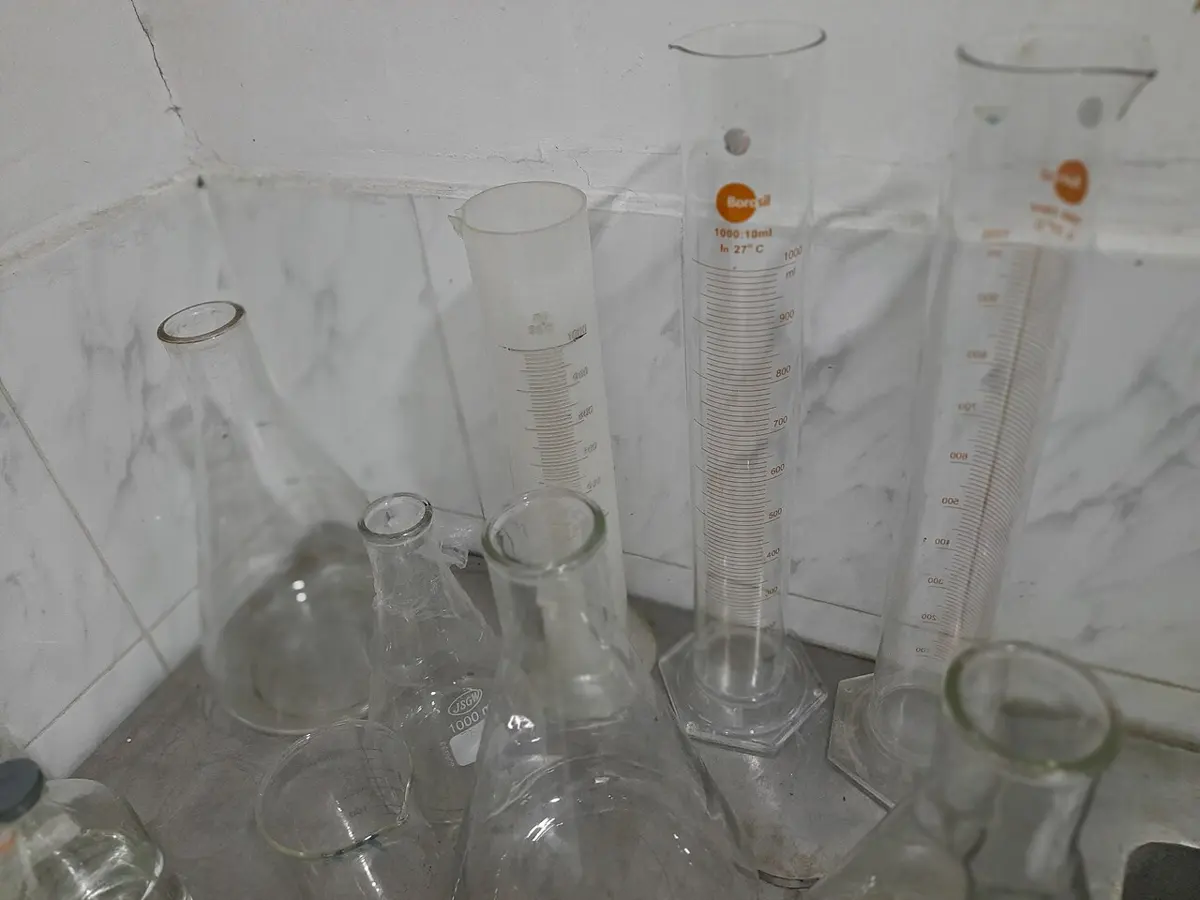
Which apparatus would you use to measure the volume of some water?
Pick an answer to see why.
Schematic diagrams
Think of a beautiful old house in Bhaktapur. A photo shows every brick, every carved window and every color. Now draw it quickly with a pencil: a few lines for the walls, the roof and the windows. Which is easier to draw? The line drawing, of course. And it still shows what the house is like.
A drawing made with simple lines or symbols is called a schematic diagram. In science, we use schematic diagrams to show the apparatus of an experiment and how it is set up.
- An engineer’s plan for building a house is a schematic diagram.
- A drawing of lab apparatus and how it is arranged is a schematic diagram.
- A drawing of an electric circuit is a schematic diagram.
Rules for drawing a schematic diagram
- Don’t close the mouth (top) of the apparatus.
- Don’t shade or color it.
- Use a single line.
- Draw it flat (two-dimensional).
- Keep the sizes in the right proportion: a test tube is smaller than a beaker.
- Use a sharp pencil and a ruler.
Make a chart of these rules and put it up on the class board.
Which of these is a rule for drawing a schematic diagram?
Pick an answer to see why.
Exercise (Scientific apparatus)
1. Choose the best answer
a. What is true of a schematic diagram?
Pick an answer to see why.
b. Look at Figure 1.10. Which drawing is a correct schematic diagram?
Pick an answer to see why.
c. What is the main advantage of a schematic diagram?
Pick an answer to see why.
d. There is some water in a bottle. Which tool would you use to find its volume?
Pick an answer to see why.
e. What is the main reason for using glass apparatus to hold chemicals in a laboratory?
Pick an answer to see why.
2. Is it correct (✓) or wrong (✗)?
a. A schematic diagram should always be drawn with a single line.
Pick an answer to see why.
b. A measuring cylinder is used to find how hot or cold a thing is.
Pick an answer to see why.
c. A schematic diagram is quick and easy to draw.
Pick an answer to see why.
d. A schematic diagram is made attractive by filling in color and shading.
Pick an answer to see why.
e. We can compare the sizes of things from a schematic diagram.
Pick an answer to see why.
3. Fill in the blanks
tripod stand, transparent, schematic, physical balance, spring balance
A drawing made with lines or symbols is called a ______ diagram.
Answer
A drawing made with lines or symbols is called a schematic diagram.
A ______ is used to hold up a flask while it is heated.
Answer
A tripod stand is used to hold up a flask while it is heated.
It is easy to observe things in glass test tubes, beakers and flasks, because they are ______.
Answer
It is easy to observe things in glass test tubes, beakers and flasks, because they are transparent.
A ______ is used to measure the mass of a thing.
Answer
A physical balance is used to measure the mass of a thing. (“Spring balance” is not needed.)
4. Match the name with the picture
Match each picture in Figure 1.11 with its name: funnel, beaker, conical flask, measuring cylinder, test tube.
Answer
- measuring cylinder
- test tube
- funnel
- conical flask
(The beaker has no picture.)
5. Answer these questions
What should we keep in mind while drawing a schematic diagram? Write any four points.
Answer
Any four:
- Don’t close the mouth of the apparatus.
- Don’t shade or color it.
- Draw with single lines.
- Draw it flat (two-dimensional).
- Keep the sizes in the right proportion.
- Use a sharp pencil and a ruler.
Write any three reasons why schematic diagrams are important.
Answer
Any three:
- They are quick and easy to draw.
- They show clearly how apparatus is set up, so others can repeat the experiment.
- Anyone can understand them, because everyone uses the same simple shapes.
- They show sizes in the right proportion, so things can be compared.
Make a table of things in a kitchen and in a laboratory that do the same job.
Answer
| Job | In the kitchen | In the laboratory |
|---|---|---|
| giving heat | gas stove, firewood | Bunsen burner, spirit lamp |
| holding a pot over the heat | bricks, odaan (tripod) | tripod stand |
| holding liquids to heat | pot, pan | beaker, flask |
| measuring liquids | measuring jug, mana | measuring cylinder |
| measuring mass | kitchen scale | physical balance, digital balance |
| pouring into a bottle | funnel | funnel |
| separating solid from liquid | tea strainer | filter paper in a funnel |
Draw a schematic diagram of the place around your home: your home, the nearby main road, the main square (chowk) and other public places.
Answer
Your map will be your own. To draw it:
- Draw roads as two straight lines, and paths as one line.
- Draw your home, school, temple or shop as small squares or simple symbols, and write each name beside it.
- Keep things in the right places: if the temple is next to the square, draw it there.
- Add an arrow pointing north (N), and use a pencil and a ruler. No shading or color.
Draw schematic diagrams of a tripod stand, a beaker, a test tube and a conical flask.
Answer
Draw them with single lines, flat, with no color, and with their mouths open, as in Figure 1.9.
- Tripod stand: a flat line for the top, with two legs slanting down and out.
- Beaker: a U with straight sides and a flat bottom, open at the top.
- Test tube: a long, thin U with a round bottom, open at the top.
- Conical flask: a narrow neck on top of a wide, sloping body with a flat bottom.
Measurement
In daily life, we buy and sell many things. We measure them to know the exact amount.
- Length is measured with a meter scale, a ruler or a measuring tape.
- Mass (weight) is measured with a balance and standard weights.
- Time is measured with a clock.
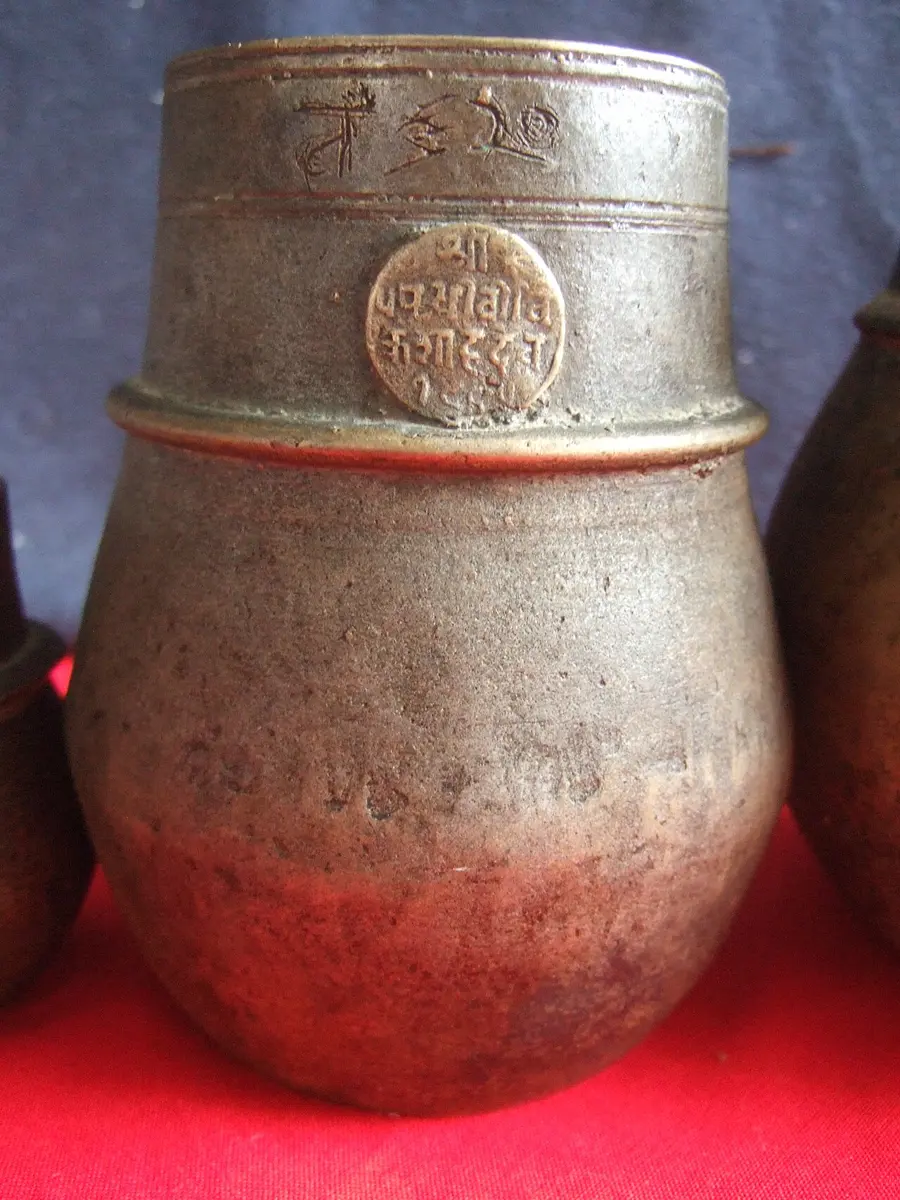
- Volume, the space taken up by milk, curd, oil or water, is measured with a mana, a pathi or a measuring cylinder.
Measurement of length
Which tools have you used to measure how long, wide or tall a thing is?
Look at two pencils side by side. You can tell which one is longer. But how much longer? To find out, you must measure. And to measure, you need something whose length is already known. A meter scale, a ruler and a measuring tape all have known lengths.
Suppose you want the length of the class board. You lay a meter scale along it. The scale fits along the board exactly two times. So the board is 2 meters long.
Here the meter scale is the known, or standard, length. The length of the board is the unknown length. Comparing an unknown amount with a known amount is called measurement. The known amount we compare with is called a unit. The meter is a unit of length.
Look closely at a ruler. The big numbers mark centimeters (cm). Between two numbers there are 10 small spaces. Each small space is one millimeter (mm).
Length is measured in millimeters (mm), centimeters (cm), meters (m) and kilometers (km). These are units of length. Choose the unit that suits the size of the thing.
| Small unit | Big unit |
|---|---|
| 10 mm | 1 cm |
| 100 cm | 1 m |
| 1000 m | 1 km |
- The thickness of a coin: in millimeters.
- A pencil: in centimeters.
- A room: in meters.
- The road from Bhaktapur to Pokhara: in kilometers.
To change a big unit into a small one, multiply. To change a small unit into a big one, divide.
Length is also measured in inches, feet, yards and miles. A carpenter or a tailor in Nepal often uses feet and inches.
| Unit | Is equal to |
|---|---|
| 1 meter | 100 cm, about 39.4 inches, about 1.09 yards |
| 1 yard | about 0.91 m (3 feet) |
| 1 foot | 30.48 cm (12 inches) |
| 1 inch | 2.54 cm |
| 1 centimeter | about 0.39 inches |
Which unit is best for measuring the length of your classroom?
Pick an answer to see why.
Measurement of mass
Everything is made of tiny particles, far too small to see. In some things the particles are packed tightly. In others they are packed loosely, with lots of space between them. In air they are very loosely packed. In a stone they are packed tightly.
So a glass of gravel holds much more matter than a glass of cotton. That makes it heavier. The amount of matter in a thing is called its mass.
We can’t find the exact mass of a thing by looking at it. We can only guess which of two things is heavier. To find the exact mass, we must measure it.
We measure mass by comparing a thing with things whose mass we already know. Pieces of metal with a known mass are called standard weights (in Nepali, dhak). A physical balance compares the unknown mass with the standard weights.
The particles of each thing are packed differently. So things with equal mass may take up different amounts of space. A kilogram of cotton takes up much more space than a kilogram of rice.
Which is heavier: 1 kg of cotton or 1 kg of iron?
Pick an answer to see why.
Mass is measured in grams (g) and kilograms (kg).
1000 g = 1 kg
So half a kilogram is 500 g, and a quarter of a kilogram is 250 g.
Measurement of time
The Sun rises this morning. That is an event: something that happens. Tomorrow morning, the Sun rises again. That is another event. The time between these two events is one day.
Events happen all the time. Some happen in nature: the Sun rises and sets, rain starts and stops. Some are made by people: a class starts and ends, an exam starts and ends. The gap between any two events is time. We measure time with a clock or a watch.
Measurement of volume
Everything is made of matter. And all matter has mass and volume. A small lump of clay has a small volume. A big lump of clay has a big volume.
The space taken up by a thing is called its volume. It depends on the thing’s length, breadth (width) and height.
Number of boxes in a pile = number along the length × number along the width × number up the height
In the same way, the space taken up by a box-shaped thing is:
volume = length × breadth × height
or, in short:
This works for regular things, shaped like a box: a duster, a board, a book, a desk, a bench. If the length, breadth and height are in centimeters, the volume is in cubic centimeters (cm³). If they are in meters, the volume is in cubic meters (m³).
A liquid has no fixed shape. It takes the shape of its container. But it has a fixed volume.
Think of a hollow cube, 10 cm long, 10 cm wide and 10 cm high. Its inside volume is 10 × 10 × 10 = 1000 cm³. The water that fills it is one liter.
1 liter = 1000 cm³ = 1000 ml
so, 1 cm³ = 1 ml
A measuring cylinder is a tall glass or plastic jar with a scale in milliliters. It measures the volume of a liquid. Measuring cylinders come in many sizes: 10 ml, 25 ml, 50 ml, 100 ml, and bigger.
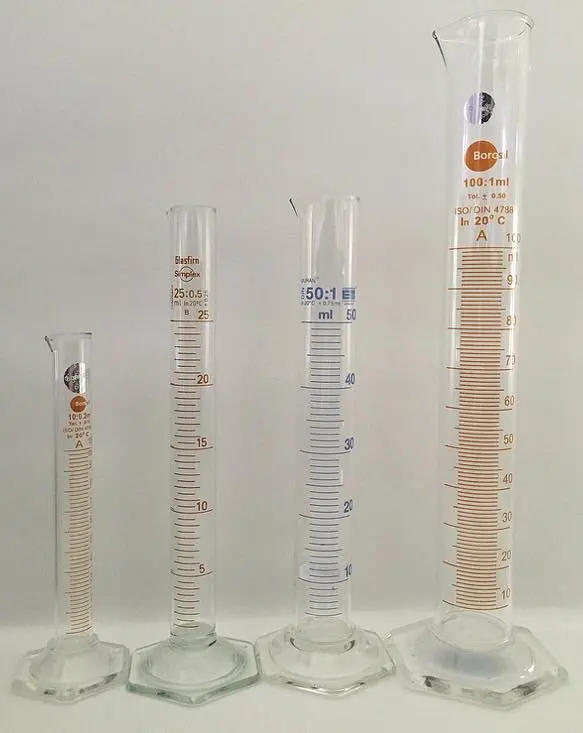
When you measure the volume of a liquid in a measuring cylinder:
- a.Stand the cylinder on a flat table.
- b.Keep your eye level with the surface of the liquid.
The volume of a stone
A stone has no neat length, breadth or height. Its shape is irregular. How can we find its volume? Water can help.
Find the volume of other solids in the same way: an eraser, a piece of brick, a key. Compare them, and write a conclusion.
| No. | Thing | Volume of water (ml) | Volume of water and thing (ml) | Volume of the thing (cm³) |
|---|---|---|---|---|
| 1. | eraser | |||
| 2. | stone, piece of brick |
Exercise (Measurement)
1. Choose the best answer
a. Which of these is equal to 5200 cm?
Pick an answer to see why.
b. What is the amount of matter in a thing called?
Pick an answer to see why.
c. How many centimeters are equal to 10 inches?
Pick an answer to see why.
d. It is 2:50 PM on Hari’s watch. What time will it show 3 hours and 10 minutes later?
Pick an answer to see why.
e. What does Figure 1.20 mean?
Pick an answer to see why.
f. Which units are used to measure the length of a pencil?
Pick an answer to see why.
g. Which of these is the biggest unit?
Pick an answer to see why.
h. Sadiksha measured a cube of wood. Its length was 4 ___ and its volume was 64 ___. Which units fill the blanks?
Pick an answer to see why.
i. A box is 12.4 m long, 16 m wide and 16 m high. What is its volume?
Pick an answer to see why.
j. Your school starts at 9:45 AM and ends at 4:00 PM. How long is that?
Pick an answer to see why.
k. Ayusha weighed a cauliflower at a vegetable shop. It was 1800 g. What is its mass in kilograms?
Pick an answer to see why.
l. How long is the strip in Figure 1.21?
Pick an answer to see why.
2. Is it correct (✓) or wrong (✗)?
a. Things of equal volume have equal masses.
Pick an answer to see why.
b. Mana and pathi are traditional measures for the volume of grains and liquids.
Pick an answer to see why.
c. There are 24 hours in a day.
Pick an answer to see why.
d. The volume of an irregular thing can be measured with the help of a measuring cylinder.
Pick an answer to see why.
e. One foot is equal to 12 inches.
Pick an answer to see why.
3. Fill in the blanks
unit, kilometer, square meters, volume, cubic meter, measurement
One thousand meters is equal to one ______.
Answer
One thousand meters is equal to one kilometer.
One ______ is equal to 1000 liters.
Answer
One cubic meter is equal to 1000 liters. (A box 1 m long, 1 m wide and 1 m high holds 1000 liters of water.)
A flat shape with no height or thickness has a surface but no ______.
Answer
A flat shape with no height or thickness has a surface but no volume.
The fixed amount used to measure a quantity is called a ______.
Answer
The fixed amount used to measure a quantity is called a unit.
______ is comparing an unknown amount with a known amount.
Answer
Measurement is comparing an unknown amount with a known amount. (“Square meters” is not needed.)
4. Match the units with what they measure
Match each unit with the quantity it measures.
Units: kilogram, meter, second, square meter, liter
Quantities: volume, weight, area, mass, length, time
Answer
| Unit | Quantity |
|---|---|
| kilogram | mass |
| meter | length |
| second | time |
| square meter | area |
| liter | volume |
(“Weight” is left over. In daily life we say a thing “weighs 2 kg”, but the kilogram is the unit of mass.)
5. Answer these questions
What is mass? Name the instruments used to measure mass, and its units.
Answer
- Mass is the amount of matter in a thing.
- Instruments: a physical balance with standard weights, a digital balance, and the weighing scales in shops.
- Units: milligram (mg), gram (g) and kilogram (kg). For very heavy things, quintal (100 kg) and tonne (1000 kg). 1000 g = 1 kg.
The school playground is 50 feet long. What is its length in meters?
Answer
1 foot = 30.48 cm.
50 feet = 50 × 30.48 cm = 1524 cm.
100 cm = 1 m, so 1524 cm = 1524 ÷ 100 m = 15.24 m.
List the instruments used in daily life to measure the volume of solids and liquids.
Answer
- Liquids: a measuring cylinder, a measuring jug, a measuring cup and spoon, a liter bottle, a syringe (for medicine), the meter at a petrol pump.
- Grains and other solids in small pieces: a mana and a pathi.
- Box-shaped solids: a ruler or measuring tape, to find length, breadth and height (V = l × b × h).
- Irregular solids: a measuring cylinder with water.
How is the timer of a phone’s clock app different from its stopwatch? Explain with examples.
Answer
- Stopwatch: it starts at zero and counts up. It measures how long something takes. Example: timing a friend running 50 m (9.6 seconds).
- Timer: you set a time, and it counts down to zero. Then it rings, to tell you the time is over. Example: cooking rice for 15 minutes, or a 10-minute test.
Describe, with a diagram, how to measure the volume of a thing with an irregular shape.
Answer
For a small stone:
- Pour some water into a measuring cylinder. Read its volume, say 50 ml.
- Tie the stone to a thread. Lower it gently until it is fully under water.
- Read the new level, say 62 ml.
- Volume of the stone = 62 − 50 = 12 cm³.
Draw it as in Figure 1.18.
For a stone too big for the cylinder, fill a pot to the brim, stand it in a bowl, lower the stone in, and measure the water that spills out (Figure 1.19).
Suruchi has a piece of wood with an irregular shape. It floats on water. How can she find its volume with a measuring cylinder? Describe it with a diagram.
Answer
A floating thing won’t go under the water by itself. So she uses a sinker: a small stone that pulls it under.
- Pour water into a measuring cylinder. Tie a small stone to a thread and lower it in. Read the level, say 60 ml.
- Take it out. Tie the wood to the stone, so the stone pulls the wood under. Lower both in until the wood is fully under water. Read the level, say 75 ml.
- Volume of the wood = 75 − 60 = 15 cm³.
She could also push the wood under with a very thin pin. The pin is so thin that it hardly changes the level.
Worksheet: Scientific Learning: observing, testing and apparatus (PDF, 4 pages)
Practice every question in the book, and keep track of the ones you miss →