
A truck stops outside a shop. The driver says it carries 6 quintals 25 kg of rice, in sacks of 25 kg each.
How many sacks is that? To find out, you need to know what a quintal is, and how to change quintals into kilograms.
Rice, wheat and potatoes are sold in big amounts by the quintal. Sugar and vegetables are sold in kilograms and grams. In this unit you will change between these units, and multiply and divide weights like 2 kg 425 g and 73 quintals 89 kg. At the end, you can count the sacks on the truck.
11.0 Review
Aman’s mother bought these vegetables for his birthday party.
| S.N. | Vegetable | Weight |
|---|---|---|
| 1. | Potato | 5 kg |
| 2. | Bitter gourd | 1 kg |
| 3. | Cauliflower | 4 kg |
| 4. | Onion | 500 g |
| 5. | Tomato | 750 g |
We weigh things in grams (g) and kilograms (kg). “Kilo” means a thousand: a kilogram is a thousand grams. For very heavy things, like a truckload of rice, we also use the quintal.
1 kg = 1000 g
1 quintal = 100 kg
How many grams are in 3 kg 40 g?
Pick an answer to see why.
Which is heavier: 2 quintals or 150 kg?
Pick an answer to see why.
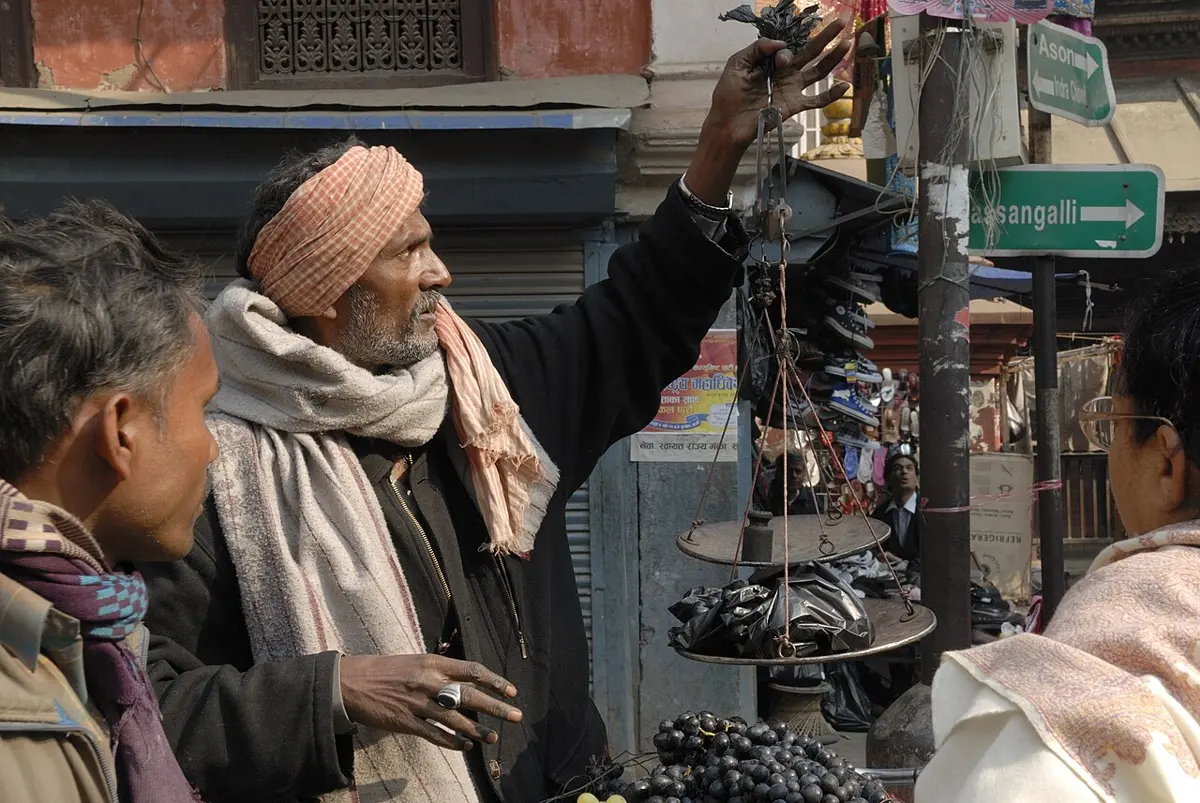
11.1 Multiplication and division with gram and kilogram
To multiply a weight in kg and g, multiply each unit by the number. Then move every 1000 g over as 1 kg.
To divide, share the kilograms first. Change the kilograms left over into grams, add, and share those.
A bag of flour weighs 1 kg 250 g. What do 4 such bags weigh?
Pick an answer to see why.
11.2 Multiplication and division with kilogram and quintal
Now 100 kg make 1 quintal. So after multiplying, move every 100 kg over as 1 quintal.
How many 25 kg sacks make 1 quintal?
Pick an answer to see why.
Back to the truck
The truck carries 25 sacks.
Put both weights in kg: 6 quintals 25 kg = 600 kg + 25 kg = 625 kg. Then 625 kg ÷ 25 kg = 25.
Check it another way: 4 sacks of 25 kg make 1 quintal. So 6 quintals are 6 × 4 = 24 sacks, and the last 25 kg is one more sack: 24 + 1 = 25. ✓
Exercise 11
Question 1
Convert.
5 kg 300 g into g
Answer
39000 g into kg
Answer
35457 g into kg and g
Answer
12 quintals into kg
Answer
700 kg into quintals
Answer
Question 2
Multiply.
2 kg 350 g by 3
Answer
6 kg 720 g by 6
Answer
21 kg 72 g by 10
Answer
25 kg 150 g by 8
Answer
12 quintals 30 kg by 9
Answer
20 quintals 56 kg by 7
Answer
Question 3
Divide.
3 kg 650 g by 5
Answer
12 kg 420 g by 9
Answer
9 kg 300 g by 6
Answer
34 kg 133 g by 11
Answer
16 quintals 35 kg by 5
Answer
25 quintals 68 kg by 12
Answer
Question 4
A carton holds 30 packets of noodles. Each packet weighs 75 g, and the empty carton weighs 170 g. What does the full carton weigh?
Answer
Question 5
The weight of a cup is 350 g.
What do 15 such cups weigh?
Answer
How many cups weigh 3.15 kg?
Answer
Question 6
The weight of an ink bottle is 270 g.
What do 14 such ink bottles weigh?
Answer
How many ink bottles weigh 5.4 kg?
Answer
Question 7
15.6 kg of chiura (beaten rice) is shared equally among 30 students. How much does each student get?
Answer
Question 8
A container holds 236 bottles of powder. Each bottle weighs 1.3 kg, and the empty container weighs 3 quintals. What does the full container weigh?
Answer
Question 9
A sack of salt holds 50 packets. Each packet weighs 1 kg.
What does the sack of salt weigh?
Answer
How many packets of salt are there in 2 quintals?
Answer
Question 10
kg of grapes is shared equally among 25 people.
How much does each person get?
Answer
Change kg into grams.
Answer
If the same grapes are shared equally among 30 people, how much does each get?
Answer
Question 11
5 people store equal amounts of potatoes in a cold store. Together they store 2.5 quintals. How many quintals does each store?
Answer
Question 12
Sugar is given out as relief to 200 people, using a scoop that holds 2.5 kg. Each person gets one scoop. How many quintals of sugar are given out in all?
Answer
Question 13
11 kg of dry snacks is shared out on a school trip. 50 students eat the snacks equally. How much does each student get?
Answer
Printable PDFs
- Study notes 1 page
- Harder practice questions 2 pages Answer key
Practice every question in the book, and keep track of the ones you miss →
Where this is used
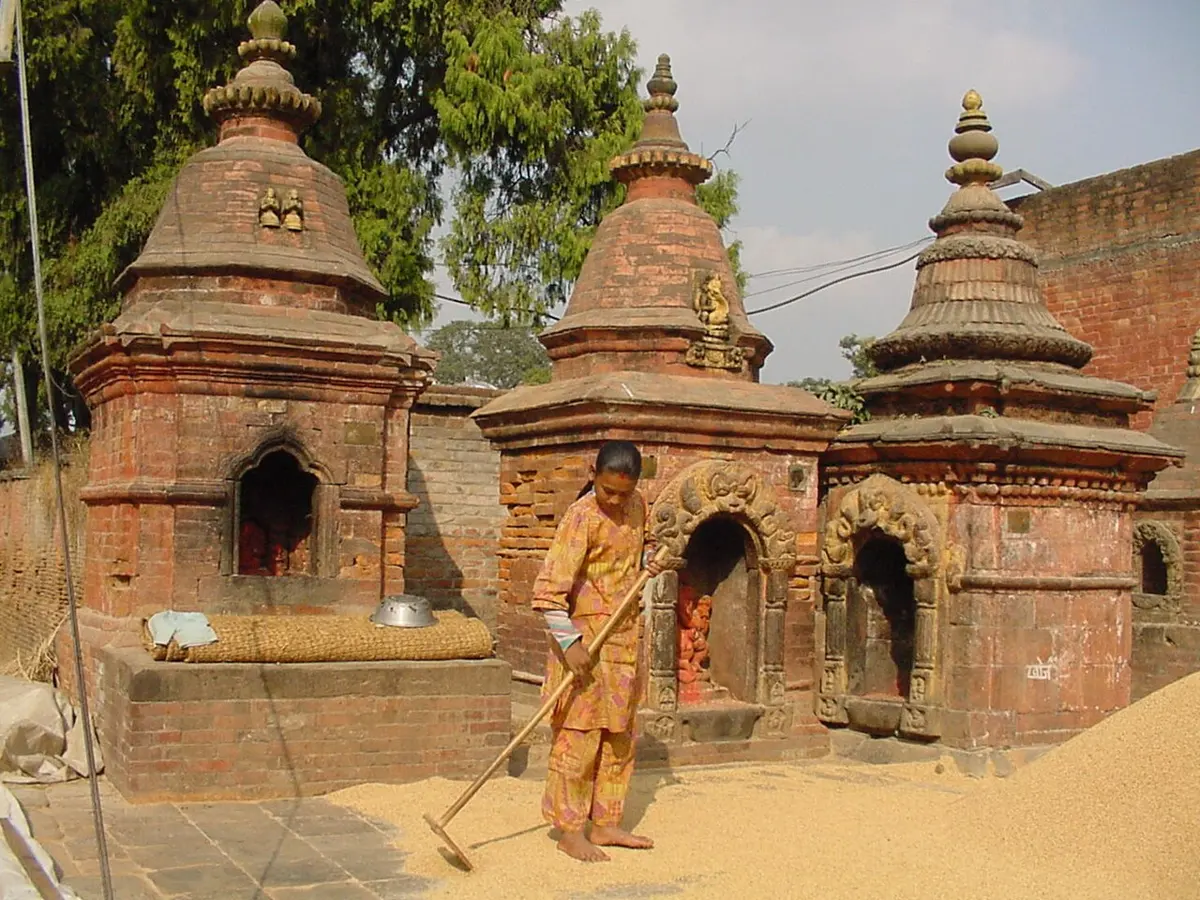
- Farmers’ grain prices. Nepal’s government sets a lowest price for paddy every year, per quintal. In May 2026 it set Rs. 3,660 a quintal for coarse paddy (mota dhan), which is Rs. 36.60 a kg.
- Fair scales in shops. The Nepal Bureau of Standards and Metrology has offices across Nepal that carry out the law on standard measures and weights, so a kilogram is the same in every shop.
- Science. The kilogram was first the mass of 1 liter of water (1795). From 1889 to 2019 it was a metal cylinder kept near Paris. Since 2019 it is defined by a fixed number from nature.
Where these facts come from
- Paddy price: Kantipur, English pages, “Government sets minimum support price for rain-fed rice”, 25 May 2026 (Jestha 11, 2083: “Rs. 3660 per quintal” for coarse and Rs. 3,860 for medium), read November 2026.
- The quintal: Wikipedia, “Quintal” (1 quintal = 100 kg in India and elsewhere, used for grain in wholesale markets), read November 2026.
- Nepal Bureau of Standards and Metrology: Wikipedia, “Nepal Bureau of Standards and Metrology” (eleven regional offices implementing the Standard Measure and Weight Act, 2025 BS, that is 1968), read November 2026.
- The kilogram: Wikipedia, “Kilogram” (1795, the mass of a liter of water; the platinum–iridium prototype from 1889 for 130 years; the present definition from 2019), read November 2026.
A companion to your textbook, not a replacement for it: study from the book your school uses, and where the two differ, follow your teacher. Found a mistake? Please tell us.