
You have a 2-liter bottle of water. Your friends bring glasses that hold 250 ml each. How many glasses can you fill?
The bottle says liters. The glass says milliliters. You can’t compare 2 with 250 until both are in the same unit.
In this unit you will learn how liters and milliliters are linked. Then you will multiply and divide amounts like 12 l 350 ml: milk for a family, juice for a party, medicine for a week. At the end, you can answer the question about the bottle.
10.0 Review
The capacity of a container is how much liquid it can hold. It is often written on the container.
| Container | Capacity written on it |
|---|---|
| a measuring beaker | 500 ml |
| three small plastic bottles | 150 ml, 100 ml and 80 ml |
| a water bottle | 1 l |
| three water tanks | 500 l, 1000 l and 2000 l |
We measure capacity in liters (l) and milliliters (ml). “Milli” means one thousandth. So a milliliter is a thousandth of a liter:
1 l = 1000 ml
- 3 l = 3 × 1000 ml = 3000 ml.
- 4500 ml = 4000 ml + 500 ml = 4 l 500 ml.
How many milliliters are there in 2 l 50 ml?
Pick an answer to see why.
10.1 Multiplication and division with milliliter and liter
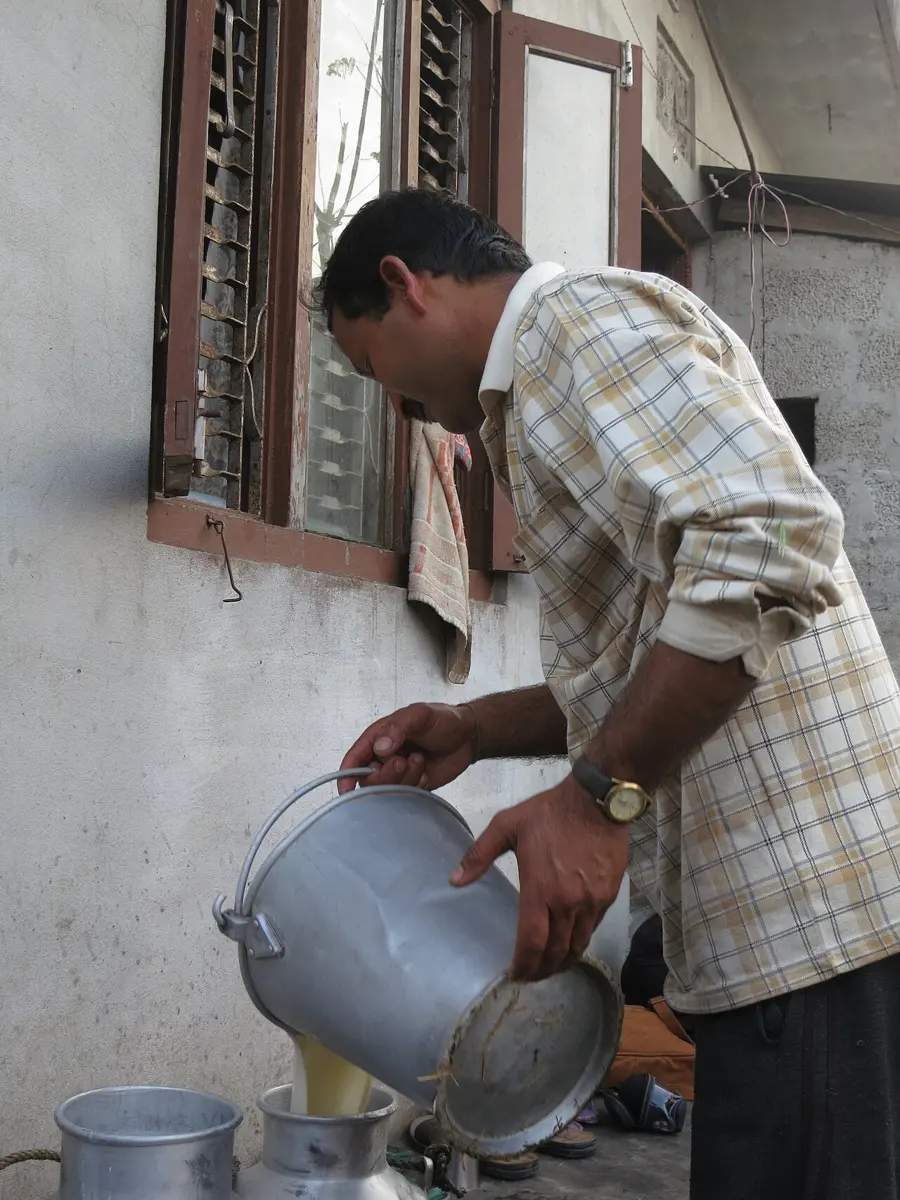
To multiply an amount in l and ml, multiply each unit by the number. Then change every 1000 ml into 1 l and move it over, as you did with km and m.
To divide, share the liters first. Change the liters left over into ml, add them to the ml, and share those.
Sometimes we know how much each gets, and want to know how many get it.
A teapot holds 1 l 200 ml of tea. How many cups of 150 ml can you fill from it?
Pick an answer to see why.
Back to the bottle
The 2-liter bottle fills 8 glasses. Put both in ml: 2 l = 2000 ml, and 2000 ml ÷ 250 ml = 8.
This is an “amount ÷ amount” question, so the answer is a number of glasses. If the glasses held 200 ml instead, the same bottle would fill 2000 ÷ 200 = 10 of them: smaller glasses, more of them.
Exercise 10
Question 1
Convert.
3 l 200 ml into ml
Answer
15 l 250 ml into ml
Answer
47000 ml into l
Answer
65450 ml into l
Answer
12425 ml into l and ml
Answer
Question 2
Multiply.
4 l 300 ml by 3
Answer
14 l 450 ml by 4
Answer
20 l 250 ml by 10
Answer
42 l 125 ml by 9
Answer
50 l 375 ml by 8
Answer
Question 3
Divide.
10 l 500 ml by 3
Answer
17 l 640 ml by 8
Answer
47 l 425 ml by 5
Answer
26 l 760 ml by 8
Answer
12 l 330 ml by 9
Answer
Question 4
A small bottle holds 250 ml of juice. How many such bottles are needed for 2 liters of juice?
Answer
Question 5
Tea is to be served to 15 people, 200 ml each. How big a kettle is needed to bring all the tea at once?
Answer
Question 6
A carton of mustard oil has 20 packets. Each packet holds 500 ml. How much oil is in the carton? Give it in liters and milliliters.
Answer
Question 7
Sana filled a jerrycan by pouring a 1.5-liter jug into it 10 times. How much water does the jerrycan hold?
Answer
Question 8
There is juice in a jug. Rojina fills 8 cups with 350 ml each, and 200 ml is still left in the jug. How much juice was in the jug?
Answer
Question 9
A doctor gives a patient with gastritis a 150 ml bottle of medicine. The patient must take 10 ml at a time, 3 times a day. How many days will the medicine last?
Answer
Question 10
At a wedding, each janti (guest from the groom’s side) is served 300 ml of lassi. There are 150 guests. How many liters of lassi do they drink?
Answer
Printable PDFs
- Study notes 1 page
- Harder practice questions 2 pages Answer key
Practice every question in the book, and keep track of the ones you miss →
Where this is used
- Medicine. A teaspoonful of medicine means 5 ml. Measuring spoons and cups for syrup are marked in ml, so the dose is the same in every home.
- Oral rehydration salts (ORS). One packet of ORS powder is made to be mixed into 1 liter of clean water, so the water must be measured. The mixed drink must be used within 24 hours.
- Science. A liter is a cube 10 cm on each side, so 1 l = 1000 cubic centimeters.
Where these facts come from
- The liter and the kilogram: Wikipedia, “Litre” (1 l = 1 dm³ = 1000 cm³, a cube 10 cm on each side; symbols L and l both standard; the kilogram first defined in 1795 as the mass of a liter of water), and “Kilogram”, read November 2026.
- Teaspoon: Wikipedia, “Teaspoon” (for dosing medicine a teaspoonful is defined as 5 mL), read November 2026.
- ORS: Médecins Sans Frontières, Essential drugs, “Oral rehydration salts = ORS” (“Sachet of powder to be diluted in 1 litre of clean water”; “Once prepared, the solution must be used within 24 hours”), read November 2026.
A companion to your textbook, not a replacement for it: study from the book your school uses, and where the two differ, follow your teacher. Found a mistake? Please tell us.