
Think of your best friend. Is she tall or short? Is he funny or quiet? Now think of your village or town. Is it busy or peaceful, hot or cool? The words you just used are describing words, and this unit is full of them.
This unit is about people and places. You will read about the jobs people do, and about a famous museum in Pokhara. You will learn adjectives, the words that describe; how to use commas; how to talk about what is happening now (She is reading); and how to say what a place has with there is and there are.
Getting started
A. People and places
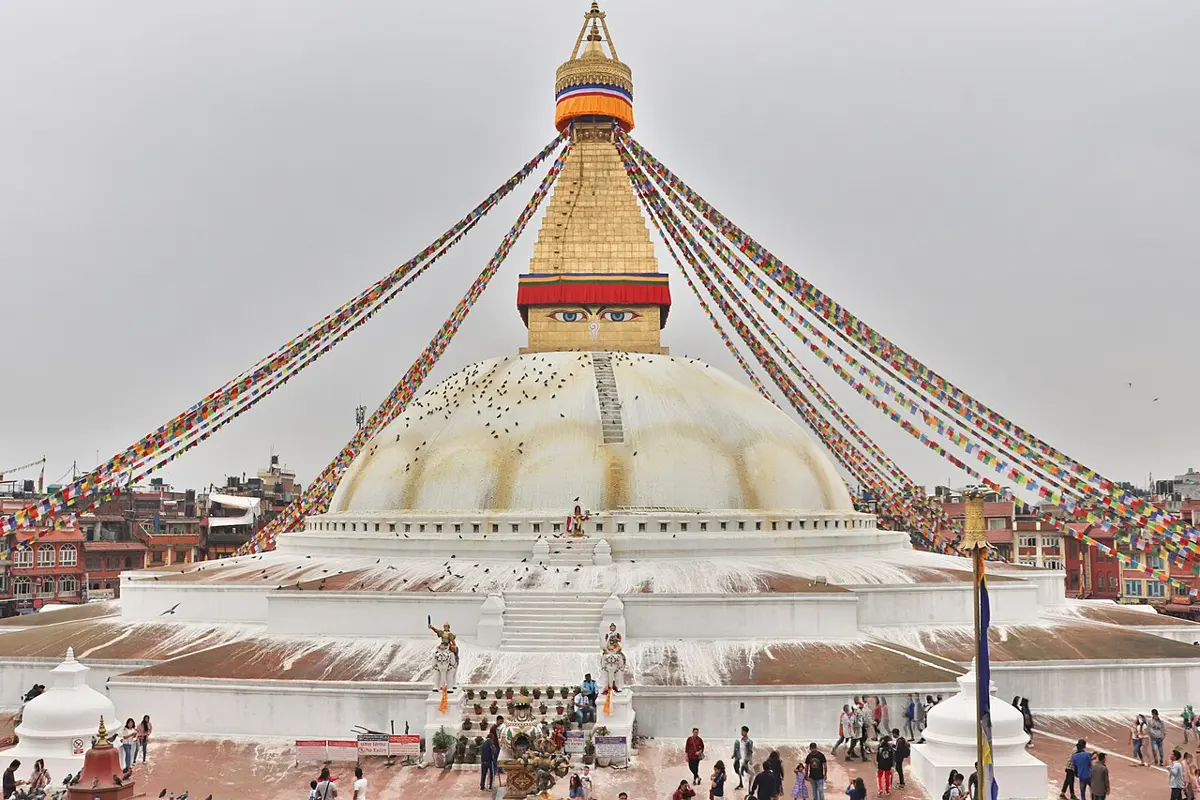
The unit opens with four pictures. Two are of famous Nepalis: the singer Tara Devi, in an old black-and-white photo, and the actor and comedian Hari Bansa Acharya, in a white shirt. Two are of famous places: the great white dome of Boudhanath stupa in Kathmandu, and the red Manakamana temple in Gorkha, with snowy mountains behind it.
Look at the pictures and describe the people and the places.
Model answers
B. Listen and sing
The song is made of opposites. It sings a word three times, then its opposite three times: big and little, long and short, clean and dirty, tall and short, fast and slow.
Did you notice that short comes twice? Short is the opposite of long (a short rope) and also of tall (a short boy).
What is the opposite of clean?
Pick an answer to see why.
Reading I: Jobs
Before you read
Identify three people you know and say what their jobs are. Give examples of what they do in their jobs.
A model answer
The text, job by job
The text begins with a big idea: all jobs are important. Then it describes eight kinds of work.
Teachers help students understand subjects and topics. They prepare students for their future careers (the jobs they will do in life).
Doctors help people who are sick. They specialize in health: they are experts in it. There are many kinds of doctors:
| Doctor | Looks after |
|---|---|
| dentist | the mouth and teeth |
| dermatologist | the skin |
| psychiatrist | the mind and feelings (mental health) |
Nurses help with the treatment of patients: the care that makes them well.
Police officers keep people safe and solve crimes (acts that break the law). Firefighters put out fires and help in other emergencies, like floods.
Farmers grow crops, such as vegetables and fruit, and raise animals. They sell what they grow in the market.
Chefs cook meals in restaurants and other venues (places) where food is sold. They are good at cooking and at running a kitchen.
Waiters bring menus, beverages (drinks), meals and the bill to the tables.
Artists make creative works: music, paintings, drawings, poems, stories and more.
Who looks after your teeth?
Pick an answer to see why.
A. Match the words
Match the words in column A with their meanings in column B.
- a.beverage · b. career · c. specialize · d. treatment · e. crime · f. venue
- i.cure · ii. activities that involve breaking the law · iii. a place · iv. any type of drink besides water · v. to become an expert · vi. job
Answer
Words linked here open in English Vocabulary, where you can practice them in a game.
| Word | Meaning |
|---|---|
| beverage | a drink other than water: tea, milk, juice |
| career | the job someone does for a long part of their life |
| specialize | to become an expert in one thing |
| treatment | the care or medicine that makes a sick person well |
| crime | something that is against the law, like stealing |
| venue | the place where something happens |
B. Complete the sentences
Choose the correct sentence endings and complete the sentences.
Endings: prepare good citizens · treat patients · protect life and property · deal with fire emergencies · produce crops and keep animals · plan menus and prepare foods · greet and serve customers in a restaurant · produce creative works
a. Teachers … · b. Doctors … · c. Police officers … · d. Firefighters … · e. Farmers … · f. Chefs … · g. Waiters … · h. Artists …
Answer
C. Jobs in your community
Make a list of jobs and professions in your community and share it in your class.
A model list
Pronunciation
Follow your teacher and pronounce the words: chief, waiter, artist, beautician, surgeon, carpenter, accountant, dentist, air hostess, author.
Answer
Grammar I: adjectives
An adjective is a word that describes a person, a place or a thing. It tells us what kind: a tall tree, an old man, a sunny day.
Adjectives usually come before the noun they describe (a red carpet), or after is, are, looks and seems (The carpet is red.).
| Adjectives for … | Examples |
|---|---|
| size | big, small, tall, short, huge, little |
| age | old, young, new, modern |
| feelings | happy, sad, angry, tired, excited |
| looks | smart, thin, slim, beautiful |
| color | red, dark, gray, golden |
| place | Nepali, Indian, American |
A. Match the pictures
There are twelve cartoon pictures: a young child, an old man with a stick, an angry man, a smart boy, a tall thin man, a fat man, an elephant, a smiling boy, a happy girl holding a report card with A+, a crying child, a tiny mouse and a tired man.
Match the pictures with these words: happy, old, large, tall, huge, sad, tired, smart, small, young, angry, thin. Some words match more than one picture.
Model answers
B. Find the adjectives
Underline the adjectives in these phrases.
a. an old man · b. a tall tree · c. a modern house · d. a Nepali movie · e. a sunny day · f. a little town
Answer
C. Make phrases
Match the adjectives with their nouns to make phrases.
- a.dark · b. red · c. hot · d. sharp · e. fresh · f. round
- i.knife · ii. table · iii. clouds · iv. carpet · v. water · vi. air
Answer
Now complete the sentences with those phrases.
- a.A ……… is laid on the floor. It looks nice.
- b.Look at the ……… . I’m sure it will rain.
- c.The people are sitting at the ……… to discuss the problem.
- d.I’m tired. Let’s go out and enjoy the ……… .
- e.You need a ……… to cut the potatoes.
- f.On cold days, I take a bath with ……… .
Answer
Which sentence is correct?
Pick an answer to see why.
Speaking
A. Three conversations
Here are three short conversations to act out.
- Kabita and Sophie talk about their new English teacher. Sophie saw her in the office. She describes her: quite young, tall and slim, with long dark hair. Kabita is excited to meet her.
- Raman and Sabu talk about Chitlang, a village in Makwanpur. Sabu went there last year and says it is very beautiful. Raman wishes he could go once.
- Samim and Phurba talk about a robot. Phurba saw one at an exhibition last week. It looked like a human, with a head, a body, two arms and two legs.
Underline the adjectives in the conversations, then act them out.
Answer
B. Describe the people
There are four people. A is a woman in striped trousers and a yellow top. B is a man in a shirt and tie. C is a woman in a long gray skirt and a jacket, holding a cup. D is a young man in a patterned suit.
Use suitable adjectives to describe the people. Talk about their clothes, height and looks.
Model answers
C. Describe the places
Look at the pictures and describe them. Use the adjectives given as clues.
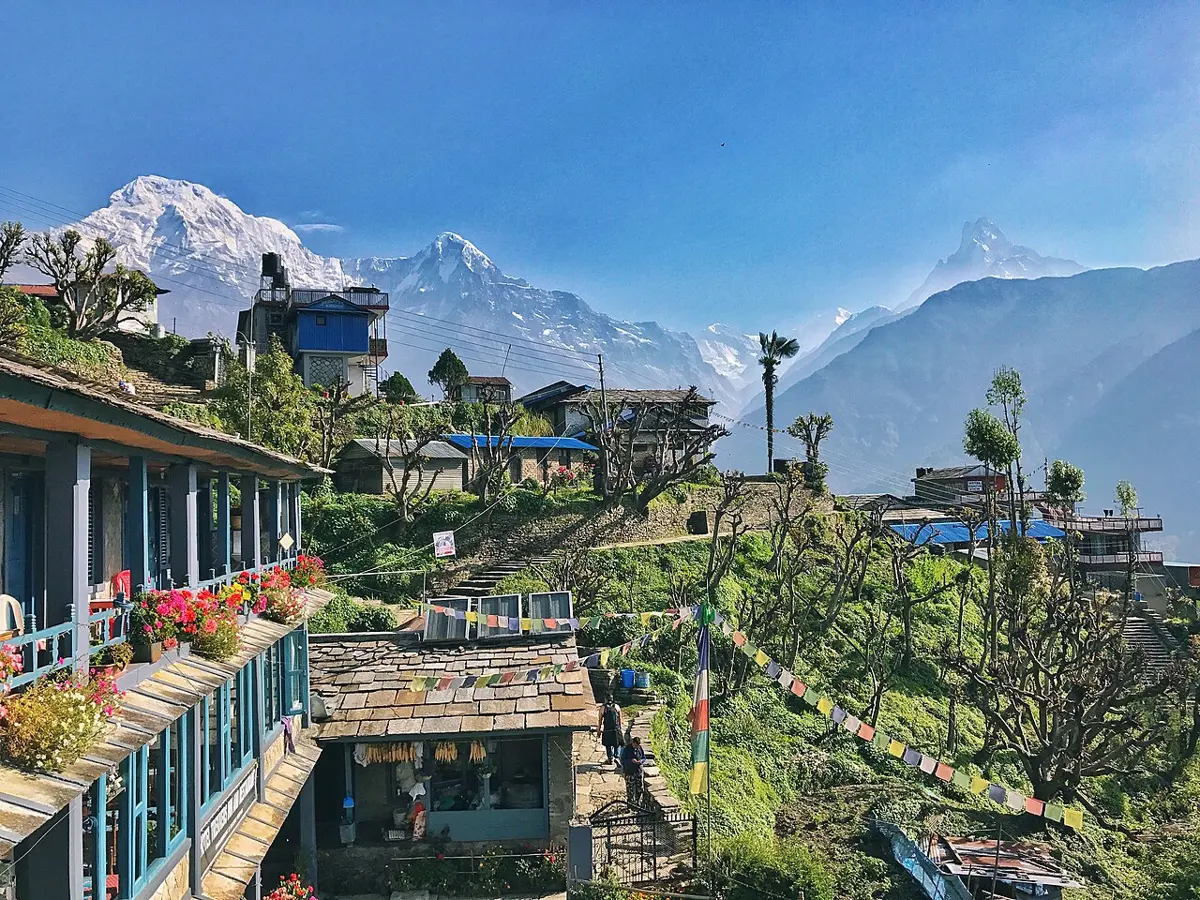
Ghandruk: busy, lonely, friendly, beautiful · Dharan’s clock tower: busy, plain, tall, beautiful
Model answers
Writing I: punctuation
A. Question mark or full stop?
A sentence that asks ends with a question mark (?). A sentence that tells ends with a full stop (.).
Be careful: some telling sentences have a question word inside them. I know where you are going. This doesn’t ask anything; it tells. So it ends with a full stop.
Add question marks or full stops to the end of each sentence.
a. Why are you crying · b. Can you pass the cup please · c. She asked me what I was doing · d. Who is your best friend · e. I don’t know where you kept your pencil case · f. When did you return from school · g. I know where you are going · h. How do you know my name · i. Please tell me what the time is · j. I want to know what you are doing
Answer
B. Where commas go
A comma (,) is a small pause. Here are six places it goes.
| Where | Example |
|---|---|
| between things in a list (not before and) | I love apples, pears, bananas and grapes. |
| around extra words about a person | Laxman, my brother, is a good dancer. |
| after yes or no | Yes, I agree. |
| after words that start a sentence | Many years ago, dinosaurs lived on the Earth. |
| before someone’s exact words | The teacher said, “Tomorrow is a holiday.” |
| before a short question at the end | It’s true, isn’t it? |
C. Add commas
Add commas where necessary.
- a.The boy said “My name is Saroj.”
- b.Gopal Prakash Prem and Raju are going to school.
- c.Roma my sister got a lot of gifts on her birthday.
- d.In 2020 Himesh won the Comedy Champion Award.
- e.She is a doctor isn’t she?
- f.No I don’t have a mobile phone.
- g.Luckily the damage was not serious.
Answer
Reading II: The International Mountain Museum
Before you read
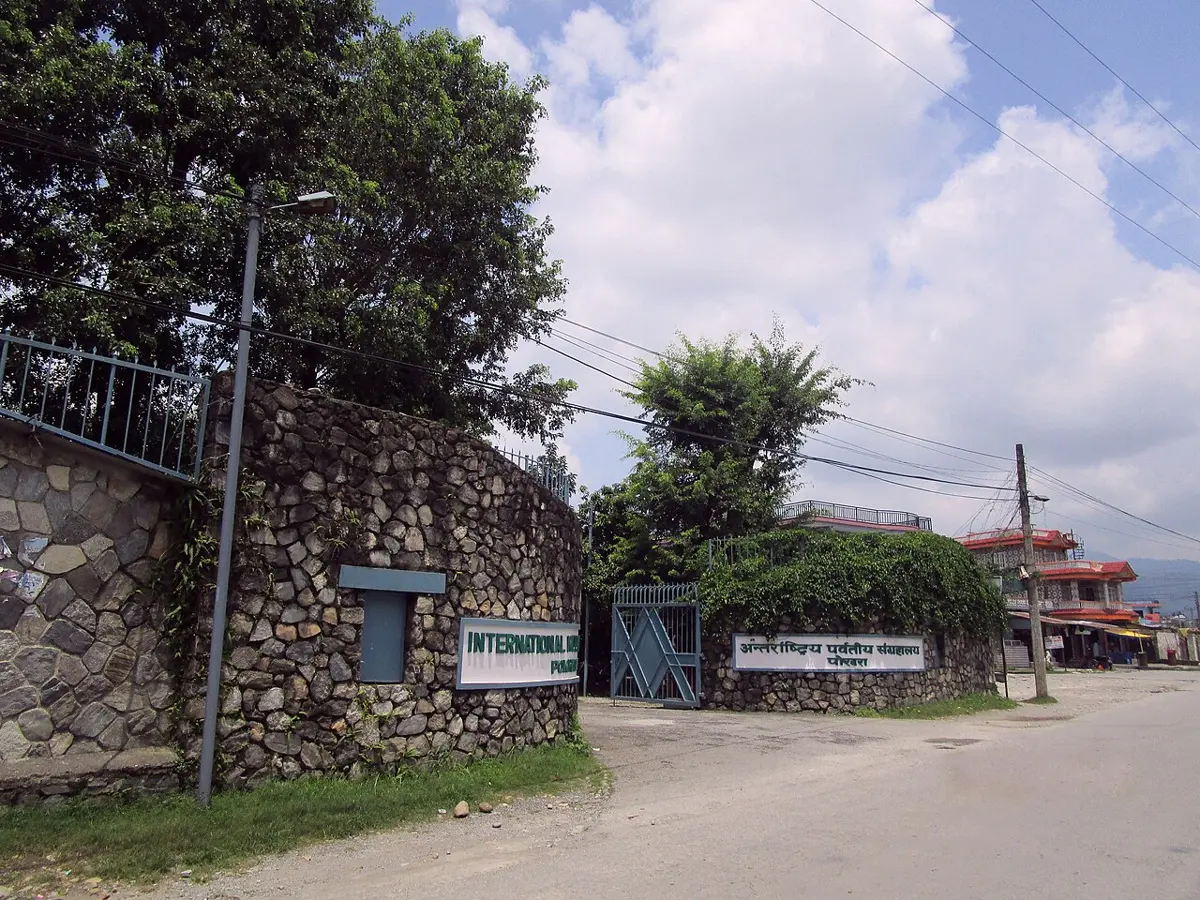
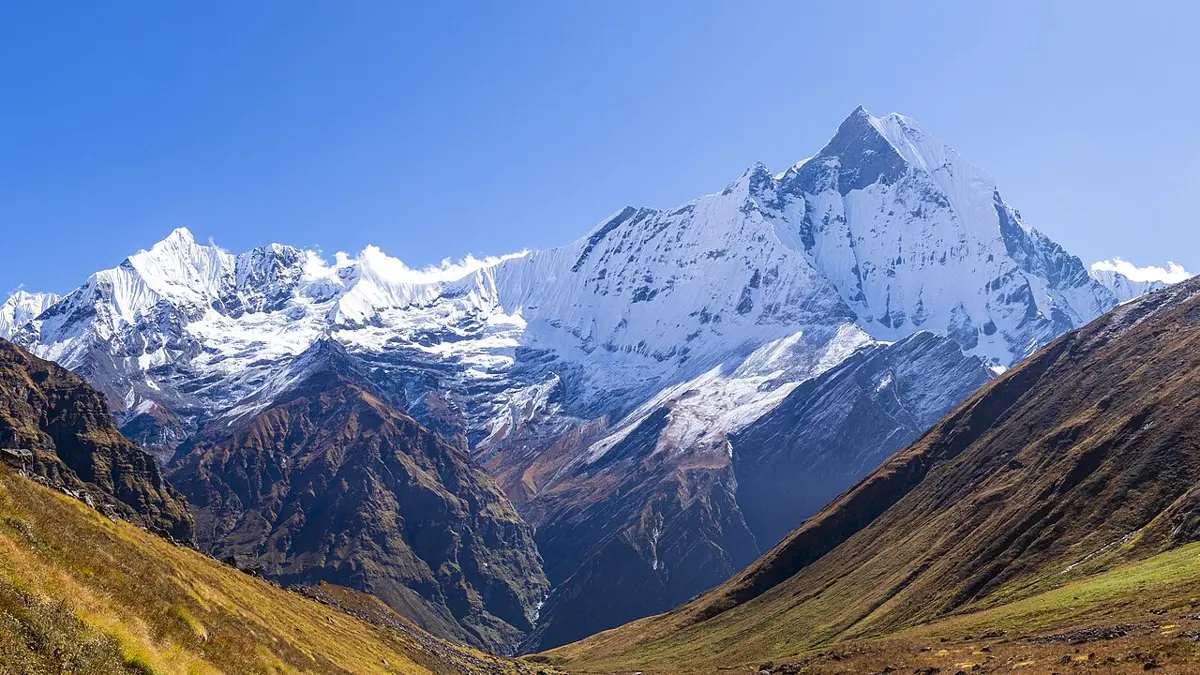
There are two pictures: a sharp snowy peak against a blue sky, and a long stone building with sloping roofs on a green lawn.
Which mountain do you think it is? Where is it?
A model answer
What do you think this place is famous for?
A model answer
The text, part by part
The text reads like a guide for visitors. It has headings, so a reader can find each fact quickly.
Introduction. The International Mountain Museum (IMM) in Pokhara is a must-see attraction (a place people visit for interest or pleasure) for mountain lovers and climbers. It shows objects and information about life and climbing high in the mountains, above 12,000 feet (about 3,700 meters). It was set up to record the story of mountaineering, then and now. More than 70,000 people visit it every year.
Location. The museum faces Machhapuchhre, about two miles (three kilometers) south-east of Lakeside. It was officially opened on February 5, 2004. It is a 10-minute drive or a 30-minute walk from Lakeside. The text says walking is better, because the paths are scenic (full of beautiful views).
Entrance fees. Foreigners pay Rs. 500, visitors from SAARC countries Rs. 250, Nepalis Rs. 100, and Nepali students Rs. 50. SAARC is a group of eight South Asian countries, Nepal among them.
Opening hours. From 9:00 a.m. to 5:00 p.m.
Major attractions. The museum has three halls.
- The Hall of Mountain People has two sections: Nepal’s mountain people, and mountain people from around the world. It tells how people live in the highlands (high, mountain lands). It also has a beautiful mandala, a round pattern with a meaning.
- The Hall of World Mountains shows the world’s highest mountains and their heights, the kinds of mountains, the wildlife that lives on them, and famous mountaineers.
- The Hall of Mountain Activities has five sections: equipment, ecology and the environment, pictures, climate change, and touch screens. It is about climbers, their tools, and the mountain climate (its usual weather).
Contact information. The text ends with the museum’s address in Ratopairo, Pokhara, its phone numbers and its email.
How much does a Nepali student pay to enter the museum?
Pick an answer to see why.
A. The word search
Find the words for these meanings in the word search. The first letter is given.
a. particular weather conditions: C… · b. a place of interest or pleasure: A… · c. having beautiful scenes: S… · d. a figure: M… · e. known by many people: F… · f. high or mountainous land: H… · g. the relation of plants and living things to their home: E… · h. a way that serves as a path: P…
Answer
Words linked here open in English Vocabulary, where you can practice them in a game.
| Word | Meaning |
|---|---|
| climate | the usual weather of a place over many years |
| attraction | a place people like to visit |
| scenic | with beautiful views |
| mandala | a round pattern with a meaning, in Hindu and Buddhist art |
| famous | known by many people |
| highlands | high, mountainous land |
| ecology | how plants, animals and their home are linked |
| pathway | a path to walk on |
B. Complete the table
Complete the table with information from the text: 1. name of the museum · 2. date of official opening · 3. entrance fee for SAARC nationals · 4. opening hours · 5. any two major attractions
Answer
C. Adjectives for the pictures
Look at the pictures in the text again. Write as many adjectives as you can to describe them.
Model answers
Grammar II: present continuous; there is, there are
What is happening now?
To say what is happening now, at this moment, we use am, is or are with a verb + -ing. This is the present continuous.
| Person | Yes | No | Question |
|---|---|---|---|
| I | I am reading. | I am not reading. | Am I reading? |
| he, she, it | She is reading. | She is not (isn’t) reading. | Is she reading? |
| we, you, they | They are reading. | They are not (aren’t) reading. | Are they reading? |
Words like now, right now, at the moment, Look! and Listen! tell us an action is happening now.
We also use it for something going on these days, even if not at this very second: We are learning fractions this week. And for something changing: The town is growing fast.
Pick the correct sentence.
Pick an answer to see why.
A. What is happening?
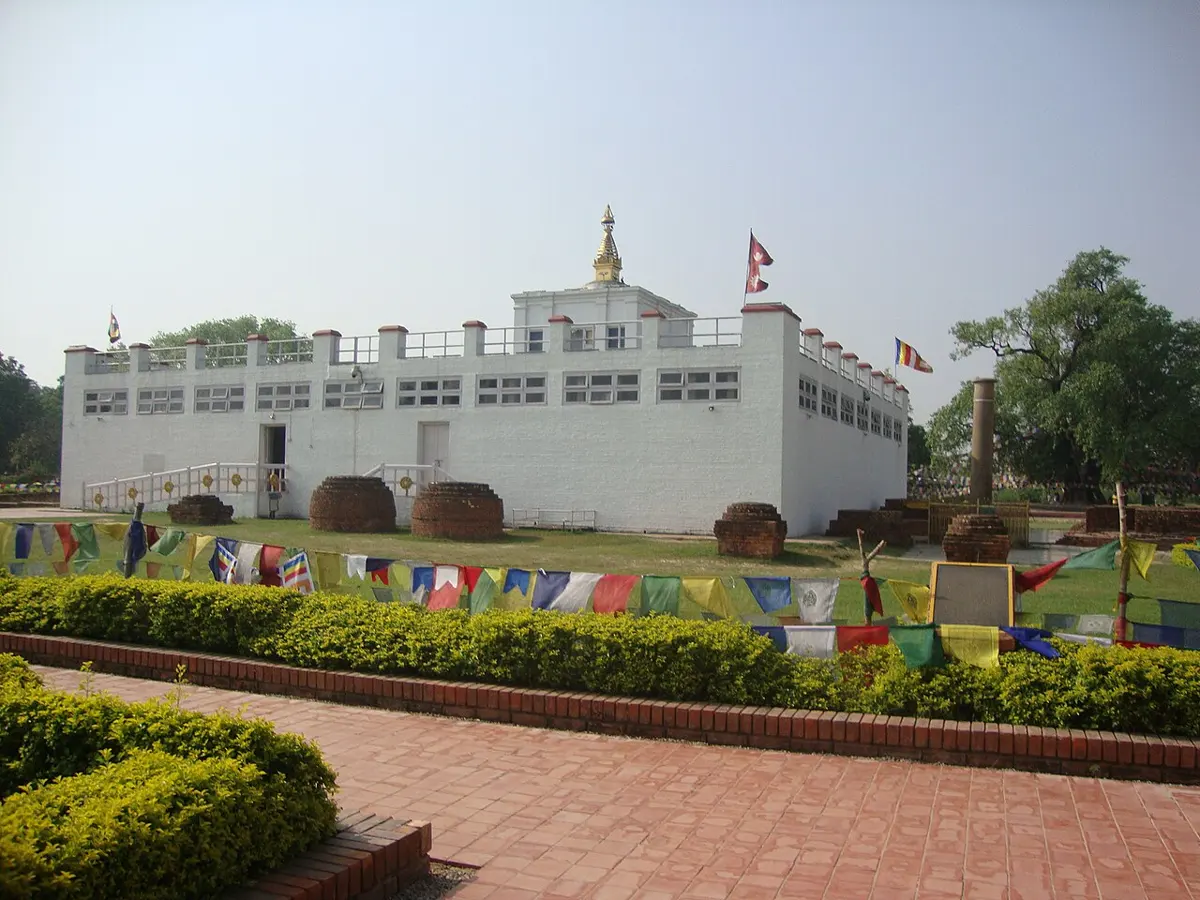
The picture shows Lumbini, the birthplace of the Buddha, in the evening. The white Maya Devi temple glows behind, and monks in orange robes sit in rows with lit candles. A boy in white sits with them.
Look at the picture. What do you think is happening? Say at least five sentences.
Model answers
B. Find the verbs
The text is about a girl called Anu. She is visiting her grandparents in the village. Right now she is sitting on her grandfather’s lap while he tells her a story, and she is happy. Her grandmother is in the garden with the plants. Her parents are busy in the kitchen: her mother with the meals, her father with the dishes.
Read the text about Anu and make a list of the verbs in the present continuous. One is done for you: a. is visiting.
Answer
C. Use the present continuous
Rewrite the sentences with the present continuous forms of the verbs in brackets. Example: Let’s go home. It ……… (not rain) now. → It is not raining now.
- a.Please don’t make a noise. I ……… (do) my homework.
- b.Listen! Somebody ……… (knock) on the door.
- c.Why ……… (you/look) outside?
- d.Excuse me, I ……… (look) for a birthday present for my sister. Can you show me a toy car?
- e.We ……… (not/go) to school today. It’s a holiday.
- f.They ……… (return) home now.
- g.What ……… (you/do) these days?
- h.The population of the world ……… (increase) day by day.
Answer
There is, there are
To say that something exists in a place, start with there is or there are.
| One thing | More than one |
|---|---|
| There is a seesaw. | There are two swings. |
| There is a tree near the gate. | There are many children. |
| Is there a slide? | Are there any benches? |
| There isn’t a pond. | There aren’t any shops. |
Use there is with a thing you can’t count, too: There is some water in the bottle. In speech, there is is often shortened to there’s.
Choose the right words: ……… three goats in the field.
Pick an answer to see why.
D. The playground
The picture shows a busy playground. It has a seesaw, swings, a merry-go-round, a sandpit, a hopscotch grid on the ground, a basketball hoop, a tire swing on a tree and monkey bars. A boy and a girl are on the seesaw, and another girl is skipping.
Look at the picture of the playground and write at least six sentences using There is … and There are …. Begin like this: There are many play things in the playground. There is a seesaw.
A model
Listening
A. Before you listen
What do you see in the picture?
A model answer
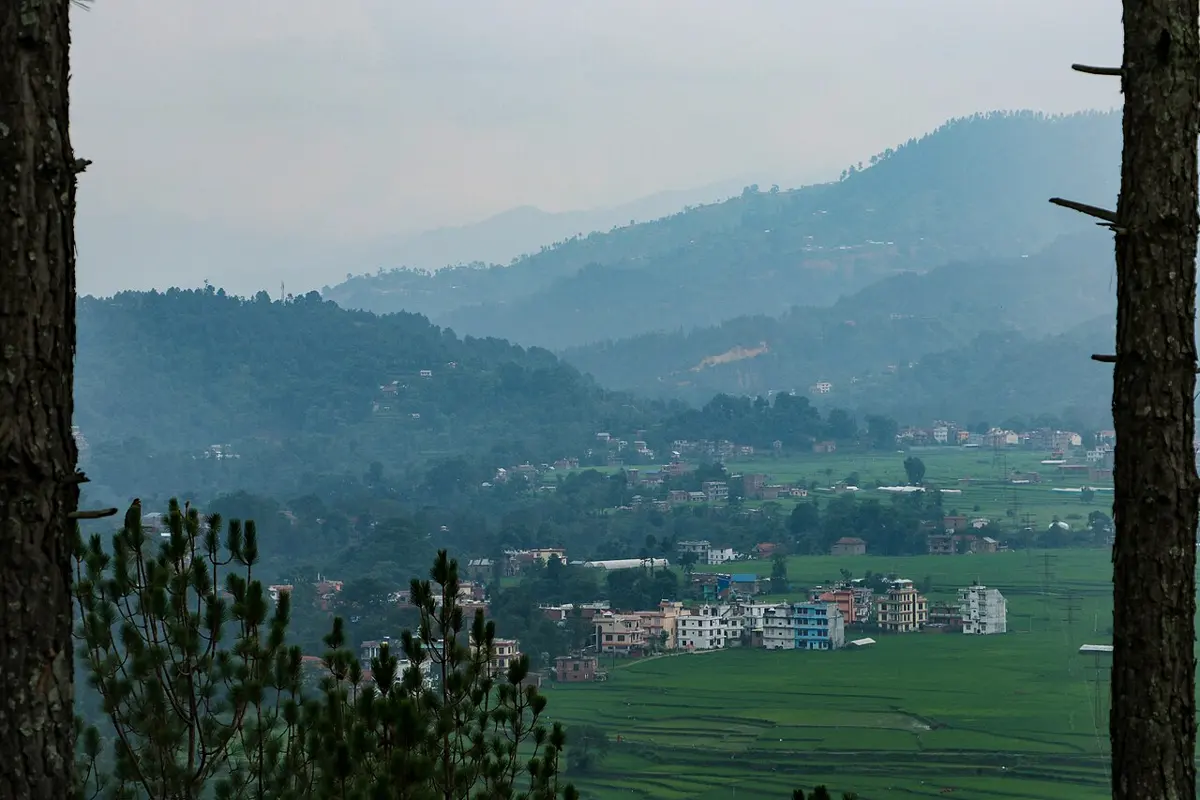
Can you guess which town it is?
A model answer
Now listen. A short talk describes Panauti. Read the sentences in B first.
B. Fill in the blanks
Listen to the audio and fill in the blanks.
- a.Panauti is a medieval ……… .
- b.The cobbled streets are surrounded by ……… and forest hills.
- c.It is situated at the confluence of the rivers ……… and Punyamata.
- d.It serves as an important religious site apart from its ……… importance.
- e.Visitors witness first-hand the local ……… .
Answer
C. Something interesting
Listen again and write one interesting thing you heard about Panauti.
Model answers
Writing II: Kupinde Lake
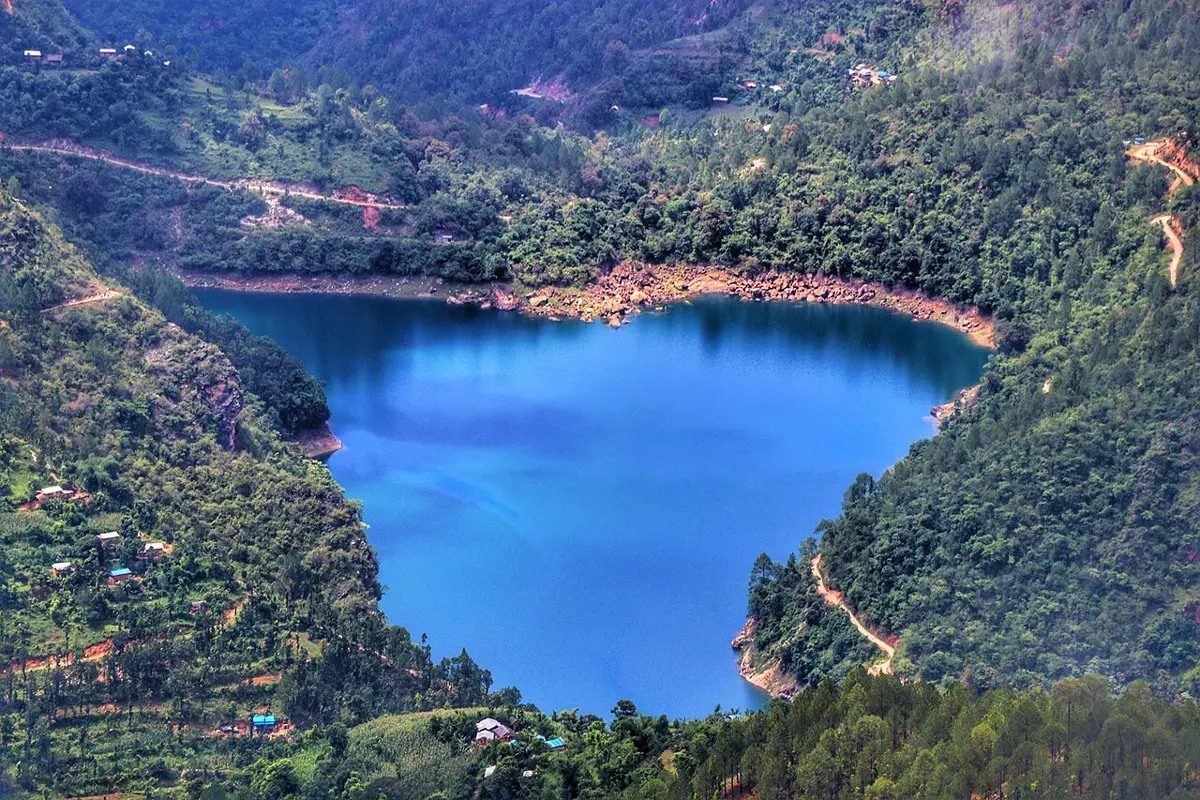
Describe Kupinde Lake using these clues: a popular tourist place · in Salyan · about 24 km west of the district headquarters · about 1,250 m long, 250 m wide and 40 m deep · surrounded by forest · changes its color three times a year · boat rides · the Barahdev temple on its bank.
A model description
Do it yourself
Exercise
Practice the whole unit. Try each one, then open the answer.
Find the adjectives: The old woman wore a long red shawl on a cold morning.
Answer
Add the punctuation.
a. Tenzing my cousin is a guide · b. Do you like momo · c. Yes I do
Answer
Put the verbs in the present continuous.
a. Look! It ……… (snow). · b. We ……… (not watch) TV now. · c. ……… she ……… (cook)?
Answer
Fill the gaps with there is or there are.
a. ……… a bank near the bus park. · b. ……… seven days in a week. · c. ……… some milk in the jug.
Answer
Who does each job? a. cooks in a restaurant · b. looks after your skin · c. puts out fires
Answer
Write two opposites from the song: the opposite of fast and of long.
Answer
Printable PDFs
- Study notes 2 pages
- Harder practice questions 2 pages Answer key
Practice every question in the book, and keep track of the ones you miss →
A companion to your textbook, not a replacement for it: study from the book your school uses, and where the two differ, follow your teacher. Found a mistake? Please tell us.