
Your friend is coming to your house for the first time. Your mother asks, “Where are your shoes?” Your teacher says, “The map is behind the door.” Every day we tell people where things are.
This unit is about describing location. Location means the place where something is. You will read about a palace on a river in Palpa, and about the clouds over your head. You will use small words like in, on, under, behind and between, and you will learn when to say in, on or at a place.
Getting started
A. Where are the things?
The unit opens with a picture of a child’s bedroom. It is full of things. Here is what you can see.
- On the left wall, there is a picture of hills and a tree.
- Higher up, a long shelf holds books and a pink piggy bank.
- A school bag hangs on a hook under the shelf.
- A desk stands in the corner. A computer, a lamp, an open book and a pencil pot are on it.
- A red chair stands in front of the desk.
- A bed is in the middle of the room. A purple dress and some CDs lie on it. A football is on the bed, near the pillow.
- A small table stands next to the bed. Some books are on it.
- A window with a blue curtain is on the right.
- A green mat is on the floor. A skateboard and a T-shirt are on the mat.
Look at the picture. Describe where the things are located. Talk about them as in the example: The picture is on the wall.
Model answers
Small words like on, under and next to tell us where things are. They are called prepositions of place. You will meet many of them in this unit.
B. Listen and sing
The song is a little girl’s pretend game: a game where you imagine things that aren’t real. When her daddy calls her, she doesn’t say “I’m in my room.” She says silly places instead.
- In the first verse, she says she is under the sea.
- In the second verse, she says she is in the window, out the door, on top of the table, and even under the floor!
- In the last verse, she is next to the fish, the little fish that swims around its bowl.
Each place is a preposition and a thing: under + the sea, next to + the fish.
The girl is in different places in the song. Name these places.
Answer
Reading I: Rani Mahal
Before you read
The picture shows a large white and blue building with many windows and a red roof. It stands on a steep hillside among green trees.
What do you think the name of the building is?
A model answer
Where is it located?
A model answer
The text, part by part
The text describes a place: where it is, what it looks like, and how to get there. Read it first. Here is what each part says.
The first part tells us where the palace is and who built it. The Rani Mahal stands right beside the Kaligandaki River, in Palpa district. Rani Mahal means “queen’s palace”. General Khadga Shumsher had it built. The work took about four years, and the palace was finished in 1893.
The second part describes the building. The palace is four storeys high, and it has about a dozen rooms (twelve rooms). The prayer room is on the eastern side, at the front. The sitting rooms are on the top floor, and the bedrooms on the middle floor. Gardens and a pond are all around the palace. Stairs go from the gate all the way down to the river. People hold the Kaligandaki as a holy river: it has religious importance.
The third part says where exactly it is. The text says the palace “is situated” 13 km north of Tansen, the main town of Palpa. Situated is a formal way of saying where a place is. It sits on a huge rock, far from noise. Visitors come in large numbers to see it, and there are hotels and camping sites nearby.
The last part tells you how to get there. A road now reaches the palace: about half an hour from Tansen by car or bus. Public vehicles leave from Narayansthan in Tansen. Or you can walk. The trail starts at Kailashnagar, near Batasedanda, about 3 km from Tansen. The walk takes about 3 to 4 hours.
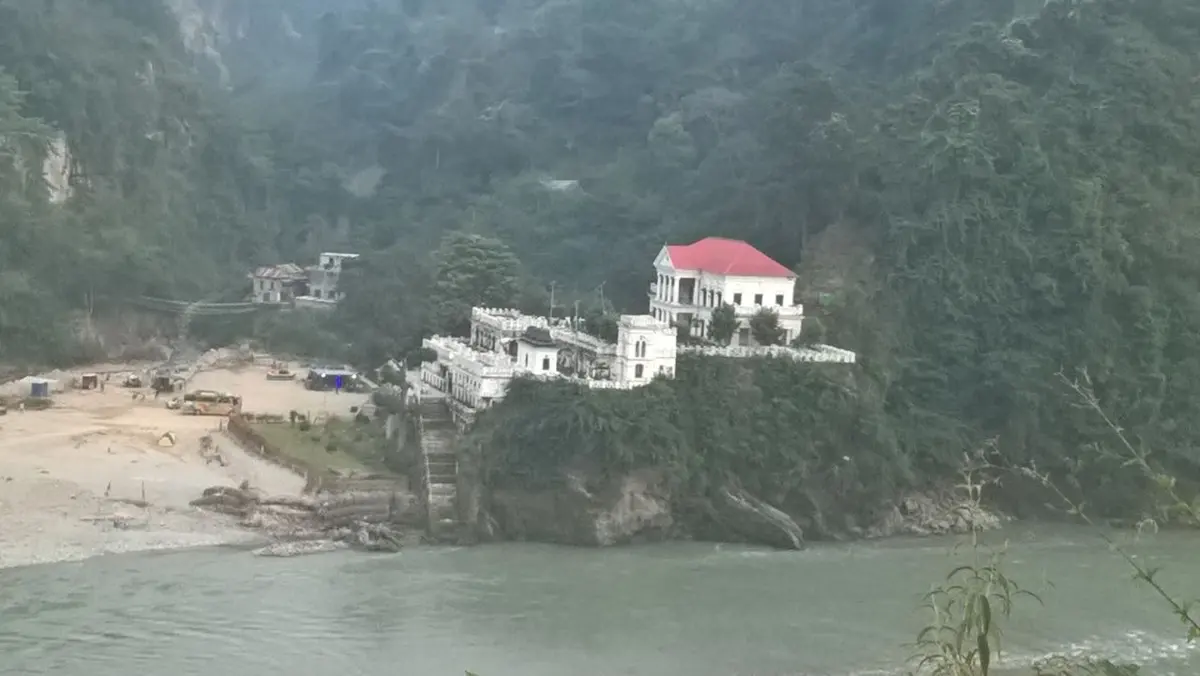
Notice how the writer describes a place. First, where it is (on the bank of a river, in which district). Next, what it is like (four storeys, gardens, a pond). Last, how to get there (by road, or on foot). You can describe any place in your own district in the same order.
Where is the Rani Mahal?
Pick an answer to see why.
Words from the text
Words linked here open in English Vocabulary, where you can practice them in a game.
| Word | Meaning |
|---|---|
| built | made or put up (a building). build → built |
| prayer | words that you say to God |
| possess | to have or own something. The river possesses religious importance means the river has it. |
| massive | very big and heavy |
| surround | to be all around something. The palace is surrounded by gardens. |
| hiking | going for long walks in the hills or the countryside |
| attractive | nice to look at |
| storey | one floor of a building. A four-storey house has four floors. (American English spells it story.) |
A. Match the words
Match the words on the left with their meanings on the right.
- a.built — i. has or owns something
- b.prayer — ii. very big
- c.possesses — iii. was all around
- d.massive — iv. words that you say to God
- e.surrounded — v. going for long walks
- f.hiking — vi. made or constructed
Answer
B. True or false?
Write True for true statements and False for false ones.
- a.Rani Mahal is on the bank of the Kaligandaki river.
- b.It took five years to build the palace.
- c.The palace has four storeys.
- d.The palace looks beautiful.
- e.You can go to the palace by motor vehicle.
Answer
C. Answer the questions
Which district does the Rani Mahal lie in?
Answer
What things are there around the palace?
Answer
What importance does the Kaligandaki River have?
Answer
How long does it take to go to the palace from Tansen in a vehicle?
Answer
D. If you visited
If you got a chance to visit the Rani Mahal, what would you like to see? Talk to your friends.
A model answer
Pronunciation
Learn to say these words. They are all about places and travel.
sites · palace · distance · massive · vehicles · hotels · landscape · motorcar
Tap each one to hear it. Then say it after the voice. The loud part, the stressed syllable, is in bold.
Two of these words often go wrong.
- Vehicle has a silent h: say VEE-uh-kl, not ve-HI-kel.
- Hotel is stressed on its end: ho-TEL. Most two-part words are stressed at the start (PAL-ace, DIS-tance, MAS-sive, LAND-scape), so hotel is an odd one.
Which part of palace is said louder?
Pick an answer to see why.
Grammar I: prepositions of place
A preposition of place tells where something is. It comes before a thing or a place: under the bed, between the trees.
| Preposition | It means | Example |
|---|---|---|
| in | inside something | Saru is swimming in the pond. |
| on | touching the top of something | The book is on the desk. |
| under | lower than something, below it | A child is hiding under the bed. |
| over | higher than something, above it, not touching | The dog is jumping over the fire. |
| in front of | at the front of something, facing it | The children are sitting in front of the TV. |
| behind | at the back of something | The blue car is behind the green car. |
| next to | at the side of, beside | The table is next to the bed. |
| between | with one thing on each side | The house lies between the trees. |
Move the ball, and watch the sentence change.
Nepal lies ___ India and China.
Pick an answer to see why.
The bird is flying ___ the house.
Pick an answer to see why.
A. Match the sentences and the pictures
There are six pictures. Here is what each one shows.
- A child is swimming under the water in a pond.
- A blue car has bumped into the back of a green car. Both face the same way.
- A small house stands with a tree on its left and a tree on its right.
- A spotted dog is jumping high above a campfire.
- Two children sit on the floor, facing a TV. We see their backs.
- A little boy is peeping out from under a bed, below the yellow cover.
Choose the correct sentences given and write them below the pictures.
- a.Look! The dog is jumping over the fire.
- b.A child is hiding under the bed.
- c.Saru is swimming in the pond.
- d.The children are sitting in front of the TV.
- e.The blue car is behind the green car.
- f.The house lies between the trees.
Answer
B. Choose the preposition
Choose the correct preposition from the brackets and complete the sentences.
- a.My dad is working ……… the kitchen. (on/in/at)
- b.I’m waiting for my friend ……… her house. (in front of/under/on)
- c.We’re playing hide and seek – I’m hiding ……… the door! (on/under/behind)
- d.I sit ……… my mum and my dad on the sofa while watching TV. (under/in/between)
- e.Can you swim ……… water? (in front of/over/in)
- f.We keep our bags ……… the desks. (over/in front of/on)
- g.Nepal lies ……… India and China. (at/in/between)
- h.Bees are flying ……… a honey pot. (between/at/over)
- i.Do not stand ……… the door. Come in. (on/in/at)
- j.The thief was hiding ……… the bed when the police came. (on/between/under)
Hint
Answer
Speaking
A. Talk about a living room
The picture shows a living room. Here is what is in it.
- A painting of a lake and hills hangs on the wall.
- A white sofa with pink cushions stands on the left. A black cat sits on the sofa, and a blue blanket lies over its arm.
- A lamp hangs from the ceiling, above a small round table.
- On the table, there is a teapot, a vase of red flowers and two cups.
- An armchair stands on the right side of the table.
- A tall bookcase stands in the corner, with a clock, books and a teddy bear on top. A plant is on top of it too.
- A big plant stands behind the sofa, between the sofa and the armchair.
- Newspapers lie on the floor next to the sofa.
- A brown cat sits on the floor, next to a red and yellow toy truck.
- A pink rug is under the table.
Look at the picture and have conversations with your friend about different things that you see. Use the prepositions in the box: in, on, at, between, under, over, in front of, behind.
Example: A: Where is the painting? B: It’s on the wall.
Model conversations
B. Your bedroom
Draw a picture of a bedroom showing all your possessions. Then, explain to your friends where your things are located.
A model answer
Writing I: my bedroom
A paragraph that describes a room goes in an order, so the reader can picture it. Start with one sentence about the room. Then move round it: from the door, left to right, or from the floor up.
Using the drawing of your bedroom above, write a paragraph explaining where various things are located in your room.
Hint
A model answer
Reading II: Clouds
Before you read
The text has two photos of the sky. In the first, thin white streaks are spread across a deep blue sky, like brush strokes. In the second, big white puffy clouds float in a blue sky.
What do you notice in the pictures?
A model answer
Go outside, look at the sky and describe the different types of clouds you see.
A model answer
The text, part by part
The text answers four questions. Each question is a heading.
What are clouds? A cloud is millions of tiny drops of water, or tiny bits of ice called ice crystals, that float high above us. Clouds come in many kinds, and they play a big part in the Earth’s weather.
How are clouds formed? The air around us always has some water in it, even on a clear day. But we can’t see it, because it is a gas, called water vapor. (British books spell it vapour.) Warm air carries the vapor up. High in the sky, the air is cooler. In the cool air, the vapor turns back into tiny drops of water. Each drop forms on a tiny speck of dust, smoke or sea salt. Millions of these tiny drops together make a cloud we can see.
What are the types of clouds? A cloud is named for two things: how high it is, and its shape. High clouds are far up in the sky. Low clouds are close to the ground, and some even touch it. A cloud on the ground is called fog. Cirrus clouds are high up and look like feathers. Cumulus clouds look like giant balls of cotton. Stratus clouds are low, and they cover the sky like a bedsheet.
What causes rain? The drops in a cloud are so small and light that they float. But sometimes they bump into each other and join. They grow into bigger drops. When a drop is heavy enough, gravity pulls it down to Earth. Falling drops of water are called rain. When it is very cold, clouds can drop sleet (rain and snow mixed), hail (balls of ice), or freezing rain.
Which clouds look like feathers?
Pick an answer to see why.
Why does a raindrop fall?
Pick an answer to see why.
Words from the text
| Word | Meaning |
|---|---|
| crystal | a small piece of something hard and clear, like ice or salt |
| vapor | (water vapor) water as a gas, which you can’t see. In everyday English, vapor is also the mist of tiny drops you see over a kettle. |
| droplet | a very small drop of liquid |
| giant | very large |
| fog | a cloud on the ground, which makes it hard to see far |
| gravity | the pull of the Earth that makes things fall down |
| sleet | rain and snow falling together |
| hail | small balls of ice that fall from clouds |
A. Match the words
Match the words in column A with their meanings in column B.
- a.crystals — i. a mixture of rain and snow
- b.vapor — ii. very large
- c.droplets — iii. small balls of ice
- d.giant — iv. small drops of liquid
- e.sleet — v. a mass of very small drops of liquid in the air
- f.hail — vi. small pieces of a substance
Answer
B. Answer the questions
Why can’t we see water in the sky?
Answer
What happens when water vapor goes higher in the sky?
Answer
Write the names of high and low clouds.
Answer
What causes the droplets to fall to the Earth?
Answer
What is the name of falling water droplets?
Answer
C. Clouds you have seen
Have you noticed various shapes of clouds in the sky? Draw and write down the shapes of clouds you have seen.
A model answer
Listening
A. Before you listen
The picture shows a big city by a river. Tall glass towers stand behind an old stone bridge with lamps.
Look at the picture and guess the answers to these questions.
- a.Which city is it?
- b.What do you see in the city?
Model answers
Now listen. Two friends, Josh and Shirley, talk about where Shirley comes from. Read the questions in B first.
B. Match
a. Shirley is …
Pick an answer to see why.
b. The nice parks in Melbourne: there are …
Pick an answer to see why.
c. A lake is …
Pick an answer to see why.
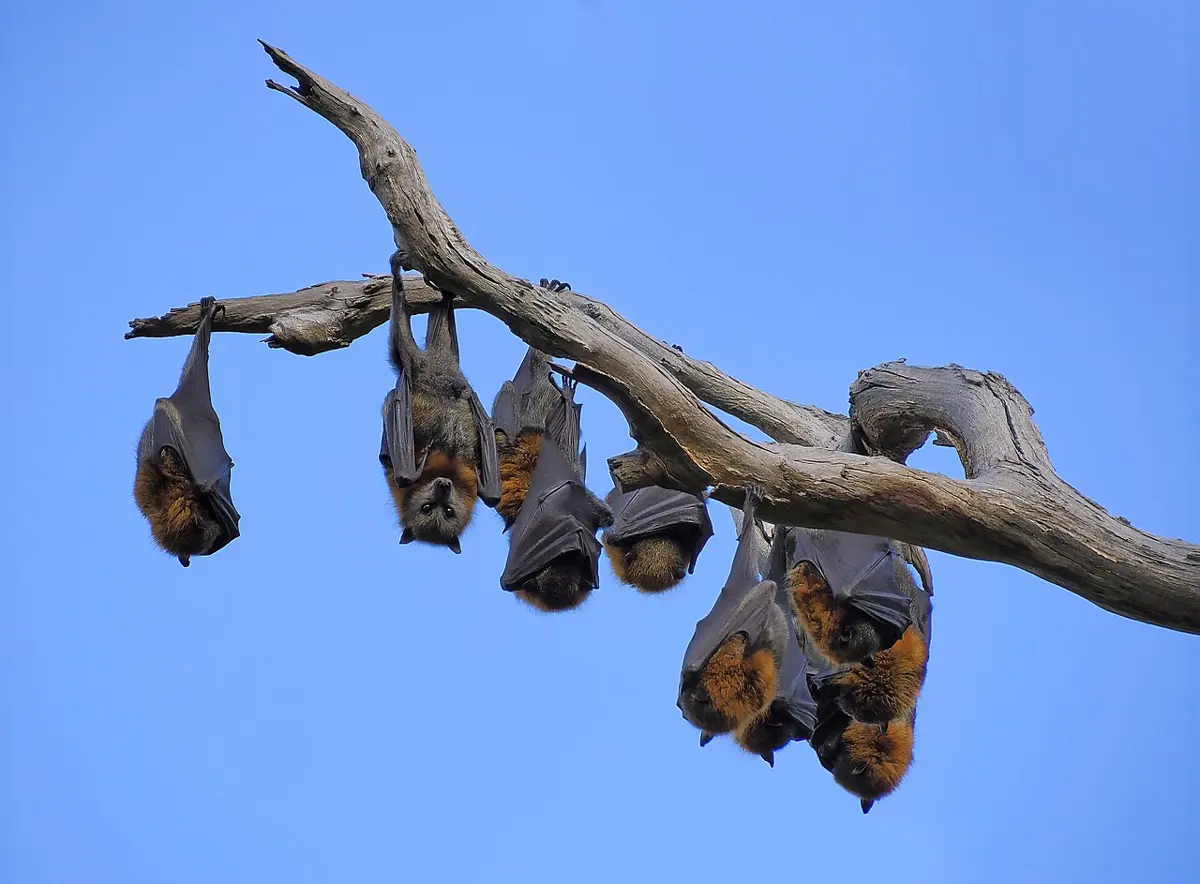
d. Fruit bats are …
Pick an answer to see why.
C. The prepositions
Listen to the audio again and list down all the prepositions you hear.
Answer
Grammar II: in, on and at for places
You learned at, on and in for times in Unit 1. They tell us about places too.
| Word | Use it for | Examples |
|---|---|---|
| in | inside a space: a box, a room, water; a town, a district, a country | in the bottle, in the kitchen, in Birgunj, in Nepal |
| on | touching a surface: a table, a wall, a page, a floor | on the table, on the wall, on page 5 |
| at | a point or a place where something happens: a building we use, a door, an event | at the airport, at the station, at the door, at school, at work |
Some fixed phrases to learn: at work, at school, at home; on the radio, on TV; at the top, at the bottom (of a page).
I’ll wait for you ___ the bus park.
Pick an answer to see why.
There is a map of Nepal ___ the wall.
Pick an answer to see why.
Complete the following sentences with in, on or at.
- a.The water is ……… the bottle.
- b.The book is ……… the table.
- c.Tenzing is ……… work.
- d.The Phewa lake is ……… Pokhara.
- e.I am listening to classical music ……… the radio.
- f.The answer is ……… the bottom of the page.
- g.She lives ……… Birgunj.
- h.I’ll meet you ……… the airport.
- i.She stood ……… the window and looked out.
- j.I waited for Rohan ……… the station.
Answer
Writing II: a living room
The picture shows another living room. Here is what is in it.
- Two small dogs sit on the rug, under a low wooden table.
- On the table, there is a pizza, some cheese, a glass of juice and a laptop.
- A red sofa stands behind the table. A cat is lying on it, next to a purple cushion.
- Behind the sofa, there is a window with purple curtains. A bird sits on the window frame.
- On the wall, high up on the left, a shelf holds books and a trophy.
- Under the shelf, a tall lamp stands next to the sofa. A guitar leans between the lamp and a plant.
- A box of toys is on the floor in front of the plant. A teddy bear peeps out of it.
- On the right, a picture of the sea hangs on the wall. A fishbowl and a plant stand on a small table under it.
- A TV stands on a low cupboard in the right corner. A bag and a racket lean against the cupboard.
This is a picture of a living room. Look at the picture and write, in a paragraph, where things are located. The start of the paragraph has been given.
This is a living room. There are two dogs under the table. There …
Hint
A model answer
Do it yourself
Exercise
Practice the whole unit. Try each one, then open the answer.
Choose the right preposition.
- a.The cat is sleeping ……… (under / between) the bed.
- b.Our school is ……… (between / over) the bank and the temple.
- c.A plane flew ……… (on / over) our house.
- d.Please wait ……… (in front of / in) the gate. I’ll come out.
- e.The broom is ……… (behind / on) the door.
Answer
Complete with in, on or at.
- a.My uncle lives ……… Dhangadhi.
- b.There is a picture of Lumbini ……… page 20.
- c.Mother is ……… home today.
- d.We heard the news ……… the radio.
- e.The milk is ……… the jug.
Answer
Answer about the Rani Mahal.
- a.What does Rani Mahal mean?
- b.How far is it from Tansen?
- c.How long is the walk from near Tansen?
Answer
Name the cloud.
- a.It looks like a feather, high in the sky.
- b.It covers the sky like a bedsheet.
- c.It is a cloud lying on the ground.
- d.It looks like a giant cotton ball.
Answer
Write three sentences about where things are in your kitchen.
Model answers
Printable PDFs
- Study notes 2 pages
- Harder practice questions 2 pages Answer key
Practice every question in the book, and keep track of the ones you miss →
A companion to your textbook, not a replacement for it: study from the book your school uses, and where the two differ, follow your teacher. Found a mistake? Please tell us.