
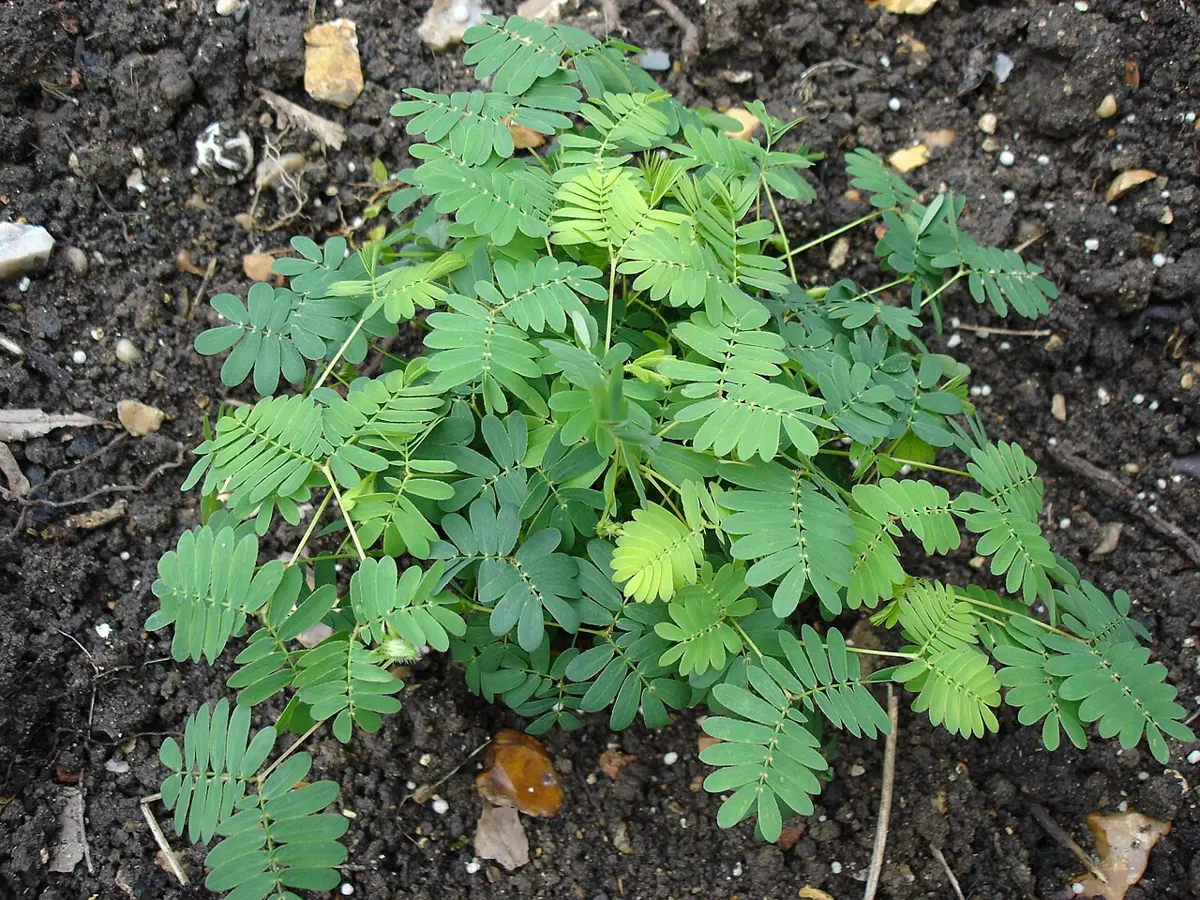
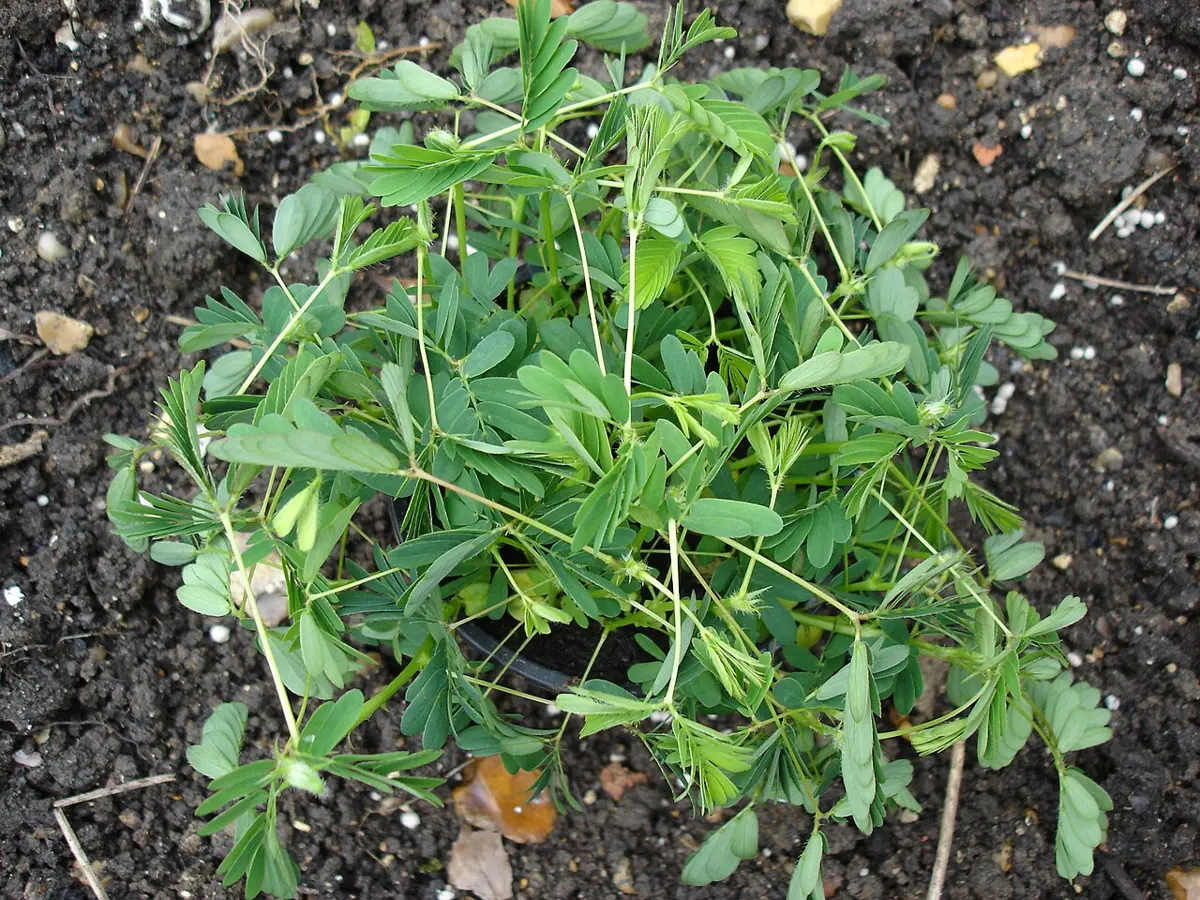
Touch a lajjawati (Mimosa pudica) growing by a path in the Tarai, and in two or three seconds its leaflets fold up in pairs and the whole leaf droops, as if it had fainted. A few minutes later it slowly opens again. The plant has no muscle and no nerve, yet it felt the touch, passed a signal along the leaf, and moved.
Most plant movements are much slower: a shoot turning to a window over a day, a root bending round a stone over a week, a bean’s tendril winding round a stick. They are easy to miss, because they happen at the speed of growth. This unit follows a plant through its life: how a seed wakes up, why some seeds wait, how a plant knows the season from the length of the night, how it grows old and drops its leaves, and how it moves.
2.5.1 Seed germination
A seed is a mature ovule, formed after fertilization. Its outer covering, the seed coat, protects it; the coat’s outer layer is the testa and the thin inner layer below it the tegmen. A small pore, the micropyle, lets water into the seed. The hilum is the scar where the seed broke away from its stalk (the funicle) on the ovary wall. Inside is the embryo: one or two cotyledons (seed leaves), the radicle (the young root) and the plumule (the young shoot). Many seeds also hold an endosperm, a food store; in others (bean, gram, pea) the food is stored in the cotyledons and the endosperm is absent.
A seed that is ripe and alive but doesn’t start growing is dormant. Given the right conditions, its embryo takes up growth again and develops into a seedling. Germination is the irreversible process by which the embryo in a seed becomes active and grows into a new seedling: the reactivation of the seed’s metabolic machinery, ending in the emergence of the radicle and plumule. For a seed to germinate it needs favorable conditions: enough water, a suitable temperature, oxygen, and for some seeds light.
The process of seed germination
Germination starts with the uptake of water by the dry seed (imbibition) and is complete when part of the embryo, usually the radicle, pushes out through the structures around it. The main events and needs:
- Imbibition. The dry seed absorbs water, mostly through the micropyle and the seed coat. It swells, the seed coat bursts, and the water activates hydrolytic enzymes, which convert the stored food (starch, proteins, fats) into substances the embryo can use (sugars, amino acids). A seed soaking up water swells with great force: a jar packed with dry peas and water can crack.
- Respiration. The embryo’s growth runs on energy from respiration, so germinating seeds respire very fast and need plenty of oxygen. A seed buried too deep, or in waterlogged soil, is starved of oxygen and can’t germinate. That is why seeds are sown shallow and fields drained.
- Light. Most seeds are unaffected by light or darkness. But many seeds, including many species of forest floors, won’t germinate until a gap in the canopy lets in enough light for a seedling to grow. Small seeds such as lettuce and tobacco need light (you met this in Unit 5).
- Temperature. Temperature sets the speed of the cell’s chemistry. Each kind of seed germinates within a range of temperature, not above or below it. Many seeds germinate well at about 16–24 °C; most common vegetables germinate best at 24–32 °C, though some, such as radish and spinach, germinate at temperatures as low as 4 °C, so they can be sown in cool weather and in the hills.
- Scarification. Some seeds have such a hard coat that it must be weakened before water can enter. In nature this happens through fire (many Australian plants), long soaking in water, or passing through an animal’s gut. Farmers and nurseries scarify such seeds by hand: rubbing them on sandpaper, nicking the coat, or dipping them briefly in hot water or acid.
- Mobilization of reserves, and hormones. As the embryo grows, its stored food is digested and carried to the growing points. Abscisic acid (ABA) keeps seeds from germinating; gibberellins break dormancy and promote germination, among other ways by switching on α-amylase in cereal grains (Unit 5).
- Development of the embryo axis into a seedling. The embryo’s axis has two parts: the hypocotyl, below the point where the cotyledons are attached, which ends in the radicle; and the epicotyl, above it, which ends in the plumule. The radicle comes out first and grows down into the soil as the root; then the plumule grows up into the shoot.
Types of seed germination
The difference between the two common types is which part of the axis grows first and longest, and so where the cotyledons end up.
Hypogeal germination (Greek hypo, below; ge, earth): the cotyledons stay below the ground. The epicotyl (the part of the axis between the cotyledons and the plumule) grows long, while the hypocotyl stays short, so the epicotyl pushes the plumule up out of the soil and leaves the cotyledons behind. Examples: gram and pea among dicots; maize, rice and wheat, as most monocots, whose single cotyledon (the scutellum) stays in the grain.
Epigeal germination (Greek epi, upon): the cotyledons are pushed above the ground. The hypocotyl grows long, often as a hook that pulls the cotyledons up out of the soil, while the epicotyl stays short. In castor, cotton, papaya and onion, the cotyledons become flat, green and leaf-like in the young seedling, and besides storing food they photosynthesize until the seedling can feed itself. In others, such as the common bean, the cotyledons are thick and never become leaf-like; they shrivel and fall off once the seedling has used their food. Other examples: sunflower, pumpkin, watermelon, cucumber and other gourds, and some lilies.
Bean: É. Deyrolle, wall chart "Graine. Germination" (c. 1900), public domain
Pea: J. M. Macfarlane, The Causes and Course of Organic Evolution (1918), public domain
In a pea seedling, the cotyledons stay under the soil while the plumule comes up. Which part of the axis grew long?
Pick an answer to see why.
Vivipary (viviparous germination)
Vivipary means giving birth to young at an advanced stage of development. Among animals, mammals are viviparous. Among plants, it is shown by many mangroves, trees of salty, muddy tidal coasts. The ground there is too salty and too poor in oxygen for a seed to germinate, and the seeds have no dormancy: they germinate while the fruit is still attached to the parent plant. Examples: Rhizophora, Bruguiera, Kandelia and Ceriops.
The embryo goes on growing inside the fruit on the tree. The hypocotyl elongates and pushes the radicle out of the seed and the fruit, and keeps growing until the hypocotyl and radicle together are tens of centimeters long (in some Rhizophora species up to about 70 cm). This seedling, the propagule, is heavy at its root end. It breaks away from the fruit and drops. On soft mud at low tide it may lodge upright, root end down, with the plumule above the water; the radicle quickly grows new roots and anchors the seedling as a new plant. Most, though, fall into water and float, sometimes for months, until they are stranded on mud, where they root.
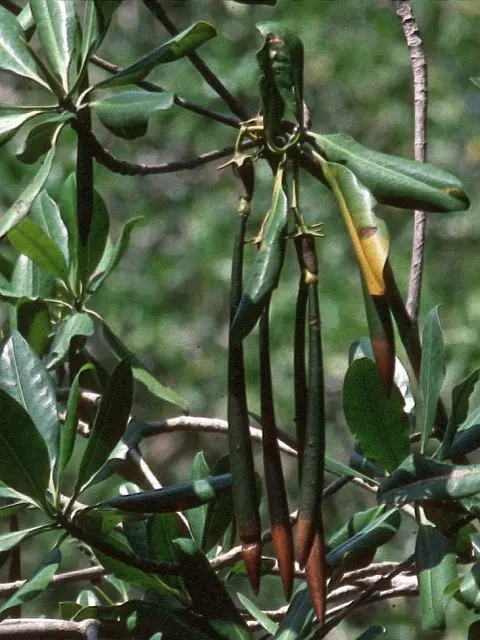
Nepal has no coast and no mangroves; the nearest are the Sundarbans, on the delta of the Ganga and Brahmaputra in India and Bangladesh, the largest mangrove forest in the world.
Why do mangroves such as Rhizophora germinate while the fruit is still on the tree?
Pick an answer to see why.
2.5.2 Seed dormancy
Seed dormancy is the failure of a viable seed (one that is alive) to germinate even when given favorable conditions. Under good conditions of moisture, temperature and air, seeds of some fruits, such as mango and citrus, germinate readily (a mango seed can sprout inside a fallen fruit). Seeds of others, such as apple, pear and cherry, don’t germinate even in good conditions: they are dormant. Dormancy is a survival mechanism: the seed doesn’t germinate until bad conditions (a cold winter, a dry season) are over. It is caused by many factors, and can last indefinitely unless the seed is given a specific treatment.
Some kinds of seed dormancy:
a. Physical dormancy (seed coat dormancy). The seed coat or covering becomes hard, fibrous or mucilaginous (gummy) as the seed dries and ripens, and is then impermeable to water and gases, so the processes that start germination can’t begin. It is common in drupes with a hard endocarp (olive, peach, plum, apricot, cherry), in nuts with a hard shell (walnut, pecan), and in the legume family (Leguminosae), where the outer seed coat hardens, becomes suberized and is impervious to water. Scarification breaks it.
b. Mechanical dormancy. The covering is strong enough to stop the radicle growing out, even though water can enter: the shells of walnuts, the pits of stone fruits and the stones of olives are too strong for the embryo to expand through.
c. Chemical dormancy. Inhibiting chemicals build up in the fruit and seed coverings as they develop, and stay with the seed after harvest. It is common in fleshy fruits and fruits whose seeds lie in juice: citrus, cucurbits, stone fruits, pear, grapes and tomatoes. Inhibitors include various phenols, coumarin and abscisic acid, which can strongly inhibit germination. (A tomato seed doesn’t sprout inside the juicy fruit, but washed and dried, it does.) Washing or soaking removes the inhibitors.
d. Morphological dormancy. The embryo is underdeveloped in size, though already differentiated into cotyledons and hypocotyl–radicle, when the seed is shed. Such embryos aren’t physiologically dormant; they simply need time to grow before the seed can germinate. Example: celery (Apium graveolens).
(The commonest kind of all is physiological dormancy, in which the embryo itself is held back by its hormones, mainly a high ABA to gibberellin ratio. The seeds of apple, pear and cherry need weeks of moist cold before they germinate, as they would get in a winter; nurseries give them this as stratification, in moist sand in a cold store.)
Advantages of seed dormancy
- It ensures the survival of the plant through bad conditions: the seed waits as a seed, which is far tougher than a seedling.
- It makes seed banks possible: seeds can be stored for years, by farmers between seasons and by gene banks for decades.
- It helps synchronize germination: seeds wait for the same signal (the end of winter, the first rains), so a population of plants reaches the same stage together and can cross-pollinate.
- It helps seed dispersal: seeds stay dormant while they travel, and some seed coats are scarified by passing through an animal’s or bird’s gut, which both carries them and readies them to germinate.
Seeds of gram and other legumes often fail to germinate because their seed coat is hard and won’t let water in. What kind of dormancy is this?
Pick an answer to see why.
2.5.3 Photoperiodism
Rice in the Tarai flowers in autumn, as the days shorten; wheat in the same field flowers in spring, as they lengthen. Many plants time their flowering by the length of the day and night. Photoperiodism is the response of plants to the relative length of day and night (the photoperiod), shown above all in flowering. It was discovered in 1920 by two American scientists, W. W. Garner and H. A. Allard, who found that a giant tobacco, Maryland Mammoth, flowered in their summer fields only if moved into a greenhouse for the short days of winter.
Plants fall into three groups by their response to photoperiod:
1. Short-day plants (SDP). These flower when the day is shorter than a critical length: typically they need a short light period (about 8–10 hours) and a continuous dark period of about 14–16 hours. They are also called long-night plants, because what they really measure is the night. Examples: rice, coffee, soybean, tobacco (Maryland Mammoth) and chrysanthemum. In short-day plants the dark period is critical and must be continuous: if it is interrupted by a brief flash of red light (wavelength 660–665 nm), the plant won’t flower. Making the continuous dark period longer brings flowering on earlier.
2. Long-day plants (LDP). These flower when the day is longer than a critical length: they need a long light period (about 14–16 hours) in each 24 hours. They are also called short-night plants. Examples: wheat, radish, cabbage, sugar beet and spinach. In long-day plants the light period is critical: a brief flash of red light in the middle of the dark period, or a longer light period, promotes flowering.
3. Day-neutral plants (DNP). These flower whatever the photoperiod, from 5 hours to 24 hours of continuous light. Examples: tomato, cotton, sunflower, cucumber, peas and some varieties of tobacco.
The leaves sense the photoperiod, with a pigment called phytochrome, which red light switches to its active form and far-red light switches back. (A red flash that breaks a short-day plant’s night can be canceled by a far-red flash just after it.) The signal to flower is then carried from the leaves to the shoot tip.
Differences between short-day and long-day plants
| Short-day plants | Long-day plants |
|---|---|
| Flower when the photoperiod is less than the critical day length. | Flower when the photoperiod is more than the critical day length. |
| Interrupting the light period with darkness doesn’t prevent flowering. | Interrupting the light period with darkness prevents flowering. |
| Flowering is prevented if the long dark period is interrupted by a flash of light. | Flowering occurs (is even promoted) if the dark period is interrupted by a flash of light. |
| A long, continuous, uninterrupted dark period is critical for flowering. | The dark period is not critical; a short night is enough. |
| Don’t flower in cycles of a short day with a short night (the night shorter than they need). | Flower in cycles of a short day followed by a still shorter dark period. |
| Examples: rice, soybean, chrysanthemum, coffee. | Examples: wheat, radish, spinach, sugar beet. |
A short-day plant is kept on 10-hour days, but each night it is given a one-minute flash of red light at midnight. What happens?
Pick an answer to see why.
2.5.4 Senescence
Plants, like people, grow old and die. Aging is the sum of the changes in a whole plant or its organs over time, chemical and structural. Aging leads to senescence, the final phase of development, which ends in death.
Senescence is the set of deteriorating processes that naturally end the functional life of an organ, an organism or another living unit. Its main feature is that metabolism turns catabolic (breaking down rather than building), and the changes eventually become irreversible and end in death. Senescence isn’t confined to the whole plant: it may affect one organ, such as a leaf or a flower, or single cells or organelles. A wheat plant that dies after its grain ripens is the senescence of a whole plant; the fall of an old frond from a coconut palm is the senescence of an organ.
Types of senescence
A. C. Leopold (1961) described four patterns of senescence in plants:
a. Overall senescence (whole-plant senescence): in annuals the whole plant dies after it has formed fruits and seeds. Examples: paddy, wheat, soybean.
b. Top senescence (shoot senescence): the parts above the ground (the shoot system) die each year, but the roots and underground stems stay alive and send up new shoots. Examples: dock (Rumex), and many perennial herbs, such as ginger and turmeric, whose leafy shoots die back each winter while the rhizome lives on.
c. Deciduous senescence (simultaneous or synchronous senescence): in deciduous woody plants all the leaves die at once, but the stem and roots stay alive. Example: the leaf fall of deciduous trees in autumn or the dry season.
d. Progressive senescence (sequential senescence): the old leaves die gradually, from the base of the plant to the top, at any time of year. Example: the leaf fall of a coconut palm.
Causes of senescence
- A senescing leaf loses its chlorophyll, RNA and enzymes early.
- The cell’s contents decrease, because they are made more slowly or broken down faster.
- Competition for nutrients between the vegetative and the reproductive organs: developing fruits and seeds draw nutrients away from the leaves.
- A senescence factor (a hormone) made in the fruits of soybean moves to the leaves and makes them senesce.
- Short days and long nights bring on flowering and leaf senescence in many plants.
- In seeds, food reserves break down and the storage cells lose their integrity.
- Senescence is controlled by hormones: ethylene and abscisic acid speed it up; cytokinins delay it (the Richmond–Lang effect in Unit 5).
Significance of senescence
- In monocarpic plants (which flower once and die, such as wheat, rice and bamboo), whole-plant senescence comes with seed setting and seed dispersal.
- As an abscission layer forms, older leaves fall, and the nutrients go to the young leaves.
- Senescence mobilizes nutrients from the vegetative parts into the fruits: much of the nitrogen in a wheat grain comes from the dying leaves.
- By letting organs senesce, plants escape seasonal hardship: deciduous trees shed their leaves, which cuts water loss by transpiration in a dry or frozen season.
2.5.5 Abscission
The shedding of leaves, flowers and fruits is called abscission. It is most striking in deciduous trees and shrubs: all the leaves fall at about the same time, leaving the plant bare. In evergreen plants the leaves fall gradually: older leaves drop while new ones form all through the year. In most herbaceous plants, though, the leaves aren’t shed even after they die; they stay on, withered and dry, even after the whole shoot is dead.
Abscission is a complex physiological process. Before a leaf falls, its color changes: the chlorophyll is broken down (letting the yellow carotenoids show) and some leaves make red anthocyanin. Leaf abscission happens at the base of the petiole, at a distinct zone, the abscission zone, often pale or brown, made of one or more layers of small cells across the petiole base: the abscission layer (separation layer).
- The cells of the abscission layer separate from each other as the middle lamella and the primary cellulose walls are dissolved by the enzymes pectinase and cellulase (switched on by ethylene; auxin from a healthy leaf holds them back).
- The petiole is then held to the stem only by its vascular strands, and the leaf’s own weight or the wind breaks them; the leaf falls.
- The broken vessels are soon plugged with tyloses or gums.
- The cells on the stem side of the break heal the wound by forming a corky layer (a protective layer, with suberin and lignin made in its walls), which keeps out disease and stops water loss. The scar left on the stem is the leaf scar.
Significance of abscission
- It lets water and nutrients go to the young leaves.
- It is a self-pruning process, by which ripe fruits and injured organs are shed.
- It helps disperse fruits and vegetative propagules.
- It removes plant parts that have collected waste materials.
Which enzymes dissolve the walls of the abscission layer so that a leaf can fall?
Pick an answer to see why.
2.5.6 Vernalization
Winter wheat is sown in autumn; it grows a little, lies under the cold through winter, and flowers in spring. Sown in spring instead, the same wheat grows leaves all summer and flowers late or not at all: it needs the winter cold to flower. Vernalization (Latin vernalis, of spring) is the process by which flowering is promoted by a cold treatment given to a fully hydrated (soaked) seed or to a growing plant. Dry seeds don’t respond to cold. It was made famous in the 1920s and 1930s by the Soviet agronomist Trofim Lysenko, who called it yarovization (Russian yarovoy, spring crop). Vernalization shortens the vegetative period, so the plant flowers early. Plants that need it and don’t get it flower late or stay vegetative, often as rosettes with no elongated stem (cabbage, carrot and radish grown as biennials, sugar beet, henbane).
Process of vernalization
The seeds are soaked and allowed to germinate a little, then given a cold treatment at 0–5 °C, for a few days to many weeks. After the cold, the seedlings are dried for a while and then sown. Vernalization prepares the plant to flower when the right photoperiod comes.
- The cold is usually sensed by the shoot apex (apical meristem). In some species any dividing cells can sense it: in honesty, Lunaria biennis, even leaf cuttings that are given the cold and then form new shoots go on to flower.
- The vernalized state can be passed from one plant to another by grafting: a non-vernalized plant grafted to a vernalized one flowers. It was proposed that the cold makes the plant produce a hormone, named vernalin. No such substance has ever been found; vernalin is a name for an unknown stimulus. (In the plant studied best, Arabidopsis, the cold slowly switches off a gene, FLC, that blocks flowering, and the cell remembers that it has been switched off as it divides.)
- The age of the plant matters: the response to cold differs with age and species.
- The best temperatures are just above freezing, about 1–6 °C. From about 7 °C upwards the response falls, and about 12–14 °C is almost ineffective.
- Vernalization is an aerobic process that needs metabolic energy: without oxygen, cold treatment has no effect. Enough water is essential too: dry seeds can’t be vernalized.
Significance of vernalization
- It shortens the vegetative period of the plant, so it flowers early.
- It increases the plants’ resistance to fungal diseases.
- It increases their cold resistance.
- In biennials, it brings on early flowering and fruit setting in the first year.
- Since the stimulus passes through a graft, flowering can be induced by grafting, which is used in horticulture.
- It helps in crop improvement: a winter crop can be sown in spring, and crops grown where winters are too short or mild.
Seeds are given a cold treatment, but no flowering response follows. Which of these could explain it?
Pick an answer to see why.
2.5.7 Plant movement
Every part of a plant, its roots, leaves and stems, can move, and in fact moves all the time. Plant movements are mostly seen as bending, turning, twisting, or the lengthening of parts.
Vital movements are the movements of living plants, brought about by the irritability of protoplasm (its ability to respond). Those of plant parts are of two types: autonomic movements, which happen by themselves, and induced (paratonic) movements, set off by an outside stimulus. (A third kind, movement of locomotion, is the movement of a whole organism from place to place: the swimming of Chlamydomonas or of sperm cells, and the streaming of cytoplasm inside a cell. When a whole swimming organism moves towards or away from a stimulus, it is called taxis: Chlamydomonas swims towards light, phototaxis.)
a. Autonomic movements
Autonomic movements take place without any external stimulus: they are caused from within. They include growth movements and movements of variation.
i. Autonomic growth movements
These are caused by unequal growth in different parts of an organ, so they are irreversible, and they don’t depend on the plant’s surroundings. There are four kinds:
Nutation. The growing stem of a twiner (pea, bean) nods from side to side: the apex grows faster on one side, then a little later on the opposite side. Since the zone of faster growth travels round the growing tip, which keeps growing upwards, the tip swings round and round, always in the same direction for the same species.
Circumnutation. In spirally growing stems and in tendrils, the zone of faster growth passes gradually round the growing point, and the stem or tendril coils in a spiral. Charles Darwin and his son Francis traced the paths of growing tips on glass, dot by dot, for months, and showed in The Power of Movement in Plants (1880) that nearly every growing tip circumnutates.
Epinasty and hyponasty. These are non-directional movements: the response is set by the structure of the organ, not the direction of any stimulus. They are shown mostly by young leaves and other dorsiventral organs (with a distinct upper and lower side).
- Epinasty is faster growth on the upper (adaxial) side, so the organ curves down and outwards: the opening of leaves, and the downward bending of leaves of a tomato plant given ethylene.
- Hyponasty is faster growth on the lower (abaxial) side, so the organ curves up and inwards: the circinate coiling of a young fern frond (the fiddlehead), and the closed sepals and petals of a flower bud.
ii. Autonomic movements of variation
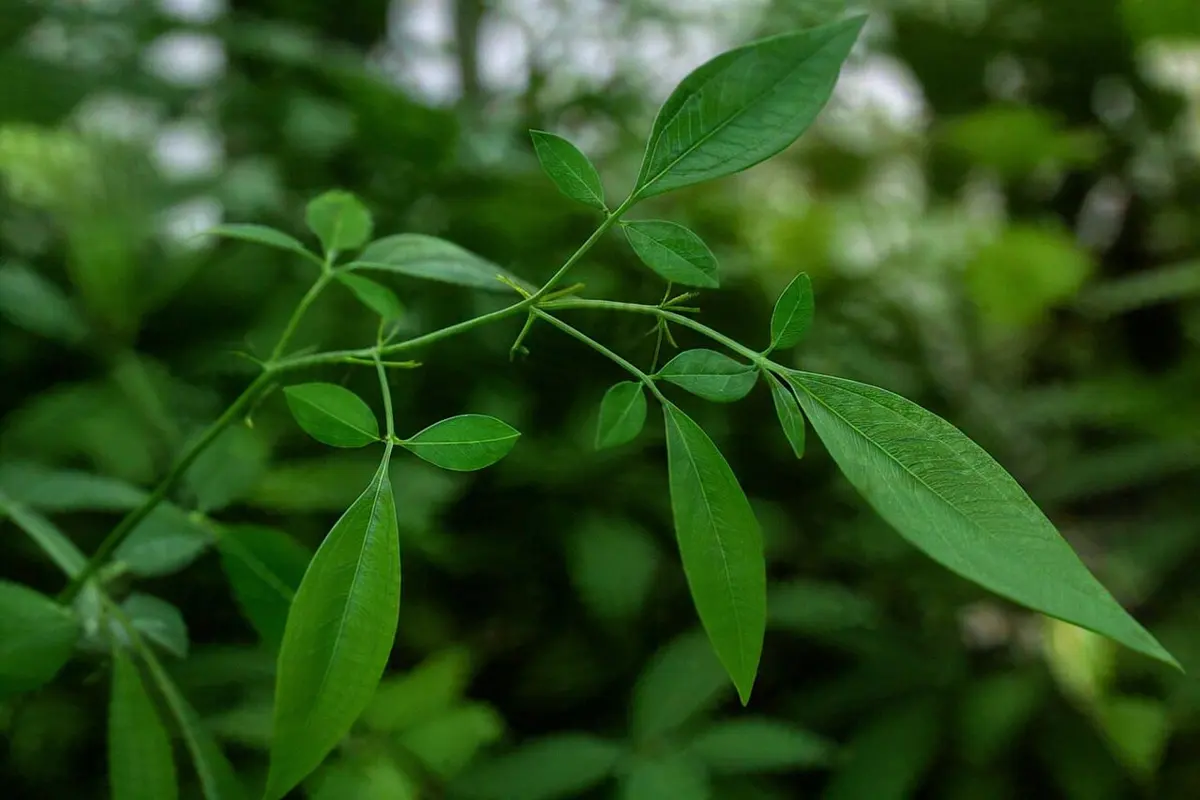
These are curvature movements that happen by themselves, with no external stimulus, but they aren’t growth movements, so they are reversible. They are also called turgor movements, because they are caused by changes in the turgor pressure of special cells (in a swelling, the pulvinus, at the base of a leaf or leaflet), as water moves in and out. The best example: the two small lateral leaflets of the telegraph plant, Desmodium gyrans (now Codariocalyx motorius), which jerk up and down by themselves, each completing a cycle in a few minutes, day and night, as long as it is warm.
b. Paratonic (induced) movements
Paratonic (or induced) movements are set off by external stimuli. They are of two kinds: tropic movements and nastic movements.
i. Tropic movements (tropisms)
Tropic movements are curvatures brought about by more growth on one side of an organ than on the other, induced by an external stimulus. So they are growth movements, and irreversible. They are directional: the direction of the stimulus decides the direction of the response, towards the stimulus (positive) or away from it (negative). The stimulus comes from one side, not from all round. They are slow, unlike nastic movements, and are found in all plants, not only in special plants or organs, typically in radially symmetrical organs such as shoots and roots. By the stimulus:
- Phototropism (heliotropism): curvature in response to light from one side. Stems bend towards light (positively phototropic); roots bend away from it (negatively phototropic). Auxin moves to the shaded side of a shoot and makes it grow faster there (Unit 5).
- Geotropism (gravitropism): growth movement in response to gravity. Main roots grow down (positively geotropic); main shoots grow up (negatively geotropic). Lateral roots and branches respond more weakly and grow at an angle to the pull of gravity: they are diageotropic (or plagiogeotropic).
- Hydrotropism: growth movement in response to water. Roots are positively hydrotropic, bending towards a source of water; stems are indifferent or negatively hydrotropic. In dry soil, a root’s hydrotropic response can override its geotropic one: roots grow sideways and up towards leaking pipes, drains and water tanks, which is why tree roots find their way into cracked or leaking drains and block them.
- Chemotropism: curvature in response to a chemical. The pollen tube grows down through the stigma and style to the embryo sac, guided by chemicals from the ovule; fungal hyphae grow towards sugars and peptones.
- Thigmotropism (haptotropism): curvature in response to contact with a solid object. It is most striking in tendrils, which coil round a support where they touch it (the side touched grows less than the other) and help the plant climb.
- Thermotropism: curvature of plant parts towards a moderate temperature, away from very high or very low ones.
ii. Nastic movements
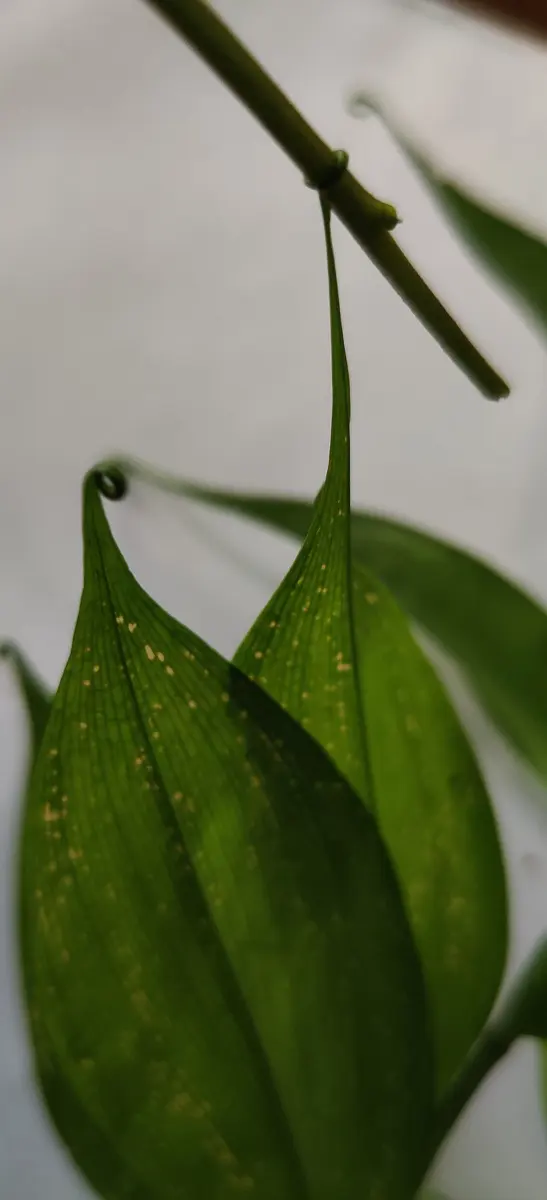
Nastic movements are set off by external stimuli such as light, temperature or touch, but the direction of the response is fixed, set by the structure of the organ, not by the direction of the stimulus. The stimulus is diffuse: it doesn’t come from any particular direction (a fall in temperature, nightfall, a shake). Many are turgor movements, reversible changes in the turgor of special cells; a few are growth movements. Compared with tropic movements, nastic movements:
- are usually faster;
- are more specialized in function;
- are shown typically by dorsiventral organs (leaves, petals);
- are shown only by special plants and organs.
Kinds of nastic movement:
Nyctinastic (sleep) movements. Leaves and flowers of some species take up a “sleep” position at night and open in the day: a daily (diurnal) movement. The prayer plant, Maranta, a common house plant, raises and folds its leaves upright at night; the leaflets of many legumes, such as tamarind and the touch-me-not, fold at dusk. By their stimulus they may be:
- Photonastic (light): the leaves of Oxalis (Nepali chari amilo) spread out flat in sunlight and droop at night.
- Thermonastic (temperature): the flowers of tulip and Crocus open in the warmth of the day and close in the cool of the night.
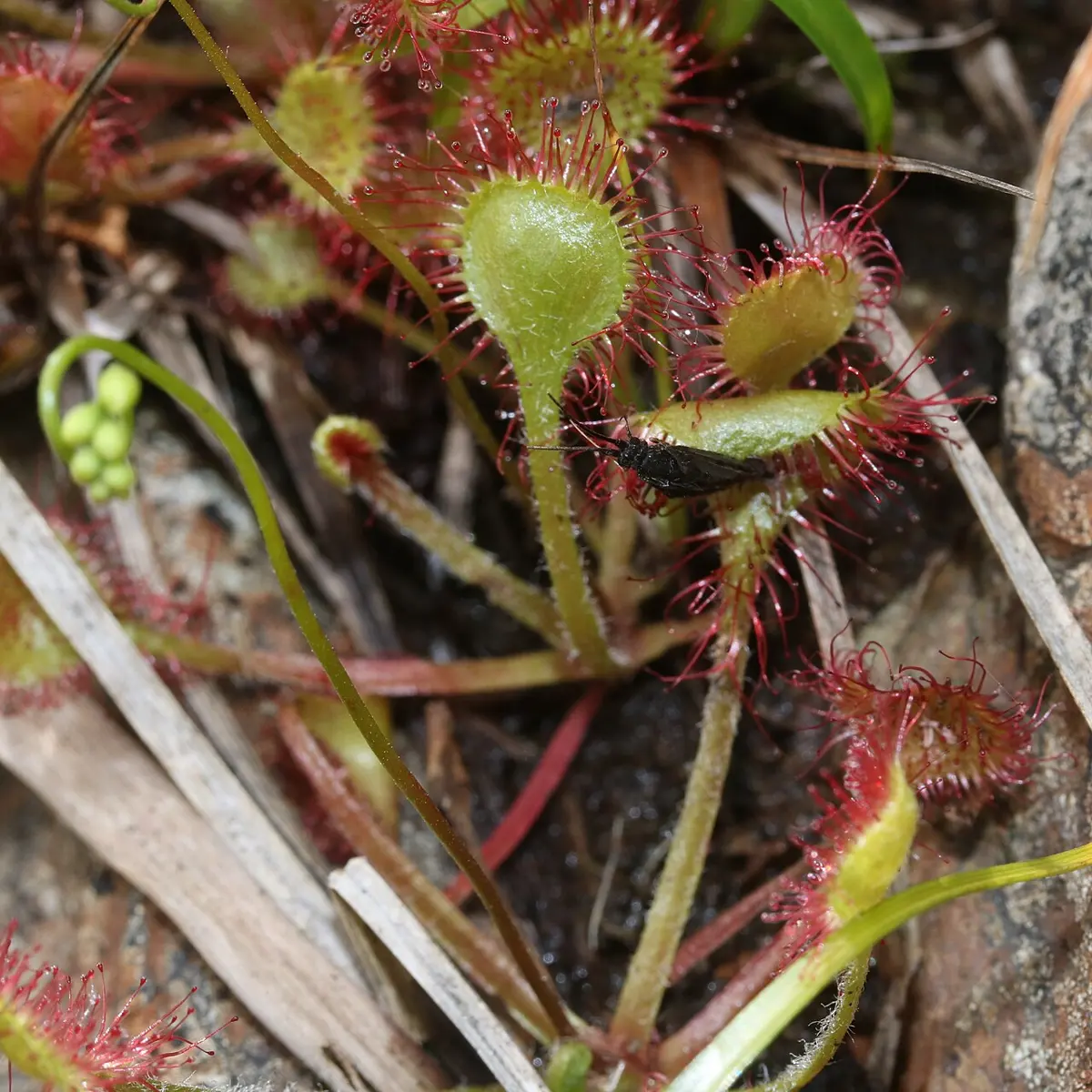
Thigmonastic (haptonastic) movements. Movements in response to touch by an object. Insectivorous plants show them: when an insect touches the glandular tentacles of a sundew, Drosera, the tentacles bend over towards the leaf’s center, carrying the insect with them, and the leaf may slowly cup round it. Sundews grow in wet, poor soils in Nepal’s hills.
Seismonastic movements. Movements in response to a shock: a blow, a shake, wind, a touch, heat or a cut. The best example is the sensitive plant, Mimosa pudica (touch-me-not, lajjawati). A touch makes cells in the pulvini at the base of the leaflets and the leaf stalk lose water quickly: the leaflets fold in pairs and the whole leaf drops, in a few seconds. An electrical signal spreads from the touched leaflet along the leaf, and a hard knock folds leaves along the whole shoot. The cells slowly take water back, and the leaf opens again in 10 to 30 minutes.
Which feature separates a tropic movement from a nastic movement?
Pick an answer to see why.
Exercise
A. Tick the correct alternatives
- Naturally occurring auxin is
Pick an answer to see why.
- Auxin is transported from
Pick an answer to see why.
- Who isolated auxin from the tip of the Avena coleoptile?
Pick an answer to see why.
- Which of the following is an effect of auxin?
Pick an answer to see why.
- Development of seedless fruits, induced by auxins, is known as
Pick an answer to see why.
- Which auxin is used in killing weeds?
Pick an answer to see why.
- Foolish seedling of rice is caused by
Pick an answer to see why.
- Which of the following is not an effect of gibberellins?
Pick an answer to see why.
- A cytokinin present in maize endosperm is
Pick an answer to see why.
- A culture medium with a higher concentration of auxin than cytokinin induces
Pick an answer to see why.
- Leaves can be kept fresh and green by treatment with cytokinins. This effect is
Pick an answer to see why.
- Bolting refers to
Pick an answer to see why.
- If the cotyledons remain under the soil, the seed germination is said to be
Pick an answer to see why.
- The main factor for seed germination is
Pick an answer to see why.
- Hypogeal germination is common in
Pick an answer to see why.
- Rhizophora exhibits
Pick an answer to see why.
- Seed dormancy refers to
Pick an answer to see why.
- Leguminous seeds fail to germinate due to hard and impervious seed coats. This is known as
Pick an answer to see why.
- Flowering in plants in response to the relative length of day and night is known as
Pick an answer to see why.
- For flowering in long-day plants, the day should be of
Pick an answer to see why.
- Which of the following is a long-day plant?
Pick an answer to see why.
- A physiological process that leads to aging and the ultimate death of an organism is known as
Pick an answer to see why.
- A process whereby flowering is promoted by a cold treatment given to a fully hydrated seed or to a growing plant is known as
Pick an answer to see why.
- During vernalization, germinating seeds are treated at
Pick an answer to see why.
- Vernalization results in
Pick an answer to see why.
- For vernalization, seeds should be
Pick an answer to see why.
- Plant movement independent of external stimuli is said to be
Pick an answer to see why.
- Autonomic movement of variation is shown by
Pick an answer to see why.
- Directional and irreversible growth in plants in response to an external stimulus is known as
Pick an answer to see why.
- Folding of the leaves of the touch-me-not plant is the best example of
Pick an answer to see why.
B. Answer the following questions
Define phytohormones and write their features.
Answer
Describe any three physiological effects of auxins.
Answer
Discuss the effects of gibberellins on dormancy, flowering and plant growth.
Answer
Define apical dominance. Name the hormones which induce and suppress apical dominance.
Answer
Elaborate bolting and parthenocarpy with suitable examples.
Answer
Describe the role of cytokinins in tissue culture and agriculture.
Answer
Describe the seed germination process in brief.
Answer
Mention the factors of seed dormancy. Write the advantages of seed dormancy.
Answer
Classify plants on the basis of photoperiodism and give two examples of each.
Answer
Point out any four differences between short-day plants and long-day plants.
Answer
Define senescence and write its significance in plants.
Answer
What do you mean by abscission? Write its significance.
Answer
Define vernalization. Write its significance in plants.
Answer
Write about autonomic growth movement in plants.
Answer
Define paratonic or induced movements. Mention their types with an example of each.
Answer
What is tropism? Describe its types with an example of each.
Answer
Describe the nastic movements shown by Drosera and Mimosa pudica.
Answer
Printable PDFs
- Study notes 4 pages
- Worksheet 4 pages Answer key
Quiz yourself: Life Processes and the Human Body, Grades 5–12 →
Practice every question in the book, and keep track of the ones you miss →
A companion to your textbook, not a replacement for it: study from the book your school uses, and where the two differ, follow your teacher. Found a mistake? Please tell us.