
In 1865, in a meeting room in the town of Brünn, a monk read a paper about peas to a few dozen members of the local natural history society. He had grown and counted many thousands of pea plants over eight years, and from his counts he had worked out rules for how characters pass from parents to children. No one in the room seems to have grasped what he had found. The paper was printed the next year, sent to libraries across Europe, and ignored for thirty-four years.
The monk was Gregor Johann Mendel, and his rules are where the science of heredity begins. In the last unit you met the molecule that carries the instructions; in this one you follow the instructions themselves from one generation to the next, as Mendel did, by counting.
3.2.1 General terminology
Genetics has its own words. Here are the ones this unit uses.
- Gene. A gene is a small segment of DNA that contains the instructions for making a particular protein or a functional RNA molecule. It is the unit of heredity: genes are what pass from parents to offspring.
- Allele. An allele is one of the different forms of the same gene, which produce the two contrasting forms of a character (tall or dwarf, round or wrinkled). The alleles of a gene are found at the same place (locus) on a pair of homologous chromosomes. For example, the gene for height in peas has two alleles: T, for tall, and t, for dwarf. By custom, the dominant allele is written with a capital letter and the recessive one with the small letter of the same alphabet.
- Homozygous organism. An organism with two identical alleles of a gene is homozygous for it: for example, TT or tt. A homozygous organism is pure, or true-breeding: it passes on the same allele to every offspring.
- Heterozygous organism. An organism with two different alleles of a gene is heterozygous for it: for example, Tt.
- Dominant and recessive character. When two parents with a contrasting pair of characters are crossed, only one character appears in the first generation; the other stays hidden. The character that appears in the first generation is the dominant character, and the one that stays hidden is the recessive character. For example, a cross of pure tall (TT) with pure dwarf (tt) peas gives only tall offspring (Tt): tall is dominant, dwarf is recessive.
- Hybridization. Crossing two genetically different organisms to produce offspring is hybridization.
- Hybrid. The offspring of two genetically different parents is a hybrid. (The Tt peas above are hybrids. They look like the tall parent, but carry the alleles of both.)
- Phenotype. The outward appearance of an organism, its observable characters (tall or dwarf, red or white flowers, a blood group), produced by its genotype together with its surroundings, is its phenotype.
- Genotype. The genetic make-up of an organism, the alleles it has inherited from both parents, whether or not they are expressed, is its genotype. TT and Tt are two different genotypes with the same phenotype, tall.
- Monohybrid cross. A cross between two parents that differ in a single pair of contrasting characters is a monohybrid cross.
- Dihybrid cross. A cross between two parents that differ in two pairs of contrasting characters is a dihybrid cross.
- First filial generation (F₁). The offspring of a cross between two pure-breeding parents are the first filial generation, F₁ (Latin filius, son). The parents are the parental generation, P.
- Second filial generation (F₂). The offspring obtained by self-pollinating (selfing) the F₁, or crossing F₁ individuals with each other, are the second filial generation, F₂.
- Punnett square. A checkerboard for working out all the possible results of a cross, named after the British geneticist Reginald Punnett, who devised it about 1905. The gametes of one parent are written along the top and those of the other down the side (here, male along the top and female down the side), and each box is filled with the genotype formed when those two gametes meet. Each box is equally likely. For example, the F₂ of a monohybrid cross for height, Tt × Tt:
| ♂ T | ♂ t | |
|---|---|---|
| ♀ T | TT (tall) | Tt (tall) |
| ♀ t | Tt (tall) | tt (dwarf) |
Punnett square for the F₂ of a monohybrid cross for height. Three boxes out of four are tall: 3 tall : 1 dwarf.
A pea plant with genotype Tt is tall. Which statement is true?
Pick an answer to see why.
3.2.2 Mendel’s experiment
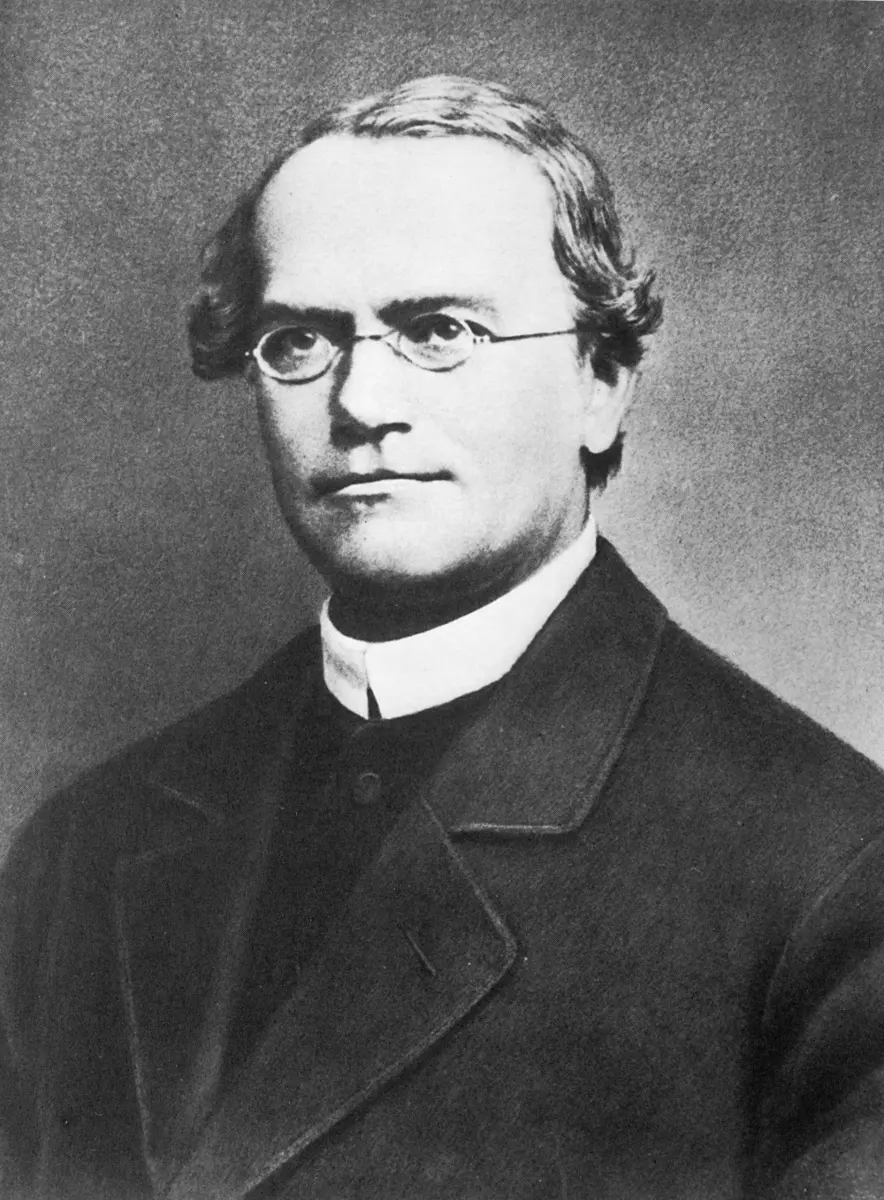
Gregor Johann Mendel (1822–1884) was a monk of the Augustinian monastery of St Thomas in Brünn, in the Austrian Empire (now Brno, in the Czech Republic). He had studied physics and mathematics at the University of Vienna, which may be why he did something no breeder before him had done: he counted the offspring of every kind, and looked for ratios.
From 1856 to 1863 (seven or eight growing seasons: he himself wrote of “eight years’ pursuit”) he carried out breeding experiments on the garden pea, Pisum sativum, in the monastery’s garden. He obtained 34 varieties of peas from seed dealers, tested them for two years, chose 22 of them, and from these studied seven pairs of contrasting characters. He presented his work to the Natural History Society of Brünn in 1865, and it was published in the society’s journal in 1866, under the title Experiments on Plant Hybrids. He was the first to work out the rules of heredity, but his paper was hardly read. Mendel became the abbot of the monastery in 1868, had little time for science afterwards, and died in 1884.
In 1900, three botanists working on their own came to the same results and found Mendel’s paper: Hugo de Vries in the Netherlands, Carl Correns in Germany and Erich von Tschermak in Austria. Mendel’s laws became the basis of the new science of genetics, and he is remembered as the father of genetics.
1. Selection of material
Mendel chose the garden pea because it has several advantages for such experiments:
- a.Pea plants have several pairs of clearly contrasting characters (tall or dwarf, round or wrinkled seeds), with nothing in between.
- b.The flowers are naturally self-pollinating: the stamens and the pistil are enclosed within the petals (in the boat-shaped keel), so a flower’s own pollen fertilizes it, and pure lines stay pure.
- c.Cross-pollination (hybridization) is easy to do by hand, so Mendel could control which plants bred with which.
- d.Pea plants have a short life cycle: several generations can be studied in a few years.
- e.They are easy to grow, in pots or in a garden, and simple to care for.
- f.Each plant produces many seeds, which gives plenty of numbers for analysis.
- g.The hybrids are fertile, so they can be crossed again and their offspring studied.
Pea flower, pod and leaf: traced from O. W. Thomé, Flora von Deutschland (1885), public domain
Round and wrinkled peas: traced from T. H. Morgan, A Critique of the Theory of Evolution (1916), public domain
Inflated and constricted pods: traced from a photo by Zenon Sych, CC BY-SA 4.0, via Wikimedia Commons (this tracing CC BY-SA 4.0 too)
2. Selection of parents
Mendel used only true-breeding (pure-breeding) plants as parents, for all seven pairs of characters. He made sure a plant was pure by selfing it for several generations: to get a pure tall variety, for example, he self-pollinated tall plants generation after generation, until all their offspring were always tall. He did the same for each of the seven characters.
3. Hybridization
Hybridization is the process of obtaining hybrids by crossing two genetically different parents. Mendel began with one pair of characters at a time (monohybrid crosses). Once he had found clear patterns, he went on to follow two pairs of characters together (dihybrid crosses).
Monohybrid cross
A monohybrid cross follows only one pair of contrasting characters. For example, to study the inheritance of height, Mendel crossed a pure-breeding tall plant (TT) with a pure-breeding dwarf plant (tt). These were the parental generation, P.
To make the cross, he removed the stamens of a flower of the tall plant before its anthers were ripe (emasculation), so it couldn’t pollinate itself, then dusted pollen from a dwarf plant on its stigma, and covered the flower with a bag. When the seeds were ripe, he sowed them. Every plant was tall. These hybrid offspring were the first filial generation, F₁.
He also made the reciprocal cross: pollen from the tall plant on the stigma of the dwarf. The result was the same, all tall. So it didn’t matter which parent, male or female, carried which character.
Pea flower, pod and leaf: traced from O. W. Thomé, Flora von Deutschland (1885), public domain
In full:
| Generation | Cross or result |
|---|---|
| P (phenotypes) | tall × dwarf |
| P (genotypes) | TT × tt |
| Gametes | all T; all t |
| F₁ | all Tt, tall |
| Selfing the F₁ | Tt × Tt |
| Gametes of each F₁ plant | ½ T, ½ t |
| F₂ (from the Punnett square in 3.2.1) | 1 TT : 2 Tt : 1 tt |
- Phenotypic ratio in the F₂: 3 : 1 (tall : dwarf).
- Genotypic ratio in the F₂: 1 : 2 : 1 (pure tall TT : hybrid tall Tt : pure dwarf tt).
Mendel’s real numbers came very close to 3 : 1 for all seven characters:
| Trait | F₂: dominant | F₂: recessive | Ratio |
|---|---|---|---|
| Seed shape | 5474 round | 1850 wrinkled | 2.96 : 1 |
| Seed color | 6022 yellow | 2001 green | 3.01 : 1 |
| Flower color | 705 violet | 224 white | 3.15 : 1 |
| Pod shape | 882 inflated | 299 constricted | 2.95 : 1 |
| Pod color | 428 green | 152 yellow | 2.82 : 1 |
| Flower position | 651 axial | 207 terminal | 3.14 : 1 |
| Stem length | 787 tall | 277 dwarf | 2.84 : 1 |
| All seven | 14 949 | 5010 | 2.98 : 1 |
Mendel’s F₂ counts, from his 1866 paper. (The seed coat is gray in plants with violet flowers and white in plants with white flowers, so this count covers both.)
Dihybrid cross
A dihybrid cross follows two pairs of contrasting characters at once. For example, to follow plant height and flower color together, cross a pure-breeding tall plant with purple flowers (TTPP) with a pure-breeding dwarf plant with white flowers (ttpp), as Mendel did his crosses: remove the stamens of the tall purple-flowered plant before its anthers ripen, and dust its stigma with pollen from the dwarf white-flowered plant. All the F₁ plants are tall with purple flowers (TtPp), and the reciprocal cross gives the same.
Each F₁ plant (TtPp) makes four kinds of gametes in equal numbers: TP, Tp, tP, tp. When the F₁ is selfed, each of the four kinds of pollen can meet each of the four kinds of egg: 4 × 4 = 16 equally likely combinations.
| ♂ TP | ♂ Tp | ♂ tP | ♂ tp | |
|---|---|---|---|---|
| ♀ TP | TTPP | TTPp | TtPP | TtPp |
| ♀ Tp | TTPp | TTpp | TtPp | Ttpp |
| ♀ tP | TtPP | TtPp | ttPP | ttPp |
| ♀ tp | TtPp | Ttpp | ttPp | ttpp |
The F₂ of the dihybrid cross TTPP × ttpp.
A box with at least one T is tall, and one with at least one P has purple flowers. Counting the boxes: 9 tall purple (one T and one P or more), 3 tall white (a T, but pp), 3 dwarf purple (tt, but a P) and 1 dwarf white (ttpp).
- Phenotypic ratio: 9 : 3 : 3 : 1 (tall purple : tall white : dwarf purple : dwarf white).
- Genotypic ratio: nine genotypes, 1 : 2 : 2 : 4 : 1 : 2 : 1 : 2 : 1 (TTPP : TTPp : TtPP : TtPp : TTpp : Ttpp : ttPP : ttPp : ttpp).
Two of the four F₂ kinds, tall with white flowers and dwarf with purple flowers, are new combinations, seen in neither the P nor the F₁. Mendel’s own dihybrid cross, of round yellow seeds (RRYY) with wrinkled green (rryy), gave in the F₂ 315 round yellow, 101 wrinkled yellow, 108 round green and 32 wrinkled green seeds: 556 seeds, close to 9 : 3 : 3 : 1 (312.75 : 104.25 : 104.25 : 34.75).
4. Self-pollination of F₁ plants
Mendel let the F₁ plants self-pollinate. To keep out foreign pollen, he covered the flowers with paper bags from the start. He collected the seeds of all the F₁ plants and grew plants from them: the second filial generation, F₂. He selfed the F₁ in both his monohybrid and his dihybrid crosses, and he went on to grow further generations, to check that his explanation predicted them too.
In Mendel’s monohybrid cross for height, what fraction of the tall F₂ plants are pure-breeding (TT)?
Pick an answer to see why.
3.2.3 Laws of inheritance
From his experiments, Mendel worked out the principles now called his laws of inheritance.
1. Law of dominance
When two pure organisms with a pair of contrasting characters are crossed, only one character of the pair appears in the first filial generation, while the other stays hidden. The character that appears in the hybrid is the dominant character, and the one that stays hidden is the recessive character.
In a monohybrid cross of homozygous tall (TT) with dwarf (tt) peas, all the F₁ plants are heterozygous tall (Tt). Tall (T) is dominant, and dwarf (t), which is suppressed, is recessive.
“Hidden” doesn’t mean lost: the recessive allele is still there in every F₁ plant, and comes back in the F₂.
2. Law of segregation, or law of purity of gametes
The two alleles of a gene stay together in a heterozygous organism without mixing or blending, but separate (segregate) when gametes are formed, so that each gamete gets only one of the two.
Each gamete is therefore pure: it carries T or t, never both and never a blend. So this law is also called the law of purity of gametes.
In the monohybrid cross, every F₁ plant has both alleles, T and t. They don’t blend in the F₁, and the recessive t isn’t changed by being beside the dominant T. When the F₁ makes gametes, the alleles separate: half the gametes get T and half get t. When gametes meet at random at fertilization, a quarter of the F₂ get t from both parents and are dwarf. The reappearance of dwarf plants in the F₂, exactly as dwarf as their dwarf grandparent, shows that the alleles segregate and stay pure.
Today we know why: the two alleles sit on a pair of homologous chromosomes, and the two chromosomes of each pair go into different gametes in meiosis Grade 11: Reductional cell division or meiosis.
3. Law of independent assortment
When two or more pairs of contrasting characters are inherited together, each pair is inherited independently of the other. The alleles of different genes are sorted into gametes at random and independently, and don’t stay together as they came from the parents.
So how one character is passed on doesn’t affect how another is passed on, and new combinations of characters can appear in the offspring.
In the dihybrid cross, tall purple-flowered peas (TTPP) crossed with dwarf white-flowered peas (ttpp) give an F₁ that is all tall with purple flowers (TtPp). When the F₁ is selfed, the F₂ has four phenotypes: tall purple, tall white, dwarf purple and dwarf white, in the ratio 9 : 3 : 3 : 1. The two new combinations, tall white and dwarf purple, could only appear if the alleles for height and those for flower color were passed on independently of each other.
The law holds for genes on different chromosomes (and for genes far apart on the same one). Genes close together on one chromosome tend to be inherited together: that is linkage, the subject of Unit 9. By luck, the seven characters Mendel studied behave independently.
An F₁ plant has genotype TtPp. Which set lists all the kinds of gamete it makes?
Pick an answer to see why.
3.2.4 Gene interaction
Mendel’s laws of dominance, segregation and independent assortment hold for the seven characters he studied in the garden pea, and have been confirmed for many characters of plants and animals. But they don’t hold for every gene, and there are many exceptions. In particular, not every gene has one allele that completely hides the other. Two such cases are described here.
1. Incomplete dominance
By Mendel’s law of dominance, only one of the two parents’ characters appears in the F₁: a cross of tall with dwarf peas gives offspring that are all tall, none dwarf and none in between. But this isn’t true of every character. For some genes, neither allele is dominant: the hybrid shows a character in between those of its two pure parents. This is incomplete dominance. It is found in plants, such as the snapdragon (Antirrhinum majus) and the four o’clock plant (Mirabilis jalapa, मालती फूल), and in animals, such as the Andalusian fowl (black × white-splashed gives a slate-blue hybrid).
Incomplete dominance in the four o’clock plant (Mirabilis jalapa)
The four o’clock plant gets its name from its flowers, which open in the late afternoon. In Mirabilis jalapa, a cross between a pure red-flowered plant (RR) and a pure white-flowered one (rr) gives an F₁ that is all pink (Rr). Neither red nor white is completely dominant, so the hybrids show a color in between. When two pink F₁ plants are crossed, the F₂ has red, pink and white flowers in the ratio 1 : 2 : 1.
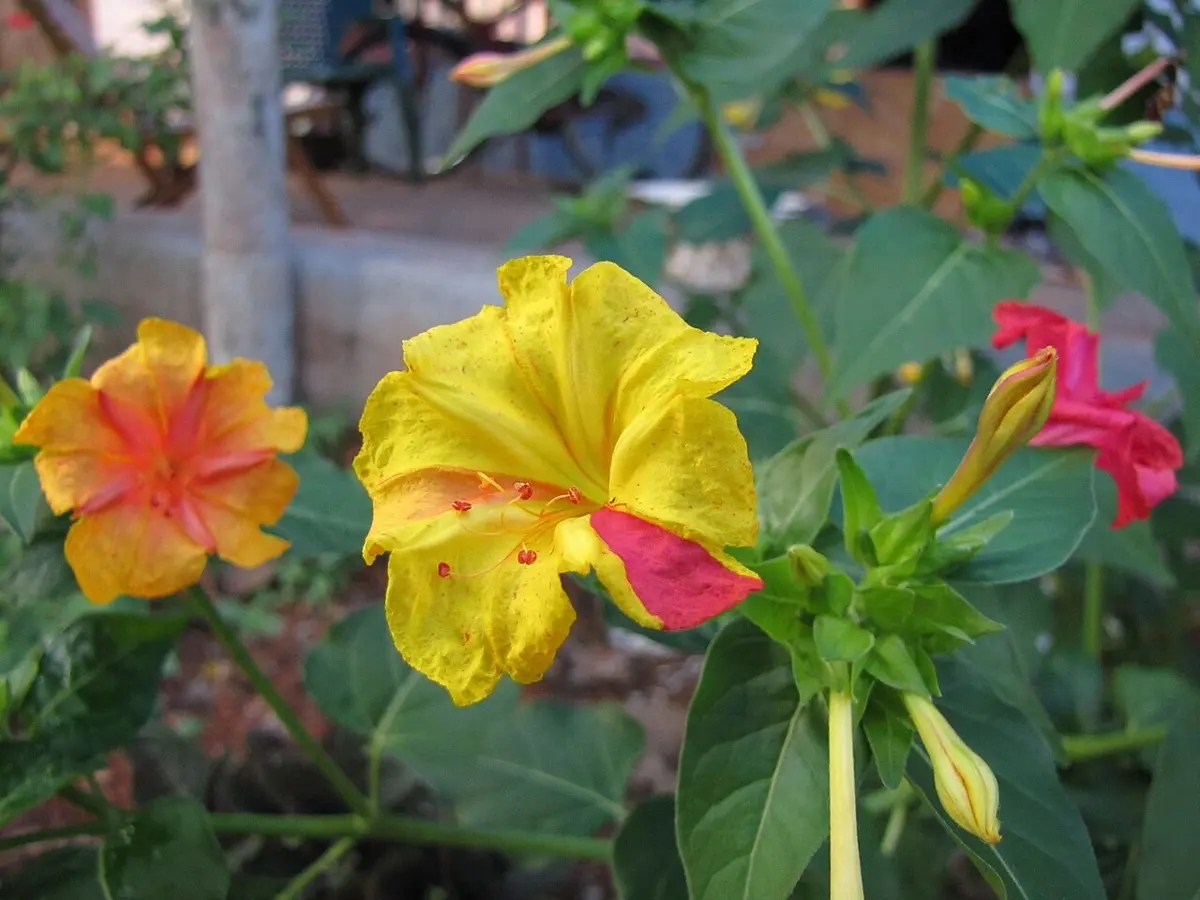
The F₂ shows that the alleles themselves don’t blend. If they had blended into a “pink allele”, the F₂ would be all pink too; instead, pure red and pure white flowers come back. The R allele and the r allele both act when they are together: a plant with only one R allele makes less red pigment than one with two, so its flower is pink. The phenotype is in between; the alleles stay pure, as the law of segregation says.
In snapdragons, red (RR) × white (rr) gives pink flowers. Which cross gives red, pink and white offspring in the ratio 1 : 2 : 1?
Pick an answer to see why.
2. Codominance
Codominance is another exception to the law of dominance. By Mendel’s law, the F₁ resembles only one parent, because only one allele is expressed. In codominance, both alleles of a gene are fully expressed in the heterozygote, side by side: neither hides the other, and the result isn’t in between either. Both parents’ characters appear together.
The best-known example is the ABO blood group of humans. The gene for it has three alleles: Iᴬ makes antigen A on the red blood cells, Iᴮ makes antigen B, and i makes neither. Iᴬ and Iᴮ are each dominant over i, but codominant with each other.
A person with homozygous blood group A (IᴬIᴬ) and a person with homozygous blood group B (IᴮIᴮ) have children who are all IᴬIᴮ, with blood group AB. Their red blood cells carry both antigen A and antigen B, in full: both alleles are expressed.
| Blood group A | Blood group B | ||
|---|---|---|---|
| Parents | IᴬIᴬ | × | IᴮIᴮ |
| Gametes | Iᴬ | Iᴮ | |
| F₁ | IᴬIᴮ: blood group AB |
Codominance in the human ABO blood group.
A cow with a red coat (RR) is crossed with a bull with a white coat (WW). The calf has a roan coat: red hairs and white hairs mixed all over. What kind of inheritance is this?
Pick an answer to see why.
Exercise
A. Tick the correct alternatives
- What is a gene?
Pick an answer to see why.
- Which of the following is a homozygous genotype?
Pick an answer to see why.
- Which term refers to the physical appearance of an individual?
Pick an answer to see why.
- In the dihybrid cross TTRR × ttrr, which gametes are produced by the F₁ plants?
Pick an answer to see why.
- Why do the recessive traits reappear in the F₂ generation after being hidden in the F₁ generation?
Pick an answer to see why.
- In pea plants, yellow seeds are dominant to green. If a heterozygous yellow-seeded plant is crossed with a green-seeded plant, what ratio of yellow and green seeded plants would you expect in the F₁ generation?
Pick an answer to see why.
- A geneticist notices that a trait appears intermediate in hybrids, but the original traits reappear in the F₂ generation. What inheritance pattern is likely?
Pick an answer to see why.
- If a red-flowered Mirabilis jalapa plant is crossed with a pink-flowered plant, what will be the expected flower color ratio in the offspring?
Pick an answer to see why.
- Which of the following crosses will give tall and dwarf pea plants in the same proportions?
Pick an answer to see why.
- Round seed (R) is dominant over wrinkled (r) seed in pea. A heterozygous round-seeded plant (Rr) is crossed with a wrinkled-seeded plant (rr). What is the possible progeny?
Pick an answer to see why.
B. Answer the following questions
Define recessive character and dominant character.
Answer
What are the genotype and phenotype of the F₁ generation in a monohybrid cross between TT and tt plants?
Answer
Arrange these in order of size, smallest first: cell, nucleus, DNA molecule, chromosome, gene.
Answer
Differentiate between monohybrid and dihybrid cross.
Answer
How is incomplete dominance different from Mendel’s law of dominance?
Answer
Why is blood group AB considered an example of co-dominance?
Answer
State Mendel’s law of dominance with an example.
Answer
Why did Mendel choose pea plants for his experiments?
Answer
Describe Mendel’s law of independent assortment with the help of a dihybrid cross.
Answer
In a species of plant, there are two alleles of the gene that determines leaf shape. One allele produces round leaves, and the other produces oval leaves. Heterozygous plants have round leaves. Which allele is dominant? Explain.
Answer
If a tall plant with red flowers (TtRr) is self-pollinated, what are the chances of obtaining a dwarf plant with white flowers in the F₂ generation? Show using a Punnett square.
Answer
A student observes a 9 : 3 : 3 : 1 ratio in the offspring of a cross. What type of cross has been performed and which of Mendel’s laws does it demonstrate?
Answer
In human beings, blue eye color is recessive to brown eye color. A brown-eyed man has a blue-eyed mother.
- a.What is the genotype of the man and his mother?
- b.What are the possible genotypes of his father?
- c.If the man marries a blue-eyed woman, what are the possible genotypes of their offspring?
Answer
A pure-breeding (homozygous) tall pea plant was crossed with a homozygous dwarf pea plant. All of the offspring had the genotype Tt. Several of these offspring were crossed together. There were 302 tall plants and 99 dwarf plants. Construct a complete genetic diagram to explain this result.
Answer
Study the table and answer the following questions.
| RY | rY | Ry | ry | |
|---|---|---|---|---|
| RY | RRYY | RrYY | RRYy | RrYy |
| rY | RrYY | rrYY | RrYy | rrYy |
| Ry | RRYy | RrYy | RRyy | Rryy |
| ry | RrYy | rrYy | Rryy | rryy |
- a.Name the dominant and recessive traits.
- b.What was the parent genotype if the table shows the F₂ generation?
- c.What is the F₂ phenotype ratio?
Answer
Printable PDFs
- Study notes 3 pages
- Worksheet 4 pages Answer key
Quiz yourself: Heredity and Evolution, Grades 5–12 →
Practice every question in the book, and keep track of the ones you miss →
A companion to your textbook, not a replacement for it: study from the book your school uses, and where the two differ, follow your teacher. Found a mistake? Please tell us.