
Put a pinch of salt on your tongue, then a drop of lemon juice. Salt is a compound of a soft metal that bursts into flame in water and a poisonous green gas; lemon juice is mostly water with a little citric acid, C₆H₈O₇. How can anyone know what these things are made of, atom by atom, when no one has ever seen an atom with their eyes? And how can a chemist say that urea is 46.7% nitrogen before a single sack of it is opened?
This unit lays the ground for the whole of Grade 11 Chemistry: what chemistry studies and why it matters to Nepal, the atoms, molecules and ions everything is made of, how atoms can be “weighed” against carbon-12, how ions are named and combined into formulas, and how a formula tells you, by simple arithmetic, what fraction of a substance each element makes up.
1.1 General introduction to chemistry
Chemistry is the branch of science that studies the composition and structure of matter and the changes matter undergoes. Matter is anything that has mass and takes up space: this book, your body, the air you breathe and the water in a Bhaktapur pond are all matter.
Knowing what a substance is made of, and how its pieces fit together, is half of chemistry. The other half is how one substance changes into another. In a chemical change the composition changes, and a new substance is made. Paper burning in air is one: the carbon in it combines with oxygen to make carbon dioxide gas, and the white sheet becomes gray ash and invisible gas, nothing like what you started with.
Chemistry is often called the central science, because every other science stands on it. A biologist studies the chemicals of life, a doctor the chemicals of the body and of medicines, a geologist the chemicals of rocks, an engineer the materials of a bridge or a chip. Chemistry and physics overlap most of all, in chemical physics and nuclear chemistry. And chemistry answers the needs of society directly: new medicines, new sources of energy, new materials, more food from the same fields, cleaner water and better health.
Classifying matter
Before you can study matter, you sort it. Everything around you is either a pure substance, with one fixed composition, or a mixture of substances.
- An element is a pure substance made of one kind of atom: copper, oxygen, carbon.
- A compound is a pure substance made of two or more elements chemically combined in a fixed proportion by mass: water, H₂O, is always 1 g of hydrogen to 8 g of oxygen. A compound can be broken into its elements only by a chemical change.
- A mixture holds substances together without fixing their proportions. In a homogeneous mixture (a solution: sugar in tea, the air, brass) the composition is the same throughout; in a heterogeneous mixture (muddy water, a plate of dal bhat) you can see the separate parts.
Which of these is a compound?
Pick an answer to see why.
1.1.1 Divisions of chemistry
All chemists study matter, but the field is so wide that it is divided into branches, each looking at matter from one side:
- a.Inorganic chemistry studies the elements and their compounds, apart from most compounds of carbon: metals, minerals, salts, acids. Such substances were once thought to come only from non-living sources, minerals and rocks. The cube-shaped crystal of common salt, sodium and chloride ions packed in turn, is a typical object of study.
- b.Organic chemistry studies the compounds of carbon (with hydrogen, and often oxygen, nitrogen and others), called organic compounds, and their reactions. They were first known from living things (plants and animals), hence the name, but today millions are made in laboratories and factories: medicines, plastics, dyes, and the products a petroleum refinery makes from crude oil (petrol, diesel, kerosene, LPG, lubricants and the raw materials of plastics).
- c.Biochemistry studies the chemical substances and reactions of living things: DNA, proteins and enzymes, how food is digested, how the immune system and viruses work. The blood tests in a hospital’s pathology laboratory are biochemistry at work.
- d.Physical chemistry studies the structure of matter and how energy affects it, using the methods of physics: how fast reactions go, how much energy a reaction gives out or takes in, how substances absorb light, how atoms are built.
- e.Nuclear chemistry studies atomic nuclei, radioactivity, and nuclear fission and fusion, and uses radioactive isotopes in medicine, farming and dating rocks. A nuclear power station makes electricity from the fission of uranium.
- f.Analytical chemistry develops the methods for finding what a substance contains and how much: the sugar in a fruit juice, the pollutants in water or air, the purity of a medicine.
- g.Environmental chemistry studies how natural and man-made substances behave in the environment and affect it: water and air pollution, solid waste, hazardous and toxic substances. The foam on the Bagmati is its subject.
- h.Forensic chemistry analyzes evidence from crime scenes (drugs, poisons, blood, fibers, explosives) so that a court can rely on the results. In Nepal, the police’s Central Investigation Bureau (CIB) and the National Forensic Science Laboratory use it.
Many branches join chemistry to another field: geochemistry (rocks and minerals), medicinal chemistry (designing drugs), agricultural chemistry, food chemistry, petroleum chemistry, soil chemistry and polymer chemistry (plastics, rubber, fibers).
Measuring how much vitamin C there is in a brand of orange juice is mainly:
Pick an answer to see why.
1.2 Importance and scope of chemistry
Where do the paper and ink you are using come from? Both are products of chemical industry: paper from wood pulp, bleached and filled; ink from dyes or pigments in a solvent. In fact it is hard to find any material around you that chemistry has not touched: plastics, medicines, paints, textiles, explosives (for roads and tunnels), fertilizers, cosmetics, fuels, detergents, glass, cement, batteries, and processes such as electroplating, metallurgy and photography.
Some of the things chemistry makes possible:
- Health: medicines and vaccines, antiseptics, anesthetics, and the tests that diagnose disease.
- Food: fertilizers, pesticides, safer storage and preservation, and the testing of food for purity.
- Homes: soaps, shampoos, toothpaste, detergents, perfumes, cement, paints.
- Energy: petrol and diesel refined from crude oil, LPG, the batteries of phones and electric cars, the silicon of solar panels.
- Environment: water treatment, measuring pollution, and greener ways of making things.
Careers in chemistry
People who know chemistry work in many jobs:
- Chemical engineers use engineering to solve chemical problems on a large scale: they design chemical plants, develop processes, and make production cheaper and safer.
- Chemical technicians help chemists and engineers: they run analyses, test products, calibrate instruments, prepare solutions and reagents, and keep quality under control.
- Hazardous materials managers supervise the safe removal, transport and disposal of harmful substances.
- Pharmacists dispense medicines, watch how patients use them, and advise patients and health workers about their effects.
- Teachers and professors of chemistry, in schools, colleges and universities.
- Medical (sales and marketing) representatives work for drug companies, explaining medicines and related products to doctors and pharmacies.
- Forensic chemists analyze samples from crime scenes.

1.3 Basic concepts of chemistry
Atom and molecule
A gold ring, an iron rod and a diamond are each made of atoms of one element: gold, iron, carbon. The idea that matter is made of tiny particles that can’t be cut is old: the Greek thinker Democritus called them atomos, “uncuttable”, about 2,400 years ago. Dalton turned the idea into science, with numbers that could be tested. The main points of his atomic theory are:
- a.Matter is made of small, indivisible particles called atoms.
- b.Atoms of the same element are identical and have the same properties; atoms of different elements differ.
- c.Compounds are made of atoms of different elements combined in small whole-number ratios.
- d.A chemical reaction is only a rearrangement of atoms into new combinations: atoms are neither made nor destroyed.
The theory has been refined since: atoms can be split (into electrons, protons and neutrons, Unit 3), and atoms of one element can have different masses (isotopes, below). But its core is how chemists still think. So an atom is the smallest particle of an element that takes part in chemical reactions and has the chemical properties of that element.
The particles of a metal, or of diamond, are atoms; those of hydrogen, oxygen and water are molecules. A molecule is formed when two or more atoms combine chemically; it is the smallest particle of a substance that can exist on its own and has the properties of that substance. The atoms in a molecule are held together by chemical bonds: covalent bonds, shared pairs of electrons, in molecules such as H₂, H₂O and CO₂ (Unit 5).
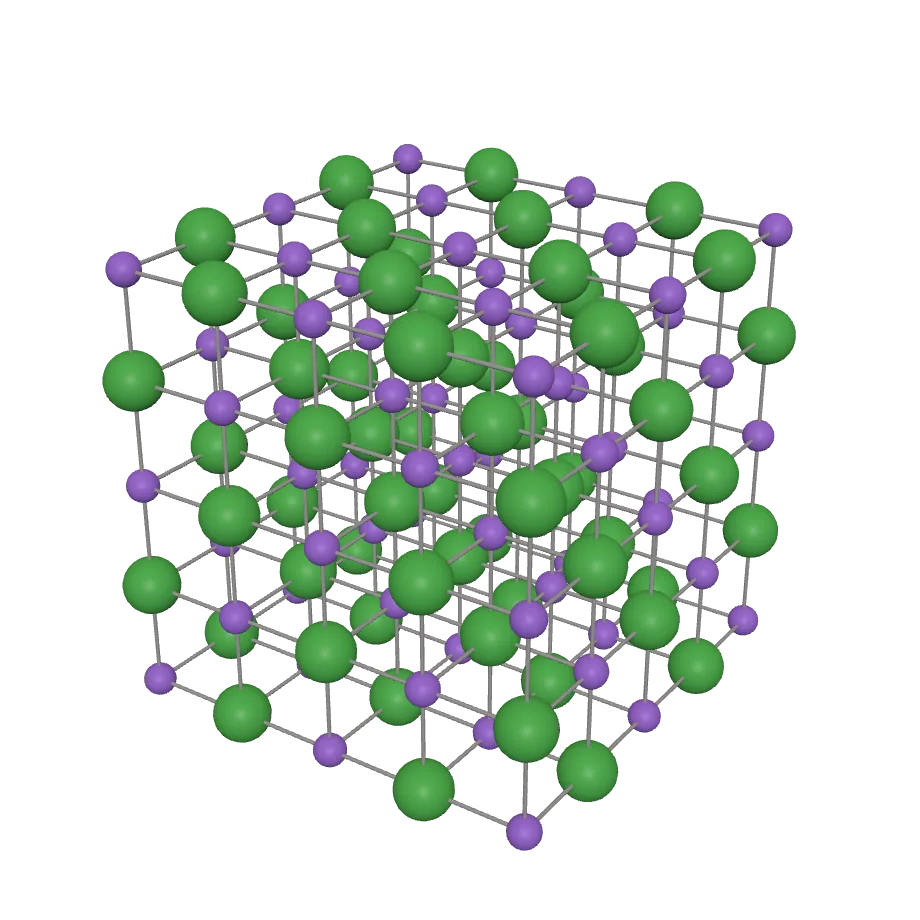
This browser can’t show the 3D model. The picture above is the same model.
A real salt crystal, five ions each way: sodium ions, Na⁺ (purple), and chloride ions, Cl⁻ (green), take turns in every direction. The lines only show which ions are neighbors: they are not shared-pair bonds.
A sodium ion, Na⁺Six chloride ions round it, above and below, left and right, in front and behind, each 0.282 nm away, and every one of them pulls on it.
A chloride ion, Cl⁻Six sodium ions round it in the same way. No ion belongs to just one partner, so the crystal is one block, not separate NaCl molecules.
The ions at their real sizes: each touches its six neighbors, and the chloride ions are much bigger than the sodium ions. A salt crystal is one packed block of ions.
Drag to turn it. Tap a part, or a name below, to pick it out; tap it again to see the whole.
Salt (halite): COD 9003308, Walker and others (2004), Crystallography Open Database, CC0: www.crystallography.net/cod/9003308.html
The number of atoms in one molecule of a substance is its atomicity:
- Monatomic (atomicity 1): the noble gases, He, Ne, Ar, exist as single atoms.
- Diatomic (atomicity 2): H₂, O₂, N₂, Cl₂, HCl, CO.
- Triatomic (3): H₂O, CO₂, O₃ (ozone).
- Tetratomic (4): NH₃, P₄.
- Polyatomic: any molecule of more than two atoms. Those of life are huge: a protein molecule has thousands of atoms, and a DNA molecule billions.
A molecule has its own properties, different from those of its atoms. Hydrogen and oxygen are gases, and a mixture of them explodes when lit; water, made of the same atoms bonded together, puts fires out.
Which of these molecules is tetratomic?
Pick an answer to see why.
Relative atomic mass and relative molecular mass
Atoms are unimaginably small. Their diameters range from about 0.1 to 0.5 nanometers (1 × 10⁻¹⁰ m to 5 × 10⁻¹⁰ m): about a million atoms side by side would span the width of a thick human hair. The mass of one atom is far too small for any balance (a carbon-12 atom has a mass of 1.99 × 10⁻²³ g). So chemists first measured how many times heavier one kind of atom is than another, and later, from these relative masses and the Avogadro constant (Unit 2), worked out the actual masses.
Just as a kitchen balance compares a load with standard weights, chemists compare atoms with a standard atom. Since 1961 the standard is the carbon-12 atom (the most common isotope of carbon, with 6 protons and 6 neutrons), given a mass of exactly 12. So masses on this scale are relative: relative atomic mass and relative molecular mass.
Most elements are mixtures of isotopes: atoms with the same number of protons but different numbers of neutrons, so different masses. Chlorine is about 76% chlorine-35 and 24% chlorine-37. So the mass that matters in a reaction is the average over the natural mixture:
Relative atomic mass of an element (Aᵣ) is the average mass of its atoms, in the natural mixture of its isotopes, compared with of the mass of one atom of carbon-12:
Being a ratio of two masses, it has no unit.
| Element | Symbol | Relative atomic mass | Used in calculations |
|---|---|---|---|
| hydrogen | H | 1.008 | 1 |
| carbon | C | 12.011 | 12 |
| nitrogen | N | 14.007 | 14 |
| oxygen | O | 15.999 | 16 |
| sodium | Na | 22.990 | 23 |
| magnesium | Mg | 24.305 | 24 |
| aluminium | Al | 26.982 | 27 |
| sulphur | S | 32.06 | 32 |
| chlorine | Cl | 35.45 | 35.5 |
| potassium | K | 39.098 | 39 |
| calcium | Ca | 40.078 | 40 |
| iron | Fe | 55.845 | 56 (or 55.8) |
| copper | Cu | 63.546 | 63.5 |
| zinc | Zn | 65.38 | 65 (or 65.4) |
| silver | Ag | 107.87 | 108 |
(Values from IUPAC’s table of standard atomic weights; the last column is how exams round them. Use the values a question gives, if it gives any.)
The relative atomic mass of silver is 107.87: an average silver atom has 107.87 times the mass of of a carbon-12 atom. Yet no silver atom has that mass. Silver is a mixture of two isotopes, silver-107 (about 51.8%) and silver-109 (about 48.2%), and 107.87 is their weighted average. So:
A relative atomic mass that is not close to a whole number shows that the element occurs as a mixture of isotopes. (Each isotope’s own mass is close to a whole number, its mass number, because protons and neutrons each have a mass close to 1.)
Many elements and compounds exist as molecules: hydrogen as H₂, water as H₂O. The mass of a molecule is given on the same scale.
Relative molecular mass (Mᵣ) of a substance is the mass of one of its molecules compared with of the mass of one atom of carbon-12:
In practice, it is the sum of the relative atomic masses of all the atoms in the molecule. For chloroform, CHCl₃:
So a molecule of chloroform is 119.5 times as heavy as of a carbon-12 atom.
An ionic compound has no molecules, so for it the same sum is called the relative formula mass (or formula mass): for sodium chloride, 23 + 35.5 = 58.5.
The atomic mass unit
The masses of atoms in grams are tiny, awkward numbers. So chemists use a unit of their own, the atomic mass unit (amu, written u in SI and also called the dalton, Da):
One atomic mass unit is of the mass of one atom of carbon-12.
So the mass of an atom in amu is the same number as its relative atomic mass: a carbon-12 atom is 12 amu, an average oxygen atom 16.00 amu, a water molecule 18 amu. The proton and the neutron each have a mass of almost exactly 1 amu (1.007 and 1.009), and the electron only 1/1836 of that, which is why the mass of an atom is almost all in its nucleus.
The relative atomic mass of boron is 10.81. Boron has two isotopes, boron-10 and boron-11. Which is more common in nature?
Pick an answer to see why.
Ions and radicals
Atoms and molecules are electrically neutral: the positive charge of their protons is balanced by the negative charge of their electrons. An ion is an atom or group of atoms that carries a charge, because it has lost or gained electrons. A bottle of sodium hydroxide contains sodium ions, Na⁺; a bottle of sulphuric acid, in water, gives sulphate ions, SO₄²⁻.
- A cation is a positive ion: an atom or group that has lost electrons (Na⁺, Ca²⁺, NH₄⁺).
- An anion is a negative ion: one that has gained electrons (Cl⁻, O²⁻, SO₄²⁻).
Cations (basic radicals)
Metals tend to lose electrons and form cations, so these are also called metallic ions, electropositive ions or basic radicals. The charge on a simple cation equals the valency of the metal: an ion of valency 1 is monovalent (Na⁺), of valency 2 bivalent (Ca²⁺), of valency 3 trivalent (Al³⁺).
Many metals, especially the transition metals, have variable valency: they form more than one cation. Their ions are named in two ways:
- The classical names add -ous for the lower valency and -ic for the higher, often to the metal’s Latin name: ferrous and ferric (from ferrum, iron), cuprous and cupric (cuprum, copper).
- The Stock names, used today, give the charge as a Roman numeral after the metal’s name: iron(II) and iron(III), copper(I) and copper(II).
| Ion | Classical name | Stock name | Valency |
|---|---|---|---|
| Fe²⁺ | ferrous | iron(II) | 2 |
| Fe³⁺ | ferric | iron(III) | 3 |
| Cu⁺ | cuprous | copper(I) | 1 |
| Cu²⁺ | cupric | copper(II) | 2 |
| Hg₂²⁺ | mercurous | mercury(I) | 1 |
| Hg²⁺ | mercuric | mercury(II) | 2 |
| Mn²⁺ | manganous | manganese(II) | 2 |
| Mn³⁺ | manganic | manganese(III) | 3 |
| Sn²⁺ | stannous | tin(II) | 2 |
| Sn⁴⁺ | stannic | tin(IV) | 4 |
| Pb²⁺ | plumbous | lead(II) | 2 |
| Pb⁴⁺ | plumbic | lead(IV) | 4 |
| Cr²⁺ | chromous | chromium(II) | 2 |
| Cr³⁺ | chromic | chromium(III) | 3 |
| Co²⁺ | cobaltous | cobalt(II) | 2 |
| Co³⁺ | cobaltic | cobalt(III) | 3 |
| Au⁺ | aurous | gold(I) | 1 |
| Au³⁺ | auric | gold(III) | 3 |
Two of these need care. The mercury(I) ion is not Hg⁺ but Hg₂²⁺, two mercury atoms bonded together and sharing a charge of 2+, so mercurous chloride is Hg₂Cl₂, not HgCl. And manganese in valency 4 (as in MnO₂, manganese dioxide) is named manganese(IV); the classical name manganic belongs to Mn³⁺.
Not every cation is a metal: the ammonium ion, NH₄⁺, is a group of atoms that behaves like a metal ion in salts (ammonium chloride, NH₄Cl).
Anions (acid radicals)
Non-metals tend to gain electrons and form anions, so these are called non-metallic ions, electronegative ions or acid radicals. Again an anion is monovalent, bivalent or trivalent by its charge. An anion of a single atom is monatomic, and is named by giving the element’s name the ending -ide:
| Element | Ion | Name of ion | Valency |
|---|---|---|---|
| carbon | C⁴⁻ | carbide | 4 |
| nitrogen | N³⁻ | nitride | 3 |
| phosphorus | P³⁻ | phosphide | 3 |
| oxygen | O²⁻ | oxide | 2 |
| sulphur | S²⁻ | sulphide | 2 |
| selenium | Se²⁻ | selenide | 2 |
| tellurium | Te²⁻ | telluride | 2 |
| fluorine | F⁻ | fluoride | 1 |
| chlorine | Cl⁻ | chloride | 1 |
| bromine | Br⁻ | bromide | 1 |
| iodine | I⁻ | iodide | 1 |
An anion of more than one atom is polyatomic (a compound radical). Most are made of oxygen and one other element, and are called oxyanions. Their names follow a pattern:
- When an element forms two oxyanions, the one with fewer oxygen atoms ends in -ite, the one with more in -ate: sulphite SO₃²⁻ and sulphate SO₄²⁻; nitrite NO₂⁻ and nitrate NO₃⁻.
- When there are more than two, hypo- (“under”) marks the one with the fewest oxygens and per- (“beyond”) the one with the most. Chlorine forms four:
| Formula | Name | Formula | Name |
|---|---|---|---|
| ClO⁻ | hypochlorite | SO₄²⁻ | sulphate |
| ClO₂⁻ | chlorite | HSO₄⁻ | hydrogen sulphate (bisulphate) |
| ClO₃⁻ | chlorate | SO₃²⁻ | sulphite |
| ClO₄⁻ | perchlorate | S²⁻ | sulphide |
A few polyatomic anions behave like monatomic ones in many reactions and also end in -ide: the cyanide ion, CN⁻, and the hydroxide ion, OH⁻, are named like the chloride ion. An ion of one atom (Cl⁻, H⁻, I⁻, Na⁺) is a simple ion; one of more than one atom (CrO₄²⁻, HCO₃⁻, PO₄³⁻, NH₄⁺) is a compound ion.
| Formula | Name of the ion | Formula | Name of the ion |
|---|---|---|---|
| F⁻ | fluoride | CrO₄²⁻ | chromate |
| Cl⁻ | chloride | Cr₂O₇²⁻ | dichromate |
| Br⁻ | bromide | CO₃²⁻ | carbonate |
| I⁻ | iodide | HCO₃⁻ | hydrogen carbonate (bicarbonate) |
| H⁻ | hydride | NO₂⁻ | nitrite |
| O²⁻ | oxide | NO₃⁻ | nitrate |
| S²⁻ | sulphide | SiO₄⁴⁻ | silicate |
| O₂²⁻ | peroxide | PO₄³⁻ | phosphate |
| O₂⁻ | superoxide | HPO₄²⁻ | hydrogen phosphate |
| OH⁻ | hydroxide | H₂PO₄⁻ | dihydrogen phosphate |
| CN⁻ | cyanide | C₂O₄²⁻ | oxalate |
| CNO⁻ | cyanate | SCN⁻ | thiocyanate |
| MnO₄⁻ | permanganate | MnO₄²⁻ | manganate |
| S₂O₃²⁻ | thiosulphate | SO₄²⁻ | sulphate |
| HSO₄⁻ | hydrogen sulphate (bisulphate) | SO₃²⁻ | sulphite |
What is the formula of the chromate ion?
Pick an answer to see why.
Which of these is a polyatomic cation?
Pick an answer to see why.
Molecular formula
Vinegar, used to preserve and flavor food, is a solution of about 5% acetic acid (ethanoic acid) in water. Its formula, CH₃COOH, tells you that acetic acid is made of carbon, hydrogen and oxygen, and exactly how many of each atom are in one molecule: 2 C, 4 H and 2 O.
A compound is written with the symbols of its elements, each followed by a subscript for the number of atoms of that element (no subscript means one). For a molecular substance this is its molecular formula: the symbols and numbers of the atoms in one molecule of it. Water’s molecular formula, H₂O, says each molecule has two hydrogen atoms and one oxygen atom.
Each compound has its own formula, and changing a single number makes a different substance: hydrogen peroxide, H₂O₂, a bleach and antiseptic, is quite unlike water, H₂O. Other well-known formulas: sucrose (table sugar) C₁₂H₂₂O₁₁, aspirin C₉H₈O₄, ammonia NH₃, methane CH₄.
Writing the formula of an ionic compound
An ionic compound is electrically neutral, so its ions are taken in the numbers that make the charges cancel. A quick way is the criss-cross method: write the cation first and the anion second; the valency of each becomes the subscript of the other; cancel any common factor; put brackets round a polyatomic ion if it needs a subscript.
The table below shows the compounds that some common cations form with some common anions.
| Cl⁻ | CO₃²⁻ | OH⁻ | SO₄²⁻ | PO₄³⁻ | |
|---|---|---|---|---|---|
| Na⁺ | NaCl | Na₂CO₃ | NaOH | Na₂SO₄ | Na₃PO₄ |
| K⁺ | KCl | K₂CO₃ | KOH | K₂SO₄ | K₃PO₄ |
| H⁺ | HCl | H₂CO₃ | H₂O (HOH) | H₂SO₄ | H₃PO₄ |
| Ca²⁺ | CaCl₂ | CaCO₃ | Ca(OH)₂ | CaSO₄ | Ca₃(PO₄)₂ |
| Mg²⁺ | MgCl₂ | MgCO₃ | Mg(OH)₂ | MgSO₄ | Mg₃(PO₄)₂ |
| Zn²⁺ | ZnCl₂ | ZnCO₃ | Zn(OH)₂ | ZnSO₄ | Zn₃(PO₄)₂ |
| Fe²⁺ | FeCl₂ | FeCO₃ | Fe(OH)₂ | FeSO₄ | Fe₃(PO₄)₂ |
| Fe³⁺ | FeCl₃ | Fe₂(CO₃)₃ | Fe(OH)₃ | Fe₂(SO₄)₃ | FePO₄ |
| Al³⁺ | AlCl₃ | Al₂(CO₃)₃ | Al(OH)₃ | Al₂(SO₄)₃ | AlPO₄ |
| Co³⁺ | CoCl₃ | Co₂(CO₃)₃ | Co(OH)₃ | Co₂(SO₄)₃ | CoPO₄ |
The formulas follow from the charges, but not every one is a compound you can buy: iron(III) carbonate and aluminium carbonate break down in water, and cobalt(III) chloride is unstable. The rule gives the formula a compound would have; whether it exists is a matter of experiment.
Common names
Many household chemicals are better known by their common names than by their systematic ones:
| Common name | Systematic name | Formula |
|---|---|---|
| baking soda | sodium hydrogen carbonate (sodium bicarbonate) | NaHCO₃ |
| bleach | sodium hypochlorite (in water) | NaClO |
| bleaching powder | calcium chlorohypochlorite | CaOCl₂ |
| borax | sodium tetraborate decahydrate | Na₂B₄O₇·10H₂O |
| brimstone | sulphur | S₈ |
| chalk, limestone, marble | calcium carbonate | CaCO₃ |
| Epsom salt | magnesium sulphate heptahydrate | MgSO₄·7H₂O |
| gypsum | calcium sulphate dihydrate | CaSO₄·2H₂O |
| plaster of Paris | calcium sulphate hemihydrate | CaSO₄·½H₂O |
| quicklime | calcium oxide | CaO |
| slaked lime | calcium hydroxide | Ca(OH)₂ |
| lye, caustic soda | sodium hydroxide | NaOH |
| washing soda | sodium carbonate decahydrate | Na₂CO₃·10H₂O |
| magnesia | magnesium oxide | MgO |
| milk of magnesia | magnesium hydroxide (in water) | Mg(OH)₂ |
| muriatic acid | hydrochloric acid | HCl |
| potash | potassium carbonate | K₂CO₃ |
| saltpeter | potassium nitrate | KNO₃ |
| talc | magnesium silicate hydroxide | Mg₃Si₄O₁₀(OH)₂ |
| vinegar | acetic acid (ethanoic acid, in water) | CH₃COOH |
| water | dihydrogen oxide | H₂O |
| ammonia | nitrogen trihydride | NH₃ |
A subscript after a symbol and a number in front of it mean different things. H₂ is one hydrogen molecule, two atoms bonded together. 2H is two separate hydrogen atoms. 2H₂ is two hydrogen molecules: four atoms in all, in two pairs.
How many oxygen atoms are there in 3Ca(NO₃)₂?
Pick an answer to see why.
Empirical formula
A molecular formula gives the actual number of each kind of atom in one molecule. Carbon dioxide, CO₂: one carbon and two oxygens, a ratio of 1 : 2. That ratio can’t be made simpler, so here the simplest formula is the same as the molecular one.
Glucose, C₆H₁₂O₆, has 6 carbons, 12 hydrogens and 6 oxygens in each molecule, a ratio of 6 : 12 : 6. But the simplest whole-number ratio is 1 : 2 : 1. That simplest formula is the empirical formula: for glucose, CH₂O.
The empirical formula of a compound is the formula that gives the simplest whole-number ratio of the atoms of each element in it. (Empirical means “found by experiment”: chemical analysis gives the ratio of the elements first, as Unit 2 shows, and the size of the molecule only later.)
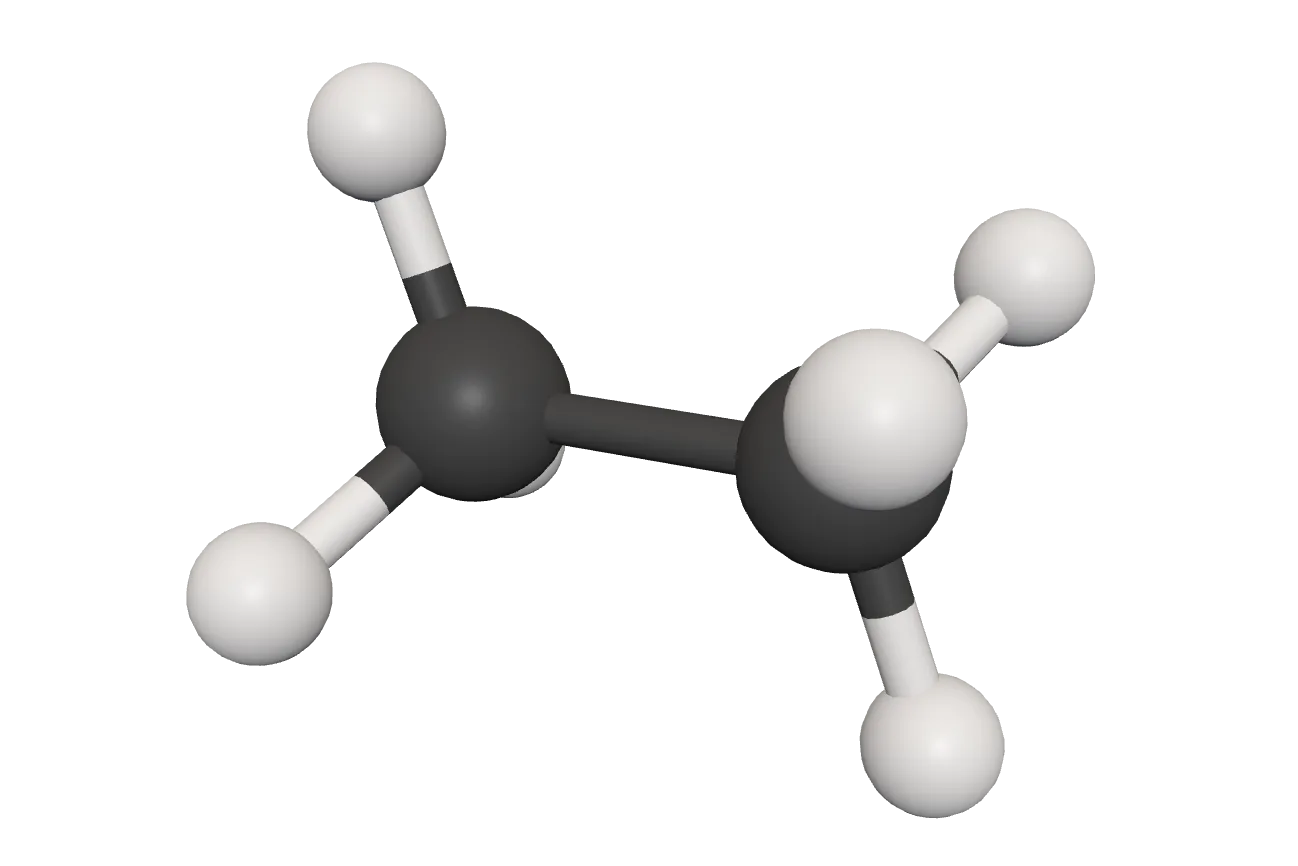
This browser can’t show the 3D model. The picture above is the same model.
Single bonds only: each carbon’s four bonds point to the corners of a tetrahedron, about 109.5° apart (108.3° and 110.6° in this computed model).
Carbon atom: four single bonds, three to hydrogens and one to the other carbon.
Hydrogen atom: one single bond.
Drag to turn it. Tap an atom to see what it is.
Molecules: computed 3D conformers from PubChem, National Library of Medicine (public domain): pubchem.ncbi.nlm.nih.gov, CID 6324
Relationship between molecular and empirical formula
The molecular formula is always a whole-number multiple of the empirical formula:
where the empirical formula mass is the sum of the atomic masses in the empirical formula.
| Compound | Molecular formula | Empirical formula | n |
|---|---|---|---|
| hydrogen peroxide | H₂O₂ | HO | 2 |
| benzene | C₆H₆ | CH | 6 |
| ethane | C₂H₆ | CH₃ | 2 |
| glucose | C₆H₁₂O₆ | CH₂O | 6 |
| acetic acid | C₂H₄O₂ | CH₂O | 2 |
| water | H₂O | H₂O | 1 |
| carbon dioxide | CO₂ | CO₂ | 1 |
Notice that glucose and acetic acid share the empirical formula CH₂O: an empirical formula alone can’t tell two compounds apart.
Which pair of compounds has the same empirical formula?
Pick an answer to see why.
1.4 Percentage composition from molecular formula
Have you noticed the table of percentages on a packet of noodles or biscuits, or on a bag of cement? The cement in a Nepali building is mostly one of two kinds: OPC (ordinary Portland cement) and PPC (Portland pozzolana cement, in which part of the clinker is replaced by fly ash or volcanic ash). Their oxides are in quite different proportions:
| Compound | OPC (%) | PPC (%) |
|---|---|---|
| CaO | 64 | 40 |
| SiO₂ | 19 | 28 |
| Al₂O₃ | 4.6 | 8.3 |
| Fe₂O₃ | 3.7 | 3.8 |
| MgO | 0.7 | 1.0 |
(Typical values; the rest is mainly sulphate from the gypsum added, and small amounts of other oxides. The percentages differ from one factory to another.)
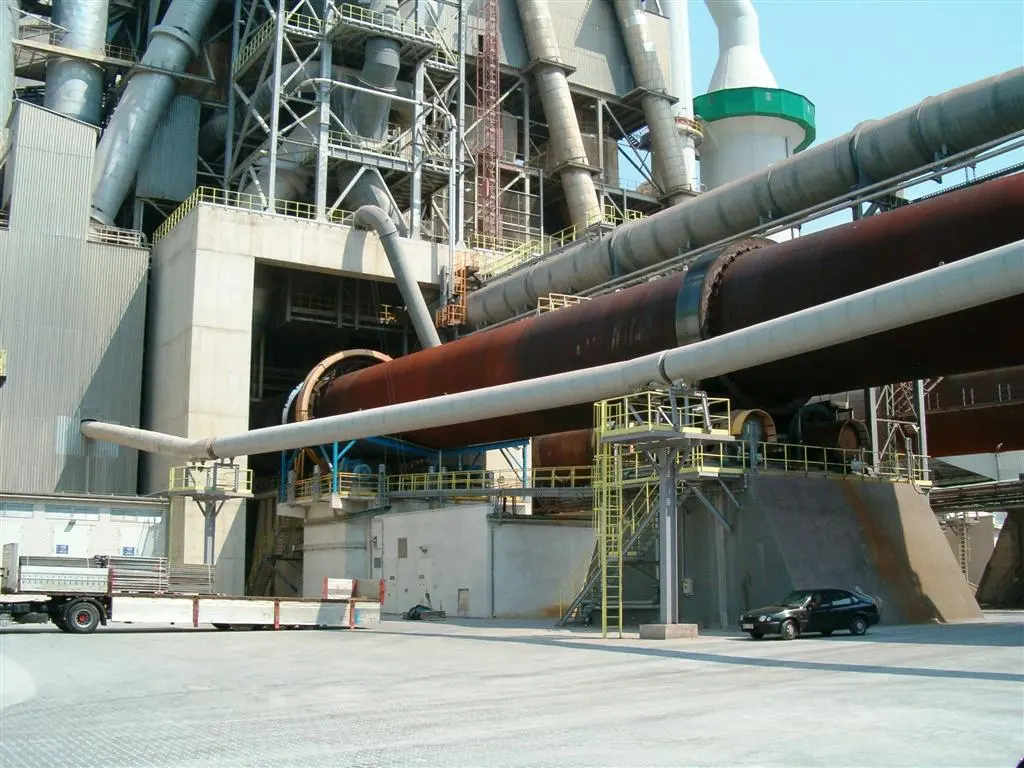
The percentage composition of a compound gives the mass of each element in 100 g of the compound. It tells you how much of each component a substance contains. If the formula is known, the percentage of each element can be calculated, because every sample of a compound has the same composition by mass (the law of constant proportions, Unit 2):
The mass of the element is its atomic mass times the number of its atoms in the formula.
Applications of percentage composition
Knowing the percentage composition of a substance helps chemists to understand and use it:
- Finding the empirical formula: from the percentage composition you can find the simplest whole-number ratio of the atoms, the empirical formula (Unit 2 shows how).
- Finding the molecular formula: together with the molecular mass, it gives the molecular formula, the actual number of atoms of each element in a molecule.
- Quality control: in industries that make chemicals (cement, fertilizer, medicines), keeping a fixed percentage composition makes the product’s quality the same in every batch. A composition away from what is expected shows an impurity or a fault in the process.
- Stoichiometric calculations: it is used in working out the amounts of substances that react and are produced (Unit 2).
- Predicting properties: compounds of the same elements in different proportions are different substances, with different properties: carbon monoxide (42.9% C) is a deadly poison, carbon dioxide (27.3% C) a gas we breathe out.
Which has the highest percentage of nitrogen by mass?
Pick an answer to see why.
Project work
Exercise
Choose the correct option
- Which of the following make up most of the mass of an atom?
Pick an answer to see why.
- Two atoms are isotopes of the same element. Which of the following is the same for both?
Pick an answer to see why.
- Which of the following is true about compounds?
Pick an answer to see why.
- Which of the following is true for the atom ?
Pick an answer to see why.
- Which of the following formulas has the most atoms?
Pick an answer to see why.
- Which of the following radicals has the highest valency?
Pick an answer to see why.
- One atomic mass unit is about the mass of:
Pick an answer to see why.
- Which of the following molecules is tetratomic?
Pick an answer to see why.
- A calcium compound is used to make casts that hold fractured bones in place while they heal. Which?
Pick an answer to see why.
- Which of the following compounds has the same empirical formula and molecular formula?
Pick an answer to see why.
- What percentage of the mass of CuSO₄·5H₂O is water? (Cu = 63.5)
Pick an answer to see why.
- Which of the following is heaviest?
Pick an answer to see why.
Answer these questions
Define chemistry. How does the study of chemistry help in the development of society? Write any four points.
Answer
Why is chemistry called the central science? Write two roles of chemistry in agriculture and two in medicine.
Answer
Gypsum is a mineral with the formula CaSO₄·2H₂O, used to make plaster of Paris.
- a.How many atoms are there in one formula unit of gypsum?
- b.Calculate the molecular mass of gypsum.
- c.How is it used to make plaster of Paris?
- d.Calculate the percentage of sulphate in gypsum.
Answer
Ammonia and ammonium nitrate are both used as nitrogen fertilizers.
- a.Write their formulas.
- b.Calculate the percentage of nitrogen in each.
- c.Which do you think is the better fertilizer, and why?
Answer
Fill in the table with the correct formulas.
| Radicals | K⁺ | Zn²⁺ | Fe³⁺ | Cu⁺ |
|---|---|---|---|---|
| MnO₄⁻ | KMnO₄ | |||
| MnO₄²⁻ | ||||
| Cr₂O₇²⁻ | ||||
| O²⁻ | ||||
| N³⁻ | ||||
| PO₄³⁻ |
Answer
Write two differences between:
- a.atom and molecule
- b.atomic mass and molecular mass
- c.molecular formula and empirical formula
- d.atom and radical
- e.acid radical and basic radical
Answer
The masses of atoms and molecules are measured on a special scale.
- a.Why is it difficult to measure the mass of an atom or a molecule?
- b.Define 1 amu. Calculate its value in grams.
Answer
Write the formula of each ion, and tick whether it is monatomic or polyatomic, a cation or an anion.
| Ion | Formula | Monatomic | Polyatomic | Cation | Anion |
|---|---|---|---|---|---|
| phosphate | |||||
| iodide | |||||
| fluoride | |||||
| cyanide | |||||
| carbonate | |||||
| nitride | |||||
| oxalate | |||||
| nitrate | |||||
| sodium | |||||
| aluminium | |||||
| ammonium |
Answer
In Figure 1.9, the red balls are oxygen atoms and the gray ones hydrogen atoms.
- a.Find the total number of oxygen and hydrogen atoms.
- b.Write the molecular formula of the molecules shown.
Answer
Chemistry plays a very important role in many areas of science.
- a.Nepal Aushadhi Limited makes the paracetamol tablet Cetamol. How does chemistry contribute to developing new medicines like this?
- b.What role does chemistry play in protecting the environment and in sustainable practices?
- c.How is chemistry involved in the design and manufacture of electronic devices and materials?
Answer
Penicillin, C₁₄H₂₀N₂SO₄, was the first antibiotic (a substance that kills bacteria), discovered by Alexander Fleming.
- a.Why is penicillin called a compound?
- b.How many atoms are there in one molecule of penicillin?
- c.Calculate the molecular mass of penicillin.
- d.Calculate the percentage of each element in penicillin.
Answer
The structural formula of an organic compound is given in Figure 1.10.
- a.Write its molecular and empirical formulas.
- b.Find its empirical formula mass and molecular mass.
- c.Calculate the percentage of carbon and of hydrogen in it.
Answer
Nicotine, a stimulant found in tobacco, has the percentage composition C 74.02%, N 17.27%, H 8.71%. Find its molecular formula if its molecular mass is 162.
Answer
Printable PDFs
- Study notes 3 pages
- Worksheet 4 pages Answer key
Quiz yourself: Matter, Atoms and Reactions, Grades 5–12 →
Practice every question in the book, and keep track of the ones you miss →
A companion to your textbook, not a replacement for it: study from the book your school uses, and where the two differ, follow your teacher. Found a mistake? Please tell us.