
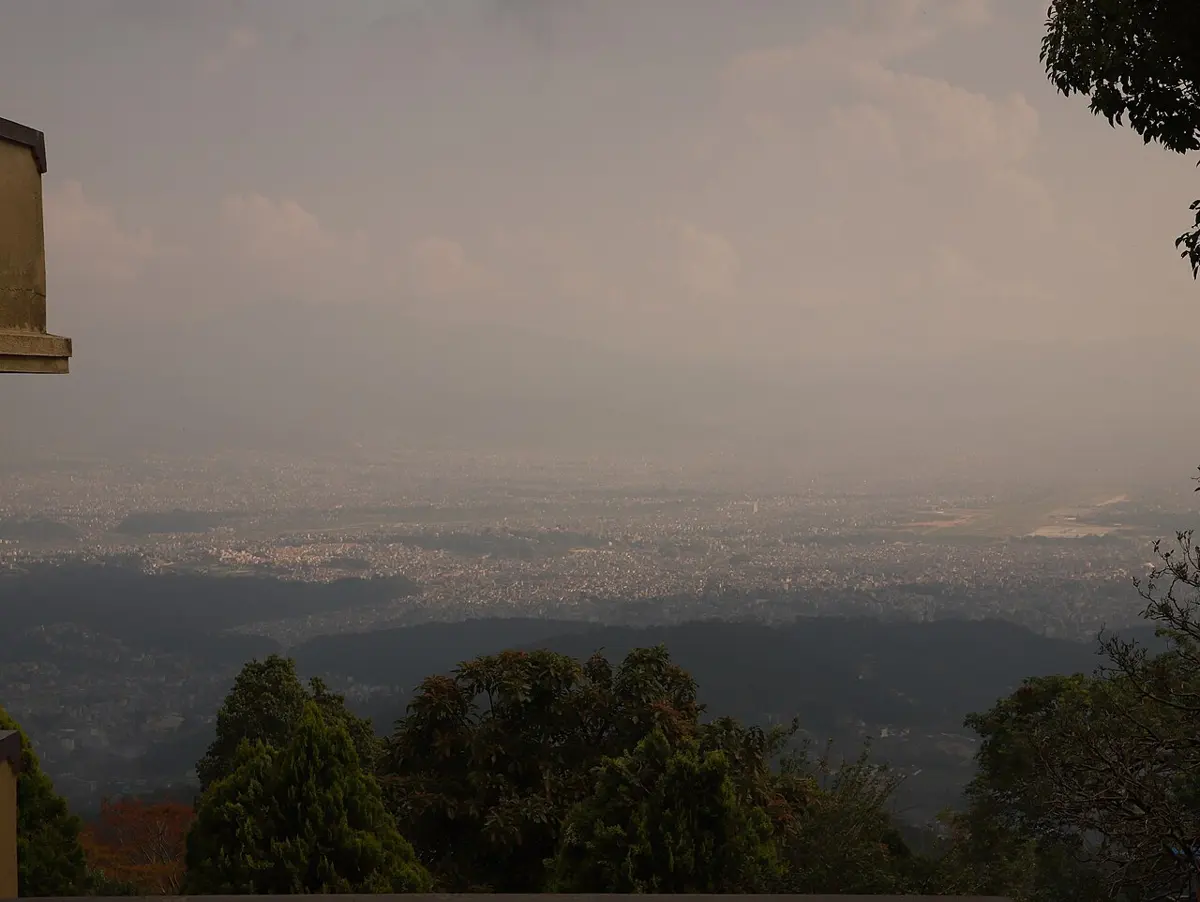
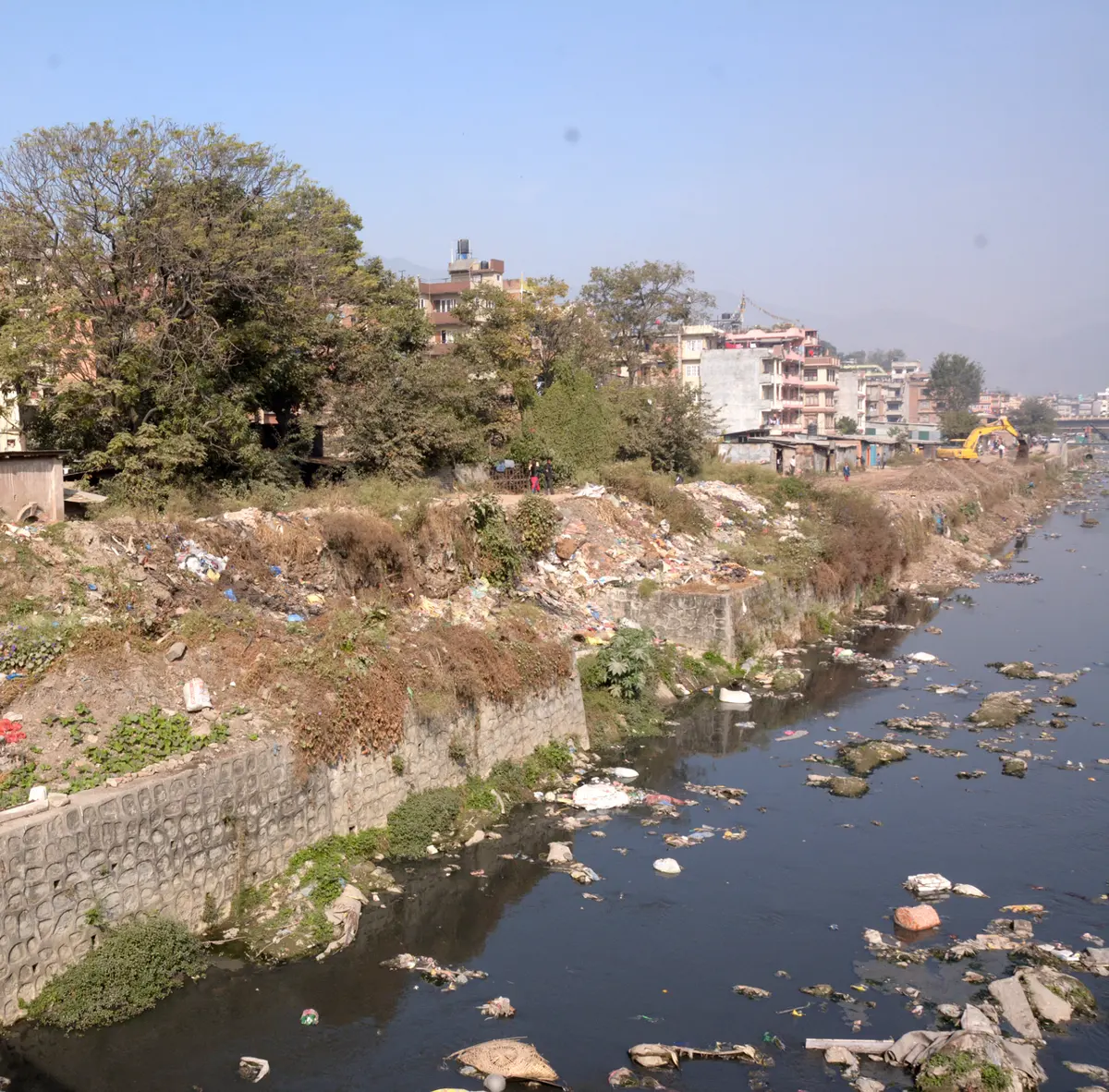
On some winter mornings in Kathmandu you can’t see the hills that ring the valley, and on a bad day the air is among the dirtiest of any city in the world. The same valley’s holy river, the Bagmati, runs black through the city, and vegetables in its markets are tested for pesticide left on them. Where does all this come from, what does it do to living things, and what can be done?
This unit is about pollution of the air, water and soil, and about pesticides, poisons we spread on purpose that end up where we never meant them to go.
9.3.1 General introduction
The word pollution comes from the Latin pollutionem, “defilement”, making something dirty. Simply put, pollution is the release of harmful substances (or energy, such as heat and noise) into the environment, which lowers the natural quality of the air, water or soil.
Pollution has natural and anthropogenic (human-made) causes:
- Anthropogenic causes: industries, too much pesticide and chemical fertilizer on farmland, burning fossil fuels, careless dumping of household and industrial waste, cutting forests and the spread of towns.
- Natural causes: volcanic eruptions, forest fires, dust storms, the decay of dead organic matter, pollen.
Pollution is now a pressing problem worldwide, a serious threat to plants, animals and people. In humans it causes or worsens asthma, bronchitis, poor mental health, anemia, COPD (chronic obstructive pulmonary disease), high blood pressure and more.
The human population grows every day, and with it the demand for food, transport, water, roads, houses, hospitals, vehicles, electricity and factory goods. The result is that natural resources are used up and degraded.
To sum up, pollution is any undesirable change in the physical, chemical or biological characteristics of the environment (air, water or soil) that harms, or may harm, living things. Any substance that makes the environment dirty and harmful is a pollutant.
Types of pollutants
By whether they change after release:
- a.Primary pollutants stay in the same form in which they are released from their source. Examples: DDT, fly ash, sulphur dioxide, carbon monoxide.
- b.Secondary pollutants are formed in the environment by chemical reactions between primary pollutants (often helped by sunlight). Many are more harmful than the pollutants they come from. Examples: ozone near the ground, peroxyacetyl nitrate (PAN) and photochemical smog, which form from oxides of nitrogen and hydrocarbons in sunlight; and sulphuric acid in acid rain.
By whether they break down:
- a.Biodegradable pollutants are broken down quite quickly in nature by microorganisms (and heat). Examples: sewage, food and other organic wastes. They cause harm only when there is more than nature can break down.
- b.Non-biodegradable pollutants are not broken down, or only extremely slowly, so they stay in the environment and build up. Examples: DDT, BHC (lindane), plastics, tin cans, heavy metals such as mercury and lead.
Ground-level ozone in a city’s smog is not released from any chimney or exhaust pipe. What kind of pollutant is it?
Pick an answer to see why.
9.3.2 Air pollution
Clean, dry air is about 78.08% nitrogen, 20.95% oxygen, 0.93% argon and 0.04% carbon dioxide, with tiny amounts of other gases. Real air also holds water vapor, from almost none to about 4%, depending on the weather. When chemicals, smoke, particles and gases from human activities or natural sources change this natural quality of the air, it is air pollution. It harms natural resources and the health of plants, animals and people. Substances that pollute the air are air pollutants: the main ones are particles (PM2.5 and PM10, soot, dust, fly ash), carbon monoxide, sulphur dioxide, oxides of nitrogen, ground-level ozone, hydrocarbons and lead.
1. Sources
- a.Natural sources: dust storms, volcanic gases, natural gas seeping from the ground, pollen and spores, methane from decaying plants and animals, and methane released from thawing Arctic ground. Natural pollution is spread thinly over the whole Earth; human pollution is packed into the places where people live and work, which is why it does so much harm.
- b.Factories: food, paper, cement, brick, shoe, rubber and textile factories give off harmful gases such as CO₂, SO₂, NO, H₂S and CO, and particles. In Nepal, the brick kilns of the Kathmandu Valley and the Terai, burning coal through the dry season, are among the biggest sources.
- c.Transport: vehicles, aircraft and diesel trains burn petrol, diesel and other fossil fuels, releasing CO₂, CO, oxides of nitrogen, hydrocarbons, soot and, from fuel with sulphur in it, SO₂. Tyres, brakes and dusty roads add particles.
- d.Metal processing: smelting and refining metals from their ores has polluted the air for centuries. It releases mineral dust, fumes with fluorides, and harmful metals such as lead, nickel, mercury, arsenic, cobalt and selenium.
- e.Burning fuel and waste at home and in fields: firewood, dung, kerosene and cooking gas give off CO₂, CO and smoke; smoke from wood and dung stoves fills many kitchens in Nepal. Burning plastic, crop stubble left in fields, rubbish at dumping sites, and forest fires all add to it.
- f.Nuclear power plants: occasional or accidental releases of radioactive substances, which give off alpha, beta and gamma radiation.
2. Effects of air pollution
a. Effects on the environment
- i.Greenhouse effect: some gases in the air, the greenhouse gases, let sunlight through but absorb the heat the Earth gives off, warming the Earth. The main ones are water vapor, carbon dioxide, methane, nitrous oxide (N₂O), CFCs and ground-level ozone. Adding more of them makes the Earth warmer than it would be: global warming. Sulphur dioxide (SO₂) and nitrogen dioxide (NO₂) are not counted among the greenhouse gases; take care not to mix up nitrogen dioxide with nitrous oxide (N₂O), a different oxide of nitrogen, which is one. More in Unit 15.
- ii.Acid rain: sulphur dioxide and oxides of nitrogen react in the air with oxygen and water to form sulphuric and nitric acids, which fall as acid rain (wet deposition), or settle on buildings, rocks and trees as dry particles that turn to acid when it rains (dry deposition). It harms forests, lakes and their fish, soils and buildings. Clean rain is only slightly acidic, from the carbon dioxide dissolved in it. More in Unit 15.
- iii.Depletion of the ozone layer: chemicals such as CFCs, methyl chloroform, carbon tetrachloride and methyl bromide last a long time in the air, rise to the stratosphere and destroy ozone there. More harmful ultraviolet radiation then reaches the ground, causing skin cancer, cataracts in the eyes and damage to living tissues. More in Unit 15.
- iv.Less visibility: smoke, dust and fog make the air hazy, so distant things can’t be seen. Flights into Kathmandu are sometimes delayed by winter haze.
- v.Less sunlight reaching the ground: particles block sunlight. Some, such as sulphate droplets, reflect it back to space; others, such as soot (black carbon), absorb it and warm the air around them. Soot that settles on Himalayan snow and glaciers darkens them, so they absorb more sunlight and melt faster.
b. Effects on plants and animals
Dust settling on leaves blocks light and clogs the stomata, reducing photosynthesis, respiration and transpiration. Sulphur dioxide and ozone entering the stomata damage the leaf’s cells directly: the leaves turn yellow (chlorosis) or get dead patches, growth is stunted and crops yield less. Acid rain washes nutrients out of the soil and releases aluminium that harms roots, so trees weaken; it also makes lakes too acidic for fish. Lichens are very sensitive to sulphur dioxide and die out where the air holds much of it, so the lichens growing on trees and walls are used as indicators of clean air: many kinds of lichens means clean air, few or none means polluted air.
Animals suffer the same problems as people: bronchitis, pneumonia and heart and blood vessel disease. Some pollutants also upset hormones, leading to weaker gonads, infertility and young born with defects.
c. Effects on humans
- i.Smoke, fly ash, dust and soot dirty clothes and buildings, and cause allergic reactions, asthma and chronic bronchitis.
- ii.Carbon monoxide joins with hemoglobin over 200 times more firmly than oxygen does, forming carboxyhemoglobin, so the blood carries less oxygen. It causes headache, dizziness, blurred vision and, in a closed room, asphyxia (suffocation) and death. In Nepal, people die every winter from charcoal or gas heaters left burning in closed rooms; carbon monoxide has no color or smell.
- iii.Hydrogen sulphide irritates the eyes and throat and causes nausea.
- iv.Nickel and cadmium cause lung disorders, and lead causes anemia and damages the nervous system, most of all children’s growing brains.
- v.Oxides of nitrogen irritate the eyes and airways, and in high doses cause fluid in the lungs (pulmonary edema).
- vi.Breathing polluted air for years is linked to heart disease, strokes, COPD, lung cancer and asthma, and studies also link it with dementia, poor mental health and, in pregnancy, babies born too early or too small. Studies have also reported links with anemia, infertility, miscarriage and gestational diabetes in women, though the evidence for these is weaker.
Why is carbon monoxide so dangerous indoors?
Pick an answer to see why.
3. Preventive measures
- i.Particles in factory smoke can be removed before it leaves the chimney with arresters and filters (cloth bag filters, cyclones that spin the dust out), electrostatic precipitators and scrubbers (Figure 29.2). A wet scrubber washes the gas with water; a dry scrubber passes it through a bed of dry powder, such as lime, that takes up acid gases.
- ii.Gases from factories should be treated to make them less harmful before release: a scrubber whose water is made alkaline with lime, for example, removes sulphur dioxide.
- iii.Vehicles: keep engines tuned and replace old smoky vehicles; use fuel with less sulphur; fit catalytic converters, which turn carbon monoxide, hydrocarbons and oxides of nitrogen in the exhaust into carbon dioxide, water and nitrogen; use public transport, cycles and walking. Electric vehicles give off no exhaust at all (their tyres and brakes still make some dust), so they should be encouraged by the government and the public. In Nepal, where nearly all the electricity comes from hydropower, they cut air pollution much more than in countries that burn coal for electricity.
- iv.Use less fossil fuel and more renewable energy: solar, hydroelectricity, wind and biogas.
- v.Build industries away from where people live; raise public awareness; and enforce environmental laws strictly. Brick kilns rebuilt with the zigzag design, in which the air winds through the bricks, burn less coal and give off much less soot.
9.3.3 Water pollution
Water pollution is a change in the natural quality of water caused by adding substances to it: inorganic, organic, biological or radioactive substances, or heat. It makes water unfit and unsafe for people to use and for water life to live in. Clean water is colorless, has no smell and no taste; polluted water is often turbid (cloudy), smells unpleasant and tastes bad, but water that looks clean can still carry germs or poisons. In short, water pollution is any undesirable change in the physical, chemical or biological characteristics of water.
1. Sources
- i.Domestic sewage: everything that drains from houses, such as food scraps, water from washing dishes and clothes with detergents, human and animal feces, and wastes from slaughterhouses and food factories, often goes straight into rivers, lakes and streams. It is mostly biodegradable. Raw sewage holds organic matter, inorganic substances such as nitrates and phosphates (from feces and detergents), sodium and calcium, and many pathogens (germs) that cause waterborne diseases.
- ii.Industrial effluents: the waste water from factories is called effluent. It may hold inorganic poisons such as lead, mercury, chromium, sulphides and sulphites, and organic wastes such as oils, grease, dyes and solvents. Tanneries, dye works and paper mills are among the worst. Some industries, such as breweries and pharmaceutical plants, also release microorganisms.
- iii.Runoff from farmland: many farmers now use more and more insecticides, fungicides, herbicides and chemical fertilizers. Rain washes them off the fields into rivers, lakes and ponds.
- iv.Oil spills: oil from damaged tankers, pipelines and oil wells spreads as a thin film over the water, which stops oxygen from the air dissolving into it, coats the feathers of seabirds and the fur of sea mammals, and poisons water life.
- v.Radioactive substances: nuclear weapon tests, nuclear power stations, dumped radioactive waste and nuclear accidents contaminate water, and mining uranium pollutes surface and ground water.
- vi.Natural sources: in parts of the Terai, the groundwater pumped from tube wells holds arsenic dissolved from the rocks, at levels that harm health.
2. Effects
- a.Waterborne diseases: polluted water carries pathogens such as Escherichia coli and Salmonella Typhi, and causes diarrhea, cholera, typhoid, dysentery and hepatitis A and E, sometimes in epidemics. E. coli lives in the gut of people and animals, so finding it in water shows that feces got into it: water is tested for it for that reason.
- b.High BOD: when there is a lot of organic waste in water, decomposers (bacteria and other microorganisms) multiply to break it down, and they use up the oxygen dissolved in the water. The amount of oxygen microorganisms need to break down the organic matter in a liter of water is the biochemical oxygen demand (BOD), usually measured over 5 days at 20 °C, in milligrams per liter. Clean river water has a BOD of a few mg/L; untreated household sewage has a BOD of about 100–400 mg/L. The higher the BOD, the more polluted the water, and the less oxygen is left for fish.
- c.Thermal pollution: many factories, and power stations (thermal and nuclear) that use river, lake or sea water to cool their machines, pour hot water back into it. Warm water holds less oxygen than cold water, and fish and other water animals need more oxygen in it, because they are cold-blooded and their bodies run faster when warm.
- d.Biomagnification: pesticides and fertilizers washed into rivers and seas change the water’s chemistry. Pesticides that don’t break down are taken up by living things, passed along food chains and build up in the animals at the top (see 9.3.5).
- e.Radioactive pollution: radioactive wastes harm sea animals, and people who eat seafood from polluted water.
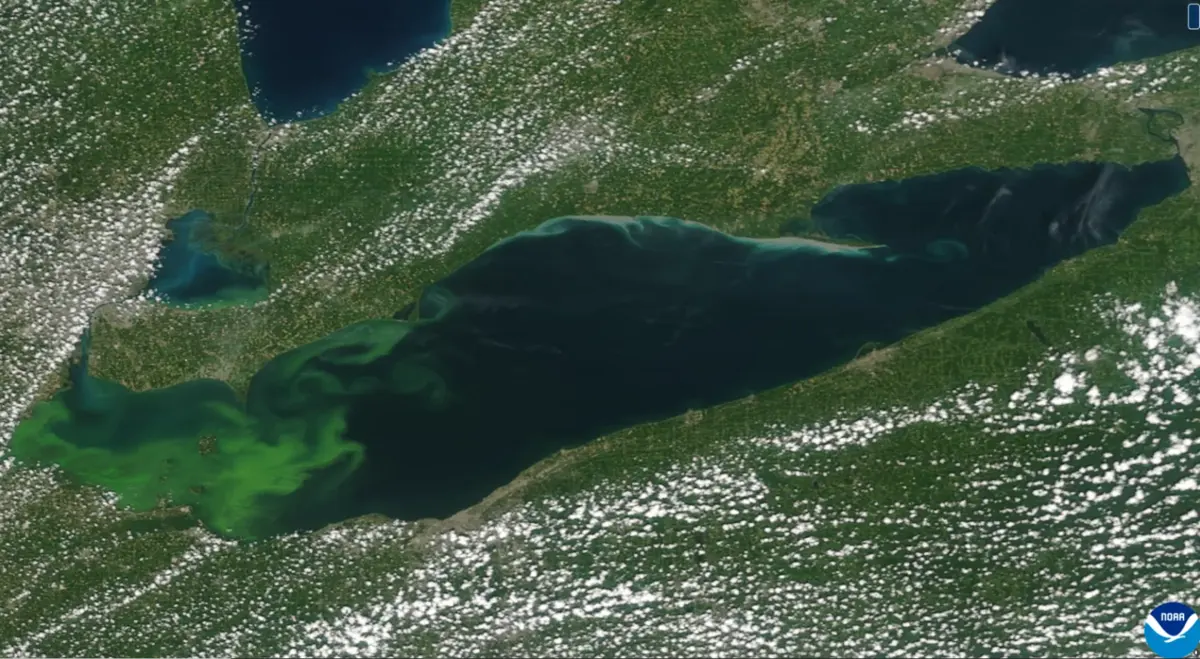
- f.Eutrophication: nitrates and phosphates from sewage, effluents and farm runoff enrich the water with nutrients. Algae and water plants grow fast and cover the water (an algal bloom), blocking sunlight from the plants below. When they die, bacteria decomposing them use up the oxygen, and fish suffocate. This chain of events is called eutrophication. Phewa Lake in Pokhara is slowly filling with silt and choked by water hyacinth, partly because of the sewage and nutrients flowing into it.
- g.Heavy metals such as mercury, lead, arsenic, chromium and cadmium in water damage the kidneys, nerves, heart and blood vessels and skin, and some cause cancer. They are not broken down, and some, such as mercury, are biomagnified.
| Water temperature | Oxygen in fresh water full of air, at sea level |
|---|---|
| 0 °C | 14.6 mg/L |
| 10 °C | 11.3 mg/L |
| 20 °C | 9.1 mg/L |
| 25 °C | 8.3 mg/L |
| 30 °C | 7.6 mg/L |
3. Preventive measures
- i.Organic household waste and sewage can be collected and turned into compost or biogas.
- ii.Sewage and industrial effluents should be treated in treatment plants, to remove solids, break down organic matter (lowering the BOD) and remove poisons, before they are let into rivers. Kathmandu’s sewage treatment plant at Guheshwori treats some of the valley’s sewage before it reaches the Bagmati.
- iii.Wastes should be recycled where possible, or treated before they are dumped.
- iv.The use of insecticides, pesticides and fertilizers (agrochemicals) should be cut to the minimum the crops need, and replaced by safer methods where possible (see IPM below).
- v.Raise public awareness, plant trees along rivers (their roots hold the banks and filter runoff), control population growth, and enforce environmental protection laws strictly.
9.3.4 Soil pollution
Soil is the part of the environment in which plants, most land animals and countless microorganisms live. Throwing and dumping wastes onto it from many sources harms its natural quality. Soil pollution is any undesirable change in the physical, chemical or biological characteristics of soil. It changes the soil’s texture, fertility and water-holding capacity.
1. Sources
- a.Domestic wastes: plastic, rubber, food scraps, dust, waste paper, tin cans, animal dung, broken pots and glass, and spoiled farm produce are dumped on the soil. They lower its fertility, and rotting heaps breed germs that spread to nearby homes and cause epidemics.
- b.Municipal wastes: in towns, the municipality collects plastic, leather, paper, glass and other waste from hospitals, offices, houses, schools, colleges and streets. It holds both biodegradable and non-biodegradable waste, which should be sorted and managed separately; otherwise the soil gathers too much rotting matter and heavy metals such as copper, lead, chromium and nickel. Most of the Kathmandu Valley’s waste goes to the Sisdol landfill in Nuwakot (and now to the Banchare Danda site beside it), where the people nearby have often protested at the smell and leaking water.
- c.Industrial wastes: paper and pulp mills, food factories, soap and detergent factories, pharmaceutical plants and mines produce wastes (by-products) such as sulphides, bleaching liquids, pathogens, polyphosphates, drugs, mine waste, suspended solids, chlorides and heavy metals, which pollute the soil.
- d.Biocides and chemical fertilizers: biocides are chemicals that kill insects, mites, fungi, rodents and other pests that destroy crops or trouble us: insecticides, rodenticides, fungicides, herbicides. They include DDT, aldrin, lindane, parathion and toxaphene. Farmers also use chemical fertilizers to raise yields. Using them too much and carelessly has polluted the soil.
- e.Physical disturbances: badly planned irrigation (which can make soil salty), building work, nuclear explosions and deforestation damage the soil and lead to soil erosion and the spread of deserts.
- f.Acid rain: the acids from polluted air settle on the soil either as dry particles and gases (dry deposition) or dissolved in rain (wet deposition). They wash nutrients out of the soil and make it acidic.
- g.Radioactive wastes: radioactive dust and wastes sink into the soil and stay there, giving off radiation for many years.
- h.Overgrazing and deforestation: these remove the plants that cover the soil. Wind and water then wash away the topsoil, rich in organic matter and nutrients, leaving the infertile subsoil. They also upset the soil’s microorganisms and the cycling of nutrients between soil and plants, and pack the soil hard, so it holds less water and air.
2. Effects of soil pollution
- i.Too much biocide and chemical fertilizer kills the soil’s living things and changes its chemistry, making it unfit for plants and animals; food becomes scarce and contaminated.
- ii.Polluted soil pollutes the air and water too: rain carries its poisons into rivers and groundwater, and dust blows from it.
- iii.People and other organisms that come into contact with soil holding heavy metals such as lead and mercury, or eat food grown in it, suffer from cancer, eye problems, skin allergies, nervous, urinary and digestive disorders, and birth defects.
- iv.Plastics, rubber and glass in the soil stop roots from growing and taking up water and nutrients, disturbing growth and leading to crop failure.
- v.Polluted soil can’t support its microorganisms, and with them goes the area’s other life: plants, insects, birds.
- vi.A polluted landscape loses its beauty and its value for recreation.
3. Control measures of soil pollution
- i.Instead of dumping all waste in one place, follow the 3R principle: reduce, reuse, recycle.
- ii.Use animal dung to make biogas for cooking, and the slurry left as manure.
- iii.Ban or minimize the use of biocides.
- iv.Use biofertilizers (such as Rhizobium and blue-green algae, which fix nitrogen) and manure instead of chemical fertilizers.
- v.Prevent landslides and soil erosion by stopping the cutting of trees and planting trees (afforestation).
9.3.5 Pesticides
Biocides are chemicals used to kill organisms that cause economic harm; they include insecticides, rodenticides, fungicides and herbicides. A pest is any unwanted organism that destroys or interferes with crops, livestock or forests, or troubles people: insects, mites, snails and slugs, rodents, weeds, fungi, roundworms. Pesticides are poisonous chemicals used to kill pests.
Their main types:
- Organochlorines (chlorinated hydrocarbons): DDT (dichlorodiphenyltrichloroethane), dieldrin, aldrin, lindane, toxaphene. They are called hard pesticides because they persist in the environment for a long time and are hard to break down. They kill by contact, when eaten and, some, as vapor. Most are now banned under the Stockholm Convention (2001); DDT is still allowed only for killing mosquitoes that spread malaria.
- Organophosphates: parathion, malathion, chlorpyrifos. They are nerve poisons: they block the enzyme acetylcholinesterase, which clears the chemical messenger acetylcholine from the junctions between nerves, so the nerves keep firing. They kill by contact and as fumigants. They break down faster than organochlorines, but are more poisonous to people.
- Carbamates: compounds of carbamic acid, such as carbaryl, aldicarb and methomyl. They are nerve poisons too, blocking acetylcholinesterase in insects, though less lastingly.
- Plant-derived insecticides: some plants are poisonous to insects, and the poison is extracted from them: pyrethrum from the dried flowers of the pyrethrum daisy (Chrysanthemum cinerariifolium, its active parts the pyrethrins), rotenone from the roots of Derris elliptica, nicotine from tobacco leaves, and azadirachtin from neem seeds.
- Synthetic pyrethroids: man-made chemicals built on the pattern of the natural pyrethrins but more stable in sunlight, such as permethrin, cypermethrin and fenvalerate. Mosquito coils and the insecticide in bed nets are pyrethroids.
- Oils: light mineral oils sprayed on crops kill insects and their eggs by blocking their breathing pores.
- Insect growth regulators: they upset an insect’s growth hormones or the making of its chitin exoskeleton, so it can’t molt or grow up. Examples: diflubenzuron (sold as Dimilin), penfluron and the other benzoylureas.
Effects of pesticides
- Pesticides kill pests, but also pollute the air, water and soil.
- Many, especially organochlorines, are non-biodegradable and dissolve in fat, not water. Taken in by plants and small animals, they are stored in body fat and passed up the food chain, each animal eating many of the one below it, so they become more and more concentrated at each level: biomagnification (Figure 29.5). Fish-eating birds high in the chain got so much DDT that their eggshells became thin and broke under the parents, and ospreys, pelicans and peregrine falcons nearly died out in North America and Europe until DDT was banned in the 1970s.
- Many pesticides kill a wide range of animals, not just the pests: pollinating insects such as honeybees, soil animals such as earthworms, and birds, mammals and fish.
- Pesticide residues stay on and in fruits, vegetables and leaves, which are then eaten by people and animals, harming health in the long run. A large dose poisons at once: organophosphates and carbamates cause sweating, vomiting, cramps and, in severe cases, failure of breathing. Small doses taken in over years, by farmers who spray without protection and by people eating the residues, have been linked to damage to the liver and kidneys, nerve disorders (including Parkinson’s disease), problems with fertility and the unborn child, damage to DNA and some cancers. Farmers should wear gloves, a mask and long clothes when spraying, and wait the number of days printed on the label before harvesting. At Kalimati, Kathmandu’s main vegetable market, a laboratory tests vegetables for pesticide residues with a quick test before they are sold.
- Used over a long time, pesticides harm wild animals and plants, water life, microorganisms and biodiversity as a whole (ecosystem, species and genetic diversity).
- Pests become resistant. In any population of pests a few have genes that let them survive a pesticide. They survive, breed, and pass the genes on, so with every spraying more of the pests are resistant, and the pesticide stops working.
- Farmers then spray more, or buy newer and often costlier pesticides, until the pests resist those too; meanwhile the pesticides kill the pests’ natural enemies, such as spiders, ladybird beetles and wasps, so pests rebound even faster. This trap of ever more spraying is called the pesticide treadmill. It contaminates the environment more and more and harms useful insects, wildlife and people.
Copepod: Pablo Amador; minnow (bleak): Carlos Cano-Barbacil; egret: Caleb M. Gordon; all CC0, via PhyloPic
Pike: PhyloPic, public domain
Alternatives that reduce the use of pesticides
Besides chemicals, pests can be controlled by:
- Crop rotation: growing a different crop each season, so pests of one crop find no food the next.
- Biological control: using a pest’s natural enemies: ladybird beetles that eat aphids, tiny Trichogramma wasps that lay their eggs in the eggs of stem borers, and the bacterium Bacillus thuringiensis (Bt), which kills caterpillars.
- Biopesticides: pesticides of natural origin, such as ash, cow urine and neem extracts, used by many farmers in Nepal.
- Mechanical control: picking off pests by hand, traps, nets, and sticky yellow cards that catch flying insects.
- Resistant crop varieties.
Today the method recommended by scientists and environmentalists is integrated pest management (IPM), which uses all these methods together, watches the fields to spray only when pests are many enough to do real harm, and uses chemical pesticides as little as possible. Nepal has run IPM farmer field schools since the late 1990s.
Exercise
A. Tick the correct alternative
- Acid rain is mainly caused by an increased concentration of which gases?
Pick an answer to see why.
- Minamata disease was first detected in:
Pick an answer to see why.
- Photochemical smog in big cities mainly consists of:
Pick an answer to see why.
- Too much fertilizer reaches a freshwater body. What is the process that follows called?
Pick an answer to see why.
- Why is DDT considered a harmful pesticide for the environment?
Pick an answer to see why.
- Which day is World Environment Day?
Pick an answer to see why.
- Pollution of water by E. coli is caused by the discharge of:
Pick an answer to see why.
- Which of the following is not a greenhouse gas?
Pick an answer to see why.
- The full form of BOD is:
Pick an answer to see why.
- Which of the following is most closely linked with outbreaks of typhoid fever, and why?
Pick an answer to see why.
- The gas produced in paddy fields that causes global warming is:
Pick an answer to see why.
- Which of the following indicates SO₂ pollution in the environment?
Pick an answer to see why.
- The phenomenon in which certain pollutants build up in increasing concentration along a food chain is called:
Pick an answer to see why.
- Which heavy metal pollutant was released in automobile exhaust?
Pick an answer to see why.
B. Answer the following questions
What is pollution? Briefly describe the different types of pollutants.
Answer
What do you mean by air pollution? Write its sources and effects.
Answer
What is water pollution? What are the sources of water pollution?
Answer
What is the role of industries and agrochemicals in soil pollution?
Answer
What measures do you suggest to prevent water pollution?
Answer
How can we control pollution from automobile exhausts? Give suggestions.
Answer
Describe the ways by which soil is degraded.
Answer
How can we control gaseous pollutants?
Answer
What are the effects of air pollution on the health of human beings and other living organisms?
Answer
Briefly describe the effects of water pollution.
Answer
Printable PDFs
- Study notes 3 pages
- Worksheet 4 pages Answer key
Quiz yourself: Environment and Biodiversity, Grades 5–12 →
Practice every question in the book, and keep track of the ones you miss →
A companion to your textbook, not a replacement for it: study from the book your school uses, and where the two differ, follow your teacher. Found a mistake? Please tell us.