
A baby crocodile has never seen water, yet it swims the moment it reaches the river. A moth flies into a lamp, an ant finds its way home across bare sand by the sun, and every autumn thousands of cranes fly south through the Kali Gandaki gorge without a map. Nobody taught them. How does an animal know what to do, and why does it do it?
This unit is about animal behavior: what animals do in answer to the world around them, from a reflex that pulls your hand off a hot pan to journeys halfway round the Earth.
9.2.1 General introduction
The activity of every living thing, from a bacterium to an elephant, is influenced by its environment. Any change in the environment that an organism can detect, such as heat, cold, touch, pain, a chemical, light or sound, is a stimulus (plural stimuli). What the organism does in reply is a response.
- In single-celled organisms, the one cell itself senses and responds: Euglena swims towards a glucose solution.
- Plants respond too. The leaflets of the touch-me-not, Mimosa pudica (लाजवन्ती), fold within seconds when touched; and the slow, directional growth of a plant part towards or away from a stimulus, such as light, a chemical or gravity, is called tropism.
- Animals with a well-developed nervous system are the most sensitive and respond fastest. When a mosquito repellent coil is burnt in a room, the mosquitoes fly away.
Animal behavior is what an animal does, the actions it shows outwardly, in response to a stimulus in a given situation. Behavior helps an animal survive in its environment: it is a kind of adaptation. The study of animal behavior, especially of animals in their natural surroundings, is called ethology. Its founders were Konrad Lorenz, often called the father of ethology, Nikolaas Tinbergen and Karl von Frisch, who shared the Nobel Prize in Physiology or Medicine in 1973.
Behavior is of two broad kinds.
1. Innate behavior
Innate (inborn, instinctive or stereotyped) behavior is controlled by genes: the animal does it correctly the first time, without learning or practice, because the nerve circuits for it are inherited. Every member of a species does it in much the same way. Examples:
- a young fish or a hatchling turtle swims as soon as it leaves the egg;
- a young spider spins its web without ever having seen one being made;
- the silkworm caterpillar spins its cocoon;
- a newborn baby sucks when something touches its lips.
Reflexes, taxes, kinesis, migration, courtship, dominance and leadership are kinds of innate behavior, though in many animals experience shapes them too.
2. Learned behavior
Learned (acquired) behavior is changed by an animal’s own experience and practice during its life. It is not passed from parents to young in the genes, though young animals often learn by watching their parents. Singing a particular song, dancing, painting and speaking a language are learned. Some simple kinds of learning are:
- Habituation: an animal learns to stop responding to a stimulus that is repeated and does it no harm. Birds soon ignore a scarecrow that never moves; a snail tapped again and again stops pulling into its shell.
- Conditioning: an animal learns to link two things. Ivan Pavlov’s dogs, fed just after a sound, began to salivate at the sound alone. A dog that runs to the kitchen at the sound of its bowl has learned the same way.
- Imprinting: in the first hours after hatching, goslings and ducklings follow the first moving object they see and treat it as their mother. Lorenz found that greylag goslings that saw him first followed him everywhere. It is learning, but only possible in a short, early window.
- Trial and error, and insight (solving a new problem by thinking, as when a chimpanzee stacks boxes to reach a banana).
Dolma’s cat runs to the kitchen whenever it hears the fridge door open. What kind of behavior is this?
Pick an answer to see why.
9.2.2 Reflex action
In higher animals many responses are involuntary and instant: they happen without thinking. Your mouth waters at the smell of food; you pull your hand away from a flame or your foot off a thorn; you blink when something comes at your eyes; you throw out an arm when you start to fall off a chair; you cough when dust gets into your windpipe. Each of these is a reflex action: an automatic, rapid, involuntary response to a stimulus. Reflexes are innate, and most of them protect the body.
By the part of the central nervous system that handles them, reflexes are of three kinds:
- a.Spinal reflexes are handled by the spinal cord and spinal nerves, without the brain. Examples: the knee jerk, pulling the hand away from fire.
- b.Cranial reflexes (called cerebral reflexes in some books) are handled by the brain, mostly by the brainstem (not the thinking part, the cerebrum), and cranial nerves. Examples: blinking, sneezing, salivation, the pupil narrowing in bright light.
- c.Reflexes involving both the brain and the spinal cord. Examples: coughing and hiccups: the centers that control them are in the brainstem, but they act through spinal nerves on the breathing muscles of the chest and the diaphragm.
The route a nerve impulse takes in a reflex, from the receptor to the effector, is called the reflex arc (Figure 28.1).
Spinal cord: Polarlys, CC BY 2.5, via Wikimedia Commons
A reflex arc is made of five parts:
- a.Receptor: a sense organ, such as the skin, eye, ear or tongue, whose nerve endings detect the stimulus and start sensory impulses.
- b.Sensory (afferent) neuron: carries impulses from the receptor to the spinal cord or brain. Its cell body lies in the dorsal root ganglion, a swelling on the dorsal (back) root of the spinal nerve.
- c.Modulator (the center): the brain or spinal cord, where the sensory impulse is turned into a motor impulse. In the spinal cord, the incoming fiber ends in the gray matter, where it forms a synapse (a junction between neurons) with a short interneuron (relay neuron), which connects to the motor neuron. In some reflexes, such as the knee jerk, there is no interneuron: the sensory neuron synapses straight onto the motor neuron. These are monosynaptic reflexes (one synapse), the fastest of all.
- d.Motor (efferent) neuron: carries impulses from the brain or spinal cord to the effector. Its cell body lies in the ventral horn (front part) of the gray matter, and its axon leaves the cord through the ventral root.
- e.Effector: the organ that responds: a muscle (which contracts) or a gland (which secretes).
Mechanism of reflex action
A reflex happens in four steps: reception, conduction, modulation (interpretation) and effect. Take the hand touching ice or a hot pan:
- Reception: receptors in the finger detect the stimulus and start impulses.
- Conduction: the impulses travel along the sensory nerve to the spinal cord.
- Modulation: in the gray matter, through the interneuron, they are turned into motor impulses, which go out along the motor neuron.
- Effect: the motor impulses reach the muscles of the arm, which contract quickly, and the hand is pulled away.
At the same time, other neurons carry the message up the spinal cord to the brain, so you feel the pain, but only a moment after your hand has moved: the reflex doesn’t wait for the brain.
Significance of reflex action
- i.It protects the body from harm, since it is far faster than a thought-out response.
- ii.It saves the brain work: the spinal cord handles many routine responses, so the brain isn’t overloaded.
- iii.It keeps many body processes going without our attention: blinking, swallowing, the size of the pupil, coughing out what blocks the airway.
In the reflex arc of pulling a hand from a flame, which part is the effector?
Pick an answer to see why.
Where is the cell body of a sensory neuron of a spinal nerve?
Pick an answer to see why.
9.2.3 Taxes
Animals normally hold their bodies in a balanced position in space. When they meet a stimulus, many turn their whole body towards it or away from it, and move. Such a directional movement of a whole organism (or a free cell) in response to a stimulus is called a taxis (plural taxes). It is positive when the organism moves towards the stimulus, and negative when it moves away.
Examples:
- Bacteria swim towards nutrients such as sugars and amino acids (positive), and away from harmful substances and their own wastes (negative).
- Euglena avoids a salt solution (negative) but moves towards a glucose solution (positive).
- Cockroaches run from a lighted area (negative).
A taxis is different from a tropism in plants, which is directional growth, and from a kinesis, in which an animal changes its speed or how often it turns, but not its direction, in response to a stimulus. Woodlice in dry air move faster and turn less; in damp air they slow down and turn a lot. The result is that they end up gathered in damp places, without ever moving towards them.
Types of taxes, by the stimulus
- Phototaxis: movement towards or away from light. Earthworms, mosquitoes and cockroaches move away from bright light (negative phototaxis); Euglena, moths and houseflies move towards light (positive). Euglena swims towards moderate light, where it can photosynthesize, but away from very bright light.
- Chemotaxis: movement towards or away from a chemical. Euglena moves away from a strong acid (negative) but towards a weak acid (positive). Mosquitoes fly away from a repellent, and towards the carbon dioxide and smells we breathe out. A sperm swims towards chemicals released around the egg.
- Thermotaxis: movement in response to temperature. Paramecium gathers in water between about 24 °C and 28 °C and avoids water colder or warmer than that. Hydra prefers cool water and moves away when the water gets warmer than about 25 °C.
- Thigmotaxis: response to touch or contact. Paramecium and Amoeba back away after touching an object (negative). Earwigs and cockroaches squeeze into cracks where their bodies touch a surface on all sides (positive).
- Geotaxis (gravitaxis): response to gravity. Earthworms burrow downwards (positive). Paramecium swims upwards in water (negative), and fruit flies in an upright tube climb to the top (negative). In general, climbing animals show negative geotaxis, and burrowing animals positive geotaxis.
- Rheotaxis: response to a current of water. Most fishes in a stream turn and face into the current and swim against it (positive rheotaxis): this keeps them in place, brings food and oxygen to them, and stops them being swept downstream. A few, such as some young fish going down to the sea, let it carry them. The same response to a current of air (wind) is called anemotaxis: a moth flies upwind along a trail of scent to find its mate.
- Galvanotaxis (electrotaxis): response to an electric current. In a weak electric field, Paramecium swims towards the cathode (the negative electrode).
Types of taxes, by the way the animal orients
The way an animal steers depends on its sense organs.
- Klinotaxis: an animal with receptors only at the front of its head, and no paired sense organs, swings its head first to one side and then the other, comparing the stimulus one side after the other, and turns towards the stronger side. It goes on until both sides are stimulated equally. Its path is wavy. Examples: the maggots of the housefly crawling away from light, and Euglena.
- Tropotaxis: an animal with paired sense organs (two eyes, two antennae) compares the stimulus on both sides at the same time and turns until both get the same amount; then it moves straight towards or away from the stimulus, with no swinging. It is found in bilaterally symmetrical animals. The test: if one eye is painted over, the animal keeps turning towards its working eye and goes round in circles (circus movement). Woodlice and many beetles show positive phototropotaxis this way.
- Telotaxis: when two equal stimuli act at the same time, the animal heads straight for one of them, never between them. A honeybee flies to one flower in the light, not to a point between two; then it heads back to the hive. The animal must be able to fix on a single source, which needs well-developed eyes.
- Menotaxis (the light compass response): the animal moves at a fixed angle to a stimulus, usually the sun, so its path is straight even though it isn’t going towards the light. Ants, honeybees and dung beetles (Geotrupes) find their way home like this. In 1911 Felix Santschi shaded ants from the sun and showed them its reflection in a mirror on the other side: the ants turned round and walked the wrong way, keeping the same angle to the “sun” they could see.
- Mnemotaxis: movement guided by memory of many stimuli together: landmarks, the direction of light, chemical trails. In the 1930s Tinbergen put a ring of pine cones round the nest of a digger wasp while she was inside. When she flew out, she circled to learn the landmarks. While she was away he moved the ring a little way off; on her return she landed in the middle of the cones, not on her nest. Long-distance migrating birds, too, use landmarks such as coastlines, rivers and mountain ranges, with the sun and stars.
A woodlouse with one eye painted over walks round and round in circles under a lamp. Which kind of orientation does this show it normally uses?
Pick an answer to see why.
A moth flies towards a lamp, and a cockroach runs from it. These are:
Pick an answer to see why.
9.2.4 Dominance
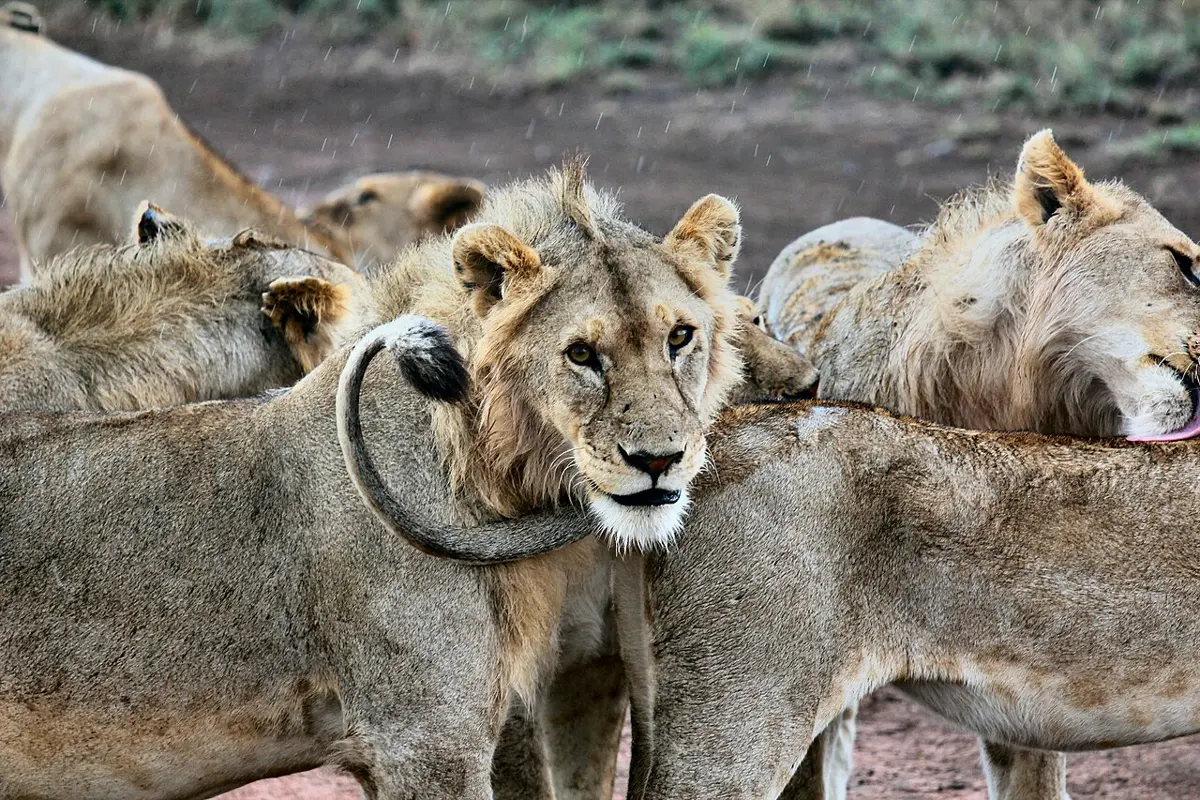
Dominance is a social behavior in which one individual controls others in its group by aggression, threat or display, and gets first use of resources. In social animals it keeps order in the group: once each animal knows its place, they fight less. The dominant animal has a better chance of getting food, mates, shelter and other resources.
Dominance depends on age, sex, experience, size and strength, and the animal’s physical condition. Usually the older dominates the young, the stronger the weak, the bigger the smaller; often males dominate females, but not always.
The ranking of animals in a group is a dominance hierarchy. It was first described in the 1920s in hens by the Norwegian zoologist Thorleif Schjelderup-Ebbe, who called it the pecking order: hen A pecks all the others, hen B all except A, and so on down to the hen that every other hen pecks.
Examples of dominance:
- Songbirds hold territories and win mates by singing; a male with a strong, full song keeps rivals away without fighting.
- A dog defends its territory by snarling and baring its teeth at another dog. The dog that gives in lowers its tail and runs away.
- In a herd of cattle, the dominant animals take the middle of the herd, the safest place, and get first use of food and water.
- In ring-tailed lemurs, unusually, the females dominate the males: they feed first and take the best sleeping places.
- When two strange buffaloes meet in a grassland, each shows its strength by pawing the ground, head-butting, shoving or even charging, until one gives way. Goats and oxen do the same.
Significance of dominance
- i.The dominant animal gets more of the resources: mates, food and shelter.
- ii.Dominance is linked with survival and reproductive success.
- iii.The dominant animal has a better choice of mates, so its genes are passed on more often.
- iv.Animals that know their rank fight less, so fewer are injured, and the group stays stable.
9.2.5 Leadership
Leadership is a social behavior in which one individual leads and guides the others of its group. A leader starts, keeps steady and coordinates what the group does: when it moves, finds food, migrates, defends its territory or meets an enemy. A leader need not be the most aggressive animal; often it is the oldest and most experienced, and its sex depends on the species. Leadership is seen in ants, deer, sheep, elephants, wolves, kangaroos and many others. The leader often gets priority in food, place and mates.
Examples:
- In red deer, an old female (a hind) leads the herd of females and young. The males (stags) join the herd only in the breeding season, to mate, and then leave.
- In Asian elephants, as in Chitwan, the herd is led by the oldest female, the matriarch, who remembers where water and food can be found in a dry year.
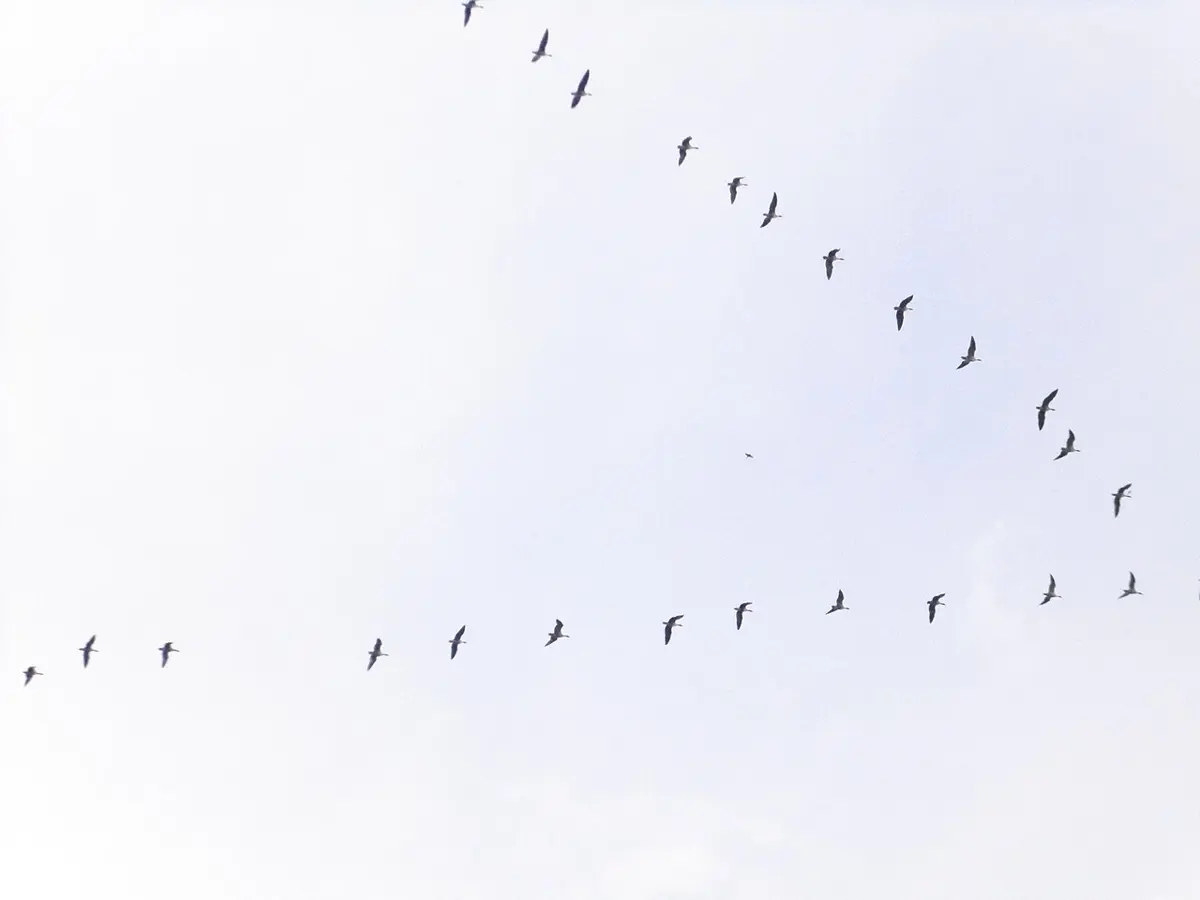
- A flock of geese flies in a V, one bird at the front. Each bird behind gets a little lift from the air swirling off the wingtip of the bird ahead, which saves it energy. Studies of northern bald ibises, a bird that also flies in a V, showed this lift in 2014, and in 2015 showed that the birds take turns at the front, the most tiring place.
- In a honeybee colony the queen releases pheromones (chemical signals) that hold the colony together and stop the workers from raising new queens. She doesn’t direct the work, though: the workers decide where to forage, telling each other by their dances, and even when to swarm.
- In rhesus monkeys, leadership and dominance go together: a strong, dominant male leads the troop and keeps its large territory. The troop has less dominant males, adult females and infants.
In a herd of red deer, who is the leader?
Pick an answer to see why.
9.2.6 Migratory behavior in animals
The word migration comes from the Latin migrare, “to move from one place to another”. Migration is the regular, periodic movement of animals from one place to another and, usually, back again. It is a complex, mostly innate behavior shown by insects, fishes, birds, turtles and some mammals. Animals migrate to find food, to escape harsh weather, to find mates, shelter and safe places to breed.
1. Migration in fishes
Fish migration is the to-and-fro movement of fishes between their feeding and resting places and their breeding places. Not all fishes migrate: those that don’t are resident fishes. Some migrate every day, others at a fixed season; some move a few meters, others thousands of kilometers.
During migration fishes move in three ways:
- Drifting: carried passively by the current (as the larvae of many fishes are).
- Random swimming: swimming in all directions.
- Oriented swimming: swimming in a particular direction in response to a stimulus, such as a current or the smell of the home river.
Factors influencing fish migration
- i.Physical factors: light, temperature, water currents, turbidity (muddiness) and depth. A change in any of these drives fishes to look for better water: fishes of clear water move away when rivers and streams turn muddy in the monsoon.
- ii.Chemical factors: salinity, smell and taste of the water, pH, dissolved oxygen and the water’s chemistry in general. A salmon finds its home river by its smell.
- iii.Biological factors: the ripening of the gonads under hormones from the pituitary (the gonadotropins, such as FSH), the supply of food, and predators.
Types of fish migration
- Diadromous migration: migration between the sea and fresh water, by truly migratory fishes such as salmon, hilsa, eels and gobies. It is of three kinds:
i. Anadromous migration: fishes that live in the sea swim up into fresh water to breed. Examples: salmon, sea lamprey, hilsa, shad. During the journey they live on stored food and stop feeding, their gonads ripen and the gut shrinks. Hilsa adults go back to the sea after spawning; Pacific salmon die after spawning, while Atlantic salmon may return.
ii. Catadromous migration: fishes that live in fresh water go down to the sea to breed. Example: the Indian mottled eel (Anguilla bengalensis), found in Nepal’s rivers, travels to the sea, probably the deep Indian Ocean, to spawn. On the way it stops feeding, its gonads ripen, its gut shrinks, and its body turns from yellowish to silvery white.
iii. Amphidromous migration: fishes move between the sea and fresh water both ways, but not to breed, usually to feed or as young. Example: many gobies. - Potamodromous migration: migration only within fresh water, for example from a lake or big river up into small streams to breed. Examples: carps, trout, and the golden mahseer (सहर), which swims up Nepal’s rivers to spawn in the monsoon.
- Oceanodromous migration: migration only within the sea. Examples: tuna, mackerel, herring.
- Alimental migration: migration in search of food. Examples: sharks, carps.
- Shoreward migration: movement towards the seashore or a riverbank. Example: the climbing perch (Anabas), which in the rains wriggles over wet ground from pond to pond.
- Vertical migration: movement from deep water up to the surface and back, usually every day: up at night to feed, down by day to hide. Examples: swordfish, mackerel, lanternfish.
- Latitudinal migration: from north to south and back. Examples: swordfish, hammerhead sharks.
- Climatic migration: movement with the change of season or climate, to find safe, suitable water.
Advantages of fish migration
- Fishes find plenty of food, suitable breeding grounds and shelter.
- The young grow up where there are fewer enemies and more food.
- Fishes escape bad conditions, such as cold, drought or low oxygen.
- Some ichthyologists (fish biologists) see migration as an adaptation to reach the richest places at the right time.
Bishal reads that the eels in Nepal’s rivers swim to the sea to breed. What kind of migration is this?
Pick an answer to see why.
2. Migration in birds
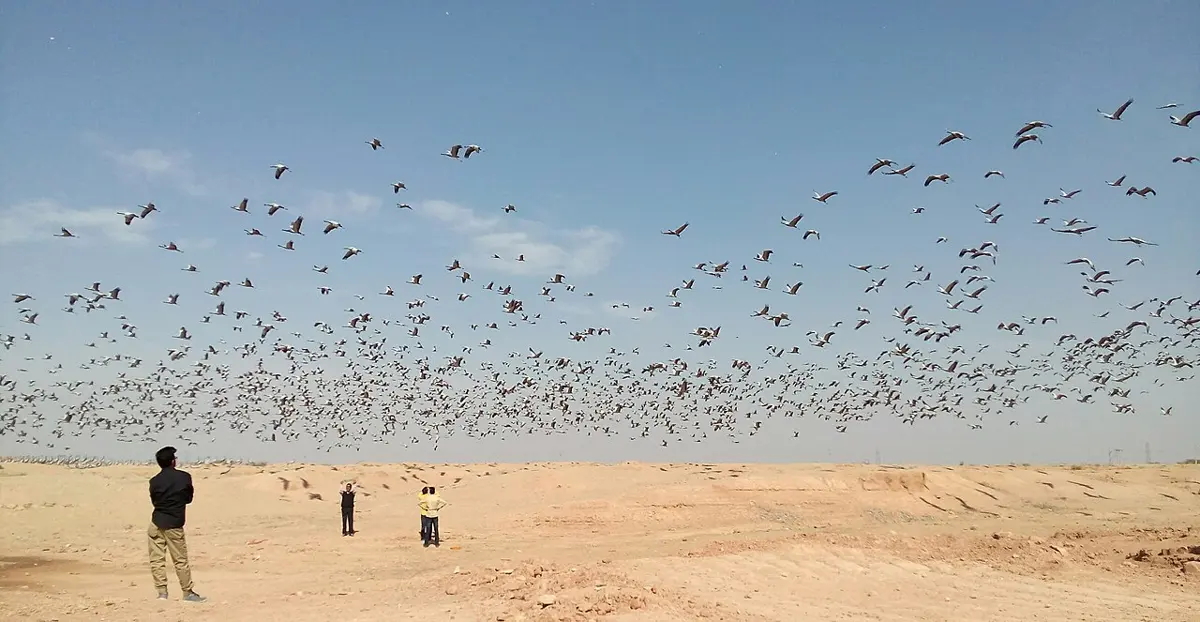
Bird migration is one of nature’s great spectacles. Cahn (1935) defined migration as “the periodic passing of animals from one place to another”. Bird migration is the regular, periodic movement of birds between their breeding (nesting) grounds and their feeding (resting or wintering) grounds. It happens at the same time each year, and the birds usually follow the same routes. Migratory birds include Siberian cranes, the American golden plover, cuckoos, robins, hawks, cranes and geese. Birds that stay in one area all year are resident birds: in Nepal the house sparrow, the red-vented bulbul and the common myna; in America the bobwhite quail.
Causes of migration
The exact cause is not fully known, but these trigger it:
- i.Changing day length (light) acts through the brain and hormones on the gonads and starts the urge to migrate.
- ii.Scarcity of food, shorter days and the coming of cold (or great heat) in an area.
- iii.Before migrating, many birds eat heavily and lay down fat (their fuel), then become restless, especially at night, a sign that the journey is about to begin.
Types of bird migration
- Latitudinal migration: from north to south and back, the commonest. The American golden plover breeds in the Arctic and winters as far south as Argentina. Ducks, geese and waders from Siberia and Central Asia winter on the lakes and rivers of the plains of Nepal and India: Koshi Tappu fills with ruddy shelducks (चखेवा), bar-headed geese and many ducks from November to March.
- Longitudinal migration: from east to west and back. Starlings from eastern Europe and Asia winter on the Atlantic coast of western Europe.
- Altitudinal migration: up the mountains in summer and down in winter, common in the Himalaya. The Himalayan monal (Lophophorus impejanus, डाँफे), Nepal’s national bird, moves down the slopes when snow covers its summer meadows; so do wallcreepers, many thrushes and bushchats, and the snow partridge.
- Vagrant (irregular) migration: birds scatter in all directions over long distances, for food and safety. Young herons wander like this after breeding.
- Seasonal migration: birds that come with a season. Summer visitors to Nepal arrive from the south in spring to breed, such as cuckoos and swifts; winter visitors come from the north for the winter, such as many ducks, wagtails and redstarts.
- Daily migration: daily movements from the roost to feeding places and back, in response to light, temperature and food, as sparrows, crows and egrets do.
Mode of flight during migration
Birds that migrate at night are nocturnal migrants: thrushes, warblers, nightjars, owls. Those that fly by day are diurnal migrants: crows, swallows, pelicans, cranes and birds of prey, which ride the rising warm air. Some travel in flocks of their own species, others in mixed flocks.
The distance depends on the species and the climate. The snow partridge of the Himalaya moves down only a kilometer or two. The white stork flies up to about 10,000 km from Europe to southern Africa. The record is the Arctic tern: tracked birds covered about 70,900 km a year between the Arctic and the Antarctic (Egevang and others, 2010). Most small birds fly within about 1,000 m of the ground, but some cross the Andes and the Himalaya at 6,000 m or more: bar-headed geese have been tracked at over 7,000 m. Birds usually fly for several hours a day and stop to rest, feed and drink.
Migrating birds follow definite flyways. They steer by the shape of the land (coastlines, great rivers, mountain ranges), by the sun and the stars, and, it has been shown, by the Earth’s magnetic field. Nocturnal migrants travel on a broad front with the general flow of the air.
Advantages of bird migration
- i.It protects birds from harsh winters and the shortage of food that comes with them.
- ii.It takes them to good breeding grounds, with long summer days and plenty of food for the young.
- iii.It prevents overcrowding and lets birds use the food of new or untouched places.
- iv.It gives the young a better chance of surviving, away from many predators.
Disadvantages of bird migration
- i.On a long journey some birds become exhausted and fall into the sea, rivers, forests or onto rocks and die.
- ii.They meet many natural enemies on the way.
- iii.Storms, heavy rain, snowfall and hurricanes kill many migrating birds.
- iv.Birds may pick up parasites and diseases on the way, and carry them to new places.
The Himalayan monal spends summer high on the mountains and comes down in winter. What kind of migration is this?
Pick an answer to see why.
Exercise
A. Tick the correct alternative
- A young fish starts swimming as soon as it comes out of the egg. What type of behavior is this?
Pick an answer to see why.
- The organs which perceive a stimulus are called:
Pick an answer to see why.
- Which of the following is not an example of reflex action?
Pick an answer to see why.
- A toad is active at night. This is an example of:
Pick an answer to see why.
- A male cockroach is attracted by the pheromones given off by a female cockroach at the time of mating. This is an example of:
Pick an answer to see why.
- Migration of fishes that takes place only in fresh water is called:
Pick an answer to see why.
- In the rainy season there are floods and strong currents in rivers and streams. Fishes move to smaller side channels with less current, to the bottom, or hide under rocks. Which type of taxis is this?
Pick an answer to see why.
- Moles burrow down into the ground and live there. Which type of taxis is this?
Pick an answer to see why.
- Think about the movement of sperm towards the egg in fertilization. Which statement is true?
Pick an answer to see why.
- Which type of taxis is also called the light compass response?
Pick an answer to see why.
- Migration of fishes from sea water to fresh water (to breed) is called:
Pick an answer to see why.
- Some fishes, such as Anguilla, move from the river system of Nepal to the sea. Which type of migration is this?
Pick an answer to see why.
- Which of the following birds shows latitudinal migration?
Pick an answer to see why.
- Which of the following is a spinal reflex?
Pick an answer to see why.
- A snail crawling on a glass sheet pulls its body into its shell when tapped. When tapped again and again, it stops hiding and goes on its way. What type of behavior is this?
Pick an answer to see why.
B. Answer the following questions
What is animal behavior? Describe its types briefly.
Answer
Spinal cord: Polarlys, CC BY 2.5, via Wikimedia Commons
What is shown in the diagram above? Label the parts A, B, C, D, E, F and G.
Answer
How do animals show dominance? Describe briefly.
Answer
Describe the various types of taxes on the basis of the nature of the stimulus, with examples.
Answer
What is migration in birds? Why do birds migrate? What are the different types of bird migration?
Answer
Fish migration is regulated by several factors. List them and describe them.
Answer
Describe the various types of fish migration.
Answer
What is leadership? Briefly describe leadership in animals.
Answer
What are the advantages and disadvantages of bird migration?
Answer
Printable PDFs
- Study notes 3 pages
- Worksheet 4 pages Answer key
Quiz yourself: Environment and Biodiversity, Grades 5–12 →
Practice every question in the book, and keep track of the ones you miss →
A companion to your textbook, not a replacement for it: study from the book your school uses, and where the two differ, follow your teacher. Found a mistake? Please tell us.