
Nepal counted 2,64,94,504 people at the 2068 census and 2,91,64,578 at the 2078 one: 10.08% more in ten years. So did the population grow by about 1% a year? Not quite, and the reason is the whole of this unit.
Things also lose value. Nepal’s tax law lets a business count its cars, buses and minibuses as losing 20% of their value every year. Five years at 20% sounds like 100%: is a five-year-old car worth nothing? It isn’t, and by the end of this unit you will be able to say exactly what it is worth, and what rate really turns 10.08% in ten years into a yearly figure. One idea does both: repeating a percentage means multiplying, again and again.
Figures: National Statistics Office, 2021 census (Onlinekhabar, March 2023); Income Tax Act 2058, Schedule 2.
3.0 Review: Nepal’s censuses
Nepal’s first census was taken in 1968 BS (1911 AD), and there has been one about every ten years since. Figure 3.1 shows what each counted.
Look at (f) again. From 2038 to 2048 the population grew by about the same number of people as in the ten years before, 34.7 lakh, yet the percentage fell, from 30% to 23%, because the same number was added to a bigger population. In this unit a growth rate is always a percentage of what there already is.
3.1 Growth
Activity 1: a municipality grows
a. 2079: 25000 + 2% of 25000 = 25000 + 500 = 25500.
b. 2080: the 2% is now of 25,500, not of 25,000: 25500 + 510 = 26010.
c. Yes, exactly. The second year’s growth (510) is bigger than the first (500), because the 500 people added in the first year have children too, just as the first year’s interest earns interest. With P = 25000, R = 2 and T = 2, the compound-amount formula gives the same answer:
Adding R% is multiplying by (1 + R/100). So a population that grows by R% every year is multiplied by the same number every year, and after T years by that number T times (Figure 3.2).
When a population (or a price, or anything) increases by the same percentage of itself every year, that percentage is its growth rate (questions often write a yearly rate as “2% p.a.”, per annum, Latin for “each year”), and what it has grown to is the grown population (or grown price). With P the population at the start, R% the yearly growth rate and T the number of years:
These are Unit 2’s compound amount and compound interest with new names: P is the population at the start instead of the principal, R the growth rate instead of the interest rate, T the time in years in both.
If the rate is different each year, R₁% in the first, R₂% in the second and so on to , each year multiplies by its own factor:
A real population doesn’t follow one rate for ever. Births and deaths set its natural growth, and people moving in (in-migration) and moving out (out-migration) change it more. In a question, people who move in, move away or die in a given year are added or taken away at that point, and the population grows on from the new number.
A town of 40,000 grows by 5% a year. Which gives its population after 3 years?
Pick an answer to see why.
Back to the census
A steady 0.965% a year, not 1%, takes Nepal from its 2068 count to its 2078 count.
Ten years of 1.008% (10.08% ÷ 10) would give , or 2,92,89,605: about 1.25 lakh too many, because each year’s 1% is of a bigger population than the last. Find the rate yourself:
The National Statistics Office gives the rate as 0.92% a year. It is lower than 0.965% for two reasons. The 2078 count was held five months later than planned, because of COVID-19, so a little more than ten years separate the two censuses. And the office’s formula assumes a population that grows a little every moment, not in one jump a year, which reaches the same total at a slightly lower rate. Both ways of counting agree on the big fact: the growth was the slowest of any ten years since the 1987 census.
Worked examples: growth
In each one, write down P, R and T first, decide whether the question wants the population, the increase, the rate or the time, then put the numbers in.
The population, and the increase
Finding the rate
Finding the time
Working backwards
A different rate each year
People moving in, and deaths
Exercise 3.1
Question 1
A place has population P now, and after T years, growing at R% a year. Write the formula for .
Answer
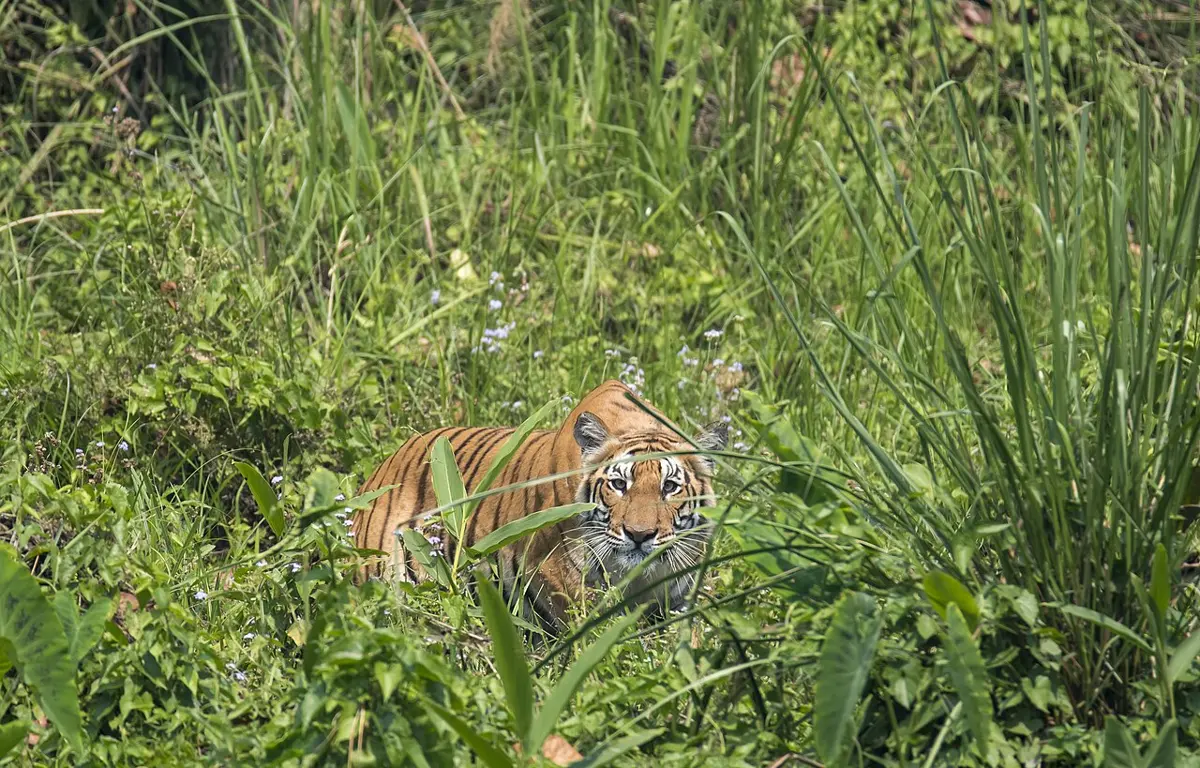
Chitwan National Park had x tigers in 2079 BS, and their number grows by R% a year. How many tigers will it have after N years?
Answer
The number of Nepalis going abroad for work grows by R₁%, R₂% and R₃% in the first, second and third years. If P went in the year before, write the formula for the number after 3 years.
Answer
Question 2
If a country’s death rate is lower than its birth rate, does its population increase or decrease?
Answer
A year ago a 25 kg sack of rice cost Rs 1,500. Its price has risen by 10% a year. What does the sack cost now?
Answer
Question 3
At the 2021 census a city had 5,18,452 people. If it grows by 4.5% a year, what will its population be after 3 years?
Answer
A landlord agrees with a businessman to raise the rent by 15% a year. If a shutter’s rent is Rs 10,000 now, what will it be after 3 years?
Answer
The bacteria that set curd grow by 10% an hour. If there are at 6 a.m., how many are there 2 hours later?
Answer
Question 4
Two years ago a rural municipality had 28,500 people. If it grows by 2% a year, by how much has its population increased in 2 years?
Answer
Three years ago a school’s Grade 10 monthly fee was Rs 6,500. Its rules raise fees by 10% every year. By how much has the fee risen in 3 years?
Answer
A plot of land costs Rs 6,00,000 now. If its price rises by 10% a year, by how much will it rise in 2 years?
Answer
Question 5
A university has 21,632 students now; 2 years ago it had 20,000. What is the yearly rate of increase?
Answer
A rural municipality had 40,000 people at the end of 2018 AD and 44,100 at the end of 2020 AD. Find its yearly growth rate.
Answer
Three years ago a liter of cooking oil cost Rs 125; now it costs Rs 216. What is the yearly rate of inflation?
Answer
Question 6
A village has 13,310 people, and its population grows by 10% a year. How many years ago did it have 10,000?
Answer
At the start of Baisakh a papaya plant was 4 m tall. If it grows by 4% a month, after how many months will it be 4.3264 m tall?
Answer
Question 7
Land now costs Rs 19,96,500 an aana, and its price has risen by 10% a year. What was its price per ropani 3 years ago? (1 ropani = 16 aana)
Answer
Land now costs Rs 2,66,200 an aana, and its price has risen by 10% a year. What was its price per ropani 3 years ago?
Answer
Question 8
A patient’s urine sample had bacteria at 6 a.m. Tests at 7, 8 and 9 a.m. showed they grew by 3%, 4% and 5% in those hours. How many bacteria were there at 9 a.m.?
Answer
Three years ago a city had 1,50,000 people. Its population then grew by 2% in the first year, 4% in the second and 5% in the third. What is it now?
Answer
Question 9
An insurance company started 3 years ago with 1,000 trained agents. From the start, its rule has been that every group of 5 agents adds 1 new agent each year. How many agents does it have now?
Answer
A financial institution started at the beginning of 2078 with 200 marketers. Its rule is that every group of 5 marketers adds 1 new marketer each year. How many marketers will it have at the end of 2079?
Answer
Question 10
A rural municipality’s population grows by 10% a year. At the end of 2 years, 5,800 people moved in, and the population then was 30,000. What was the population at the start?
Answer
Question 11
Over two years the US dollar rose against the Nepali rupee by 5% a year, and now Rs 120. How many rupees was worth 2 years ago?
Answer
Question 12
Two years ago a village had 31,250 people, and it grows by 6% a year. One year ago, 625 people moved away. What is its population now?
Answer
Question 13
Three years ago a district had 3,75,000 people, growing by 2% a year. At the end of the second year 1,480 people moved in and 2,750 died in a natural disaster. What is its population now?
Answer
Question 14
At the beginning of 2075 BS a metropolitan city had 5,00,000 people; at the end of 2077 BS it had 6,65,500.
What was its yearly growth rate?
Answer
If it keeps growing the same way, what will its population be at the end of 2079?
Answer
3.2 Depreciation
Activity 1: why things lose value
Most things people use, machines, vehicles, phones, furniture, wear out and go out of date, so their value falls as time passes. This fall in value is depreciation. When the value falls by the same percentage of what is left every year, it is compound depreciation, and that percentage is the rate of depreciation.
Activity 2: the formula
Let a thing be worth V₀ at the start, and lose R% of its value every year. Let be its value after T years.
After 1 year it has lost R% of V₀:
Taking R% off is multiplying by (1 − R/100). In the second year it loses R% of what is left, V₁, not of V₀:
The same way, , and after T years:
The value lost in that time, the depreciated amount, is
Does a thing lose the same percentage every year? Not always: a rate may change from year to year. With R₁%, R₂%, …, :
It is growth’s formula with one sign changed. Growth multiplies by a number more than 1 every year, so the value increases; depreciation multiplies by a number less than 1, so it decreases.
Back to the car
A car losing 20% a year is still worth about a third of its price after 5 years, not nothing.
Each year takes 20% of what is left, so it keeps 80%: . A Rs 40,00,000 car is worth , Rs 13,10,720. “5 × 20% = 100%” would be true only if every year took 20% of the first price. And because each year keeps 80% of something more than zero, the value never reaches zero, however many years pass. Half of it is gone a little after 3 years ().
A laptop worth Rs 80,000 depreciates by 10% a year. Which is its value after 2 years?
Pick an answer to see why.
A machine depreciates by 20% a year. In which year does it lose the most rupees?
Pick an answer to see why.
Worked examples: depreciation
The value after some years
Finding the rate
Finding the time
Profit or loss
Working backwards
How the SEE asks it
In the SEE’s Compulsory Mathematics paper, Arithmetic carries 13 marks in three questions (compound interest; growth and depreciation; currency and exchange), with knowledge, understanding, application and higher-ability parts spread among them (CDC’s specification grid). In CDC’s model paper the growth-and-depreciation question looks like this:
| Part | Level | Marks | What it asks |
|---|---|---|---|
| a. | knowledge | 1 | a formula: grown value, depreciated value or amount |
| b. | understanding | 1 | a value after a few years |
| c. | higher ability | 2 | a twist: an unknown rate from a total, two things at once, migration |
Here is a question in that shape, and a longer one to practice with.
Exercise 3.2
Question 1
A thing costs Rs P at first and depreciates by R% a year. Write the formula for its value after T years.
Answer
In , the value after T years, what does R stand for?
Answer
Question 2
Ram sells a watch that cost Rs 5,000 after 1 year, at 7% depreciation. How much value has it lost?
Answer
After 1 year, at 5% depreciation a year, a motorcycle sells for Rs 57,000. What did it cost?
Answer
Question 3
What will a cupboard costing Rs 16,800 be worth after 2 years at 15% depreciation a year?
Answer
A new 125 cc motorcycle made in India costs Rs 2,50,000 in Nepal. If its value falls by 4% a year, what will it be worth after 3 years of use?
Answer
Question 4
Sameer bought a mobile phone for Rs 30,000. Because of a problem at home he has to sell it after 2 years, at 30% depreciation a year. Find the depreciated amount.
Answer
A maths teacher bought a laptop for Rs 96,000 for online classes. It depreciates by 15% a year. If he sells it after 3 years, how much value has it lost?
Answer
Question 5
Three years ago, 4 ropani of land in the hills was bought for Rs 12,50,000. Now it can be sold for only Rs 1,60,000 a ropani. By what percentage a year has its price depreciated?
Answer
A man bought a watch for Rs 5,000 and sold it after 3 years for only Rs 625. Find the yearly rate of depreciation.
Answer
Question 6
A printing press bought for Rs 4,00,000 some years ago has lost 30% of its value every year and is now worth Rs 1,96,000. How many years ago was it bought?
Answer
A car costs Rs 8,00,000. If its value falls by 10% a year, after how many years will it be worth Rs 5,83,200?
Answer
Question 7
Over 2 years the US dollar lost 5% of its value against the rupee each year, and now Rs 125. How many rupees was worth 2 years ago?
Answer
Three years ago a group of young people back from work abroad started a cow farm with Rs 2,80,000. Because of political instability, the farm’s value has fallen by 5% a year. What is it worth now?
Answer
Question 8
A photocopy machine costs Rs 5,00,000 now. It depreciates by 15% in the first year, 10% in the second and 5% in the third. What will it be worth after 3 years?
Answer
A lamination machine was sold for Rs 24,168 after depreciating by 4% in the first year and 5% in the second. What did it cost 2 years ago?
Answer
Question 9
A businessman bought a heavy truck for Rs 48,00,000 and earned Rs 6,80,000 with it in 2 years. It depreciates by 10% a year, and he sells it after 2 years. Find his profit or loss.
Answer
Question 10
A bus owner bought a bus for Rs 16,00,000 and ran it on the Kathmandu–Baglung route for 3 years, earning only Rs 5,10,000. Its value depreciates by 5% a year, and he sells it after 3 years. Find his profit or loss.
Answer
Question 11
A finance company’s shares on the Nepal Stock Exchange fell in price by 10% a year for 2 years. Your neighbor sold all his shares for Rs 28,350. If he had bought them 2 years ago at Rs 100 a share, how many shares had he bought?
Answer
Question 12
A hydropower company’s share price is falling by 10% a year. Sashi sells all his shares now for Rs 7,10,775.
What were his shares worth 2 years ago?
Answer
He bought them in the IPO, 2 years ago, at Rs 100 a share. How many shares did he buy?
Answer
Question 13
At a fixed yearly rate of depreciation, a thing will be worth Rs 10,240 after 2 years and Rs 8,192 after 3 years.
Find the rate of depreciation.
Answer
What was it worth at first?
Answer
Question 14
At a fixed yearly rate of depreciation, a thing will be worth Rs 5,41,500 after 2 years and Rs 5,14,425 after 3 years.
What is the rate of depreciation?
Answer
What was it worth at first?
Answer
Practice every question in the book, and keep track of the ones you miss →
Where these facts come from
- Nepal’s 2021 census, the final count of 29,164,578 and the growth rate of 0.92% a year (the opening, 3.0, Back to the census): Onlinekhabar, “29,164,578 is the official size of Nepal’s population”, 24 March 2023, reporting the National Statistics Office.
- The populations at every census, 1911–2021 (3.0, Figure 3.1): Wikipedia, “Census in Nepal”, read October 2026, giving the National Statistics Office’s table.
- The 2078 census postponed by five months because of COVID-19 (Back to the census): Onlinekhabar, “Deferred national population census from November 11 to 25”, September 2021.
- Consumer price inflation of 7.74%, 5.44% and 4.06% (3.1, “Prices grow the same way”): Nepal Rastra Bank, “Current Macroeconomic and Financial Situation, based on annual data of 2024/25”, Table 2, August 2025.
- Malthus’s Essay on the Principle of Population, 1798 (3.1): Wikipedia, “An Essay on the Principle of Population”, read October 2026.
- Darwin reading Malthus in 1838, and the words quoted from his Autobiography (3.1): University of California Museum of Paleontology, “Thomas Malthus (1766–1834)”, read October 2026.
- Nepal’s tigers, 121 in 2010, 355 in 2022 and 429 in 2026, Chitwan’s 128 in 2022 and 145 in 2026 (3.1): Onlinekhabar, “Tiger census 2026: tiger population reaches 429 in Nepal”, 29 July 2026.
- The depreciation pools and their rates, 5% (buildings), 25% (computers, furniture, office equipment), 20% (automobiles, buses and minibuses) and 15% (construction machines and other depreciable assets) of the pool’s value each year (the opening, 3.2): Income Tax Act 2058, Schedule 2, “Assessment of depreciation deduction”, read October 2026.
A companion to your textbook, not a replacement for it: study from the book your school uses, and where the two differ, follow your teacher. Found a mistake? Please tell us.