
In 1950 there were about two and a half billion people on Earth. Today there are more than eight billion. Will we keep growing for ever, and where will all those people live? People move too: young Nepalis leave for study and work abroad, and every winter thousands of birds fly over the Himalaya to spend the cold months on Nepal’s rivers and lakes, without a map or a compass.
This unit reads a United Nations report on the world’s population from 1950 to 2050 and a text about how and why birds migrate. Along the way you will learn to interpret a chart, a table and a figure in words, to say the British r correctly, to join two ideas that contrast with although, despite, however and their friends, and to write an essay about young people leaving Nepal.
Getting started
The unit opens with four pictures. Each shows a kind of population (how many of something live in a place) or migration (moving from one place to another).
| Picture | What it represents |
|---|---|
| A crowded city street, people crossing a busy road between tall buildings | population growth and crowded cities: more and more people live in towns |
| A chart of reindeer numbers, falling from about 4.7 million in the mid-1990s to about 2.1 million in 2016, a fall of 56% | an animal population in decline: wild reindeer and caribou in the Arctic, whose numbers have fallen by more than half |
| A long line of people walking along a road with bags and children | human migration: people leaving their homes because of war, poverty or disaster, looking for safety or work |
| A flock of birds flying in a V across the sky | bird migration: birds traveling between their summer and winter homes |
Reading I: A Century of World Population Trends
Before you read
Answer these questions.
- a.Do you know the population of Nepal as per the population census, 2078 BS? Present your idea.
- b.What are the factors that influence the population change in a country?
A model answer
What kind of text it is
The text is adapted from World Population Prospects 2022, a report by the United Nations, whose population experts publish new estimates and projections of every country’s population every two years. It is a report full of numbers: it says what happened (since 1950), what is happening (2022) and what is projected (expected, from today’s trends) up to 2050. When you read it, ask of every number: is it a fact about the past, or a projection about the future?
The report, part by part
1. A hundred years of growth
In 1950 the world had about 2.5 billion people. It took about 37 years for that number to double, to more than 5 billion in 1987. Doubling again will take longer, about 70 years: the world is expected to pass 10 billion by 2059. Today’s population is more than three times what it was in 1950.
Growth was fastest in 1962–1965, at 2.1 percent a year on average. Since then it has slowed by more than half, because fertility (the number of children born to each woman) has fallen. In 2020, for the first time since 1950, growth fell below one percent a year, and it is expected to keep slowing until the end of the century. The projections: about 8.5 billion in 2030 and 9.7 billion in 2050.
2. How sure can we be?
A projection rests on guesses about the two components (parts) of world population growth: fertility and mortality (deaths). So it is uncertain, and more uncertain the further ahead it looks. But the next few decades are fairly certain, because most of the people who will have children before 2050, the women whose offspring (children) will add to the population, are already alive. Some countries are still growing; others have reached stabilization (their numbers have stopped changing) or have started to shrink.
Why are experts fairly sure about the size of the world population in the near future?
Pick an answer to see why.
3. The regions in 2022
The United Nations groups the world’s countries into eight regions (the regions of the Sustainable Development Goals). In 2022:
- The most populous region was Eastern and South-Eastern Asia, with 2.3 billion people, 29 percent of the world.
- Next came Central and Southern Asia, with 2.1 billion, 26 percent. Nepal is in this region.
- China (in the first) and India (in the second) each had more than 1.4 billion people.
- Europe and Northern America (more than 1.1 billion) and sub-Saharan Africa (more than 1.2 billion) were about the same size, but they got there along very different trajectories (paths). Europe and Northern America have grown by less than 1 percent a year since the mid-1960s, and by close to zero in 2020 and 2021. Sub-Saharan Africa’s growth peaked (reached its highest) at 3 percent a year in 1978 and stayed above 2.8 percent through the 1980s; since then it has been the fastest-growing region.
- Oceania (Australia, New Zealand and the Pacific islands) had about 45 million people. Without Australia and New Zealand, the islands grew from about 2.5 million in 1950 to about 13.6 million in 2022.
| Region | 2022 | 2030 | 2050 |
|---|---|---|---|
| World | 7,942 | 8,512 | 9,687 |
| Sub-Saharan Africa | 1,152 | 1,401 | 2,094 |
| Northern Africa and Western Asia | 549 | 617 | 771 |
| Central and Southern Asia | 2,075 | 2,248 | 2,575 |
| Eastern and South-Eastern Asia | 2,342 | 2,372 | 2,317 |
| Latin America and the Caribbean | 658 | 695 | 749 |
| Australia/New Zealand | 31 | 34 | 38 |
| Oceania (without Australia and New Zealand) | 14 | 15 | 20 |
| Europe and Northern America | 1,120 | 1,129 | 1,125 |
| Least developed countries | 1,112 | 1,328 | 1,914 |
| Landlocked developing countries | 557 | 664 | 947 |
| Small island developing states | 74 | 79 | 87 |
Population of the world, its regions and some groups of countries, in millions, 2022, with the United Nations’ medium projections for 2030 and 2050 (World Population Prospects 2022). The last three rows are groups that overlap the regions: Nepal is both a least developed and a landlocked developing country.
4. The world in 2050
The regions will grow at very different rates, so the world’s population will be spread out differently in 2050:
- Central and Southern Asia is expected to become the most populous region by about 2037, because Eastern and South-Eastern Asia may start to shrink in the mid-2030s.
- Sub-Saharan Africa is expected almost to double between 2022 and 2050, passing two billion in the late 2040s. With women there still having about three children each in 2050, it will provide more than half of the world’s growth. In 2022 it was growing by 2.5 percent a year, more than three times the world’s 0.8 percent.
- Europe and Northern America are expected to reach their peak and begin to decline in the late 2030s, because fertility has been low for a long time.
- More than half of the growth to 2050 will come from just eight countries: the Democratic Republic of the Congo, Egypt, Ethiopia, India, Nigeria, Pakistan, the Philippines and Tanzania. The Congo and Tanzania will grow by 2 to 3 percent a year.
- Because the largest countries grow at disparate (very different) rates, their ranking will change: India was projected to surpass (become larger than) China as the most populous country in 2023.
Why will sub-Saharan Africa provide more than half of the world’s growth to 2050?
Pick an answer to see why.
Words from the report
| Word | Meaning |
|---|---|
| populous | having many people living in it |
| mortality | the number of deaths in a place or a period of time |
| fertility | here, the number of children born to women: a fertility of three births per woman |
| projection | an estimate of what a number will be in the future, from today’s trends |
| demographic | about the population and the groups in it (by age, sex, place) |
| peak | to reach the highest point; (noun) the highest point |
| stabilization | becoming steady, unlikely to change |
| trajectory | the path something follows |
| surpass | to become greater than; to exceed |
| disparate | completely different from each other |
| offspring | a person’s child or children; an animal’s young |
| witness | to see something happen |
| inhabitant | a person who lives in a place |
A. Match the words with their meanings
Match the words with their correct meanings.
- a.populous
- b.mortality
- c.projection
- d.demographic
- e.peak
- f.stabilization
- g.trajectory
- h.surpass
- i.disparate
- i.a path followed by something
- ii.relating to the population and different groups within it
- iii.an estimation of what figures will be in the future
- iv.the process of making somebody or something unlikely to change
- v.having a large population; densely populated
- vi.to be greater than something; exceed
- vii.the number of deaths in a particular situation or period of time
- viii.completely dissimilar
- ix.to reach the highest point or value
Answer
B. Complete the sentences
Complete the sentences with the correct information from the text.
- a.The highest population growth rate in the past hundred years was ……… .
- b.The world population is likely to reach ……… by the middle of the twenty-first century.
- c.The factors that determine the growth rate of world population are ……… .
- d.In the early 2020s, Eastern and South-Eastern Asia had ……… population.
- e.The population of the sub-Saharan region is likely to reach ……… by the end of the 2040s.
- f.The low level of fertility will cause a fall in the population size of Europe and Northern America by ……… .
- g.India is likely to exceed the population of China by ……… .
Answer
C. Answer the questions
What was the size of the world population in the mid-twentieth century?
Answer
What was the fastest population growth rate in the past century?
Answer
Why has the population growth rate declined in recent years?
Answer
What is the predicted world population size by 2050?
Answer
How do fertility and mortality contribute to the size of the population?
Answer
Which countries contribute to the largest population in Eastern and South-Eastern Asia?
Answer
Why will the regions have different population changes in the next 30 years?
Answer
Which countries are most likely to contribute to the growth of world population by 2050?
Answer
D. Will it happen?
Do you think the world population will increase as projected in the text? Discuss.
A model answer
Pronunciation: the British r
In British English (and most of the English taught in Nepal’s textbooks), the letter r is said only when a vowel sound comes right after it. Before a consonant, or at the end of a word, it is silent and the vowel before it is longer: world /wɜːld/, car /kɑː/, bird /bɜːd/. In American English every r is said: /wɜːrld/.
| Pronounced with /r/ | Pronounced without /r/ |
|---|---|
| growth /ɡrəʊθ/: gr + vowel | furthermore /ˌfɜːðəˈmɔː/: no vowel after either r |
| experience /ɪkˈspɪəriəns/: r + i | fertility /fɜːˈtɪləti/: r + t |
| comparable /ˈkɒmpərəbl/: r + ə | uncertain /ʌnˈsɜːtn/: r + t |
| zero /ˈzɪərəʊ/: r + o | future /ˈfjuːtʃə/: at the end |
| distribution /ˌdɪstrɪˈbjuːʃn/: tr + i | birth /bɜːθ/: r + th |
| concentrated /ˈkɒnsntreɪtɪd/: tr + a |
Speaking: interpret a figure and a chart
To interpret a picture or a table is to say what it shows and what it means: first what it is about, then the main point, then the details, then what you think it tells us. Useful phrases:
- The figure shows / illustrates…
- First…, then…, after that…, finally… (for steps)
- The most common… is…, followed by…; Only…% of households have…; Just over half…, about a third…
- This suggests that…, It is clear that…
a. First aid for an unconscious person
The first figure shows what to do when you find someone unconscious (not awake and not answering). The steps, as first-aid organizations teach them:
- Check for danger. Make sure that you and the person are safe: traffic, electric wires, fire.
- Check for a response. Kneel beside them, tap their shoulders and ask loudly, “Are you all right?”
- Shout for help and call an ambulance: in Nepal, 102 (police 100, fire 101). Put the phone on speaker.
- Open the airway. Put one hand on the forehead and gently tilt the head back; lift the chin with two fingers.
- Check breathing for up to 10 seconds: look at the chest, listen and feel for breath on your cheek.
- If they are breathing, put them in the recovery position: on their side, the upper leg bent at the knee to stop them rolling, the head tilted back so that vomit can run out of the mouth. Stay with them and keep checking their breathing.
- If they are not breathing, start CPR: push hard and fast in the center of the chest, 5–6 cm deep, 100–120 times a minute, and give two rescue breaths after every 30 pushes if you are trained. If you are not trained, keep pushing on the chest until help arrives.
Interpret the figure to your friends.
A model talk
b. Household facilities in Nepal
The second is a table from the National Population and Housing Census 2011: the percentage of Nepal’s households that had each facility.
| Facility | % of households | Facility | % of households |
|---|---|---|---|
| Radio | 50.8 | Mobile phone | 64.6 |
| Television | 36.5 | Motor (car) | 1.6 |
| Cable television | 19.3 | Motorcycle | 9.6 |
| Computer | 7.3 | Bicycle | 32.4 |
| Internet | 3.3 | Other vehicle | 0.7 |
| Telephone (landline) | 7.4 | Refrigerator | 7.2 |
Interpret the table to your friends.
A model talk
Grammar I: Connectives of contradiction
Sometimes the second idea is a surprise after the first: It was raining heavily. We continued the match. English has many words to join such ideas. They are called connectives of contradiction (or of contrast, or concession). The trick is to know what follows each one:
| Connective | What follows | Example |
|---|---|---|
| although, even though, though | a clause (subject + verb) | Although it was raining, we continued. |
| despite, in spite of | a noun phrase or -ing, no verb | Despite the rain, we continued. In spite of feeling tired, she went. |
| despite the fact that, in spite of the fact that | a clause | Despite the fact that it was raining, we continued. |
| however, nevertheless | a new sentence, with a comma after it | It was raining. However, we continued. |
| but, yet | a clause, in the middle, after a comma | It was raining, but/yet we continued. |
| while, whereas | a clause: a contrast between two things | I like cricket, while my brother likes football. |
Even though is stronger than although: it stresses the surprise. Though is the same as although, a little more informal, and can also end a sentence: It was cold. We enjoyed it, though.
……… the heavy traffic, we reached the airport on time.
Pick an answer to see why.
She studied hard for the exam. ………, she failed the maths paper.
Pick an answer to see why.
Which sentence is correct?
Pick an answer to see why.
A. Match the sentence halves
Match the sentence halves and make meaningful sentences.
- a.We continued the match
- b.Dolma was selected for the post
- c.Christina attended the class
- d.I often leave home quite late;
- e.Chintamani never participates in social functions
- f.It was snowing heavily,
- g.He did not give up smoking
- h.I have never been to Bandipur
- i.We were lost in the town
- i.however, I always reach my office on time.
- ii.yet it was not too cold.
- iii.despite looking very sociable.
- iv.though it is not far from my home.
- v.although it was raining heavily.
- vi.although we had the map of the town with us.
- vii.even though she had no prior experience for the job.
- viii.despite the fact that she was not feeling well.
- ix.in spite of the warnings of the doctor.
Answer
B. Complete the sentences
Complete the sentences below in a suitable way. Use the connectives of contradiction where necessary.
- a.Although I had not seen him before, ……… .
- b.Even though it was snowing outside, ……… .
- c.In spite of his hard work, ……… .
- d.……… Sarmistha gave a good speech at the function.
- e.……… she spoke excellent French.
- f.I had not eaten anything since last evening ……… .
- g.……… we were not qualified for the final match.
- h.……… even though the restaurant was not very popular.
- i.……… I could only attempt half of the questions.
- j.……… she was not pleased with us at all.
Model answers (others are possible)
Writing I: Interpret a graph and a chart
An interpretation (or description) of a graph or chart is a short paragraph, or two, that says in words what the picture shows. It has three parts:
- Introduction: what the graph shows, where, and when (The bar graph shows the number of Nepali students who went abroad to study from 2009/10 to 2018/19.).
- The main trend or the main point: the biggest change, the largest share.
- Details with numbers: the highest and lowest, the changes, comparisons. Then, if you like, one sentence of conclusion.
Use the past tense for past years, round the numbers where it helps (about 27,000), and don’t give reasons the chart doesn’t show unless you mark them as your opinion (This may be because…).
a. Nepali student migration
| Year | Students | Year | Students |
|---|---|---|---|
| 2009/10 | 26,948 | 2014/15 | 30,696 |
| 2010/11 | 11,912 | 2015/16 | 37,037 |
| 2011/12 | 10,258 | 2016/17 | 50,659 |
| 2012/13 | 16,499 | 2017/18 | 58,758 |
| 2013/14 | 28,126 | 2018/19 | 63,259 |
Study the graph in Figure 13.1 and write an interpretation of it.
A model interpretation
b. The languages of Kathmandu
Study the pie chart in Figure 13.2 and write an interpretation of it.
A model interpretation
Reading II: Discovering Migration: What Birds Reveal
Before you read
Answer these questions.
- a.Have you ever noticed birds and animals migrating to new places?
- b.Why do you think they migrate?
A model answer
What kind of text it is
The text is adapted from Animal Behavior, a book for young readers by Gretel H. Schueller and Sheila K. Schueller, two American science writers. It is an informative text: it starts with a puzzle (where do birds go in winter?), gives the old wrong answers, then the true one, and explains it with many examples, mostly from North America.
The text, part by part
1. Where do birds go in winter?
A snowy forest is quiet in winter, but full of birdsong in spring. Where were the birds? Long ago people had strange answers: birds slept in holes in the ground; they hid in the mud at the bottom of ponds, alive and waiting for spring; or summer birds transformed (changed) into other kinds of birds for the winter. The truth is even more incredible (hard to believe): they migrate. They fly over land and oceans, with no roadmap or compass, to places sometimes thousands of kilometers away.
2. Like marathon runners
Birds pace themselves like marathon runners, so that they don’t run out of energy before they can land. All the time they adjust their speed, height and path to the winds, their own weight and storms. In spring they retrace their path (go back the same way) to their summer homes.
Each autumn about five billion birds fly south from North America for the winter, and nearly 500 of its 650 kinds of birds migrate. Around the world about 1,800 of the roughly 10,000 bird species are long-distance migrants, and many more make shorter journeys; each species makes its own.
3. Not only birds
Insects, amphibians, reptiles, fish and mammals migrate too. Huge herds of wildebeest arrive at the green pastures of the southern Serengeti in Africa every January; swarms of free-tailed bats reach caves in Texas every March; northern fur seals gather on islands of Alaska every June; and Chinook salmon swim up the rivers of Washington State in September. You can witness (see) these journeys if you are in the right place at the right time. But birds can be seen migrating almost anywhere, and most of what we know about migration comes from studying them.
4. Different journeys
- East to west: not all birds fly north and south. White-winged scoters, ducks that dive for up to a minute to grab shellfish from the sea floor, spend the summer by ponds and lakes in Alaska and western Canada, and fly to the milder Pacific and Atlantic coasts for winter.
- Up and down: some mountain birds, like brindled titmice and mountain chickadees, move only about 300 meters (1,000 feet) down, from high evergreen forests to wooded valleys: a short trip for a big change of climate. Many Himalayan birds do the same, coming down the hills in winter.
- Partial migration: in some species some birds migrate and others don’t. American robins are a sign of spring in the northern United States, because they fly south for the winter; but some robins live in the south all year.
What is partial migration?
Pick an answer to see why.
5. Nonstop, or with stops?
Some birds fly nonstop. Sea terns, for example, can’t rest on the water for long, because their feathers get waterlogged (soaked). But for most birds nonstop flights are unusual: they stop to rest and refuel. Even a small cluster (group) of bushes with berries can give crucial (very important) energy. They may stay at a stopover for days or weeks, and wait for good weather or wind for the next leg (part) of the journey.
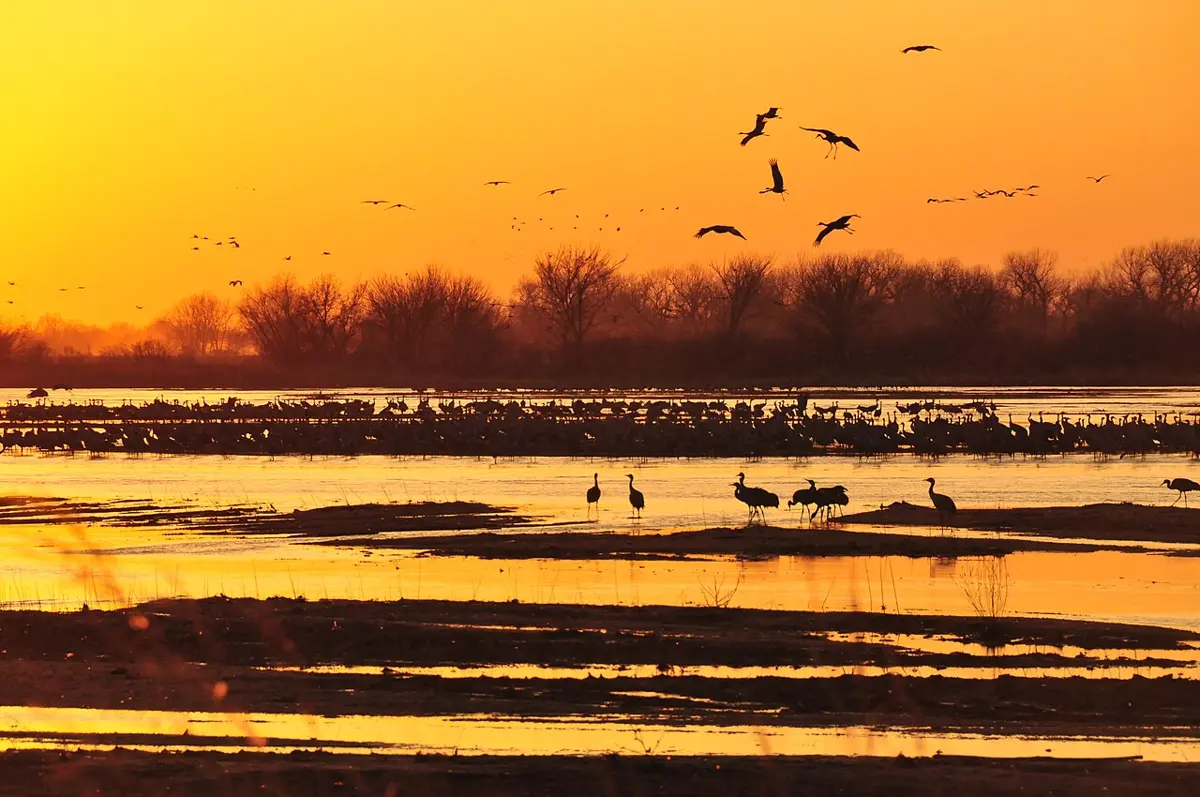
Some stopovers draw huge crowds. A 120-kilometer (75-mile) stretch of the Platte River in Nebraska is a gathering place for up to nine million birds each spring. Almost all the world’s sandhill cranes, about 500,000, spend about six weeks there, eating corn in the fields to put on fat, before flying north to Canada, Alaska and Siberia. Some birds make long, perilous (dangerous) journeys: many kinds of ducks and other water birds fly from Siberia to Nepal to escape the cold.
6. By day or by night
Ducks, geese and swans fly both by day and by night. Some day travelers feed as they fly: swallows and swifts catch flying insects on the way. But most songbirds feed and rest by day and fly at night, perhaps because the air is cooler and calmer. In the dark they are almost invisible, except for their chattering calls, and they can be seen only when they pass in front of the moon. That is how people count them: on a migration night, a moon watcher with a telescope may see as many as 200 birds an hour.
Words from the text
| Word | Meaning |
|---|---|
| migrate | to move from one place to another, often every year, for food, a better climate or to breed |
| transform | to change completely |
| incredible | hard to believe; amazing |
| roadmap | a map of roads; a plan to follow |
| retrace | to go back along the same path |
| grab | to take hold of something quickly |
| elevation | height above sea level |
| waterlogged | so full of water that it is heavy or can’t work |
| refuel | to take in more fuel (for a bird, food) |
| cluster | a small group of things close together |
| crucial | extremely important |
| perilous | very dangerous |
| stopover | a short stay on a long journey |
A. Synonyms and antonyms
Study the list of words and write their synonyms and antonyms from the list after each. Write NA if the word has no synonym or antonym in the list.
transform: stagnate, change, remodel, commute, revamp, hold on
incredible: unbelievable, credible, plausible, amazing, wonderful
roadmap: guideline, plan, direction, map, protocol, procedure
retrace: backtrack, forget, recall, recollect, reminisce
grab: clutch, snatch, free, liberate, release, capture
elevation: height, altitude, flat, level, lowness
waterlogged: dehydrated, dry, wet, sodden, arid, soaked, drenched
refuel: refill, replenish, deplete, exhaust, restock
cluster: array, band, bunch, clump
crucial: trivial, insignificant, unimportant, vital, fundamental
perilous: risky, dangerous, harmless, precarious, terrifying
Example: witness: synonyms onlooker, viewer, bystander, spectator; antonym participant.
Answer
B. Complete the sentences
Complete sentences a–f with their correct endings (one ending is not needed).
- a.In the past, people had the misconception that
- b.To supply themselves with energy,
- c.When the weather is favorable in spring,
- d.As a sign of partial migration,
- e.To wait for favorable weather,
- f.For better flying conditions,
- i.some birds of a species travel to a different place while others do not.
- ii.some birds stop to feed themselves with grains.
- iii.birds fly back to their summer homes.
- iv.birds hid underground or changed into some other birds.
- v.some birds choose to fly during the night.
- vi.some birds stay at stopovers for days or weeks.
- vii.birds fly in large groups.
Answer
C. Answer the questions
What is incredible about the migration of birds?
Answer
What things do birds consider while flying to their destinations?
Answer
Which animals other than birds migrate to new places?
Answer
What do scoters dive underwater for?
Answer
Which birds travel up and down instead of north to south?
Answer
What is partial migration of birds?
Answer
Why can sea terns not stay long on the water?
Answer
How do birds feed themselves during their journeys?
Answer
What are the signs of birds flying in the night sky?
Answer
D. Why animals migrate
You might have seen or heard of animals migrating to new places. What could be the reasons for animals to migrate? Discuss.
A model answer
Listening: wildlife in decline
A. Before you listen
Answer these questions.
- a.What do you think is the status of the population of animals in the world today?
- b.Why is wildlife important to human beings?
A model answer
The textbook’s listening task is a news report about the World Wildlife Fund’s study of wildlife around the world. CDC’s own recording is below: read the questions in B and C first, then listen, as many times as you need. The answers are hidden under the questions; after that, practice with a talk of our own that your browser reads aloud.
B and C. The textbook’s audio: answers
Listen to the audio and fill in the gaps with the correct words or phrases.
- a.According to the World Wildlife Fund, we need to overhaul the way we ……… .
- b.Wildlife across the world is ……… .
- c.The population of animals and birds has decreased by ……… in the past 50 years.
- d.The World Wildlife Fund monitored about ……… animal populations in its study.
- e.Agriculture is responsible for ……… of deforestation in the world.
- f.We can save wildlife for future generations by ……… .
Answer
Answer these questions in not more than four words.
- a.What does the decline in wildlife indicate?
- b.What is the biggest reason for the destruction of wild animals’ habitats?
- c.Where do terrestrial species live?
- d.Where should we look to stop the trend of population decline?
Answer
What efforts is Nepal making to save wildlife? Discuss.
A model answer
Practice listening alone
Grammar II: More practice with contradiction
The connectives of Grammar I, again, in harder sentences. Two things to watch:
- The meaning. The second part must really be a surprise after the first: ✗ Although it was raining, we stayed at home (that is no surprise: use because).
- The grammar of what follows: a clause, a noun phrase, or a new sentence.
| Before the comma | After the comma | |
|---|---|---|
| Although / Even though | a clause | the main clause |
| Despite / In spite of | a noun or -ing | the main clause |
| …However, / …Nevertheless, | (after a full stop or a semicolon) | a clause |
I called her many times, ……… she did not answer.
Pick an answer to see why.
……… the fact that the film was popular, it lost money.
Pick an answer to see why.
A. Choose the correct alternative
Complete the sentences with the correct alternatives from the brackets.
- a.Even though ……… (we have different ideologies / we have similar ideologies), we are intimate friends.
- b.……… (Despite / Even though) our hard efforts, we could not establish a hospital in the village.
- c.……… (Even though / In spite of) the film was very popular, it was a commercial failure.
- d.I enjoyed all the luxuries of life ……… (despite the fact / though) that I grew up in a remote village.
- e.I watched a late night movie. ……… (However / In spite of), I didn’t feel sleepy in the morning class.
- f.Even though ……… (scientists have done a lot of research / scientists have done no research), there is no evidence of life on Mars.
- g.……… (Even though / In spite of) my efforts, I can’t ever score excellent marks in the exam.
- h.My room was burgled ……… (although / yet) I had locked it securely before going out.
- i.I called Siddhartha several times ……… (in spite of / but) he did not respond.
- j.Even though we had not invited them, ……… (they came to the party / they did not come to the party).
Answer
B. Join the sentences
Join the following pairs of sentences with the connectives given in brackets.
- a.I was really exhausted. I could not sleep well. (Although)
- b.She did not meet the requirements. She was shortlisted for the job. (In spite of)
- c.I decided to work for the company. The pay was quite low. (Even though)
- d.We lost the match. We had prepared for the match really well. (Yet)
- e.Dipisha completed her assignment. She had badly injured her hand. (Despite)
- f.Kripa exercises every day. She is gaining weight. (However)
- g.Barcelona won the match. They were limited to ten players. (Nevertheless)
- h.I love to watch cricket on TV. My brother loves to watch football. (While)
- i.He had not gone to bed until midnight. He woke up early in the morning. (In spite of)
- j.He was selected for the school team. He had not played well. (Although)
Answer
Writing II: An essay on youth migration
A large number of young people and professionals leave Nepal and migrate abroad each year. Write an essay expressing your opinion about the impacts of such migration. Also include suggestions and solutions to the problems caused by migration.
Hint
A model essay
Project work
Types of adjectives
An adjective modifies (tells us more about) a noun or pronoun: what kind, how many, which one, whose. Most come before the noun (a tall building), but some also come after a verb like be (The building is tall).
| Type | What it does | Examples |
|---|---|---|
| Descriptive (also called of quality) | describes a quality: what kind | a brown bear, a tall building, a good student, a beautiful house |
| Proper | made from a proper noun; starts with a capital | Chinese tea, a French soldier, Nepali people |
| Of quantity | how much of an uncountable thing | much money, a little water, more information, some time, enough / sufficient food |
| Numeral (numerical) | how many, or in what order | five people, sixty students, the first day, many birds, few chances |
| Demonstrative | points out which one | this vitamin, that tree, these houses, those days |
| Interrogative | asks a question, before a noun | Whose pen is this? Which watch did you buy? What time is it? |
| Possessive | shows whose | my, your, his, her, its, our, their shoes |
| Distributive | refers to the members of a group one at a time | each man, every student, either side, neither answer |
In “Neither answer is correct,” neither is …
Pick an answer to see why.
Name the type of each adjective in bold.
- a.Those mangoes are from Indian farms.
- b.Whose bag did you take?
- c.She drank a little milk and ate three eggs.
- d.Every student must bring their own lunch.
- e.It was a cold morning.
Answer
Exercise
SEE-style practice on this unit. Try each one as in the exam, then open the answer.
Write True or False after each statement about Reading I.
- a.The world population doubled between 1950 and 1987.
- b.The population growth rate was highest in 2020.
- c.Projections of population become more certain over time.
- d.Sub-Saharan Africa will provide more than half of the world’s growth to 2050.
- e.India was expected to become the most populous country in 2023.
Answer
Put these events of Reading II in the order in which they are described.
- a.Robins in the south stay all year.
- b.People once thought birds slept in the mud.
- c.Sandhill cranes eat corn on the Platte River.
- d.Moon watchers count birds flying at night.
- e.Birds pace themselves like marathon runners.
- f.White-winged scoters dive for shellfish.
Answer
Complete each sentence with although, despite, however or but.
- a.……… the cold, the cranes stayed on the river for six weeks.
- b.Nepal’s population is still growing, ……… more slowly than before.
- c.……… fertility has fallen, the population of Nepal is still growing.
- d.The birds were tired. ………, they flew on through the night.
- e.……… having no map, the birds found their way home.
Answer
Read the passage and answer the questions.
Every winter, the wetlands of Koshi Tappu in the eastern Terai fill with ducks from Siberia and Central Asia. They come because the lakes of the north freeze and they can no longer find food. Bird watchers from many countries visit the reserve in January, when the birds are most numerous. Although the reserve is protected, the birds face problems: fishing nets, pesticides from nearby farms, and the loss of grassland. Local people who earn money as guides now help to protect them.
- a.Where is Koshi Tappu?
- b.Where do the ducks come from?
- c.Why do they come?
- d.When is the best time to see them?
- e.Name two problems the birds face.
Answer
Study the table and write an interpretation of it in about 100 words.
| Household facility | 2011 | 2021 |
|---|---|---|
| Ordinary mobile phone | 64.6% | 73.2% |
| Television | 36.5% | 49.4% |
| Internet | 3.3% | 37.7% |
| Refrigerator | 7.2% | 23.7% |
| Motorcycle | 9.6% | 27.3% |
A model interpretation
Practice every question in the book, and keep track of the ones you miss →
A companion to your textbook, not a replacement for it: study from the book your school uses, and where the two differ, follow your teacher. Found a mistake? Please tell us.