
In 1893 Lewis Carroll, who had written Alice’s Adventures in Wonderland many years before, published a story in which a visitor from a far-off country boasts about his people’s maps. Each one they made was larger and more detailed than the last, until at last they made a map on the scale of “a mile to the mile”. It has never been spread out, he admits: “the farmers objected: they said it would cover the whole country, and shut out the sunlight! So we now use the country itself, as its own map, and I assure you it does nearly as well.”
The joke works because every map-maker knows the opposite is true. A map is useful because of what it leaves out. A trekking map of the Annapurna trails shows the paths, the villages, the passes and the heights, and not the stones on the path, the color of each house or which lodge has hot water. A bus map of Kathmandu draws each route as a straight colored line and doesn’t care that the real road bends. What a map keeps depends on what it is for, and a map that kept everything would be as large and as confusing as the land.
Economists make maps too, of how people make a living, and call them models. Most of what economists know, they know this way, and the steps are simple to say. Pick out the few things that seem to matter for one question. Imagine everything else held still. Work out what ought to follow, often with a little arithmetic or a line on a graph. Then check it against what really happens, and mend the map or throw it away if it leads you wrong. All along, keep two kinds of statement apart: what is, which evidence can settle, and what ought to be, which evidence alone never can.
Maps that leave things out
Take a question Anshu, who runs the tea shop in this book, might ask herself. If she charges Rs. 30 for a glass instead of Rs. 25, will she sell fewer? A model for that leaves out nearly everything about her customers: their names, their jobs, whether they like her, what they talked about yesterday. It keeps one thing, that people tend to buy less of something when it costs more. It is rough, but it gives an answer that can be checked. She can try the new price for a week and count the glasses.
Leaving things out is not a weakness a model has to apologize for. It is the point. In 1953 the American economist Milton Friedman went further and argued that the most important theories always rest on assumptions that are, in his words, “wildly inaccurate descriptive representations of reality”. A theory matters, he wrote, when it explains much by little. So the test is not whether its assumptions look like real life, because they never do, but whether it predicts well. Many economists think that goes too far. A map with a river in the wrong place may get you to the right village once, by luck, and lose you the next time, and a model built on badly wrong assumptions can fail in exactly the case where it matters most. Both sides agree on the part that counts: a model earns trust only by being tested against the world.
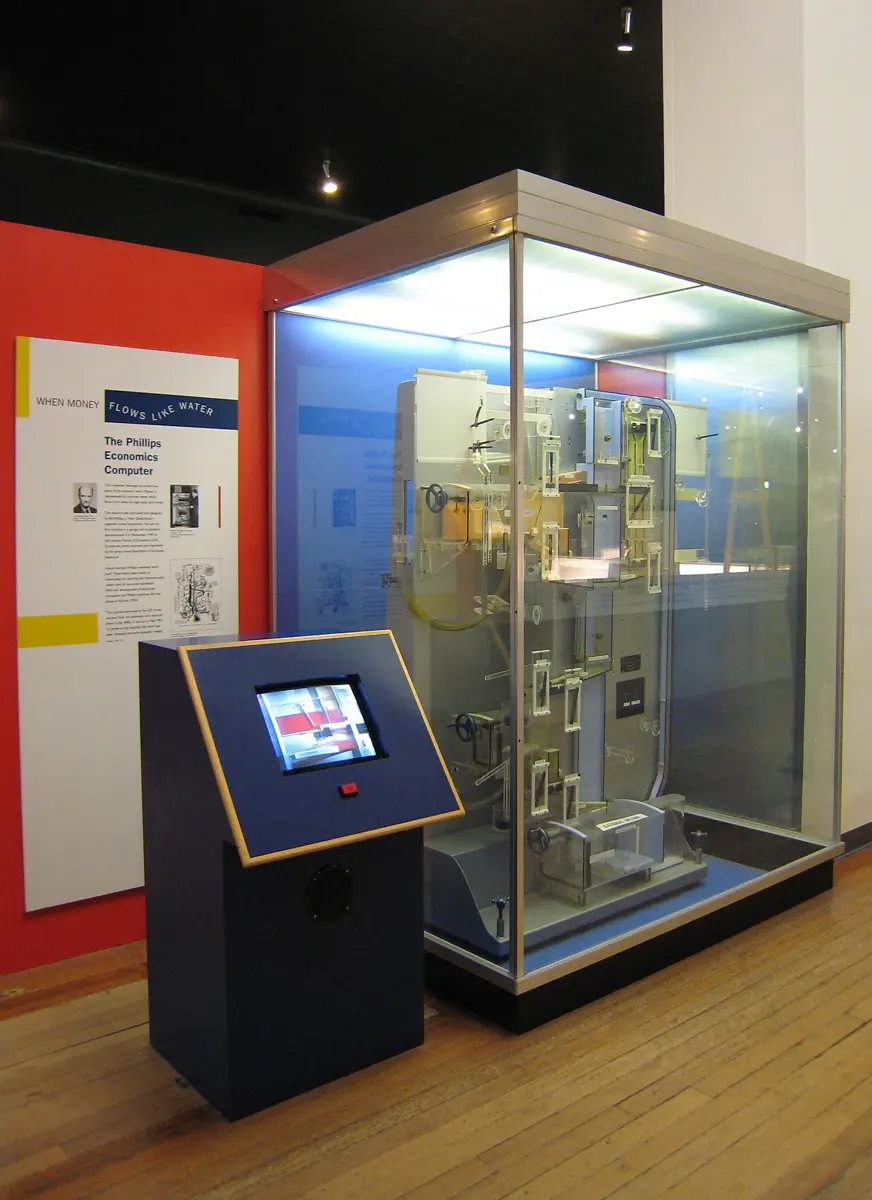
Sometimes the map was a real object you could touch. In 1949, in his landlady’s garage in Croydon, south of London, a New Zealander studying at the London School of Economics, Bill Phillips, built a model of a whole country’s economy out of clear plastic tanks, pipes and water, with a pump salvaged from a wartime bomber. The water was money. Pumped up to the top, it ran down through the machine, and taps and channels shared it out among tanks that stood for the parts of an economy: households, businesses, the government, and trade with other countries. Change a setting, and you could watch the water settle at new levels. The machine came to be known as MONIAC, the Monetary National Income Analogue Computer, and about fourteen were built. The one in London’s Science Museum stands 2 meters tall, and another, in the Reserve Bank of New Zealand’s museum in Wellington, has been mended and still works.
What the machine did with water, economists usually do with numbers and lines. A rule like “people buy less when the price rises” can be drawn as a line sloping down a graph, or written as a short equation, and then it can say how much less, not only that it will be less. Written that way, an idea is exact. Everyone can see which assumption the answer rests on, two people working it out get the same result, and the result can be set beside real figures to see whether it fits. That is why Nepal’s school courses in economics bring in straight lines and equations, and why one small sum, for where two lines cross, is worth knowing.
The cost is that numbers are easiest to find for things that are bought and sold, so the things nobody counts, a mother’s unpaid work, clean air, trust between neighbors, tend to drop off the map. A number can also look more certain than the guess behind it. Alfred Marshall, the English economist whose textbook every student read around 1900, knew the mathematics well and was wary of it. In a letter of 1906 he gave a friend his rules: use mathematics “as a short-hand language, rather than as an engine of inquiry”, keep to it until the work is done, translate it into English, illustrate it with examples that matter in real life, and then burn the mathematics. If no real example could be found, he added, burn the English too, since it couldn’t have mattered.
All else equal
Suppose Anshu raises her price in the same week the first cold weather arrives. Her sales go up. Did the higher price bring in more customers? Of course not. The cold did, and it was stronger than the price. To see what the price did on its own, she would have to imagine the same week with the same weather, the same festivals, the same road, the same number of people in town, and only the price changed. Two things that move together aren’t always cause and effect, as Together Is Not Because in Thinking Clearly, for the Curious shows at length.
Economists do this imagining so often that they have a Latin phrase for it, ceteris paribus, “other things being equal”, which Nepal’s textbooks put as अन्य पक्षहरू यथावत् रहेमा. Marshall described it vividly. A person studying something as tangled as an economy, he wrote, has to go step by step, and so he shuts the causes whose “wanderings happen to be inconvenient” away for a while “in a pound called Caeteris Paribus”. A pound is the pen where stray cattle used to be kept. Nobody pretends the cattle aren’t there. They are only kept out of the way while one thing is studied. And Marshall saw the price of it plainly: “The more the issue is thus narrowed, the more exactly can it be handled: but also the less closely does it correspond to real life.”
In real life, all else is hardly ever equal. That is why so much of an economist’s work goes into finding cases where it nearly is, or into sorting out several causes at once, which is much harder.
What can be held still also depends on how much time there is. Tomorrow Anshu can buy more milk and sugar, but she can’t get a bigger room or a second burner fitted by morning. Economists call that the short run: some things can change, others are stuck. Over a year or two she can move, add a burner or hire a helper, and almost nothing is stuck. That is the long run. Over a much longer stretch, the way tea is made can change too, with a new kind of stove or a machine nobody has invented yet, and that is sometimes called the very long run. An answer can be right for one stretch of time and wrong for another.
John Maynard Keynes, the most famous economist of the twentieth century, warned in 1923 against leaning too hard on the long run. It is “a misleading guide to current affairs”, he wrote. “In the long run we are all dead.” Economists, he went on, give themselves “too easy, too useless a task” if, in a storm, all they can say is that once the storm has long passed the sea will be flat again.
Small and large
Some questions are about one shop, and some about the whole country, and economics is split along that line. Microeconomics, व्यष्टि अर्थशास्त्र, studies the small parts: one household deciding what to buy, one firm deciding how much to make, one market and its price, the wage of one kind of work. Macroeconomics, समष्टि अर्थशास्त्र, studies the whole: everything a country makes in a year, prices in general, how many people have jobs, how much money there is. Micro asks why the sugar Anshu buys costs more this month. Macro asks why nearly everything does.
The words are newer than the questions, less than a century old. Older books had divided the subject by activity instead, into consumption, production, exchange, distribution and public finance (सार्वजनिक वित्त), the government’s own earning and spending. Newer ones divide it by size. Nepal’s Grade 9 book sets out both, and the pages ahead take the newer split: buyers, sellers and firms first, then the whole economy.
Why not simply add up all the shops? Because what is true for each one can be false for all of them together. Picture the bus park before Dashain. If one family goes at dawn, it gets seats on the bus. If every family goes at dawn, the queue simply starts at dawn and nobody is better off. Standing up at a cricket match helps you see, until everyone stands. Mistaking what works for one for what works for all is common enough to have a name, the fallacy of composition.
In November 2008, when banks around the world were failing, Queen Elizabeth II opened a new building at the London School of Economics and asked, in a briefing about the crisis, why nobody had noticed it coming. The British Academy held a meeting of experts to answer her, and the next summer two of its fellows wrote to her. Many people had done their own jobs well, they said, judged by the usual measures. “Individual risks may rightly have been viewed as small, but the risk to the system as a whole was vast.” The failure was “principally a failure of the collective imagination of many bright people” to understand the risks to the system as a whole. That is why the whole economy has to be studied as a whole. Each bank on its own looked safe, and together they were not.
The two halves need each other. The whole economy is made of households and shops, and each household and shop lives inside the whole. But in the whole, much less can be held still. When all prices rise, wages follow, then prices again, and every change feeds back on the others, so the pound of ceteris paribus holds far fewer cattle.
What is, and what ought to be
Here are two sentences about Nepal. “In 2022/23, 20.27% of Nepalis lived below the poverty line.” And: “Nepal should halve its poverty in ten years.”
The first is a statement about what is. Economists call it positive, वास्तविक. It may be true or false, and evidence can settle it. This one comes from the government’s national survey of households, and you could argue about where the poverty line should be drawn or how well the survey was done, but those are questions about facts and measurements. The second is a statement about what ought to be, called normative, आदर्श. No survey can prove it, because it depends on what you value: how much poverty matters set against everything else the country’s money could do.
Most real arguments mix the two. “A higher tax on cigarettes would make people smoke less” is positive. It can be tested, and it might turn out wrong. “So the tax should go up” adds an ought, that fewer smokers is worth the burden on those who keep smoking and pay more. A person who agrees with the first sentence can still reject the second, and nobody has made a mistake in logic.
The line between them was drawn sharply by John Neville Keynes, a Cambridge economist and the father of John Maynard Keynes. In a book of 1891 he split the subject into three. A positive science, “a body of systematized knowledge concerning what is”. A normative science, about “what ought to be”. And an art, “a system of rules for the attainment of a given end”: once a goal has been chosen, how best to reach it, the kind of advice a finance ministry gives. “Confusion between them is common,” he wrote, “and has been the source of many mischievous errors.” When Nepal’s textbooks say that economics is both a science and an art, this is the old distinction they mean. It explains what happens, and it helps people get what they have decided they want.
Keeping the two apart is harder than it sounds, because people care about the answer. Friedman, in the same essay, warned that experts and everyone else alike are tempted to bend what they find about facts to fit what they already believe ought to be. It also explains much of why economists seem to disagree so often. Often they agree about what would happen and differ about what should be done, and sometimes the facts truly aren’t settled yet. Telling which kind of disagreement you are hearing is half of understanding it. Thinking Clearly, for the Curious follows the missing “should” further, in What Facts Can’t Settle.
Is it a science?
Economics is called a social science, because what it studies is people, and people are awkward to study. A chemist can mix the same two liquids a hundred times and get the same result. Nobody can run Nepal twice, once with a new tax and once without, and people change what they do when they hear what economists predict. For a long time this was the strongest reason to say economics could never be a science like physics.
Friedman had an answer to that too. Astronomers can’t experiment on stars either, he pointed out, and nobody doubts that astronomy is a science. They rely on the “experiments” that happen to occur, and so can economists. Economists have since found three ways of testing ideas against the world. They set up small markets in a laboratory and watch how real people trade, a method that won the Nobel prize in 2002. They run trials in villages and schools the way medicine tests a drug, giving a new idea to one group chosen by chance and not to another, and in 2019 three economists won the prize for doing this to fight poverty. And they look for natural experiments, where chance or a change in the rules happened to treat two similar groups differently, as a lottery or a new law can. That idea won the prize in 2021, for showing how questions like what an extra year of school does to a person’s later pay can be answered without a planned trial. Thinking Clearly, for the Curious explains both kinds of test, in A Fair Test and Without an Experiment.
The limits are real. Economists are poor at telling when a crisis will come, as the Queen’s question showed. The simplest models assume people weigh every choice carefully, and people don’t always: they put off saving, follow the crowd, stick with whatever was chosen for them. A whole branch of the subject now studies those habits, and in 2017 the American economist Richard Thaler won the Nobel prize for bringing psychology into it. And economics can’t say what to want. It can say what a policy would probably do and who would gain and lose, but not whether that is worth it.
This book, too, speaks the language most economists share, of markets, costs and incentives, and like every way of seeing it shows some things clearly and leaves others out. Where economists who see differently have a strong case, the chapters say so.
Inside those limits economics is useful to nearly everyone. A family planning how to spend a small income, a shop deciding what to charge, a worker bargaining for a wage, a government writing a budget, a country choosing what to buy and sell abroad: each is making choices with scarce means, which is what economics studies. Keynes had a modest hope for his subject. “If economists could manage to get themselves thought of as humble, competent people, on a level with dentists,” he wrote in 1930, “that would be splendid!”
So economists know things the way a good map-maker does. They leave most things out on purpose and keep what matters for one question. They imagine all else held equal, and remember that it rarely is. They ask whether the answer is about one shop or the whole country, since the two can disagree, and they keep what is apart from what ought to be. Then they check their maps against the world, by trials, by lucky accidents and by numbers, and mend them when they fail. A model is never the country itself, and it isn’t meant to be.
Found a mistake? Please tell us.