
Every model needs somewhere to start, and economics starts with the plainest fact of ordinary life: there isn’t enough. Not enough land for everything a family would like to grow, not enough hours for everything a person would like to do, not enough money for everything a country would like to build. This chapter draws this book’s first map, a simple one of a village deciding what to grow. Almost everything later in this book is drawn on top of it.
Goods, services and the few free things
Start with what people want. Some of it can be held, like a sack of rice, a pair of shoes or a mobile phone. Economists call these goods. Some of it is work done for you, like a haircut, a bus ride, a doctor’s advice or a teacher’s lesson. These are services. A good can be made today and sold next month, stored in a godown and carried to another town. A service is used up in the moment it is given. A bus ride can’t be kept for later, and a lesson can’t be put in a sack. Most of what people buy is a bit of both. A plate of momo in a restaurant is the food, and also the cooking, the table and the washing up.
Nearly all of these cost something, because making them takes land, work, tools or materials that could have made something else. These are economic goods. A few things are free in the economist’s sense, because there is so much of them that nobody has to give anything up to get more. The air you breathe on a walk is one, and so is sunlight on a winter afternoon, or the water of a mountain stream where only a few houses draw from it.
The line between the two moves. Water in a Himalayan stream is free. Water in Kathmandu is not. The valley’s water company says the area it serves needs about 514 million liters a day, and in the year to mid-July 2025 it produced about 232 million a day on average, less than half. The rest is bought from tankers, drawn from wells, carried in jars or simply done without. The water is the same water. What changed is how many people want it in one place.
Goods are sorted in other ways too, and each sorting answers a different question. A plate of rice is a consumer good, eaten by the person who buys it. A tractor or a sugar mill’s crusher is a producer good, bought to make other things. Milk and green vegetables are perishable goods: they soon spoil. A bicycle or a house is durable and lasts for years. A pair of shoes is transferable, since it can be sold or handed to someone else, but a doctor’s skill or a singer’s voice can’t be given away. Some goods are necessities, like salt, rice and a roof, and others are luxuries that people buy only once the necessities are paid for.
Other sortings depend on how people behave when their income or prices change. Most goods are normal goods: as a family’s income rises, it buys more of them. A few are inferior goods. When income rises, people buy less of them, because they switch to something they like better. A family that gets richer may buy less coarse rice and more of the finer kinds. Some goods are substitutes, like tea and coffee, where more of one means less need for the other. Others are complements, like a motorbike and petrol, which are wanted together. Then there is a strange case named after the Victorian statistician Robert Giffen. A Giffen good is one that very poor families buy more of when its price rises. This happens because the price rise makes them too poor to afford anything better, so they give up the better food and fill the gap with more of the cheap staple. Alfred Marshall wrote about it in 1895, crediting Giffen. Real examples are very hard to find. The best evidence came only in 2007, from very poor households in Hunan, in China, buying rice. Chapter 7 explains how demand works.
The last pair matters most for this book. A private good, like a samosa, is used up by whoever eats it, and the shop can refuse it to anyone who doesn’t pay. A public good is different in both ways. A streetlight lights the road for everyone walking under it, and one walker’s light doesn’t leave less for the next. It also can’t easily be kept from someone who didn’t pay for it. What makes a good private or public, in the economist’s sense, is not who owns it but these two features. A government can own a canteen, and a private firm can light a street. Goods like streetlights are hard for a market to provide, because people can use them without paying. Chapter 26 returns to them.
Wants without end
If wants could be satisfied, scarcity would be a passing problem. Make enough, and the economy would be finished.
In 1930 John Maynard Keynes wrote an essay called “Economic Possibilities for our Grandchildren”. He guessed that within a hundred years living standards in the rich countries would be “between four and eight times as high” as they were then. Once that happened, he thought, people would need to work very little, perhaps “three-hour shifts or a fifteen-hour week”. He split needs into two kinds. Absolute needs are the ones we feel whatever other people have, like food and warmth. Relative needs are the ones we feel only because others have more. The first kind, he expected, would soon be met. The second, he admitted, “may indeed be insatiable”.
His first guess was close. A study by the economic historian Nicholas Crafts found that by 2011 the average British person’s income, after allowing for prices, was a little over five times what it had been in 1931. His second guess was wrong. British men’s working hours did fall by more than a quarter, but they stayed far above fifteen a week. Economists who have looked at why give several reasons, and two of them matter here. New goods kept arriving, so wants grew with incomes, and people kept spending to keep up with those around them, the relative needs Keynes himself had named.
Wants have no end, while hours, land and money do. That is scarcity. In economics it doesn’t mean poverty. It means that what we want is more than what there is, and that is as true of a rich family as of a poor one, and as true in Kathmandu as in London. It follows that every use of something scarce is a choice, because using it here means not using it there.
The cost of a choice
So what does a choice cost? The answer is the most useful idea in this book. The real cost of anything is the best thing you gave up to get it. Economists call this its opportunity cost (अवसर लागत).
Take a student who has just passed Grade 12 and is deciding between two more years of study and a job that pays Rs. 20,000 a month. The fees and books are the cost anyone would count. The money the student would have earned is also part of the cost, because it is given up. Two years of study cost the fees plus the Rs. 480,000 not earned, and that is often the bigger part. Many families in Nepal weigh exactly this when a son or daughter thinks of going abroad to work instead of studying.
The cost is only the best thing given up, not everything. A farmer with a field who could grow wheat worth Rs. 100,000 or mustard worth Rs. 70,000, and grows wheat, has given up the mustard. The tomatoes she could also have grown, worth less again, don’t count as well. She could only ever have grown one crop in that field.
Two old stories show how easily this cost is missed. In saloons in American towns more than a century ago, bars offered a “free lunch” to anyone who bought a drink. The saloon counted on the drinks to pay for it. A newspaper in Washington in 1909 put the lesson plainly: “there is no such thing as free lunch. Somebody has to pay for it.” The saying stuck.
The other story is older. In 1850 the French writer Frédéric Bastiat imagined a shopkeeper’s careless son breaking a pane of glass. Some neighbors said it was good for trade, because the glazier would earn six francs for mending it. Bastiat asked about what is not seen. Without the broken window, the shopkeeper would have spent the six francs on new shoes or a book. The glazier’s gain is plain to see. The shoemaker’s loss, the shoes that were never made, is invisible. The town is one window poorer, not richer. People still use his parable today, when someone says a flood or a war is good for the economy because of the rebuilding it brings.
Opportunity cost is easiest to see in big decisions. Early in 1942, on the government’s orders, the car factories of the United States stopped making cars for people to buy. For more than three years no new ones were made for sale. The same factories, workers and steel made weapons and vehicles for the war instead, Ford’s alone turning out jeeps, bombers and gliders. The war’s cost was not only the money spent. It was also every car that was not made.
A village’s frontier
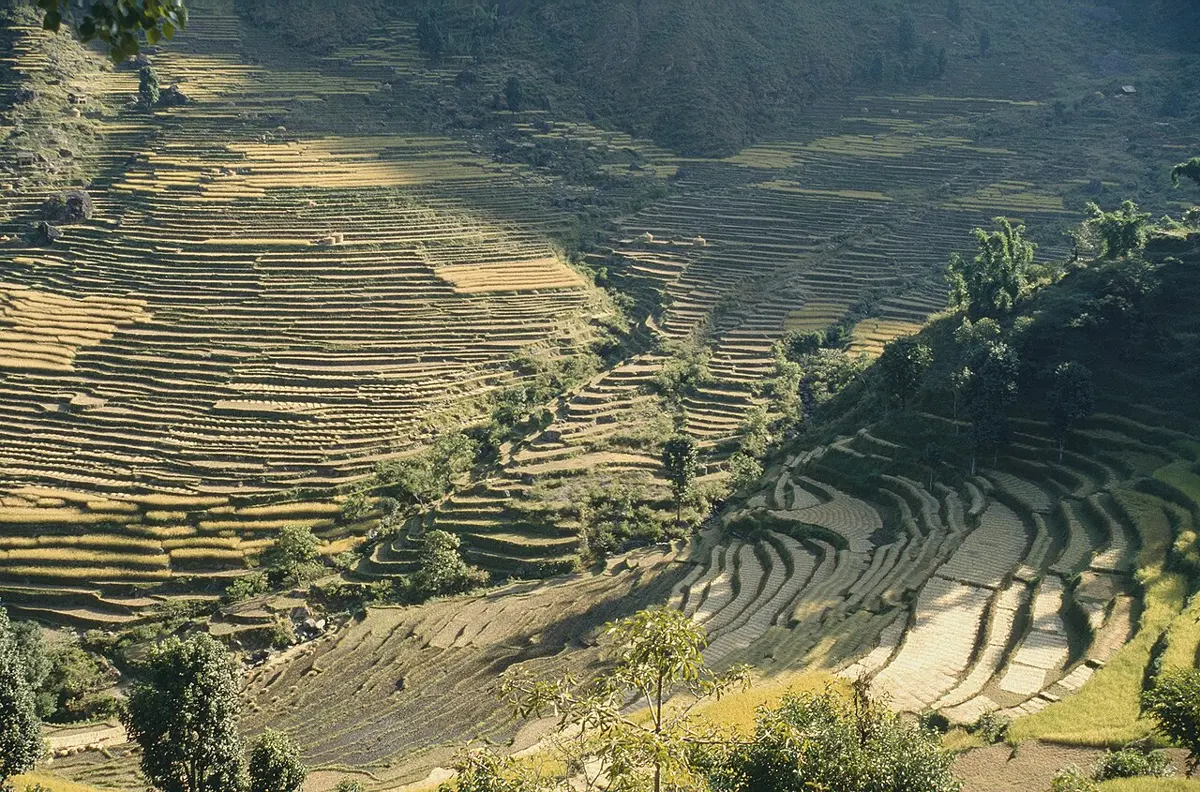
To see the idea at work, picture a village in the hills with ten fields of two hectares each. Five are khet (खेत), the terraced, watered fields along the stream where rice grows best. The other five are bari (बारी), the dry fields higher up the slope, which depend on the rain. Each field could grow rice or vegetables. The village is made up, but its yields are round numbers close to Nepal’s averages. The question is simply how many fields should grow each crop.
If every field grows rice, the village harvests 61 tonnes and no vegetables. If every field grows vegetables, it gets 280 tonnes and no rice. Between the two lie all the splits in between. Draw the most rice the village can grow for each amount of vegetables, and you get a line economists call the production possibility frontier. It shows everything the village could make with its land and its people, if nothing is wasted.
The first fields to switch should be the ones worst at rice, the high, dry bari. The top field gives up only 2 tonnes of rice for 26 tonnes of vegetables. That is about 80 kg of rice for every tonne of vegetables. As more fields switch, the village has to use better and better rice land. The last field to change, the best khet by the stream, gives up 9 tonnes of rice for 29 tonnes of vegetables, about 310 kg of rice for every tonne. Each extra tonne of vegetables costs more rice than the one before.
That rising cost is what gives the frontier its shape. It bows outward, away from the corner, instead of running straight. If every field were equally good at both crops, the cost would stay the same and the frontier would be a straight line. The bow comes from the land being different, and the same is true of workers, machines and anything else that is better at one job than another. Economists call this the law of increasing opportunity cost.
The frontier also sorts every possible harvest into three kinds. A point on the line is efficient, because the village can’t get more of one crop without giving up some of the other. A point inside the line is wasteful. Some field is lying idle, or some hands are not working, so the village could have more of both. A point beyond the line can’t be reached with the land, people and methods the village has now.
Being on the frontier is not the whole story. Every point on it is efficient, but the village still has to choose one. Ten fields of vegetables might be efficient, but a village that needs rice to eat would go hungry. The best point is the mix people actually want most, and economists call that allocative efficiency. The frontier shows what is possible. It can’t say which point to choose.
The frontier can move. Dig a canal to the bari, and the upper fields get water. Each can now grow more of both crops, so the whole frontier moves outward. The village can now have more of everything. Better seeds, better tools, more land brought under the plow, or more people working all move the frontier outward in the same way. Things that destroy land, tools or skills move it inward, like a flood that buries fields in stones or an earthquake.
So can people leaving. In Lamjung, a study of hill villages published in 2019 found that farmland was more often underused than abandoned outright, and not only by households with someone working abroad. With fewer hands in the village, the land that can be worked shrinks, and the village’s frontier moves in. What the family abroad earns is a different matter, and Chapter 32 counts it.
Who gets the land and the hours
Every society has to share out its scarce land, hours and money among all the things people want. Economists call this allocation. It comes down to the three questions from Chapter 1. What should be made, and how much of it? How should it be made? For whom should it be made?
The village’s slider is the first question: how much rice and how many vegetables. The second asks about methods. Rice can be planted by many people working by hand, or by a few people with a machine. The first method uses lots of labor and is called labor-intensive. The second uses more tools and machinery and is called capital-intensive. A country with many people and little money tends to choose the first, and a country with few workers and plenty of money the second. Nepal’s hill farms are mostly the first kind, which is why a family short of hands at planting time is in trouble.
The third question is who gets what is made. Does the rice go to whoever owns the fields, to whoever worked them, to whoever needs it most, or to whoever can pay? Each answer is a different kind of society.
Some allocations are made in plain view. South Korea takes workers from Nepal through its Employment Permit System, and the first step is a Korean language test. In 2025 about 103,000 people applied to sit it, by press reports, and the notice calling for applications expected about 5,300 to pass, nearly twenty applicants for every pass. Even a pass doesn’t promise a job, since a Korean employer still has to choose the worker. Some rule had to decide who went: a test, a queue, a lottery, a price. Every rule leaves most people disappointed, because scarcity guarantees that. The rule only decides which people they are.
Scarcity is not a problem that economics will one day solve. It is the starting condition of the subject. Wants grow as fast as the means to meet them, so every use of land, hours or money is a choice, and every choice has a cost: the best thing given up. A village’s frontier shows that choice on one page. It bows outward because land differs, it shows waste inside the line and the impossible outside it, and it moves out with canals and new seeds and in with floods and empty houses. What the village’s map can’t say is who should move the slider, the farmers themselves, a market, or an official with a plan. Different societies have answered that differently, and that is where the book goes next.
Found a mistake? Please tell us.