
Anshu runs a tea shop in a bazaar town in the hills. She and the town are made up, but her shop is like thousands of real ones: a bench, a gas burner, a pan of milk always close to the boil, a row of small glasses. A customer asks for tea, and a minute later she hands him a glass of chiya for Rs. 25, our example price. He drinks it in five minutes and goes off to work.
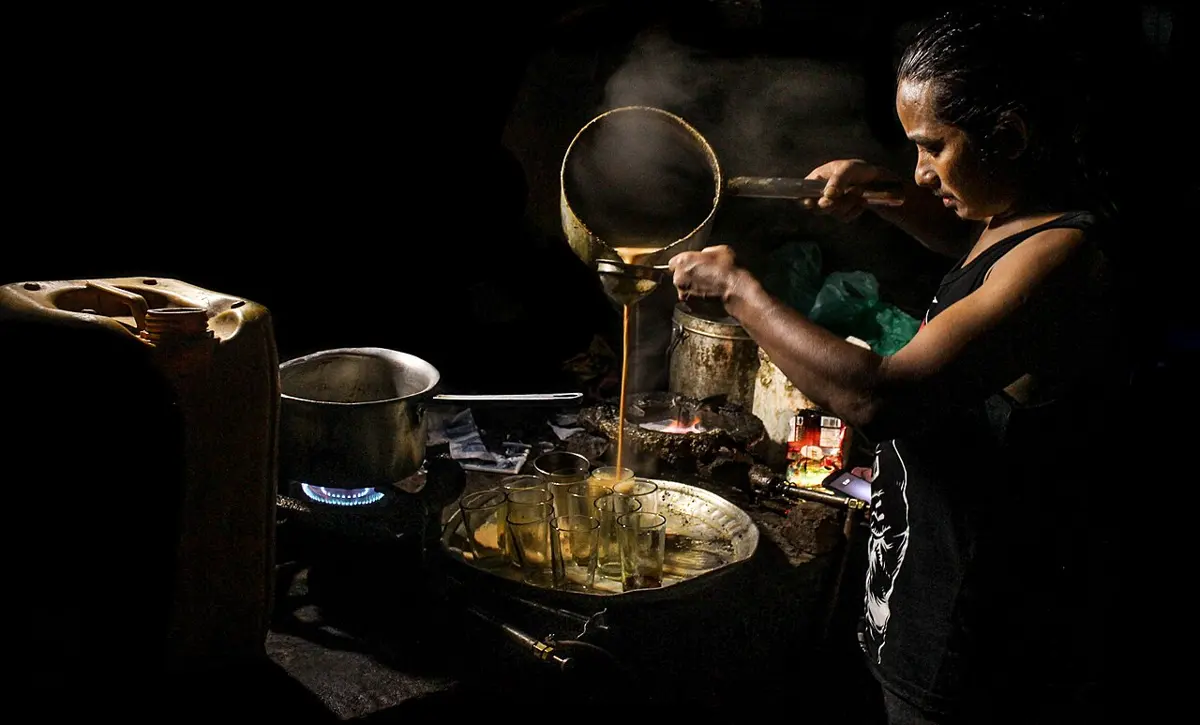
That glass took more people to make than anyone could count. The dark granules of tea were picked and rolled somewhere in the east of the country. The sugar was cane in a field in the plains, crushed in a mill, unless it was bought from abroad, as about a third of Nepal’s sugar is. The milk came from a buffalo or a cow on somebody’s farm. The gas under the pan came through India, and much of India’s own comes by ship from the Gulf. Even the rupee notes in Anshu’s drawer were printed in another country. Behind each of these stand more people: the ones who built the trucks, drilled for the gas, mended the road, lent the farmer money for a new animal.
Nobody arranged any of it. No office in Kathmandu decided that Anshu should have exactly this much sugar on this morning. The tea pickers in Jhapa have never heard of her, and she doesn’t know their names. Each of them did their own work for their own reasons, and the glass of tea turned up anyway, hot, for the price of a short bus ride.
People noticed this long ago. In 1776 a Scottish professor named Adam Smith looked at the rough woolen coat of an ordinary laborer and counted the people behind it: the shepherd, the sorter of the wool, the comber, the dyer, the spinner, the weaver, and the merchants and sailors who brought the dyes “from the remotest corners of the world”. Then he went further back, to the shears that cut the wool, and the miner, the furnace builder and the charcoal burner who made the shears. Without “many thousands”, he wrote, the poorest person in a country like his could not be fed and clothed. In 1958 an American writer, Leonard Read, made the same point about a pencil, telling its life story in its own voice. “Not a single person on the face of this earth,” the pencil says, “knows how to make me.”
How do millions of strangers, none of them in charge, end up making what other people need? And when they don’t, why not? That, more than anything, is what economics is about.
The three questions
Every family, village and country runs into the same wall. There is never enough of everything. Anshu has fourteen or fifteen working hours in a day, one burner, a little money saved and a room that fits two benches. What people want has no such end: more tea, a better school, a doctor nearby, a phone, a motorbike, a holiday. So everything that is used for one thing can’t be used for another, and someone has to choose.
Economists boil the choosing down to three questions, which every society has to answer somehow.
What will be made? Anshu could sell only tea, or tea and momos, or turn the back room into a phone repair counter. A country could grow more rice or more cardamom, build roads or hospitals.
How will it be made? Anshu could boil the milk on gas or on an electric induction stove. More and more Nepali families have been answering that question for themselves. In the first seven months of the fiscal year that began in July 2025, Nepal imported about 132,000 induction stoves, against 111,600 in the same months the year before. Then, in March 2026, war in the Gulf made gas hard to get and Nepal Oil Corporation began selling cylinders only half full, and a stove that runs on electricity looked better still. Nobody ordered anyone to switch. Each household simply did its own sum.
And for whom? Anshu’s tea goes to whoever pays Rs. 25. That is one answer, and a market gives it. A family gives another: the grandmother who earns nothing still gets the first glass. A government gives a third, when it pays for a school meal or a health post. Every country mixes all three, and much of the arguing in the world is about the mix.
Answering these questions means doing four kinds of things, and the study of them is the ground economics covers. Things are made (production, उत्पादन). They are traded, for money or for other things (exchange, विनिमय). What is earned is shared out among the people who helped make it, as wages, rent, interest and profit (distribution, वितरण). And they are used up, drunk, worn, lived in (consumption, उपभोग). Economics follows all four, from one household’s choice of what to cook up to a whole country’s prices, jobs and debts. That is why it is worth knowing even for someone who will never be an economist: it is the study of how a living is made, and everyone has to make one.
How exactly to say what economics is, though, has been argued over for two and a half centuries. Three answers became famous, and each tells you something about the time it came from.
What the word means
The English word comes from Greek. A short book by the Greek writer Xenophon, written in the fourth century BCE, is called Oeconomicus, from oikos, a house, and a word meaning to manage. It is about running a household and a farm well: keeping stores, training workers, getting the most from the land. For a long time that is what “economy” meant, careful management of a home, and the word still keeps a little of it when people say they are being economical with sugar.
The Nepali word for the subject, अर्थशास्त्र, is also the name of an old Sanskrit book, the Arthashastra, credited to कौटिल्य (Kautilya) and put together in layers over a few centuries, probably between the first century BCE and about 300 CE. It is a manual for kings: taxes, markets, mines, forests, trade, spies and war. Near its end it says what अर्थ, its main word, means: the livelihood of people, and the land they live on. So in Nepali the subject is named after making a living, which is not a bad name for it.
Wealth
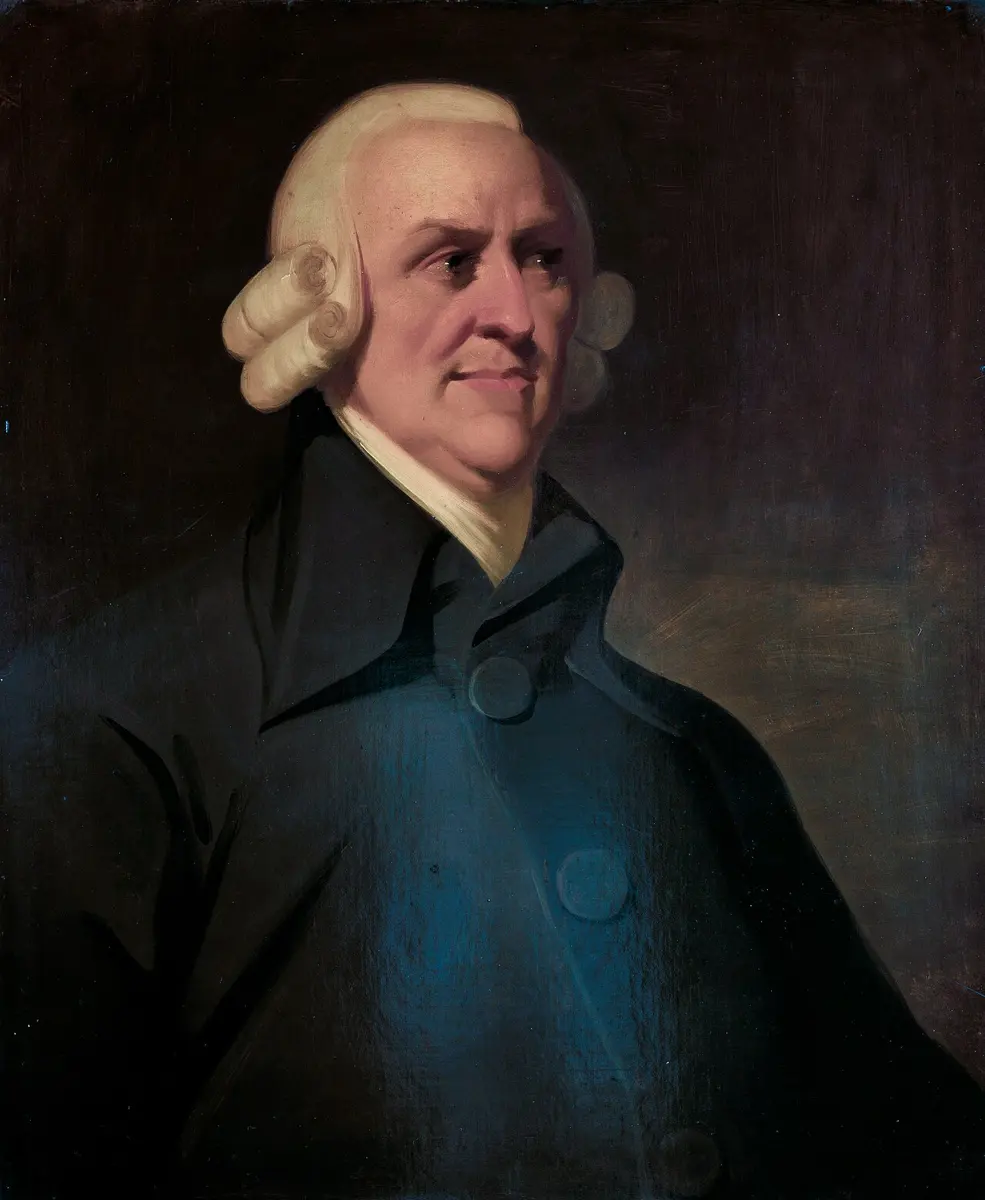
Adam Smith’s great book, published in 1776, is usually called The Wealth of Nations. Its full title asks about the nature and causes of the wealth of nations, and that is how he saw the subject: the study of wealth, what it is and how a country gets more of it. Smith is often called the father of economics, because his book drew the whole subject together as no book had before.
His idea of wealth was new. Many in his day thought a country was rich if it piled up gold and silver. Smith said that was the wrong thing to count. A country’s wealth was what its people made in a year, the food, cloth and houses they had to live on. His book opens with that thought, and its first chapter answers how a country makes more: by dividing up the work, so each person gets good at one part of it. When he described what his subject was for, he gave it two jobs: to let the people earn a plentiful living, and to give the state enough money for its public services.
Smith also gave the subject its most quoted line about why strangers serve each other. “It is not from the benevolence of the butcher, the brewer, or the baker, that we expect our dinner,” he wrote, “but from their regard to their own interest.” The baker doesn’t bake out of love for you, but because you pay him, and that is enough for bread to appear every morning. Anshu doesn’t make tea out of kindness either, though she may be kind.
Critics have found a lot to argue with in all this. Putting wealth at the center seemed to put things before people. The English writer John Ruskin attacked the economists of his day in a series of magazine essays, so hotly that the magazine stopped printing them after four. “There is no wealth but life,” he wrote, meaning love, joy and the happy people a country can raise, not its goods. More than forty years later a young lawyer in South Africa, Mohandas Gandhi, read the essays on a train, changed the way he lived, and translated them into Gujarati as Sarvodaya, the well-being of all.
Smith’s wealth was narrow in another way. He counted as wealth only what left a lasting thing behind, like a coat or a table. The work of doctors, lawyers, writers, musicians and opera singers was gone the moment it was done, so he called it unproductive, not useless, but not adding to the stock of goods. Today a teacher’s or a nurse’s work counts as fully as a weaver’s. He was also accused of describing an “economic man” who cares only for his own gain. That is unfair to him. His first book, published seventeen years before The Wealth of Nations, is about how people feel for each other, and it begins by saying that however selfish a person may be, other people’s happiness still matters to him. He knew the baker had a heart. He just noticed that the bread doesn’t depend on it.
Welfare
By the end of the nineteenth century the subject had a new center. The English economist Alfred Marshall’s Principles of Economics, first published in 1890, became the book every student read for a generation. Marshall opened it by calling economics “a study of man’s actions in the ordinary business of life”: how people get their incomes and how they use them. It was, he wrote, on one side a study of wealth, and on the other, “more important side, a part of the study of man”. Wealth mattered for what it did for people. The goal was well-being, or welfare, and especially material welfare, the part of a good life that comes from food, clothes, shelter and other things that can be bought.
This put people first, where Ruskin had wanted them, and for decades it was the standard definition. It also made economics a subject about real people in a real society, not imaginary money-hungry ones. Marshall was clear that people bring their sense of duty and their affections with them into business.
Then came the objections. Material welfare left things out. A teacher’s lesson or a doctor’s care does a great deal for well-being without being a material thing. Economists also study things that do people no good at all, like the market for alcohol and other drugs, or how a country pays for a war. And what is the “ordinary business of life”? Famines, monopolies and wars aren’t ordinary, but they are some of the most important things economists study.
Scarcity
The objection that won came from Lionel Robbins, an English professor at the London School of Economics, in a short book of 1932. He asked what all the problems economists study have in common, and his answer was not wealth or welfare but choice.
People have many ends, the things they want, and some matter more to them than others. The means of getting them, time, land, money, skills, are scarce, and each can be used in more than one way. Once both are true, you have to give up one thing to get another, and that is an economic problem wherever it turns up. His definition is still the most quoted: economics is “the science which studies human behaviour as a relationship between ends and scarce means which have alternative uses”.
Robbins’s own examples show why it’s a wider net. Air is free, he wrote, because breathing it doesn’t mean going without anything else. But there are only twenty-four hours in a day, and every hour spent on one thing is not spent on another. Anshu’s hours work exactly like that: an hour at the burner is an hour not spent with her children or learning to keep accounts. Robbins pointed out that the services of an opera dancer are as much a matter for economics as a cook’s, since both are wanted and both are limited. He even imagined Robinson Crusoe, the shipwrecked sailor of the old novel, talking to his parrot on his island, which has nothing to do with wealth, and then rescued, going on stage and talking to the parrot for a living, which has a great deal to do with it. What made it economic wasn’t the parrot. It was the choice of how to spend scarce hours.
Most textbooks today start from Robbins’s idea. One of the most widely used free ones puts it in a line: economics is “the study of how humans make decisions in the face of scarcity.” Scarcity, and the cost of every choice, will come up again and again in this book.
Robbins has his critics too. His definition says how economists think, but not what they should hope for, so it seems to leave out the question of what is good for people, which Marshall had put at the center. Scarcity also isn’t the whole story. A country can have plenty of something and still be poor in it. Nepal’s rivers carry enormous amounts of water down from the mountains, yet for years many towns sat in the dark with power cut for hours a day. The water wasn’t scarce; using it well was hard. And because choice is everywhere, Robbins’s net catches almost everything, so that economists have since written about marriage, crime and voting. To some that is the subject’s strength, and to others it has spread too far.
None of the three is simply wrong. Smith saw that a country grows rich by making things and that people working for their own gain can serve each other. Marshall saw that the point is the well-being of people. Robbins saw the common thread, choice under scarcity. Each was answering the question of his day: how nations grow, how people can live better, and what makes a problem economic at all.
Newer books try to hold all of it at once. CORE, a free course written by economists from many countries, calls economics the study of how people interact with each other and with their natural environment in producing and acquiring their livelihoods, and how that changes over time and differs across societies. That brings back the livelihood in अर्थ, the society in Marshall, and the land, the forests and the climate that none of the old three mentioned, all of which this book will need. An American economist, Jacob Viner, is remembered for a shorter answer: economics is what economists do.
So for Anshu’s glass of tea, economics asks how the tea, the sugar, the milk and the gas found their way to her shop without anyone in charge, what she should make with her few hours and her one burner, how much she should charge and who will end up drinking it, and what happens to all of that when a war far away makes the gas run short. It looks at one shop and at the whole country, at what is and at what ought to be.
In the end, economics is about making a living together. Wants are many and the means are few, so every person, family and country has to choose what to make, how to make it and who gets it. Smith, Marshall and Robbins each described the subject by what mattered most to them: wealth, well-being and choice. Keep all three in view, along with the strangers behind every glass of tea, and the shape of the whole subject is already there. What it doesn’t yet say is how economists find anything out. Nobody can follow every glass of tea in Nepal, so they do what map-makers do: they draw a simpler picture, leave most things out on purpose, and check whether it leads anywhere true.
Found a mistake? Please tell us.