
In April 2018 a woman of 47 came to the outpatient clinic of Patan Hospital, in Lalitpur, worried that she was putting on weight though she was eating no more than usual. Her muscles were sore and her body was bruised. For two years, she told the doctors, she had had pain in many of her joints, and for those two years she had been taking an unlabeled tablet from a local practitioner she believed to be an Ayurvedic doctor. The tablet took her pain away and made her feel strong enough to do chores she couldn’t do before. She had chosen it, she said, because she believed Ayurvedic medicine could do no harm. The doctors sent the tablet to be analyzed. It was prednisolone, a steroid, one of the most powerful drugs in modern medicine, and the weight, the sore muscles and the bruises were its side effects, taken unknowingly for two years. When she stopped it, her joints swelled and hurt again, and she was found to have rheumatoid arthritis, a disease that needed real treatment all along.
Nobody in her story meant to poison anyone, perhaps. But it holds most of what this chapter is about. A medicine sold as herbal may hold something else. A medicine that is truly herbal can still harm, because anything strong enough to change the body can change it the wrong way. And a person who trusts a remedy because it is “natural” may lose time that a treatable disease didn’t have.
The plain answer is this. Herbal medicines, Ayurvedic ones among them, can cause harm in four main ways: a herb can change how a doctor’s medicine works; some herbs can injure the liver, rarely but sometimes badly; a product can be contaminated with metals or secretly mixed with modern drugs; and a product sold with a promise it can’t keep can keep someone from treatment that works. Ayurveda itself never said that a natural thing is safe: its own books class some plants as poisons and teach that the dose decides. Regulators in Nepal, India and elsewhere have stepped in, unevenly. And one rule holds through all of it: nobody stops or swaps a doctor’s treatment for any of this. None of it is medical advice; it is what the studies and the regulators have found.
When a herb meets a medicine
A medicine works because a certain amount of it reaches the right place in the body for a certain time. The liver and the gut break many medicines down, using a family of chemical tools, enzymes, that clear foreign substances out of the body. Anything that speeds those tools up makes a medicine leave the body faster, so it does less. Anything that slows them down makes it build up, so it does more. Many plants contain chemicals that do one or the other.
The standard example is not Ayurvedic at all. St John’s wort is a herb sold for low mood. It strongly speeds up those clearing enzymes and a pump in the gut that pushes drugs back out, and as a result it has been shown to weaken a long list of important medicines: the drug that keeps a transplanted kidney from being rejected, a drug for HIV, the contraceptive pill, the blood thinner warfarin and the heart drug digoxin among them. America’s National Center for Complementary and Integrative Health, the government’s research center on these products, says the risk matters most for drugs where a small change in the amount in the blood makes a big difference, such as cancer drugs, warfarin and digoxin.
The same center says that many of the interactions reported for herbs rest only on animal or laboratory studies, and that good studies in people are few. But it lists possible interactions for अश्वगन्धा (aśvagandhā), for one: with medicines for diabetes and blood pressure, with those that calm the body’s defenses after a transplant, with sedatives, with medicines for epilepsy and with thyroid hormone. It also advises against अश्वगन्धा in pregnancy and while breastfeeding, and for people with thyroid disorders. The reasoning is simple even where the trials are missing. A herb taken to lower blood sugar, beside a tablet that lowers blood sugar, may lower it too far. Nepal’s Grade 10 Ayurveda book lists several herbs for diabetes, as Ayurveda Under Test tells, and many people with diabetes take one beside their tablets. That is why doctors and pharmacists ask to be told about every remedy a person takes, and why the best answer to “do you take anything else?” is the whole list.
The liver
The liver is where most of what we swallow is processed, and so it is where a harmful herb most often shows itself. In the United States, liver specialists reported in 2017 that herbs and dietary supplements had grown to about a fifth of the cases of liver injury from medicines in their research data. Most of those were products of many ingredients, where nobody could tell which part was to blame. In India the same story has been told by liver doctors, with Ayurvedic herbs among the causes.
Two herbs that earlier chapters met show how it happens. गुर्जो (gurjo), the vine Ayurveda calls गुडूची (guḍūcī), was promoted in India as an immune booster during the COVID-19 pandemic, and in 2021 and 2022 liver doctors began to report patients made ill. A study across thirteen centers in India gathered 43 of them, who had taken it for a median of 46 days before falling ill; in about two in three, the doctors judged the herb the probable cause. Four of them died, all four people whose livers were already diseased, sometimes without their knowing it. India’s Ministry of AYUSH, which oversees Ayurveda, rejected the first small report, from Mumbai, as misleading: it said the authors hadn’t checked which plant the patients took, since a look-alike species, Tinospora crispa, is known to harm the liver. The Mumbai doctors later had the plants identified and reported that their patients with serious injuries had taken गुर्जो itself, and the larger study had the products it could find chemically analyzed. The ministry, in 2022, still called reports linking गुर्जो to liver damage false. The two sides still disagree, and the गुर्जो page tells both. The other herb is अश्वगन्धा. Liver doctors in Iceland and the United States, and then in India, have described people who developed jaundice weeks after starting it; in the Indian series, the products were analyzed and found to hold nothing but the plant, and three people who already had liver disease died.
These injuries are rare. Most people who take these herbs come to no harm, and a trial of a few hundred people can easily miss a harm that strikes one person in many thousands. That is why such harms are found by doctors who notice a pattern, not by trials. The knee trial in Ayurveda Under Test, whose Ayurvedic mixtures held गुर्जो, found a rise in a liver test in some patients that nobody expected; the authors asked for more study. The doctors’ reports agree on one thing above all: people who already have a liver disease are the ones most at risk of being badly hurt. And it is exactly those people who often reach for a remedy for the liver. Doctors at Patan Hospital wrote in 2019 that most people in Nepal, whatever their schooling, think of jaundice as a disease for Ayurvedic medicine, and that since jaundice usually takes days or weeks to clear, people credit the remedy. They described a young woman with hepatitis whose jaundice deepened after a local healer gave her packets of powders and gold ash; whether the powders or the disease itself made her worse, they wrote, wasn’t clear.
Metals, and drugs that aren’t on the label
The metals are told in Mercury and Gold: in tests of Ayurvedic medicines on sale in the United States, about one in five held lead, mercury or arsenic, most often those made with metals on purpose, and people in America, India and Nepal have been poisoned by them. What that chapter doesn’t tell is the other kind of contamination: a modern drug, hidden.
The woman with the steroid tablet is one case, and her doctors at Patan Hospital wrote that she was not alone. Unknown powders mixed with drugs such as steroids, they wrote, are sometimes handed out in the name of Ayurveda, especially to people with long illnesses like arthritis and asthma. A steroid can make the pain go away, as hers did, while its harm comes slowly, as her weight, sore muscles and bruises showed, and stopping it suddenly brings its own trouble. The same doctors saw a man of 57 whose blood pressure was controlled by a medicine sold as Ayurvedic. Its leaflet listed सर्पगन्धा (sarpagandhā) among its herbs, the plant that gave reserpine, which From the Forest to the Pharmacy tells was put aside as a first choice because of its side effects. He had come to no harm, but he was taking an old drug in a form whose dose nobody could know. They moved him to a modern tablet.
In Nepal the job of finding such products falls to the Department of Drug Administration, which registers medicines, Ayurvedic ones included. In 2024 its inspectors found unregistered supplements and beauty creams containing pharmaceutical ingredients on sale in pharmacies, and it told pharmacies to stop selling them, warning that such products could do more harm than good. Its laboratory is small for the work, as From the Forest to the Pharmacy tells.
Promises that can’t be kept
The commonest harm of all needs no chemistry. It is a promise. A product that claims to cure diabetes, cancer, or a virus is dangerous even if it is pure and harmless in itself, because someone who believes it may stop or delay a treatment that works.
How much that costs has been measured for one disease. In 2018 a team at Yale studied American patients with cancers that could be treated, of the breast, prostate, lung and bowel, that had not spread, and compared 280 who chose alternative medicine alone, of any kind, with 560 similar patients who had the usual treatment. Those who chose alternative medicine alone were two and a half times as likely to die in the years that followed; for breast cancer, more than five times. The study wasn’t about Ayurveda in particular, and people who make such a choice may differ in other ways. But the size of the gap is the point.
Regulators have stepped in. In June 2021, during the pandemic, the Nepal branch of an Indian Ayurvedic organization handed Nepal’s health minister some fifteen hundred kits of a product claimed to help against COVID-19, and Nepal’s Department of Ayurveda said they would not be used, because the product had not gone through Nepal’s approval process for medicines. In India a law of 1954 already forbids advertising a medicine as a cure or treatment for any of a list of diseases, diabetes, cancer and asthma among them. In 2024, hearing a case the Indian Medical Association brought over a large Ayurvedic company’s advertisements claiming its products could treat diseases, India’s Supreme Court ordered that, before an advertisement runs on television or in print, the advertiser declare that it obeys the law. And in 2026 the Nepal Ayurveda Doctors Association, the practitioners themselves, asked the public to send it evidence of illegal Ayurvedic medicines and misleading advertising, online and off, to pass on to the police and the drug regulator. It said it had zero tolerance for illegal work done in Ayurveda’s name.
Natural is not the same as safe
Behind all of this sits one idea that sounds kind and is wrong: that what comes from a plant is gentle, and what comes from a factory is harsh. Nepal’s hills hold deadly plants too. वत्सनाभ (vatsanābha), the dictionary says, is a plant with a root like a calf’s navel, and it calls it a poison plant. It is aconite, and in 2024 doctors reported a traditional healer in rural Nepal who drank a homemade herbal tea containing it and died within twelve hours of reaching hospital. Its poison acts on the heart and nerves, and there is no specific antidote.
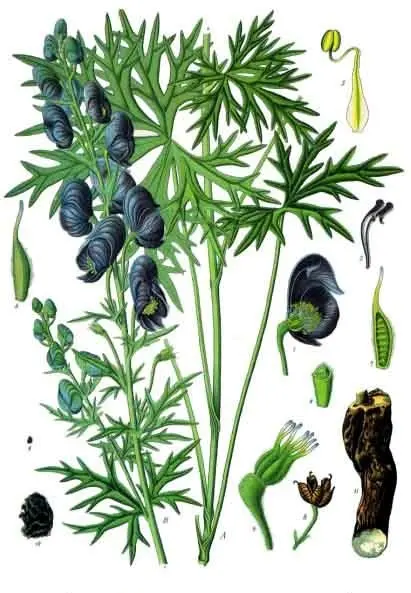
Ayurveda never pretended otherwise. CDC’s own course for Grades 11 and 12 lists वत्सनाभ among the medicinal substances as a poison, with a group of lesser poisons beside it, धतुरो (dhaturo), datura, and भाङ (bhāṅ), cannabis, among them. Charaka’s book, as Charaka tells, says that a poison well used can be a medicine and a medicine badly used a poison. And the Grade 10 book’s lesson on dose says the same in plain words: too little of a medicine does nothing and lets the disease grow, too much can put the patient’s life in danger, and so a wrong dose can make a medicine like a poison. That is the tradition at its wisest, and it is exactly what modern pharmacology says. The danger is not Ayurveda. It is the idea, often used to sell things, that a herbal product needs no care.
What doctors and health agencies ask is the same as for any medicine. They want to be told about every remedy a person takes, herbal or not, and they warn about unlabeled products and products that promise cures. And the rule that runs through this book holds here most of all: nobody stops or replaces a doctor’s treatment because of a remedy, an advertisement or a story, however good it sounds. For the same advice as a short habit, see Don’t take “natural” to mean safe and Never stop a medicine because of a post.
What should a reader take away? Herbal and Ayurvedic medicines can do real harm, though most people who take them come to none. A herb can change how a medicine works, which is why doctors need to know everything a person takes. A few herbs, गुर्जो and अश्वगन्धा among those studied, have been linked to rare but serious liver injury, worst in people whose livers were already ill. Some products hold lead, mercury or arsenic, and some sold as Ayurvedic have held hidden steroids or old drugs. The most costly harm is a false promise that keeps someone from treatment that works. The tradition itself knew that a plant can be a poison and that the dose decides; “natural” is a sales word, not a safety test.
Found a mistake? Please tell us.