
One morning in 1984, people came to the small two-roofed temple in Patko Tole, a neighborhood of Patan a short walk from Durbar Square, to do their daily पूजा (pūjā, worship), and found the niche empty. Bricks lay scattered where the god had stood. It had been there, worshipped every day, for centuries.
The god was Laxmi-Narayan, a rare kind of image: Vishnu and his consort Laxmi carved as one body in gray stone, about 85 centimeters tall. Down the middle runs the line between them. On one side are Vishnu’s mace, discus, conch and lotus, on the other Laxmi’s mirror and jewel pot, and her breast. It weighs about 70 kilograms, which is not something one person carries off on a whim. Years later it turned up in an American museum.
This chapter is about how that happens, how a god that is worshipped on Monday is gone on Tuesday and turns up a few years later in a sale catalog. The short version is a chain of people, each of whom makes the object look a little more respectable. A thief takes it from a shrine at night. A dealer buys it, and someone gets it past the border and through customs. In another country it is sold, often at auction, to a collector, with the part of its story that matters, where it came from, quietly missing. The collector may give it or lend it to a museum, which puts it on a plinth under good lighting with a label giving its name, its century and its country. By the end it looks less like stolen property than like art. Nobody in the chain has to think of himself as a thief except the first.
From a shrine to a catalog
For the Laxmi-Narayan, every link of that chain can be traced. A few years after the theft it came up for auction at Sotheby’s in New York. From 1990 it was on loan to the Dallas Museum of Art in Texas, lent by a private collector who meant to give it to the museum one day, and in 1993 it was in an exhibition of his sculptures there.
1993 was also the year that Patko gave up hope. With no idea where their god had gone, the neighbors had a copy carved and set it in the empty niche. It wasn’t a good copy. One of the neighbors, Bhai Raja Shrestha, an old man by the time reporters came to ask, put it simply: “God is god regardless of it being a replica or not.” But fewer people came. “People still came to do puja every day,” he said, “but it was not the same thing.” So for years the same god stood in two places at once: the copy in a Patan shrine, worshipped, and the original in a gallery in Dallas, admired.
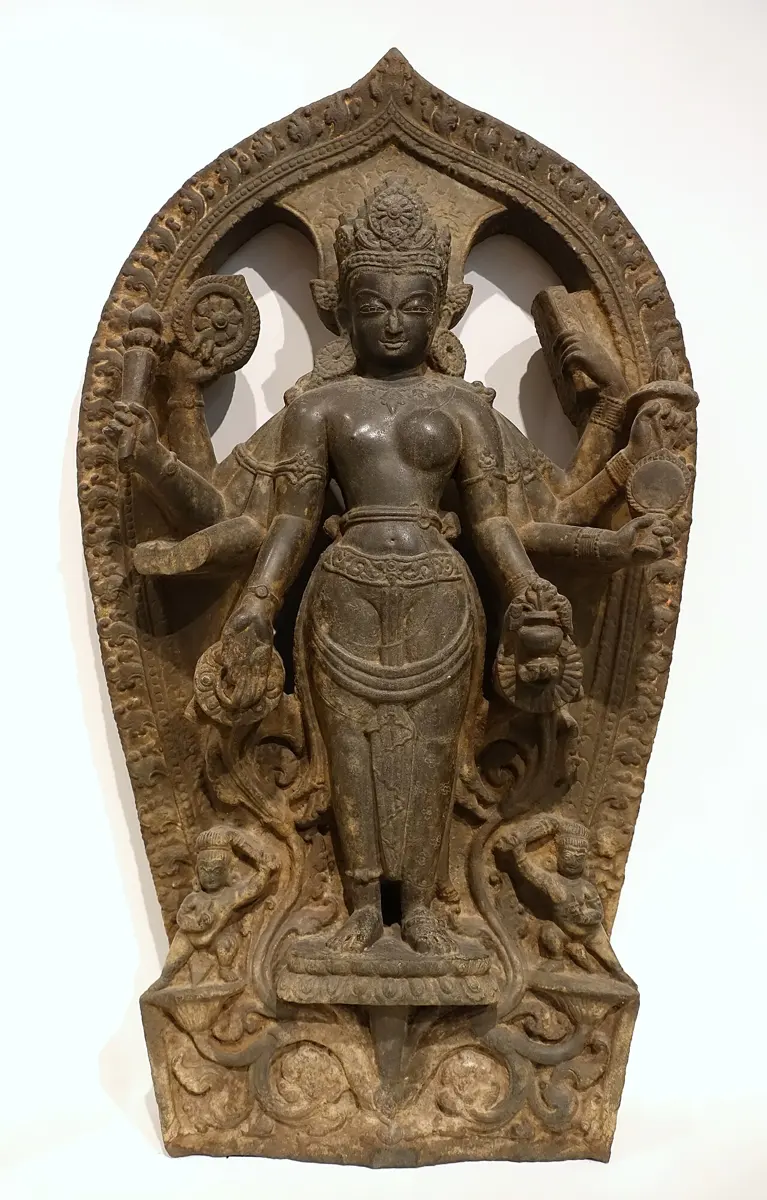
It was found by an artist. Joy Lynn Davis, an American painter, lived in Patan in 2013 and painted shrines that had lost their gods, putting each missing image back into its empty niche in gold. The Laxmi-Narayan was one of them, painted from the copy. In 2015, searching online for pictures of stolen Nepali gods, she came across a blurry photograph on a blog kept by a Nepali living in Dallas, who didn’t know it had been stolen. She knew it at once. It was on show at the Dallas Museum of Art, a short drive from her parents’ house.
Knowing where a god is doesn’t bring it home. In November 2019 an American professor who studies art crime, Erin Thompson, posted pictures on Twitter: the god in its shrine before 1984, in the auction catalog, and in the gallery. A month later the museum took it off display. The FBI, the American police force that deals with crimes across state and national borders, became involved, and on 5 March 2021 the god was handed over at Nepal’s embassy in Washington. Whether the museum moved fast or slow depends on who tells it. The museum says it contacted Nepal’s embassy as soon as it learned of the god’s history, worked with the lender, and was glad to send it home. Thompson and Davis say it dragged its feet until the FBI made a strong case.
In April 2021 the god flew back to Kathmandu and was kept in the Patan Museum while Patko decided what to do. That wasn’t simple. One of its eight arms was missing, and it had a copy, which people had been worshipping for nearly thirty years. In the end both stayed. On Saturday 4 December 2021 the Laxmi-Narayan was carried in procession from the museum to its temple, and after a क्षमा पूजा (kṣamā pūjā), a ritual that asks forgiveness, it was set back on its old stone plinth. The copy was moved to the side, where it is still worshipped too, and the temple has security cameras now.
How the gods got out
The Laxmi-Narayan was one of thousands. Until the 1950s Nepal was nearly closed to outsiders. When it opened, the Kathmandu Valley was what visitors called an open museum: thousands of carved and cast gods standing in shrines, courtyards, fountains and street corners, mostly unguarded, because they had never needed guarding. In the West, collectors had just discovered how beautiful Nepali sculpture was. Between the 1960s and the 1980s the Valley was stripped. People in the old neighborhoods remember waking up, again and again, to find that another god had vanished in the night.
Nepal saw it coming. In 1956 its Ancient Monument Preservation Act banned taking such objects out of the country. It didn’t stop the trade. Many of the stolen pieces were too big for a suitcase, and getting them past the border and customs needed help, which, the people who now track them say, often came from inside. A study of how Nepali art reached American collections concludes that most of it arrived after the ban.
The thieves, dealers, smugglers, officials, auction houses, collectors and museums weren’t the only links. Scholars were part of it too. When a book prints a fine photograph of an image and praises it, collectors learn what to want, the price of anything like it goes up, and a thief learns what to take. A few scholars also bought pieces themselves.
But scholars’ photographs are now the best evidence there is. A temple in Nepal keeps no inventory, no list of what it owns with a picture of each piece. So the proof that a god in a museum is the god from a particular shrine is usually an old photograph of it standing there. The painter Lain Singh Bangdel, whose life as an artist is in Modern Nepali Art, spent decades photographing the Valley’s stone sculptures in place. In 1989 he published Stolen Images of Nepal, page after page of holy images photographed where they stood, set beside the news that they were gone. The Laxmi-Narayan is on page 248. The book became the list that Nepal didn’t have.
Photographs can find a god decades later. One night in 1970 thieves broke into the treasury above the main shrine of I Baha Bahi, a Buddhist monastery in Patan, and took the images kept there for the yearly festival. Nobody had written down what was lost. In 2015 a photograph turned up, taken at the monastery in 1969 by an American art historian and printed in an article of 2003: five wooden images on their pedestals. Using it, the people behind Lost Arts of Nepal, a page run anonymously since 2015 to trace stolen Nepali art, found all five in American collections, in Los Angeles, New York, Chicago, Philadelphia and a private collection in Florida. One museum’s own photograph of its piece didn’t match the old one until they realized the museum’s picture had been printed back to front.
Coming home
Some gods have come back. In 1994 an American collector returned four after he was shown Bangdel’s photographs of them in their shrines. In 2000 a museum in Berlin returned an image of Shiva and Parvati, stolen from a neighborhood in Dhulikhel in 1982. In 2022 the Metropolitan Museum of Art in New York sent back a carved wooden strut from Itum Baha, a monastery in Kathmandu, identified from a photograph in a book about Nepali woodcarving. In 2023 a strut came back from Australia, and in 2024 a Newar group in the United States carried home an image of Shiva and Parvati that had been sitting in the storerooms of the Brooklyn Museum. “We were very sad to see that our gods were locked in the basement,” one of them said. By late 2023 Nepal’s Department of Archaeology, which looks after the country’s monuments, counted 143 stolen objects returned. Only 35 had gone back to the places they were taken from.
A returned god goes first to the National Museum in Kathmandu, which works with the neighborhood it was taken from to decide whether it can safely go back; putting it back needs the approval of the municipality and the district administration. Most stay in the National Museum or the Patan Museum, and that is the hard part of coming home. A neighborhood may not want its god back. Some worry that it will be stolen again. Some won’t worship an image that has been broken, because a damaged image is held to be unfit for worship and even unlucky. The head of Saraswati, the goddess of learning, cut off by thieves in Pharping in 1984 because the whole stone was too heavy to carry, was sent back anonymously from the United States in 1999. Its home hasn’t taken it back. And many shrines have a copy now, worshipped for a generation. A god in a museum is safe and can be seen by anyone. A god in its shrine is alive in the way it was made to be. Different people in Nepal choose differently, and both choices are made with care.
Much of the finding is now done by people who don’t work for any government. Lost Arts of Nepal matches pictures in museum catalogs and auction lists against old photographs and posts what it finds. The Nepal Heritage Recovery Campaign, started in 2021, gathers the evidence and presses museums and auction houses, and says it has had a hand in 25 returns. Within a day of an auction of Nepali antiquities being announced in 2021, activists had it stopped. Pressure like this works because museums care what the public thinks of them.
What the law says
The law moves more slowly. Nepal’s Act of 1956 has been changed several times since. In its English text as amended in 1996, an antique more than a hundred years old that a family or a monastery owns has to be registered with the government. New craftwork sold to visitors, which the law calls a curio, is supposed to carry a government mark, so that it can be told from an antique. Stealing from a monument in the government’s care can bring five to fifteen years in prison. But the Act works only inside Nepal. Once a god has crossed the border, other countries’ laws decide.
So in 1970 the countries of UNESCO, the United Nations’ body for education, science and culture, agreed a treaty, usually called the 1970 Convention. A country that joins promises to stop its museums acquiring cultural property exported illegally from another member, to ban the import of objects stolen from a museum or a religious or public monument in another member, and, when that country asks, to help recover them. There are two catches. The ban on imports covers only objects shown to belong to the inventory of the place they were stolen from, a list a Nepali shrine doesn’t keep, so a claim has to lean on photographs like Bangdel’s instead. And the treaty covers only objects taken after both countries had joined. Nepal joined in 1976, the United States in 1983, Britain only in 2002, so for most of the worst years Nepal could hardly use it. The Laxmi-Narayan, stolen in 1984, fell just inside the line. Thompson’s answer to the dealers who say anything taken before 1970 is fair game is that a stolen thing stays stolen, whatever year it was taken.
Even when the law is on Nepal’s side, a claim goes slowly. The Department of Archaeology writes to the Ministry of Culture, which writes to the Ministry of Foreign Affairs, which writes to the embassies, which take it up with the other country’s government, which takes it up with the museum. Most returns have come from a mixture of law, evidence and embarrassment.
Other people’s gods
Nepal isn’t the only country asking. In 1897 British soldiers carried off the court art of Benin, in what is now Nigeria, by the thousand, and only lately has much of it begun to go home, as Africa tells.
The most famous case is the Parthenon, the temple of Athena on the hill above Athens that is in Greece and Rome. Between 1801 and about 1812 the agents of Lord Elgin, the British ambassador to the Ottoman Empire, which then ruled Greece, took down about half of its surviving sculptures and shipped them to Britain. The British Museum has had them since 1816. Greece has formally asked for them back since 1983, and in 2009 it opened the Acropolis Museum below the hill, with a gallery built to show the whole set together, in sight of the temple they were made for. Greece says they were taken under a foreign ruler, by a man who went well beyond whatever permission he had, and that they are parts of one building and belong together. The museum’s trustees say that in London they sit beside the art of the whole world, where anyone can see how cultures are connected. A British law of 1963 also forbids the museum to give away its collection; the British government said in 2025 that a loan would be possible, but only one that ends, and that it has no plans to change the law. In 2025 Greece and the museum were still talking.
Some gods are not stolen but destroyed. In the cliffs of Bamiyan in Afghanistan, which come into Color and Paint for their blue, stood two giant Buddhas carved into the rock in the late 500s and early 600s, about 38 and 55 meters tall. A Chinese pilgrim who passed in 632 saw them painted and covered in gold. In March 2001 the Taliban, then ruling Afghanistan, declared them false idols, shelled them, and then blew them up with explosives. Nothing was taken and nothing was sold: the statues were destroyed for what they showed.
Underneath all these stories lie two hard questions with no single answer. Should a returned god go back on its plinth, where it can be worshipped and also stolen, or into a museum, where it is safe but no longer worshipped? And who speaks for a god: the neighborhood that worships it, the government that owns it in law, or the museum that has looked after it for fifty years?
What this chapter comes down to is that a holy image is not just an object. When one is stolen, a neighborhood loses a god it prayed to every day, and in a museum abroad the same stone becomes art, with a label that leaves out how it got there. It reaches the museum through a long chain of people, and it comes home, when it does, because someone kept a photograph, someone recognized it, and enough people made a fuss. The law helps, but late and slowly. The way to protect the gods still in their shrines starts in each neighborhood, and Your Town’s Past has the first step: dated photographs of your tole’s images, kept with the people who look after them.
Found a mistake? Please tell us.