
On 21 May 1498 three Portuguese ships lay off Calicut, a port on India’s southwest coast, and their captain, Vasco da Gama, sent one man ashore. He was one of the convicts the ships carried. The townspeople took him to two merchants from Tunis in North Africa, who spoke Spanish and Italian. Their first words to him, as one of the crew wrote them down, were a curse: the Devil take you, what brought you here?
They wanted to know what he had come so far to find. Christians and spices, he said. Then they asked why the king of Spain, the king of France or the rulers of Venice hadn’t sent anyone. Later one of them came out to the ships and cheered the newcomers: “A lucky venture, a lucky venture! Plenty of rubies, plenty of emeralds!”
That greeting says a great deal. The Portuguese had sailed for ten months to reach a place they had only heard of. But to Calicut they were a few more ships among many, and its people already knew of Spain, France and Venice. Merchants from half the world traded in its market, and they had been doing it for centuries.
So here is the story in brief. In the 1400s China sent the biggest fleets the world had yet seen across the Indian Ocean, all the way to Africa, and then stopped. Sixty-five years later a few Portuguese ships came round Africa from the other side and joined a trade that was already busy. Across the Atlantic, Spanish soldiers reached the two great empires of the Americas, and toppled both. They could not have done it alone. They had local allies, and they had germs, which they hadn’t meant to bring.
The biggest fleet, and why it stopped
In 1405 a fleet of over three hundred ships and more than twenty-seven thousand men sailed from the mouth of the Yangtze River in China. Its biggest ships were huge, though how huge is argued. The old records make them over 120 meters long, nearly five times the length of Columbus’s flagship, and some historians take them at their word. Others think no wooden ship that size could have sailed well, and put the biggest at 60 to 75 meters, about the size of the largest wooden ships Europe ever built. They carried silk, porcelain, iron, tea and gold to trade or give away, and soldiers to fight if needed.
Its commander was Zheng He. He had been born into a Muslim family in Yunnan, in China’s far southwest, whose father and grandfather had both made the pilgrimage to Mecca. When he was eleven, Chinese armies conquered Yunnan, and he was captured, made a eunuch and given as a servant to a prince. The prince grew to trust him completely. When the prince took the throne by force and became the Yongle Emperor, Zheng He became his admiral.
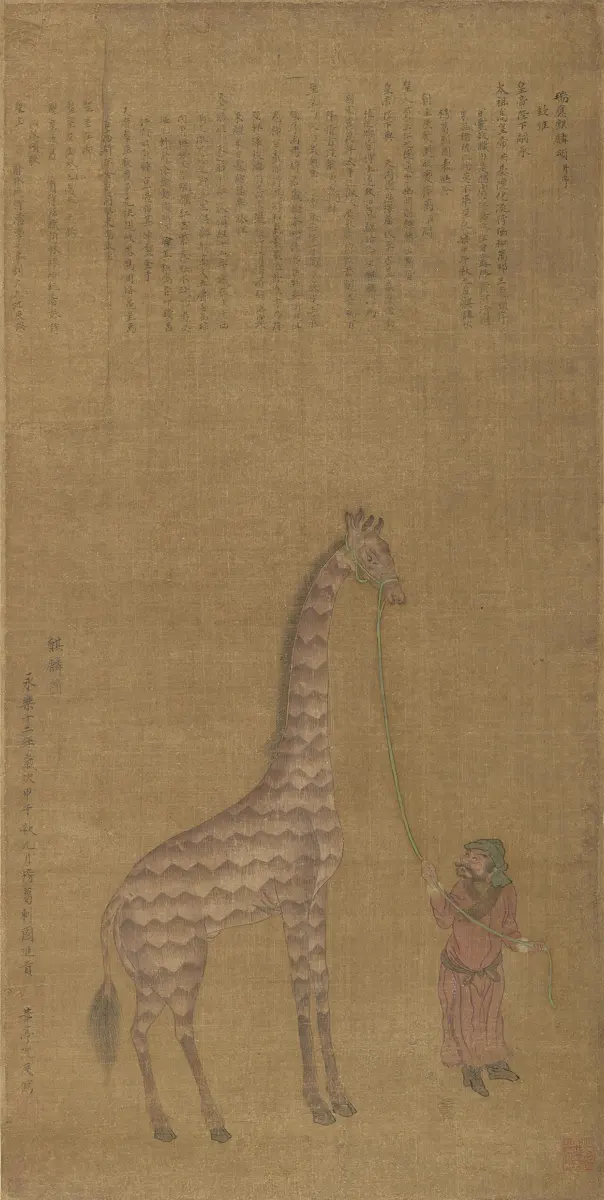
The fleet sailed seven times in twenty-eight years. It went down the coast of what is now Vietnam, through the narrow strait past Malacca, round Sri Lanka to Calicut, and later on to Hormuz at the mouth of the Persian Gulf, Aden in Arabia, and the coast of East Africa. It brought envoys back to meet the emperor, with gifts of lions, leopards, ostriches, zebras and giraffes. In China the giraffe was taken for the qilin, a gentle creature of old legends whose coming meant that the land was well ruled.
The fleet came to impress, not to conquer. But it fought when its commanders felt it had to. It destroyed a pirate fleet in Sumatra, captured a king of Sri Lanka and took him to China, and took prisoner a man in northern Sumatra whom China counted as a usurper, someone who had seized a throne that wasn’t his. In 1431, before the last voyage, Zheng He and his officers set up a stone in a temple at Liujiagang, the harbor they sailed from, listing all this. Foreign kings who were “disrespectful,” it says, “were captured alive.” They counted more than thirty countries visited.
Wherever it went, the fleet found trade already going on. Ma Huan, an interpreter who sailed with the fleet, wrote a book about what he saw, and he describes how prices were fixed at Calicut. The Chinese officers sat down with the king’s agents and the town’s merchants, agreed a price for each kind of goods, and sealed it with a handclasp, and after that nobody could change it. The local accountants, he noticed, did their sums on their fingers and toes. He also tells how Calicut’s Hindu king and its Muslims got along: the king didn’t eat beef, the Muslims didn’t eat pork, and they had agreed to respect each other’s rule.
Then it stopped. The Yongle Emperor died in 1424, and his son ended the voyages on the day he took the throne. One last fleet sailed in 1431, under the next emperor, and Zheng He died on the way home. After that no fleet like it sailed again.
Nobody knows exactly why. The plainest answer is money and politics. China was fighting the Mongols in the north and building a new capital at Beijing. The voyages had been the business of the palace eunuchs, and the scholar-officials who ran the government disliked both the eunuchs and the expense. Once the emperor who had backed the eunuchs was gone, the officials won. How much the voyages really cost is argued: some historians think they drained the treasury, others that it could easily bear them. A story is told that an official later hid or burned the fleet’s records so that nobody could revive it, though some historians doubt he could have done it. Either way, the fleet’s own logs are lost.
Trade didn’t stop when the fleets did: merchants of many peoples kept sailing the same seas in their own ships, as they had before Zheng He. What ended was China’s navy showing the flag. So when the Portuguese arrived, the ocean had no great fleet in it.
Calicut, a port that was already busy
Calicut was the chief port of the Malabar Coast, the land of pepper. Its ruler had the title Zamorin, and he was a Hindu king of a busy, mixed city. When the Moroccan traveler Ibn Battuta came there in the 1340s, he counted thirteen Chinese ships in the harbor and met merchants from China, Java, Sri Lanka, the Maldives, Yemen and Persia. Much of its sea trade was in the hands of Muslim merchants, who shipped its pepper and ginger west to the ports of Arabia.
The Portuguese came at this trade from the other end. For most of the 1400s their ships had been working south along Africa’s Atlantic coast. In 1497 Vasco da Gama sailed with four ships to finish the job. He came up Africa’s east coast to Malindi, in what is now Kenya, a town that also traded with India. Its king gave him a pilot, a sailor who knew the way across the Arabian Sea, probably from Gujarat. With the wind behind them they crossed in twenty-three days without sighting land. The way had been sailed for centuries. The Portuguese simply hadn’t known it.
The journal kept by one of the crew, whose name we don’t know, shows how little the newcomers understood. He believed Calicut was a Christian city. The captain was taken to a temple, and when its priests showed them the image inside, the Portuguese took it for the Virgin Mary and knelt to pray. The writer did notice that the painted saints on its walls had teeth sticking out of their mouths and four or five arms, which was not how saints looked at home.
The gifts went worse. Da Gama had brought cloth, hats, strings of coral, six wash basins, a case of sugar, and casks of oil and honey for the Zamorin. The king’s agent and his officials laughed at them. It wasn’t a thing to offer a king, they said. The poorest merchant from Mecca, or from anywhere in India, gave more, and if da Gama wanted to make a gift, it should be gold. Da Gama answered that he was an ambassador, not a merchant, and that he had no gold.
The Zamorin let the Portuguese sell their goods, which found few buyers, and buy some spices. He gave da Gama a letter for his king, written on a palm leaf. It is short and polite and practical: my country is rich in cinnamon, cloves, ginger, pepper and precious stones, and what I ask in exchange is gold, silver, coral and scarlet cloth. The Portuguese came away thinking the Muslim merchants had turned him against them. The two sides parted on bad terms, after each had held some of the other’s men to force a deal.
The voyage home nearly killed them all. Against the wind, the crossing took nearly three months, and scurvy, the sickness of sailors who go months without fresh food, swelled their gums over their teeth. Thirty men died of it, and by the end only seven or eight on each ship could still sail it. About fifty-five of perhaps a hundred and seventy got back to Portugal.
What followed was not peaceful trading. Portugal sent bigger fleets with cannon, and they fought for the trade rather than buying their way in. In 1500 a fight broke out at Calicut, and the Portuguese bombarded the town. In 1502 da Gama came back with fifteen ships, burned a ship full of pilgrims returning from Mecca with hundreds of people aboard, and shelled Calicut again. Portugal then built forts along the coast and made merchants buy Portuguese passes to sail. A history written in Arabic on the Malabar Coast later that century tells it from the other side: the Portuguese seizing any ship they found carrying pepper or ginger without their leave.
Two empires in the Americas
On the other side of the world, in 1519, Hernán Cortés landed on the coast of Mexico with a few hundred Spaniards. Inland lay the empire of the Mexica, often called the Aztecs, ruled from Tenochtitlan, a great city on an island in a lake.
He could not have gone far without a young woman the Spaniards called Doña Marina and the Nahua called Malintzin. She had been born into a Nahuatl-speaking family, sold as a child to Maya traders, and given to the Spaniards with nineteen other women after a battle. At first the talking went through two people: Cortés spoke Spanish to a Spaniard who had lived among the Maya, he passed it on in Maya to her, and she put it into Nahuatl. Soon she learned Spanish and spoke for Cortés herself. In the pictures the Nahua painted of the war, she often stands between Cortés and the people he is talking to, and she is sometimes drawn larger than he is.
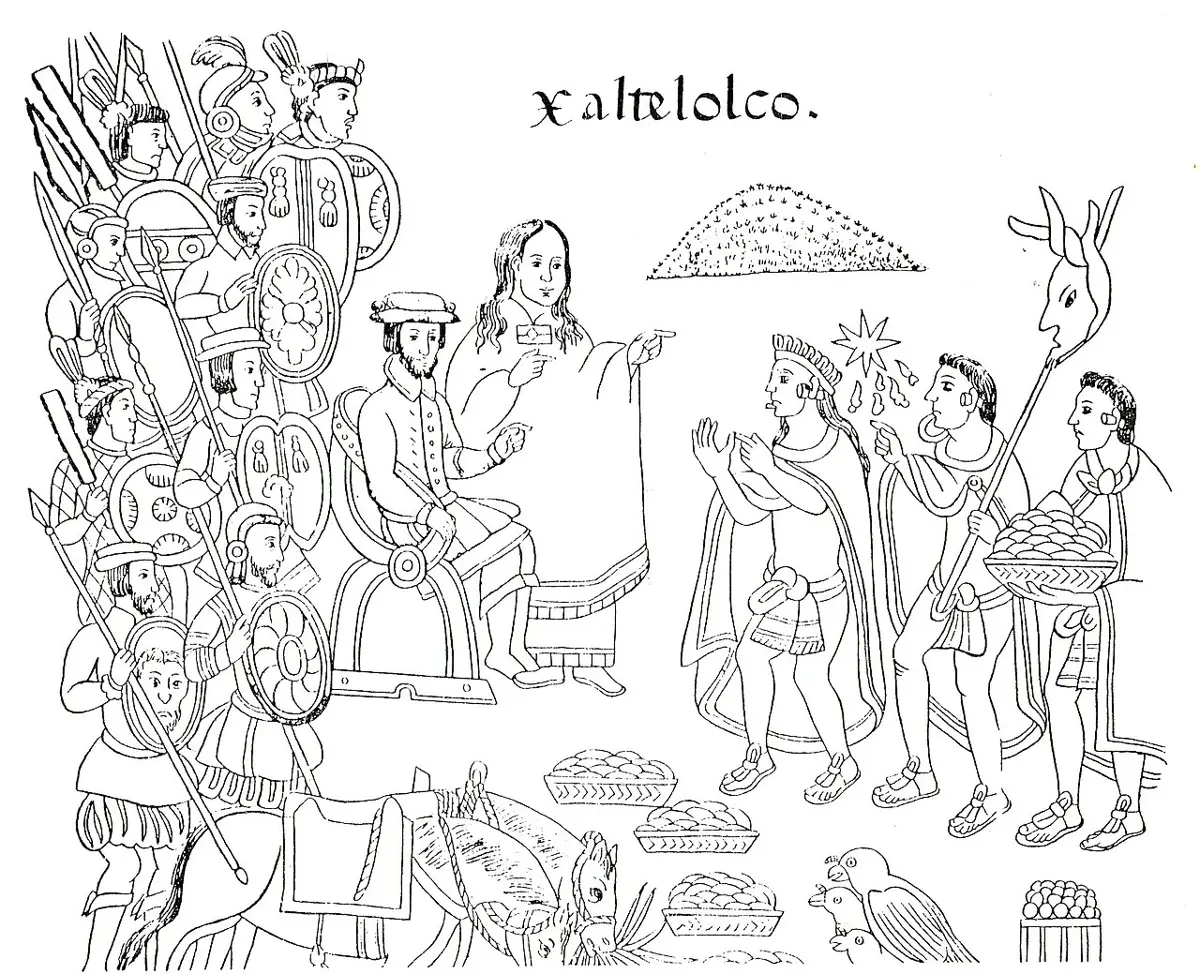
The Mexica had enemies, and the Spaniards found them. The strongest were the Tlaxcalans, who fought the Spaniards first, then decided to join them against Tenochtitlan, and other peoples joined too. From then on, most of the soldiers fighting the Mexica were not Spaniards. Thousands of allies marched with Cortés to the city, and at the end tens of thousands more, some say two hundred thousand.
Montezuma, the Mexica ruler, let the Spaniards into Tenochtitlan as guests, and they made him a prisoner. Within months he was dead. The Spanish said his own people stoned him; the Nahua said the Spanish killed him. Then the city rose and drove the Spaniards out by night, and many of them died on the causeways to the shore. It looked like the end.
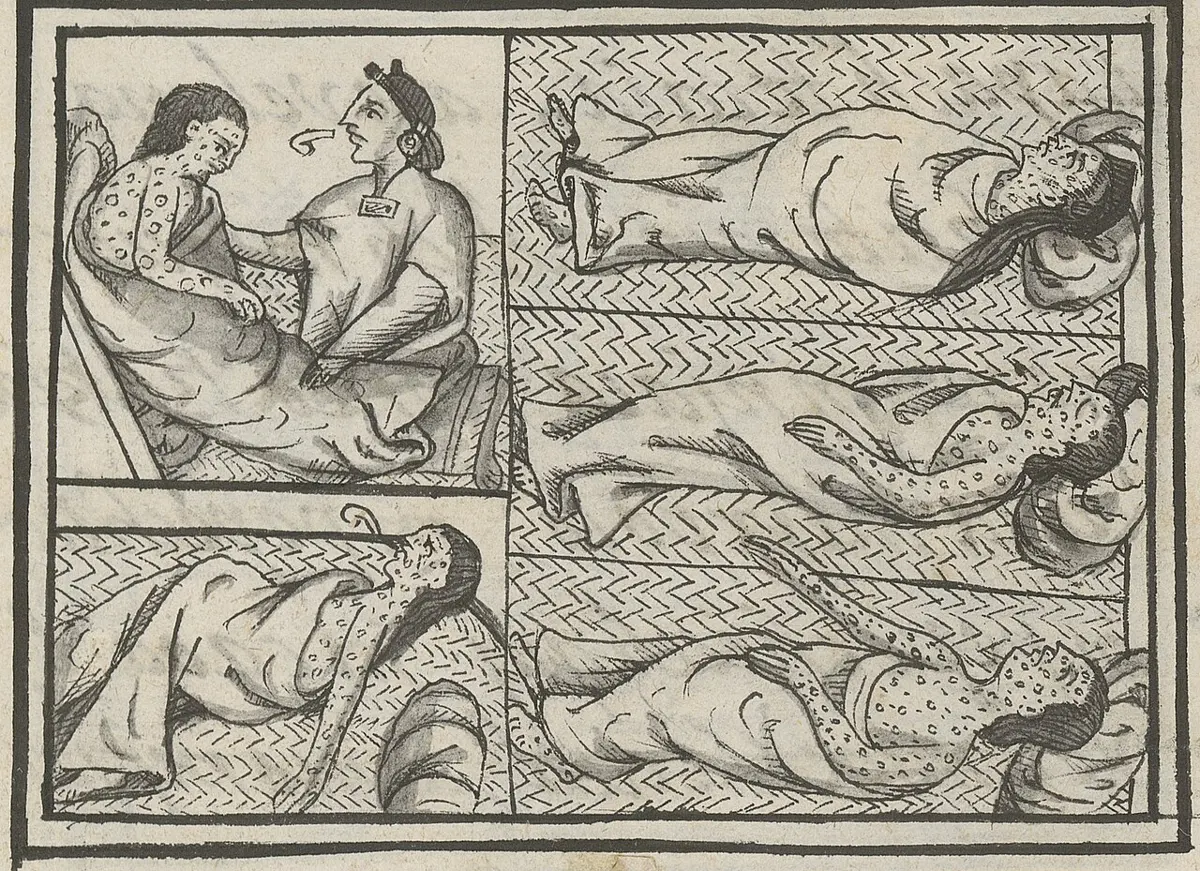
Then smallpox came. The Nahua elders who later told the story to a Spanish friar remembered it well. It began in the month they called Tepeilhuitl, at the end of September. Sores spread over people’s faces, heads and bodies until some couldn’t move or turn over, and cried out if anyone touched them. With whole families sick at once, nobody was left to cook, and many starved. Those who lived were left with pitted faces, and some lost their sight. It lasted sixty days. Montezuma’s successor died after only eighty days in power, perhaps of it too, though the early accounts don’t say.
The Spaniards and their allies came back with new forces, and built thirteen small ships to fight on the lake. They besieged the city for about three months, and it fell in August 1521. A poem written in Nahuatl within a generation mourns it: “our inheritance, our city, is lost and dead.” By the end, it says, the people had eaten lizards, rats and worms.
Francisco Pizarro reached the Inca empire in the Andes a decade later, and he too arrived at the worst possible time for the Incas. Their great ruler, Huayna Capac, had died a few years before, and his chosen heir died with him. Two of his sons then fought each other for the throne in a civil war that tore the empire apart. When Pizarro came inland with 168 men in 1532, one of them, Atahualpa, had just won, and was with his army near the town of Cajamarca.
What happened at Cajamarca is told two ways. Pizarro’s secretary, who was there, published his account two years later. A friar came forward with a cross and a book, he wrote, and told Atahualpa that the book held what God says. Atahualpa opened it, threw it five or six paces away, and told the friar he knew well how the Spaniards had treated his chiefs on the road and taken cloth from his storehouses.
The only Inca account was dictated some forty years later by Titu Cusi, Atahualpa’s nephew, and his story starts earlier. Two Spaniards came first to Atahualpa, he says, and when he offered one of them chicha, maize beer, in a gold cup, the man poured it on the ground. They showed him a letter or book that they said held the word of God and of their king, and, insulted, he threw it aside. At Cajamarca his drink was refused again, and he rose in anger: since they didn’t respect him, he said, he wouldn’t respect them. Nobody can now say which telling is closer to the truth. What came next is not in doubt. The Spaniards, hidden round the walled square, charged with horses, swords and guns, killed a great many of Atahualpa’s people and took him prisoner. Titu Cusi says his people had brought no weapons. Pizarro’s secretary says the men in front hid stones and slings under their tunics, yet he too wrote that through it all not one of them raised a weapon against a Spaniard.
To buy his freedom Atahualpa offered to fill a room with gold and twice over with silver, and his people brought it. The Spaniards killed him anyway the next year. Peoples who had been conquered by the Incas, such as the Cañari, joined the Spaniards against them, as the Tlaxcalans had in Mexico. Another of Huayna Capac’s sons, Titu Cusi’s father, later rose against the Spaniards, and when that failed he fell back to the forests of Vilcabamba, and an Inca state held out there until 1572.
Disease came here too, but how soon is argued. Huayna Capac’s death is often blamed on smallpox, which would mean it arrived ahead of the Spaniards and helped start the civil war. But the old accounts don’t describe his illness clearly, and some historians doubt it was smallpox at all.
The germs, and how many died
Smallpox was only the first. Measles followed, then other epidemics with names nobody can now pin down. In Mexico the worst came in 1545, which the Nahua called cocoliztli, “the pestilence.”
How many people all this killed is one of the hardest questions in history. The records are thin, and every estimate depends on how many people there were to begin with. One team of scientists working on Mexico thinks the smallpox of 1520 killed millions, the cocoliztli of 1545 up to eight in every ten people still alive, and another epidemic in 1576 about half of those left. Every such figure is an estimate, but the scale is not in doubt.
What caused cocoliztli was a mystery for almost five centuries. In 2018 scientists studied the teeth of people buried in a cemetery in southern Mexico that was used during that epidemic. In ten of them they found the DNA of a kind of salmonella that causes enteric fever, a disease like typhoid. They call it a strong candidate for the cause, not a proof, since the old descriptions of the symptoms are too thin to be sure.
How much the germs explain is argued too. One view puts disease ahead of guns, steel and horses: a few hundred Europeans could never have brought down two empires without it. The other says the disaster was not just bad luck. War, famine, forced labor in the mines, and the moving of whole villages into new towns made people weaker and the sicknesses deadlier.
Why not “discovery”
For a long time books said that Columbus discovered America and da Gama discovered the sea route to India. The word doesn’t fit what happened. Millions of people already lived in the Americas, and they had known their own land for thousands of years. Indian and Arab sailors crossed from Africa to India every year, and da Gama crossed with a pilot who knew the way. What was new was the joining up of routes and peoples that had never been joined before.
So historians now say that Europeans reached places, or met the people there. That keeps the people in the story: the Tlaxcalans chose their side, Malintzin did the talking, the Zamorin judged the gifts, and the Nahua elders and Titu Cusi told their own side.
So, simply: China could have ruled the seas of Asia and brought its fleets home instead. Portugal came late into an old, busy trade and forced its way in with cannon. In the Americas a few hundred Spaniards toppled two empires, helped by local peoples with their own reasons to fight and by diseases nobody understood. None of them discovered what the people living there already knew, but together they began to tie the world into one.
Found a mistake? Please tell us.