
In 2009 Paul Graham, a programmer who writes essays, puzzled over something everyone who reads the internet has seen. People could talk calmly about almost anything, programming or baking, but a discussion about religion or politics went sour almost at once. He decided the trouble wasn’t the subject. It was that these subjects had become part of who people were, and “people can never have a fruitful argument about something that’s part of their identity.” His example makes it plain. A discussion of a battle fought by the countries the people discussing it came from, he guessed, would probably turn into a political argument. A discussion of a battle from the Bronze Age wouldn’t, because nobody would know which side to be on.
That’s the last thing a belief can rest on: not a reason, a source or a number, but who you are. Most of what you believe you could give up tomorrow and lose nothing. If someone shows you that the capital of Australia is Canberra and not Sydney, you shrug and change your mind. A belief about your country, your school, your faith or your family is different. Evidence against it doesn’t feel like news about the world. It feels like an attack on you and your people, and the mind sets about defending them, which is the soldier’s mode of Scouts and soldiers at its strongest. The writer Julia Galef, who gave the scout and the soldier their names, gives a whole part of her book to this, and her conclusion is that the more a belief becomes part of your identity, the harder it gets to change.
So it helps to carry one simple test. When evidence points at your own side, swap the names. Ask: if exactly this evidence pointed at someone else, what would I conclude? If the answer comes out different, the difference isn’t coming from the evidence. It’s coming from you.
Agreeing with that is easy. Here is a case where it’s hard, because the side is ours.
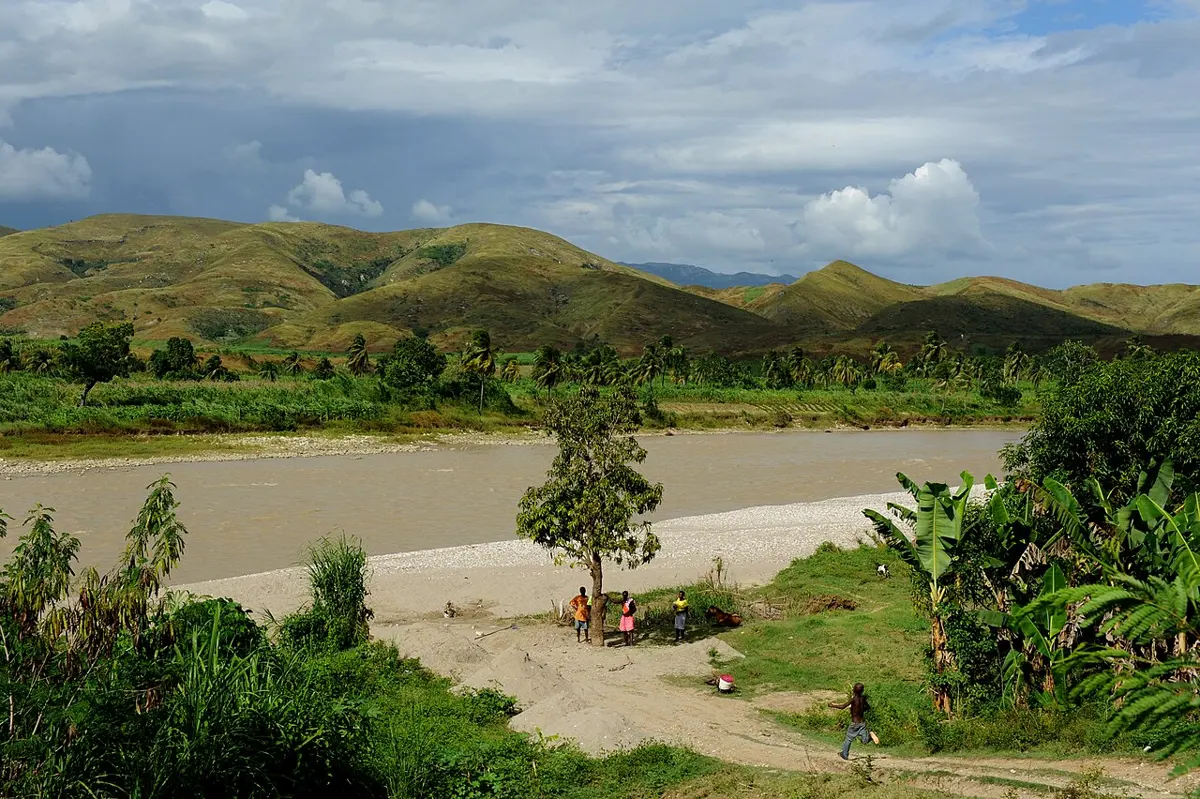
A river in central Haiti
Haiti hadn’t reported a single outbreak of cholera in more than a century. Then, in January 2010, a great earthquake struck near its capital, the one told in Geography, for the Curious, and late that year more than a million people were still living in camps. The United Nations had a peacekeeping mission there, and among its soldiers were Nepalis, posted in three camps in the middle of the country. One camp stood near the town of Mirebalais, just above a stream that flows into Haiti’s biggest river, the Artibonite.
Peacekeepers served six months at a time. A fresh Nepali contingent, after three months of training in Kathmandu, reached central Haiti between 8 and 24 October 2010; the Mirebalais camp’s new soldiers came on the 9th, 12th and 16th. A few weeks earlier, on 23 September, an outbreak of cholera had been reported in Kathmandu. Cholera is common in Nepal, as it is in much of South Asia.
On 14 October, people in Meille, a small village 2 km south of Mirebalais, began to fall sick with the watery diarrhea of cholera. The first to reach a hospital were members of one family. Within days, ten more cases turned up in the sixteen houses around theirs. Villagers drew water from the stream below the camp for cooking and drinking. Mirebalais’s prisoners drank from the same river, farther down, and 34 of them fell ill and four died, with no other cause anyone could find.
Then, on 19 and 20 October, the disease burst out all along the lower Artibonite, from a town 30 km from the sea to the coast, where the river spreads into canals and rice fields and thousands of people use its water every day. By noon on 21 October, less than 48 hours after the first alert from that part of the country, 3,020 people had been treated and 129 had died. Cholera kills by draining the body of water, and untreated it can kill within a day.
From the river it spread through the whole country. By February 2019, a month after the last confirmed case, Haiti had counted about 820,000 cases and 9,792 deaths. That count is surely low: surveys by Médecins Sans Frontières suggested that in the first months deaths may have been undercounted by as much as three times. About ten thousand people, then, by the official count, and probably many more.
Almost at once, people in Haiti blamed the Nepali soldiers. There were angry protests against the UN, and in November at least two people died in them. Some scientists offered another explanation: that the bacteria might have been in Haiti’s waters all along, woken by the weather.
What the evidence shows
Nobody could run a fair test on a question like this. It had to be answered the way cause is worked out without an experiment, from several kinds of clue that either fit together or don’t. Here there were three, and each shows something different.
The first is time and place. Renaud Piarroux, a French specialist in cholera, came at the Haitian government’s request, and with Haitian colleagues he built a record of every commune’s cases, day by day. The first cluster sat beside the camp, from 16 to 19 October. The next ran along the river. What mattered was not how close a place was to Mirebalais but whether it lay downstream of the stream at Meille. The few hamlets between Mirebalais and the delta, where hardly anyone lives on the banks, had almost no cases. The city of Gonaïves, close to the delta but watered by a different river, had just one case on 20 October, someone who had caught it on the lower Artibonite. The disease went where the water went.
The second is what came out of the camp. The Haitian investigators who reached Meille in October saw a pipe carrying sewage from the camp into the stream. When an independent panel of four experts, appointed by the UN’s Secretary-General, visited in February 2011, it found the toilets’ waste stored in tanks, the pipes around them broken or badly joined, some running over an open ditch that flowed into the stream, and the tanks emptied by a contractor into an open pit up the hill, unfenced, a short walk above a branch of the same stream and liable to overflow into it in heavy rain. The panel’s verdict: the camp’s sanitation was not good enough to keep human waste out of the river.
The third is the bacteria themselves. Every sample from Haiti turned out to be the same strain, a sign that the outbreak began from one source, once. The strain was a South Asian type, not one native to the Caribbean. In the spring of 2011 a first, rough test on a few samples from Nepal found them similar, but nobody had yet read whole genomes side by side. Then a team from Denmark, the United States and Nepal’s own National Public Health Laboratory in Kathmandu read the whole genomes of 24 samples of cholera taken from Nepali patients in 2010, in five districts, and compared them with the three from Haiti already read. Three of the Nepali samples and the three Haitian ones were almost identical, differing at only one or two places in their DNA. The team wrote that their results were “consistent with Nepal as the origin of the Haitian outbreak”.
Put together, time, place, pipes and genes tell one story, and nothing found so far tells another. That’s strong evidence. It’s also worth being exact about what it doesn’t show.
It doesn’t show which person carried the bacteria. Someone can carry cholera with no symptoms at all, and in some outbreaks such people have made up roughly half of all infections. The Nepal Army’s chief medical officer told the BBC that none of the soldiers had been tested for cholera before leaving, because the UN didn’t require it of anyone without symptoms. The UN’s medical records showed no one in its forces with severe diarrhea that September or October, so the carrier may well have been someone who never felt ill and never knew. It doesn’t show the exact event that put so much of it into the river; Piarroux wrote that this couldn’t be worked out from the pattern of cases. And it doesn’t show that anyone meant any harm. No investigation suggested any, and the panel’s members wrote in so many words that they did not think it deliberate.
Nor did the bacteria do it alone. It took a river that tens of thousands of people used for everything, canals and a delta where cholera thrives, people who had never met the disease and had no immunity, and a country where, even in 2016, only one person in four had a decent toilet and one in two had clean water. Cholera came to Haiti on one day. It became a disaster because of everything it found there.
What everyone said
In May 2011 the panel reported. Its four members were a microbiologist, an epidemiologist, a cholera specialist and an expert in water and sanitation, working in Bangladesh, Peru, the United States and India. Their report said that the outbreak came from contamination of the stream with a South Asian strain “as a result of human activity”, and that it “was caused by the confluence of circumstances”, “and was not the fault of, or deliberate action of, a group or individual.” It named no country as the source: the precise country, it said, was “debatable”, since it had only a rough comparison with a few Nepali samples, which found them similar.
Newspapers read it in opposite ways: some said it blamed nobody, others that it clearly pointed at the camp. Two years later the same four experts, writing on their own in a scientific book, said what they thought the evidence now showed: “the preponderance of the evidence and the weight of the circumstantial evidence does lead to the conclusion that personnel associated with the Mirebalais MINUSTAH facility were the most likely source of introduction of cholera into Haiti.” In the same breath they added that they believed it was “an accidental and unfortunate confluence of events.” The exact source, they wrote, “will never be known with scientific certainty”.
The UN itself held out much longer. When families of the dead brought claims, it answered that the claims were “not receivable”, and courts in New York ruled that the UN couldn’t be sued. In August 2016 the UN’s own independent expert on extreme poverty and human rights, Philip Alston, wrote in a report to the General Assembly that the organization’s refusal to take responsibility was “morally unconscionable, legally indefensible and politically self-defeating.”
On 1 December 2016, Ban Ki-moon, the Secretary-General, spoke to the General Assembly, first in Haitian Creole, then in French, then in English:
“The United Nations deeply regrets the loss of life and suffering caused by the cholera outbreak in Haiti. On behalf of the United Nations, I want to say very clearly: we apologise to the Haitian people. We simply did not do enough with regard to the cholera outbreak and its spread in Haiti. We are profoundly sorry for our role.”
It was a real apology, and a careful one. It said sorry for “our role” without saying what that role was. It apologized for not doing enough about the outbreak, and said nothing about how it began. In the same speech Ban asked the world for around $400 million over two years, to fight the disease and to help the families and places it had hit hardest. Words, he said, “cannot replace action and material support.” By March 2018 the fund set up for it had received promises of $8.7 million, from 40 countries, and what had come in, the UN reported, was not enough to pay for either part of the plan. Nepal was one of the forty.
In Nepal the first reactions were firm denials. In November 2010 the Nepal Army said in a press statement that the allegations had been “proved wrong”: water samples from the camp had tested negative, and it was official policy never to send unhealthy soldiers on a mission. In December, when news of Piarroux’s findings leaked, its spokesman said, “We strongly condemn the making of such allegations with no firm evidence or facts,” and called the conclusions “hypothetical”. On the same day its chief medical officer told the BBC that nobody had been tested for cholera before going. In 2014, after the genes had been compared, an army spokesman told a reporter, “The UN has already made it clear that our Nepali soldiers had nothing to do with the epidemic and that is also our official position.” A senior health official put the feeling behind it: “It is easy to blame Nepali soldiers as they contribute a lot to UN peacekeeping missions and they happened to be in Haiti right at the time when the epidemic occurred, but it is dangerous to pinpoint a group of nationals.”
That last worry is a fair one. Haitians blaming Nepalis as a people, or Nepalis feeling blamed as a people, helps nobody. But it answers a different question from the one the evidence asks.
Swapping the names
Now the test. Imagine the same file with the names changed. Soldiers from some other country arrive in a place that hasn’t seen cholera in a century, a few weeks after an outbreak in their own capital. Within a week, cholera breaks out in the village right below their camp, where a pipe runs from the camp into the stream. It follows the river down and nowhere else. The bacteria turn out to be almost identical to ones caught in that country the same year. And that country’s army says the claim is hypothetical, while its own doctor says nobody was tested.
Reading that about another country, you would hardly call it hypothetical. You would probably say: almost certainly it came from that camp, by accident. That is very nearly what the panel’s members said in 2013. The evidence hadn’t changed between the two versions. Only whose it was.
The test works in the other direction too. Swapping names also shows where a claim goes further than the evidence. “Nepali soldiers killed ten thousand Haitians” would fail it just as badly, because nobody would accept that sentence about another country’s troops when what the evidence shows is an unknown carrier, a broken pipe or an overflowing pit, an accident nobody intended, and a country with nothing to stop the disease once it arrived. The swap doesn’t make you harsher on your own side. It makes you judge your side by the same rule as everyone else, which sometimes means defending it and sometimes means admitting things.
The UN faced the same test. The evidence pointed at its own camp, and for years it spoke of no conclusive evidence, said claims weren’t receivable, and apologized at last for a role it never named. An institution can defend itself like a soldier just as a person can, and for the same reason.
Why is it so hard for everyone? Because the belief under attack is a good one. Few countries send more soldiers to UN missions than Nepal: in 2012 it was the seventh largest, with more than four thousand serving. The work is real. In February 2010, a month after the earthquake, Nepali peacekeepers were keeping order at rice handouts in Kenscoff. That’s something worth being proud of. Pride makes evidence against your side hurt, so the mind reaches for any reason to doubt it. Galef’s advice is to hold your identity lightly: care about your people, but don’t let a belief about them become a wall that facts can’t get through. You can be proud of Nepal’s peacekeepers and still say what the river shows.
The same swap works on smaller things, every day. A teacher at your school is accused of something. Would you weigh the evidence the same way if it were a teacher at the rival school down the road? A video shows a leader of the party your family supports saying something ugly. If it were a leader of the other party, would you be asking whether the video was cut, or would you already be forwarding it? Someone of your faith is said to have done wrong. Would the same report about someone of another faith seem more believable? Your younger brother comes home from a fight saying the other boy started it. Would you believe the other boy’s brother saying the opposite?
The swap won’t tell you what to conclude. Sometimes your school, your party or your brother really is in the right, and the swap will show that too. It only tells you whether your conclusion is coming from the evidence or from you. A river doesn’t know whose camp it runs past.
Found a mistake? Please tell us.