
At about three in the morning on 22 May 2019, three men stood on the top of Mount Everest with a satellite antenna. Khim Lal Gautam, the chief survey officer of Nepal’s Survey Department, led the team. With him were the surveyor Rabin Karki and Tshiring Jangbu Sherpa, the head of their Sherpa guides. They screwed a short tripod into the ice with a steel spike about 30 centimeters long, set the antenna on it, and spent almost two hours up there while it listened to satellites. A radar measured how deep the snow and ice were above the rock.
Few people have ever checked a fact as hard as that. And yet, even on the summit, these men were taking other people’s word for things. The antenna’s readings meant something only when matched against a second station working at the same time down in Lukla. The height above sea level had to be carried up from sea level, step by step, through trigonometric leveling first done in the 1950s, newer and more precise leveling, gravity surveys and a model of the Earth’s shape that other scientists had made. Observers worked from twelve points in Solukhumbu, Khotang, Bhojpur and Dolakha. China’s surveyors climbed from their side the next year. On 8 December 2020 the two countries announced the answer together: 8,848.86 meters.
So the most careful measurement of the most famous fact in Nepal rests on a great many people trusting a great many others. Everyone else, you and me included, simply believes the number on the say-so of those who believe each other.
Borrowed knowledge
That isn’t a weakness. It’s how knowing works for nearly everybody, nearly all the time. You know the date you were born because the people who were there told you. You know what the medicine in the cupboard is for because a label told you, and you know about the Rana years because a book did. Even the few people who could check one of these for themselves were told most of the other things they know. A doctor trusts the chemist who made the medicine and the researchers who tested it. The researchers trust the makers of their instruments. Philosophers have a plain name for knowing something because someone told you: testimony. Without it, each of us would know only what we had seen and worked out alone, which isn’t much.
So the question was never whether to take someone’s word. Everyone does. The question is whose word, about what, and how far. A belief borrowed from someone is like any other belief: it can be held lightly or firmly, and the skill is in getting the amount right. Your friend’s word that the shop opens at ten is worth a lot. Their word on the cure for a disease, unless they are a doctor, is worth much less, though they are the same friend and just as honest.
People start sorting this out very young. In the early 2000s the psychologist Paul Harris and his colleagues Melissa Koenig and Fabrice Clément showed three- and four-year-olds two speakers, sometimes people, sometimes puppets. One speaker named everyday things correctly: a shoe, a cup, a spoon. The other got them wrong. Then each gave a name to a strange object the children had never seen. One called it a “modi”, the other a “toma”. Most of the children went with the name from the speaker who had been right before. In a later study, Koenig and Harris found that four-year-olds reliably chose the speaker who had been right, while three-year-olds did no better than chance. But children of both ages preferred a speaker who knew the names over one who said, “I don’t know.” By four, then, a child is already keeping track of who has been right, and leaning on them a little more.
That’s the whole skill in small. Notice who has been right, notice who is in a position to know, and lean on them in proportion. Everything else is detail.
Too much trust
It goes wrong in two directions, and the first is the obvious one.
On 1 April 1957, the BBC’s Panorama, a serious current affairs program, showed a family in Ticino, in Switzerland, bringing in their spaghetti harvest. Women plucked long strands of spaghetti from the branches of trees and laid them in the sun to dry. The narrator was Richard Dimbleby, one of the most trusted voices in Britain. He explained that the end of March is an anxious time for spaghetti growers, since a late frost can spoil the flavor, and that each strand grows to the same length thanks to generations of careful breeding. It was an April Fools’ joke, thought to be one of the first ever played on television. Some viewers were cross with the BBC for playing it on a serious program. Hundreds of others rang up wanting to buy a spaghetti bush of their own.
It’s funny, and it’s also easy to understand. Spaghetti wasn’t a common food in Britain then. Most viewers had no idea how it was made, any more than most of us know how a phone screen is made. And this was the BBC, on a serious program, in Richard Dimbleby’s voice. So they trusted it, on a subject where they couldn’t check, from a source that had earned it. That’s the same thing the four-year-olds did. It usually works. The joke worked precisely because the trust was usually deserved.
The trouble comes when trust is handed over whole: to a person, a channel, a group or a book, on every subject, with no further thought. About 2,500 years ago, in the kingdom of Kosala, the people of a town called Kesaputta, the Kalamas, had exactly this problem, and they took it to the Buddha when he passed through. Teachers kept visiting their town, they told him. Each one explained his own teaching and tore the others’ to pieces. Which of them was telling the truth?
His answer, as the Kalama Sutta records it, is a list of things not to go by. Not what you have heard again and again. Not tradition, or rumor, or what is in a scripture. Not guesswork or clever reasoning, or a view you have grown fond of from thinking about it often. Not a speaker’s seeming ability, and not the thought, “This monk is our teacher.” Instead, when you know for yourselves that something is harmful, blamed by the wise, and leads to harm and suffering when you follow it, then give it up. And when you know that something is good, praised by the wise, and leads to welfare and happiness, then take it up.
The advice is often shortened into a line that is passed around endlessly: “Believe nothing, no matter where you read it, or who said it, no matter if I have said it, unless it agrees with your own reason and your own common sense.” The Buddha never said that, as far as anyone can find. Worse, the real passage puts clever reasoning on its list of things not to go by, and it sends the Kalamas to the judgment of the wise as well as their own. The real advice is harder than the poster: look at what a teaching does when people live by it, and check your own judgment against that of people who know more.
Too little trust
The second way it goes wrong is quieter, and it often passes for being clever. It’s to doubt everything.
A person who believes no one sounds hard to fool. In fact, they are just as easy to fool, from the other side. Nobody can live without believing someone. A person who decides that the doctors, the scientists and the newspapers are all lying doesn’t stop believing things. They just believe whoever told them that, and whoever tells them what to believe instead. Doubt doesn’t leave a space empty. It opens it to the next person who walks in.
Some people have understood this very well. In 1969 a document at the American tobacco company Brown & Williamson, titled “Smoking and Health Proposal”, said: “Doubt is our product since it is the best means of competing with the ‘body of fact’ that exists in the mind of the general public. It is also the means of establishing a controversy.” The body of fact was that smoking causes lung cancer. The company didn’t need anyone to believe that cigarettes were safe. It only needed people to feel that nobody could really know, that the experts disagreed, that the matter was still open. A smoker who thinks the question is unsettled keeps smoking. Selling doubt is cheaper than selling a falsehood, because doubt needs no evidence at all.
So the opposite of being fooled isn’t doubting everyone. That is the second way to be fooled. Researchers who study false news point out that people don’t believe everything they see online, and that they are more likely to be uninformed than misinformed: the commoner trouble is not knowing something, not believing something false. A person who has learned to wave away every source has made that trouble worse, not better.
How far to lean
Between the two failures is the skill itself, and it isn’t mysterious. Whether the person could know, whether they gain by misleading you and whether they have been right before all matter, and each has more to it than it seems. But one question does more work than the rest: does anyone else, working separately, say the same thing?
Atoms show why. A hundred and twenty years ago, some leading scientists still doubted that atoms were real. The chemist Wilhelm Ostwald, who won the Nobel Prize in Chemistry in 1909, was one of the last of them. Atoms were far too small to see, and he thought science could manage without them. Then, around 1908, the French physicist Jean Perrin spent years watching tiny grains drift in water under a microscope, jostled by something too small to see. From their jiggling he worked out how many molecules make up a standard amount of a substance, a number now named after Amedeo Avogadro.
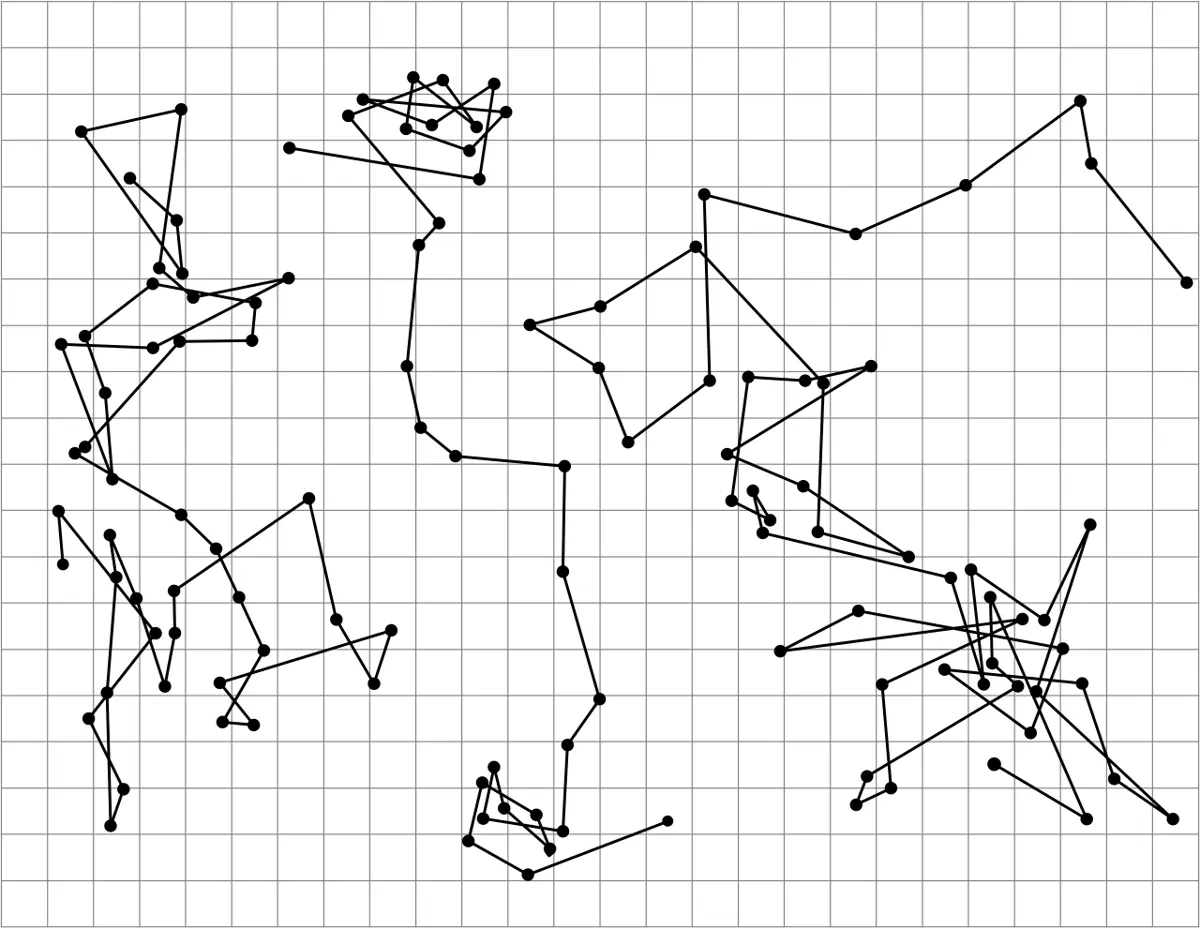
Ostwald was persuaded. In 1908, in the preface to a new edition of his chemistry textbook, he wrote that the jiggling grains, shown most conclusively by Perrin, together with J. J. Thomson’s counting of charged particles in gases, now allowed even the most cautious scientist to speak of experimental proof that matter is made of atoms.
Others had worked out the same number in quite different ways: from how gases flow, from the blue of the sky, from the glow of hot objects, from radioactivity. In his book Les Atomes (1913), Perrin set thirteen such measurements side by side, his own and other people’s. They gave almost the same answer. He wrote that the agreement aroused “our wonder”, and that it gave the real existence of molecules “a probability bordering on certainty”.
That is why you are right to believe in atoms though you have never seen one. Not because a teacher said so, though one did, but because the teacher is passing on something that many different people found in many different ways, people who would each have been delighted to prove the others wrong. Measurements of things as different as gases, sunlight in the sky, hot objects and radioactivity, all pointing to the same number, are something else entirely.
It’s also why Everest’s height can be trusted, more than most things people tell you. The Survey of India, working from 1952 to 1954, made it 29,028 feet, 8,847.73 meters, and the world rounded that to 8,848. A Chinese survey in 1975 made it 8,848.13. An American team using GPS in 1999 made it 8,850. Nepal and China, each climbing from its own side and then putting the work together, made it 8,848.86. Surveys decades apart, with different instruments, come within about two meters of each other on a mountain nearly nine kilometers high. Some of that difference may be the mountain itself, which may still be rising.

None of this means checking everything. It means checking a little where it counts, and otherwise leaning on people in proportion to how well they know and how many of them agree independently. That’s the Kalamas’ advice in modern dress: see for yourself where you can, ask the wise where you can’t, and notice when a teacher wants you to trust them on everything.
Most of what you will ever know will still be borrowed. That’s fine. What matters is knowing roughly what each borrowed belief is resting on, which starts with something simpler than it sounds: knowing exactly what has been claimed.
Found a mistake? Please tell us.