
Before he went to war, Croesus, king of Lydia, tested the gods. So says Herodotus, the Greek historian, writing about a century later. Croesus ruled from Sardis, in what is now western Turkey, and he was worried by the Persians, whose king Cyrus was growing stronger every year. He wanted the gods’ advice, but there were many oracles, places where a god was said to answer questions, and he wanted to know which of them could be trusted first. So he sent messengers to seven of them, with orders to count the days from the moment they left Sardis. On the hundredth day each was to ask the same question: what is Croesus, king of the Lydians, doing right now?
On that day Croesus did the strangest thing he could think of. He cut up a tortoise and a lamb and boiled them together in a bronze pot with a bronze lid. At Delphi, in Greece, the priestess of Apollo answered the messengers in verse. She said she could smell a hard-shelled tortoise boiling with a lamb’s flesh, with bronze beneath it and bronze on top. Herodotus says nobody recorded what most of the other oracles replied. Croesus decided that Delphi was a true oracle, and sent it a fortune in gold.
Then he asked what he really wanted to know: should he march against the Persians? The answer came back that if he did, he would destroy a great empire. Croesus was delighted. He marched, lost, and saw his capital taken and himself made a prisoner. He had indeed destroyed a great empire. It was his own.
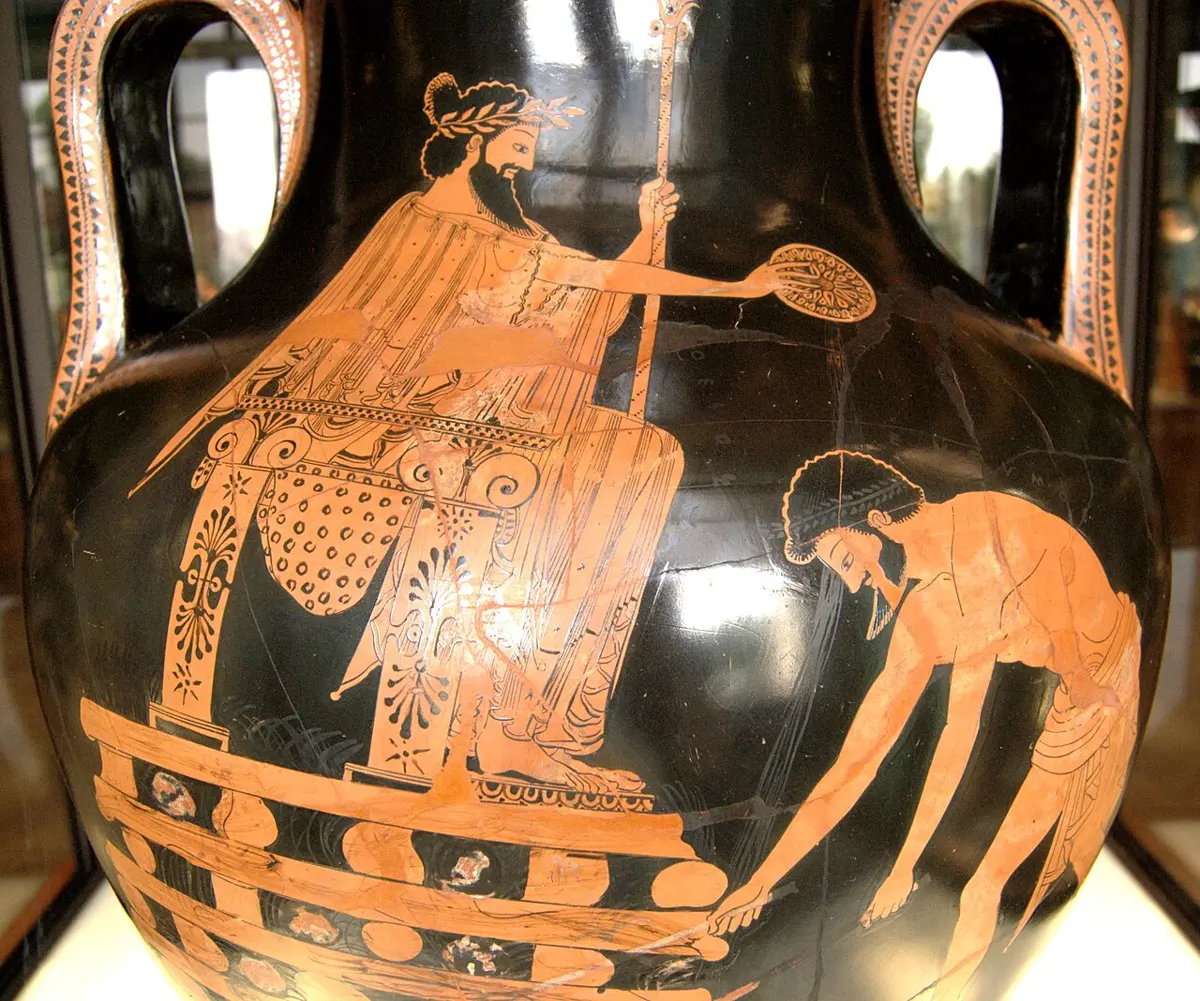
Herodotus tells what came next. Croesus sent his chains to Delphi and had his messengers ask whether the god wasn’t ashamed of himself. The priestess’s reply was that the god had told the truth. If Croesus had wanted good advice, he should have sent again and asked which empire was meant.
Croesus and the fall of Sardis are real history, but historians treat the story of the oracle as a legend, and nobody knows whether any oracle said any of it. But it has been retold for 2,500 years because the trick in it still works. Look at the two questions Croesus asked. The first had an answer that could be wrong: either he was boiling a tortoise or he wasn’t. The second had an answer that could hardly be wrong at all. Whichever side lost, a great empire would have fallen. Croesus checked the claim that didn’t matter and swallowed whole the one that did.
So before asking whether something is true, it pays to ask a duller question first. What exactly is being said, and what kind of claim is it?
Four kinds of claim
Most claims you meet are one of four kinds, and each kind is checked in its own way.
The first kind says how the world is, or was. Croesus boiled a tortoise. Water boils at a lower temperature in Lukla than in Biratnagar. A claim like this is a statement of fact, which doesn’t mean it’s true. It means it’s the kind of thing that is true or false whatever anyone wants, and you check it by looking, measuring, or finding a good record. Some facts are hard to check (nobody can visit Sardis 2,500 years ago), but the way to check them is clear.
The second kind is a prediction, a claim about what will happen. You check it by waiting, but only if it says what will happen and by when. “It will rain in Pokhara tomorrow” can be checked tomorrow. “Hard times are coming” can never be checked, because some hard times are always coming. A forecast that gives a chance, such as “70% chance of rain”, isn’t proved wrong by one dry day. It is judged over many days, by whether it rained on about seven in ten of the days it said 70%.
The third kind is a value: a claim about what is good or bad, right or wrong, beautiful, best. “Bhaktapur’s juju dhau is the best yogurt in Nepal.” “Every child should learn to swim.” No measurement settles a claim like this, because two people can agree on every fact and still disagree. That doesn’t make values a matter of whim. You test them with reasons: does this value fit with the others you hold, and what would follow if everyone acted on it? Facts feed in too. If swimming lessons really do cut drownings, that’s a fact, and it helps the case for lessons. But the “should” itself is never something you can weigh on a scale. A good deal of arguing goes wrong when one side treats a value as a fact (“everyone knows that’s the best”) or a fact as a value (“I just don’t believe in that number”).
The fourth kind is a definition, which says what a word will mean. A definition isn’t true or false the way a fact is. It’s a decision, and it is judged by whether it is clear and useful.
Pluto shows how much confusion a definition can cause. It was found in 1930 and was a planet for the next 76 years. Then, in August 2006, the International Astronomical Union, meeting in Prague, decided what a planet is. It must go round the Sun, it must be heavy enough for its own gravity to pull it nearly round, and it must have cleared the neighborhood around its orbit, sweeping its path free of other bodies. Pluto failed the third test and became a “dwarf planet”. Nothing happened to Pluto. Not a grain of it moved. Every fact about it stayed as it was, and only the word changed. That’s why the arguments since, about whether Pluto is “really” a planet, can’t be settled with a telescope. They are arguments about what a word should mean.
Sometimes a definition hides inside a number. For decades Nepal used 8,848 meters for the height of Everest, worked out by the Survey of India in 1954. In 2005 China announced 8,844.43 meters, the height of the rock. Nepal and China then disagreed over which height should count, the rock or the snow on top of it, and no measurement can settle that: it’s a question of where a mountain stops. In December 2020 their foreign ministers announced, at the same moment in Kathmandu and Beijing, one height measured by both countries together: 8,848.86 meters, to the top of the snow. The rock height was not announced.
Words that slide
Some words sound as if they say a lot and say very little. They’re popular with people selling things, because a buyer hears the strong meaning while the seller can always fall back on the weak one.
“Natural” is the best known. It sounds like “safe” or “good”, but it only says where something came from, and it often doesn’t say even that clearly. The United States’ Food and Drug Administration, which decides what may go on American food labels, has not fixed a formal definition. It goes by a loose rule of its own: nothing artificial or synthetic has been added that you wouldn’t normally expect in the food. Even a perfectly natural thing tells you nothing about what it does to you. The Nepali word बिख simply means poison, and in Nepal it is also the name of the aconite plants, which grow in the Himalaya. Doctors at the B.P. Koirala Institute of Health Sciences in Dharan have written about patients brought in after taking it, among them, in 2024, a village healer who sometimes made remedies from local aconite. He drank a homemade herbal preparation and died within twelve hours of reaching the hospital. Healers have used aconite roots for centuries, treated first to break down their poisons, because aconite is among the most poisonous plants known.
“Chemical-free” goes one better, because it can’t be true of anything. Water is a chemical. So are the air, a mango, and you. In 2008 an “organic” fertilizer was sold in Britain as “100% chemical free”, and the country’s advertising watchdog defended an advert that suggested natural things are free of chemicals. The Royal Society of Chemistry, Britain’s society of chemists, answered by offering £1 million to the first member of the public who could bring it a material that was truly free of chemicals. “Should anyone do this,” one of its directors said, “we will see thousands of years’ worth of knowledge evaporate before our eyes.” The fertilizer’s own packet listed its ingredients, among them phosphorus pentoxide and potassium oxide. What a seller usually means by “chemical-free” is something narrower, such as “no factory-made pesticides added”. That narrower claim can be checked, and a good habit is to rewrite a slippery claim into the plain one it’s hiding, then ask about that.
“Up to” is a ceiling, not a promise. A Dashain sale with “up to 70% off” is honest if a single item somewhere in the shop is 70% off. The words tell you about the best case and nothing about the usual one. The trouble is that readers don’t hear them. In 2012 the United States’ Federal Trade Commission, which polices advertising there, tested an advertisement for replacement windows that said, in big capital letters, “PROVEN TO SAVE UP TO 47% ON YOUR HEATING AND COOLING BILLS!” Researchers stopped 360 people in shopping malls in five cities and showed each person one of three versions of the advert, chosen at random. Asked what it said, between about a third and nearly half of those who saw the “up to” version said simply that the windows saved 47%, and almost half thought that half or more of buyers would save about that much. A second version left out the words “up to” altogether, and people took away much the same thing: the two words made no clear difference in readers’ minds. Even a third version, with a box saying the average owner saves about 25%, didn’t clearly change the result. In its orders that year against five window sellers, the Commission required that a seller who says “up to” be able to show that all or almost all customers can reach the top figure.
“Linked to” sounds like a finding and is really a shrug. It can mean that two things are often found together, or that one causes the other, and the reader rarely knows which. Researchers at Cardiff University ranked the ways a claim about, say, wine and cancer can be worded, from the most cautious to the boldest: drinking wine “is associated with” cancer, is “linked to” cancer risk, “might increase” it, “can increase” it, “increases” it. They put “linked to” in the middle as the ambiguous one. Then they read the press releases British universities had sent out about health research. Of those describing studies that had only found two things together, a third claimed more cause than the study had shown. When a press release did that, about four in five of the news stories based on it did too. When it didn’t, fewer than one in five did. Two things being found together is a different claim from one causing the other, and “linked to” lets a writer say the first while readers hear the second.
One word, two meanings
Slippery words are a problem on their own. A bigger one comes when a word changes meaning in the middle of an argument. A sign says “Fine for parking here”, so parking here must be fine. That’s a joke, but it’s the same move, called equivocation, that turns up in serious arguments where it is harder to spot.
“Theory” is the famous case. In everyday talk a theory is a guess: “my theory is that the bus is late because of a strike.” In science it means almost the opposite: a theory is a thorough explanation of some part of nature, backed by a large body of evidence. The theory that the Earth goes round the Sun is a theory in that sense. So when someone says that an idea in science is “only a theory”, they are using the word in its everyday sense to talk about something that only has the scientific sense. Each half of the sentence sounds fine, and the argument is made of the gap between them.
The opposite mistake is treating two different things as if they were one, which is called conflation. In October 2015 the World Health Organization’s cancer agency, the International Agency for Research on Cancer, put processed meat, such as ham, sausages and bacon, in its Group 1, “carcinogenic to humans”. Tobacco smoking and asbestos are in Group 1 too. Headlines put bacon beside cigarettes. One British newspaper ran “Processed meats pose same cancer risk as smoking and asbestos, reports say”. A story reprinted in New Zealand told readers to avoid bacon and sausages because “they’re as bad as cigarettes”.
But the agency’s groups measure one thing, and the headlines read them as another. A group says how sure the experts are that something can cause cancer at all. It says nothing about how much cancer it causes. Its own question-and-answer sheet said so in capital letters: being in the same group “does NOT mean that they are all equally dangerous.” The experts were very sure that processed meat can cause cancer, and its harm is still much smaller than smoking’s. “How sure” and “how much” are two questions, and running them together turned a careful finding into a scary false one.
Too vague to be wrong
Back to Croesus, and the answer that ruined him. What would have shown the oracle wrong? Only a war that neither side lost. Almost anything that could happen would fit the words. Later Greeks even explained one of Apollo’s names, Loxias, as the god “who sends out an oblique voice”, the god who speaks at an angle. An encyclopedia compiled in the Byzantine Empire, more than a thousand years later, gives the warning to Croesus as its example. Whatever the name first meant, that explanation shows what people thought of the oracle’s answers.
A claim like that feels strong because the listener does the work. You hear “a great empire will fall” and fill in the empire you were hoping for. The same is true of “a change is coming into your life” and “someone close to you is hiding something”. Each will come true for nearly everyone, which is exactly why it tells nobody anything. The more outcomes a claim allows, the less it says.
A claim earns attention by taking a risk: by saying something that the world could show to be wrong. “The windows will save you money” is hard to catch out. “Nine in ten buyers will save at least 40% on their bills in the first year” could be wrong, and so, if it turns out right, it actually tells you something. So when a claim sounds impressive, a useful question is: what would the world look like if this were false? If the answer is “just the same”, the claim hasn’t said anything yet.
None of these checks needs special knowledge. They need only the patience to ask what a sentence says before deciding whether to believe it. It’s the advice the priestess gave Croesus too late, and the cheapest test in this book: ask again. Which empire? Natural in what way? Up to how much, for how many? Linked how? Once it’s clear what’s being claimed, there’s a second question, which is what is holding it up.
Found a mistake? Please tell us.