
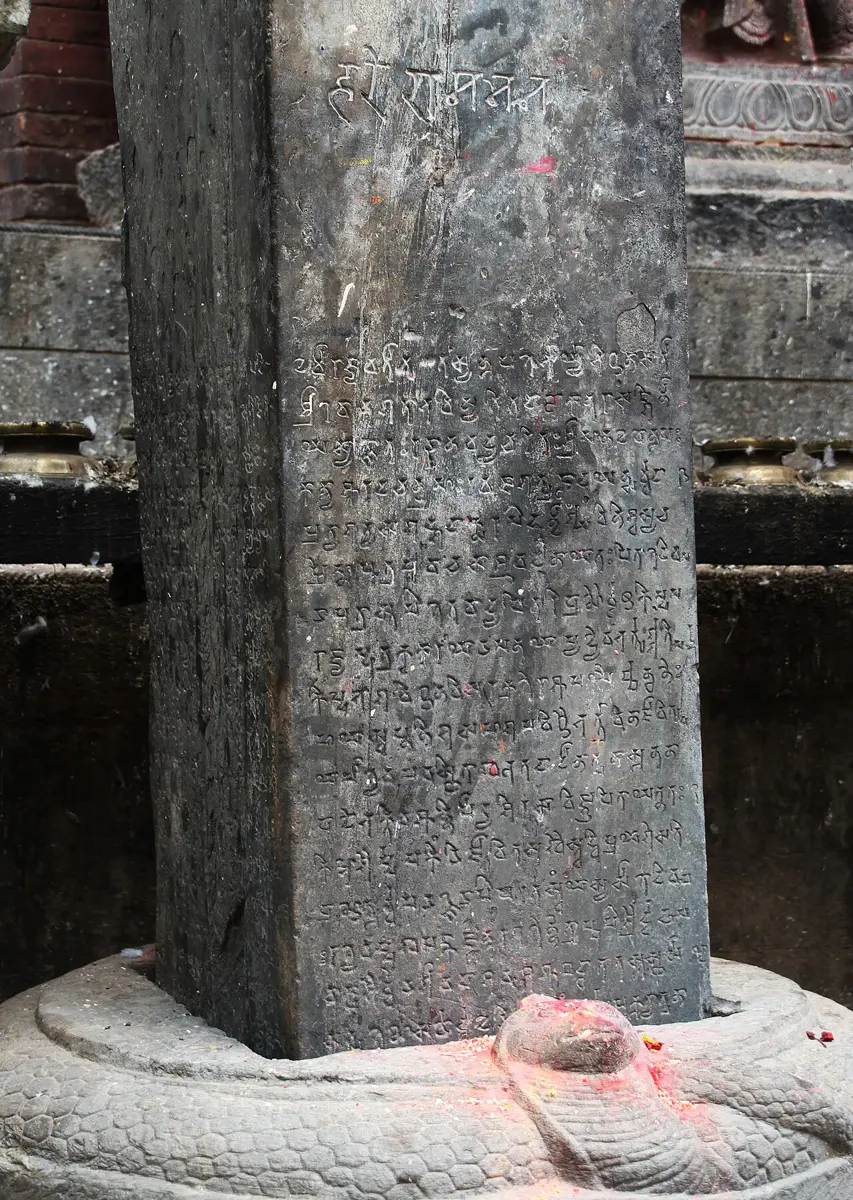
On a hill north of Bhaktapur, beside the door of the temple of Changu Narayan, a gray stone pillar about six meters tall stands on a stone snake. Its lower part is covered in small, worn letters. A class that visits the science center can go and stand in front of it, and the words on it can be read. Not guessed at, not taken on trust from a guidebook: read, with the tools of this book, the way the people who cut them meant them to be read.
They are Sanskrit, and they are among the oldest dated words in Nepal. The king who had them cut, मानदेव, ruled the Kathmandu Valley about fifteen hundred years ago, and the story of the pillar, what it tells of his family and what it says about Nepal’s early history, is told in Nepal’s History. This chapter does something else with it. It reads the Sanskrit.
The letters are in the Gupta script, an old form of Indian writing, so a reader of Nepali sees shapes that are almost familiar and not quite. They run in lines across three faces of the shaft, 26 lines on the first, 24 on the second and 28 on the third. Most of it is verse, every verse in the शार्दूलविक्रीडित (śārdūlavikrīḍita), the tiger’s play of nineteen syllables a quarter. Only the first two lines are prose, and they are a date.
A date a पात्रो reader can follow
संवत् ३८६ ज्यैष्ठमासे शुक्लपक्षे प्रतिपदि १
रोहिणीनक्षत्रयुक्ते चन्द्रमसि मुहूर्ते प्रशस्तेऽभिजिति
Anyone who has looked up a festival in a Nepali पात्रो, the yearly almanac, knows nearly every word here. संवत् is the year, as in विक्रम संवत्. ज्यैष्ठ is the month that Nepali calls जेठ. शुक्लपक्ष is the bright half of the month, when the moon is growing, and प्रतिपदि is its first day, प्रतिपदा, which the stone also writes as the number 1. रोहिणी is one of the twenty-seven नक्षत्र, the groups of stars the moon passes through in a month, and the line says the moon was among them. मुहूर्त is an hour of the day as the almanacs count it, and अभिजित् is the one that falls around noon. A पात्रो still gives all of these for every day of the year; How to read a पात्रो goes through them.
So the stone dates itself the way a wedding card in Bhaktapur might: the year, the month, the half, the day, the star, the hour. And it does it with a few endings from this book. ज्यैष्ठमासे, शुक्लपक्षे, मुहूर्ते are all in the in-case, the -ए of “in” or “at”: in the month of जेठ, in the bright half, at the hour. The middle of the second line is the pair of words that stands for a whole “when” clause, both in the in-case: रोहिणीनक्षत्रयुक्ते चन्द्रमसि, “the moon being joined to रोहिणी”, which is to say, when the moon was in रोहिणी. प्रशस्तेऽभिजिति is one more sandhi of the kind that turns ए अ into ए ऽ: प्रशस्ते अभिजिति, at the good hour, Abhijit.
The year, 386, is written on the stone with three signs, one for 300, one for 80 and one for 6, since the people who cut it had no zero; that older way of writing numbers is the story of Where Did Our Zero Come From? Which year 386 is depends on where the count starts. Most historians now take it to be the Shaka era, which makes it 464 CE, but the count is not written on the stone, and scholars have argued for other starting points, which put it anywhere from more than a century earlier to more than two centuries later.
A son and his mother
The verses begin with the god of the temple, विष्णु (Viṣṇu), called हरि (Hari) here, and then name the kings of the family, one after another: a great-grandfather, a grandfather, and the king’s father, धर्मदेव (Dharmadeva). Then the father dies. The stone says it gently: he went to heaven as if he were going out to a garden. His widow, the queen राज्यवती (Rājyavatī), turns to her son, weeping, and tells him to rule the kingdom; she will follow her husband today, on the path he has gone.
What she means, as every reader of the stone has taken it, is that she will die with him. The son, the new king, presses his head to her feet and begs her:
किं भोगैर्मम किं हि जीवितसुखैस्त्वद्विप्रयोगे सति
प्राणान् पूर्वमहं जहामि परतस्त्वं यास्यसीतो दिवम्॥
What are pleasures to me, what are the joys of life, if I lose you? I will give up my own life first, and only then will you go from here to heaven.
And she stays. The rest of the verse says she was held “by the nooses of his words, like a bird in a snare”. She does the rites for her husband with her son, gives wealth to the Brahmins to add to her husband’s merit, and lives on. The stone tells this as a son’s plea that worked. It says nothing about how often widows died that way in the Licchavi Valley, and nobody can tell from it.
The son’s line is two quarters of a शार्दूलविक्रीडित, and nearly every word in it is something already taken apart in this book. किम्, “what?”, is the question word, used here as “what use?”. भोगैः and जीवितसुखैः are in the by-case, “with pleasures”, “with the joys of living”, the way Sanskrit asks what use a thing is: what is done with pleasures? मम is “of me” or “to me”. Then comes the pair again, this time with सति, “being”, the plainest way of making it: त्वद्विप्रयोगे सति, “parting from you being”, which is to say, if I am parted from you. Sanskrit’s grammarians named this pattern सतिसप्तमी after that very word.
In the second line the verbs have persons. जहामि is “I give up”, from हा, to leave; यास्यसि is “you will go”, a future with its -स्य-. पूर्वम् and परतः, first and after, set the order: me first, then you. The line is a threat made out of love, and it works because of the order of two verbs.
Having won the town
The rest of the pillar follows the son. He is described in the style of court poetry: arms like an elephant’s trunk, eyes like lotus petals, a skin like polished gold. One detail is warmer and more ordinary. He smiles when he speaks, and he is always the first to greet people, स्मितकथः पूर्वाभिभाषी.
He tells his mother he will march east, and she gives him leave. In the east the disloyal lords bow so low that the garlands fall from their heads. Then he goes west. He hears that the lord there is behaving badly, shakes his head, slowly touches his arm, and says that if the man does not come when called, he will be brought by force. Then he speaks to his mother’s brother, his dear uncle: today, cross the Gandaki, wide and wild as the sea, and I will follow your army, तीर्त्वा नदीम्, having crossed the river, with hundreds of horses and elephants.
That -त्वा is the ending that Nepali says with -एर, “having done”, the one that strings actions together. The west face is full of them. श्रुत्वा, having heard, and स्पृष्ट्वा, having touched, are in the verse about the lord who behaved badly. Where the verb has a prefix the ending is -य instead, and the pillar has those too: प्रत्यागत्य, having come back (the queen, to her son), निपीड्य, having pressed (his head to her feet), प्रणम्य, having bowed, संस्थाप्य, having set up. And then the last verse opens with the plainest of all:
जित्वा मल्लपुरीं ततस्तु शनकैरभ्याजगाम स्वकं
देशं प्रीतमनास्तदा खलु धनं प्रादाद्द्विजेभ्योऽक्षयम्
Having won मल्लपुरी (Mallapurī), the town of the Mallas, he came back to his own country stage by stage, and then, glad at heart, he gave the Brahmins wealth that would never run out.
जित्वा is जि, to win, the root of Nepali जित and विजय, with -त्वा: having won. Where मल्लपुरी was, nobody now knows for certain; the verse before puts it beyond the Gandaki, to the west. अभ्याजगाम, came back, is a perfect, the past made by doubling the root (गम् becomes जगाम), with two prefixes in front. प्रादात्, he gave, is an old past with the अ- in front, from दा. And अक्षयम्, that never runs out, is the word the old books use for the merit of a gift. One old पुराण (Purāṇa) says that what is given at the hour अभिजित् is अक्षय, and that may be why the first line takes care to name the hour.
The very end of the third face is the king speaking to his mother once more, kindly and firmly: with a glad heart, mother, you too give this as a gift. It does not say what “this” is. The most likely answer, scholars think, is the pillar itself, a gift to the god of the temple, with the story of the family carved on it.
What the stone has lost, and what the books kept
A stone fifteen hundred years old in the open air does not keep every letter. Many lines on the first face are worn, with gaps of a whole word or more; the रो of रोहिणी in the date line is gone, and every edition puts it back. The people who cut the letters also spelled in the habit of their time: they doubled a consonant after र, writing मुहूर्त्ते and भोगैर्म्मम, and never wrote ऽ. The lines above are in the usual spelling, and where every edition puts back a worn letter, it is printed here without a mark.
The bottom of the pillar had a harder time. When it was first copied for scholars, the lower part of the shaft was in the ground, and the temple’s priest would not let anyone dig there, so the first printed edition stopped after 17, 17 and 20 lines. A later scholar, the Frenchman Sylvain Lévi, wanted the rest. He was kept out of the temple himself, but the Maharaja, Bir Shumsher, overcame the priest’s refusals and threats, and Gurkha soldiers whom Lévi had trained dug out the base without harming it and took rubbings, sheets of paper pressed onto the letters. Lévi read the lines from those. So the line about मल्लपुरी was first read from paper pressed on a stone that had been under the earth.
Every reading of the pillar since is someone’s reading. The text in this chapter is the one published by the Italian scholar Raniero Gnoli, checked line by line against the two older editions, and on the lines quoted here the three agree.
Stones are only a small part of Nepal’s Sanskrit. Far more of it is in manuscripts, books written by hand on palm leaf or paper, kept in temples, monasteries, libraries and family homes for centuries, because the Valley was a safe place for them and its weather is kind to them. Over three decades a project run by Nepal and Germany photographed about 180,000 manuscripts, in Sanskrit and in other languages, onto microfilm, now kept at the National Archives in Kathmandu. Among them is the oldest known manuscript of a Vedic text, and a स्कन्दपुराण (Skandapurāṇa) that may be the oldest dated manuscript from Nepal, copied about twelve hundred years ago. Nepal also kept a manuscript of the surgeon’s book from Chapter 28, the सुश्रुतसंहिता, copied a few decades later. The microfilm matters because the leaves don’t last forever. Insects and rats have eaten some of them since they were filmed, and a fire at the monastery of Tengboche, in Khumbu, burned its whole library, 185 Tibetan texts that had been photographed only a few months before.
And the language is still in public view. Nepal’s motto, on the red ribbon of the national emblem, is the Sanskrit line about mother and motherland. Nepal Rastra Bank’s seal carries a line from an Upanishad, and the Academy of Science and Technology’s a line from the ऋग्वेद, both read in Chapter 4.
So the pillar at Changu Narayan is a date that any पात्रो reader can follow, a son begging his mother to live, and a king who, having won a town, came home. All of it is written with the same endings and the same metre taken apart one by one in these chapters. The in-case and the सति pair make the date and the plea; -त्वा and -य carry the king west across the Gandaki and back. What the stone has lost, the editions put back and say so; what the stones never held, Nepal’s manuscripts kept, and a camera kept again.
Found a mistake? Please tell us.