
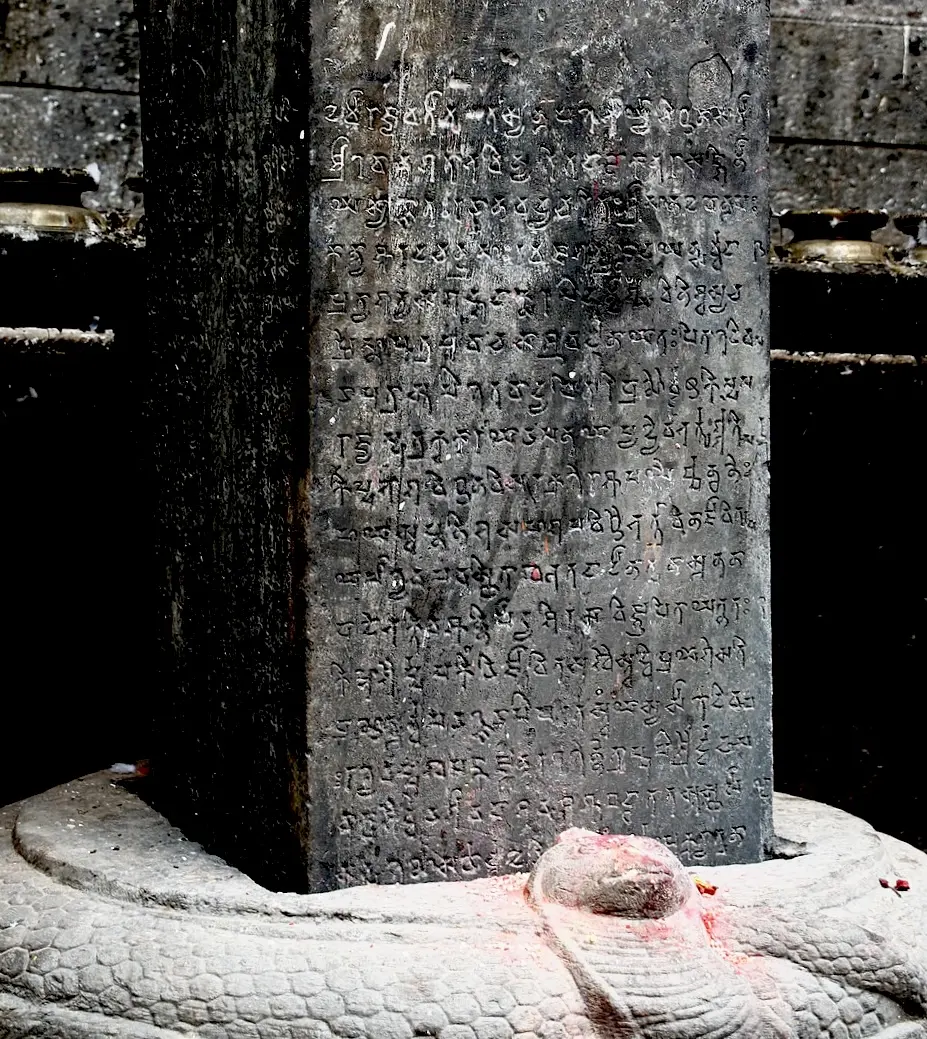
In the courtyard of Changu Narayan, on its hill above Bhaktapur, stands a stone pillar covered in old letters. It is one of the oldest inscriptions in Nepal, cut for King Mandeva in the year 386 of the era then used, which historians put at AD 464. The year is written with just three signs: one that means 300, one that means 80 and one that means 6. There is no zero anywhere on the stone, and the stonecutter didn’t need one.
Our way of writing numbers works differently. It uses only ten signs, 0 to 9, and the place of each sign tells you what it is worth. Picture a trader long ago, counting on a board of four columns with pebbles: thousands, hundreds, tens, ones. She knows the nine signs 1 to 9 but has never heard of zero. She writes each column’s count from left to right, and if a column is empty, she writes nothing for it. In her notebook she has written 35.
Before you hunt: how many different boards of four columns could the trader’s “35” have come from?
Pick an answer to see why.
Try it
More columns, more confusion
Six boards for a two-digit note is bad enough. What happens with bigger boards?
A computer counted the boards for every size:
| Columns on the board | 2 | 3 | 4 | 5 | 6 | 7 |
|---|---|---|---|---|---|---|
| Boards that write “35” with no zero | 1 | 3 | 6 | 10 | 15 | 21 |
These are the handshake numbers from How Many Handshakes at a Party of 30?: with 7 columns, picking 2 of them for the 3 and the 5 is like picking 2 people out of 7 to shake hands, 21 ways.
How many boards of four columns write as “7” with no zero?
Pick an answer to see why.
Mandeva’s way
The Changu Narayan stone never had this problem. It didn’t use place at all: it had a different sign for each digit in each place, signs for 1 to 9, other signs for 10, 20 … 90, and others again for 100, 200 and so on. So 386 is three signs, 300, 80 and 6, and 107 is just two, 100 and 7, with nothing for the empty tens. Each sign carries its own value: the sign for 300 means 300 wherever it stands. The old stones show signs up to 600 and one for 1,000; nobody has found the Licchavi signs for 700, 800, 900 or 2,000, so when we use them below, we imagine them made the same way.
So there are two ways out of the trader’s trouble. Mandeva’s way: a separate sign for every value in every place, and no need for zero, but more and more signs to learn as numbers grow, and sums that are harder to set out in columns. Or the trader’s way, place value, with just one new sign added: a sign that means this column is empty.
How often would the trader be caught? Of the numbers from 1 to 999, 180 have a 0 somewhere in them (10, 101, 990…). From 1 to 9,999 it is 2,619, more than a quarter. Without a zero, every one of them could be misread.
What’s going on
Place value
On the counting board, a pebble in the tens column is worth ten pebbles in the ones column, and a pebble in the hundreds column is worth ten in the tens. In writing, a digit is worth more or less by where it stands: in 305 the 3 means 3 hundreds, but in 35 it means 3 tens. This is place value, from Grade 6, and ten is our base: each place is worth ten times the place to its right.
The 0 adds nothing to the sum, but it isn’t useless: it holds the tens column open, so the 3 stays in the hundreds. A sign used this way is called a placeholder. With nine digits and one placeholder, ten signs in all, you can write any whole number, however big, and nobody can misread it.
Clay tablets and the empty gap
The first people known to write numbers by place lived in Mesopotamia (today’s Iraq), on clay tablets that survive from about 1700 BC. Their base was 60, not 10. A scribe pressed a reed into wet clay to make wedges: an upright wedge for 1 and a corner-shaped wedge for 10, so each place held anything from 1 to 59. One upright wedge in the next place meant 60, in the place after that 60 × 60 = 3,600.
For over a thousand years, scribes left a gap for an empty place and trusted the reader to work it out. Then, by about 300 BC, they began marking the empty place with a sign of two slanted wedges. One tablet from Kish, dated as early as 700 BC, uses three hooks instead. But they put the sign only between digits, never at the end. A single wedge could still mean 1 or 60, and only the problem around it told you which.
Zero becomes a number
A placeholder only says “empty column”. It is another step to treat zero as a number of its own, one you can add, subtract and multiply like 5 or 12. The first book known to give the rules for that was written in 628 by Brahmagupta, an astronomer from Bhillamala (now Bhinmal in Rajasthan), when he was about 30. In Colebrooke’s 1817 translation, which calls zero “cipher” or “nought”, his rules include:
The sum of cipher and negative is negative; of affirmative and nought is positive; of two ciphers is cipher.
The product of cipher and negative, or of cipher and affirmative, is nought; of two ciphers, is cipher.
In today’s words: adding 0 changes nothing (5 + 0 = 5), and anything times 0 is 0. And a number take away itself is 0: as soon as you can ask “what is 7 − 7?”, you need zero as an answer.
Which of these is not one of the rules for zero as a number?
Pick an answer to see why.
Can you divide by zero?
Brahmagupta also tried to divide by zero, and here even the great mathematicians stumbled. Division asks how many times one number fits into another: 12 ÷ 3 asks how many 3s you can take away from 12. Try it.
With groups of 0, the pile of 12 never gets smaller. You can press for ever and never finish, so 12 ÷ 0 has no answer. You can check it with multiplication too: 12 ÷ 3 = 4 because 4 × 3 = 12. So 12 ÷ 0 would be a number that gives 12 when multiplied by 0. But every number times 0 is 0, so there is no such number.
0 ÷ 0 goes wrong the other way: it would be a number that gives 0 when multiplied by 0. Every number does, so 0 ÷ 0 could be 1, 7 or a million. A question with no answer, or with every answer, is no use. So mathematicians today say division by zero is undefined: it has no meaning, and you may not do it.
Brahmagupta said that 0 ÷ 0 is 0, which is wrong, and that a number divided by zero is a fraction with zero below the line, without saying what that fraction is worth. About 500 years later Bhaskara, in the Lilavati (1150), gave the same rule, and his other book, on algebra, calls such a fraction an “infinite quantity”. That is a good guess at what happens when you divide by a smaller and smaller number (12 ÷ 0.1 = 120, 12 ÷ 0.001 = 12,000), but it isn’t a number you can calculate with.
Counting with no zero at all
Here is a twist. The trader’s trouble was that a column could be empty. What if no place were ever empty? Use the digits 1 to 9 and a tenth digit, X, worth ten. Count: 1, 2 … 9, X. Then 11, 12 … 19, 1X (one ten and ten ones, which is 20), 21… Every column always holds 1 to 10, never 0.
It works: 100 is 9X, nine tens and ten ones. 101 is X1, ten tens and one. 110 is XX, and only then does a third digit appear, at 111. A computer checked every number from 1 to 100,000: each has exactly one way to be written, with no zero and nothing to misread. Mathematicians call this bijective numeration. It was described in 1947 and has been rediscovered many times.
In zeroless counting, what is 30?
Pick an answer to see why.
So zero isn’t needed to write numbers by place! You have seen this counting before: a spreadsheet names its columns A, B … Z, then AA, AB… That is zeroless counting in base 26, with A worth 1 and Z worth 26: column AA is 1 × 26 + 1 = 27, and ZZ is 26 × 26 + 26 = 702.
Why, then, did the world keep zero? Because zero is a number too, the answer to 7 − 7, and once you have it as a number you might as well use it as the placeholder. With 0 in the system, the place values are plain (each place is worth ten times the last, starting from nothing), and the column sums you learned in primary school work the same in every column.
Other bases need zero too
In Grade 8 you write numbers in base 5 and base 2. Each needs a zero, for the same reason as ours: 25 in base 5 is 100₅ (one 25, no fives, no ones), and 8 in base 2 is 1000₂. In base 2 the only digits are 0 and 1, and that is the language of every computer: a 0 or a 1 is one bit.
Where our zero came from
Zero as a placeholder was invented at least twice, far apart: in Mesopotamia, and in Central America, where the Long Count calendar, used by the Maya and by older peoples before them, wrote dates by place in twenties and needed a zero; the Maya often drew it as a shell. The oldest Long Count date known is from 36 BC. The zero we use today came from South Asia, and its oldest records sit on stones and birch bark.
| When | Where | What survives |
|---|---|---|
| About the 3rd or 2nd century BC | India | Pingala’s book on the rhythms of poetry uses the word śūnya (शून्य), “empty” |
| 458 | India | a Jain text, the Lokavibhaga, which gives its own date, writes numbers by place with zero (the copy that survives was made centuries later) |
| About 500 | India | Aryabhata writes numbers by place, without a zero sign; his word kha, “space”, later becomes a name for zero |
| 628 | Bhillamala, Rajasthan | Brahmagupta’s rules for zero as a number |
| 683 | Sambor, Cambodia | a stone gives its year, 605 of the Shaka era, with a zero in it |
| 683–686 | Sumatra, Indonesia | three stones of the Srivijaya kingdom, dated 605, 606 and 608 of the same era: with Sambor’s, the oldest zero digits whose date is sure |
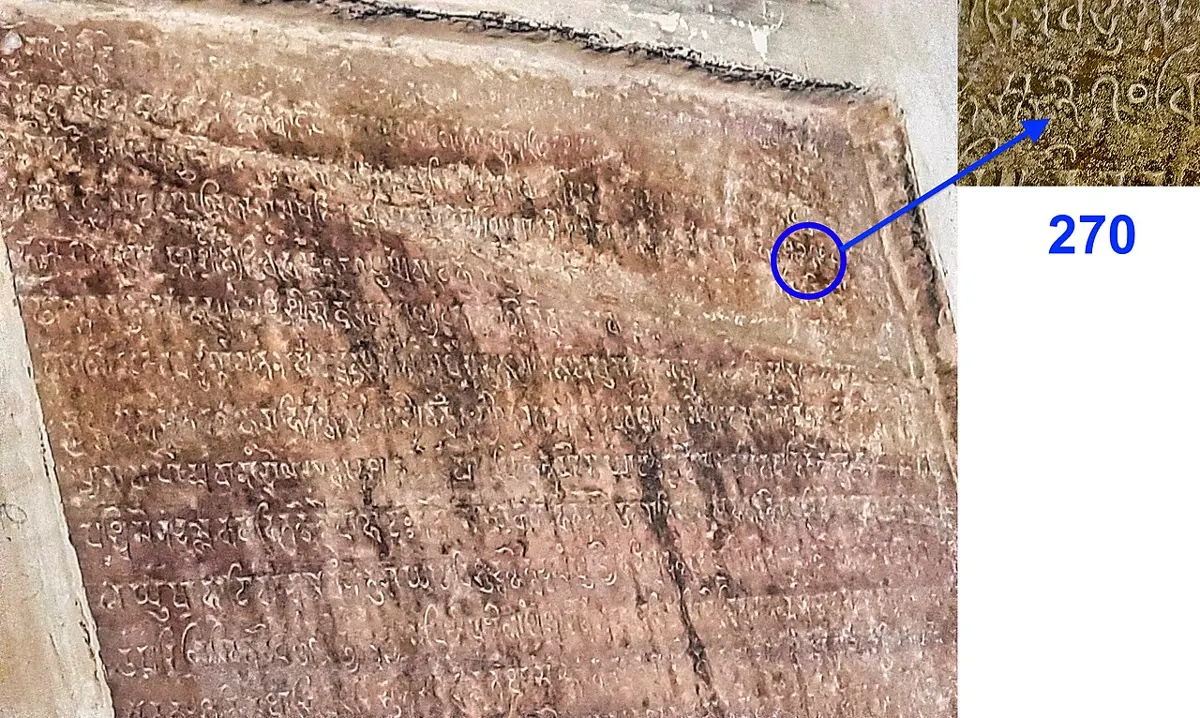
| 876 | Gwalior, Madhya Pradesh | a temple inscription with the numbers 270 and 50, each ending in a small circle |
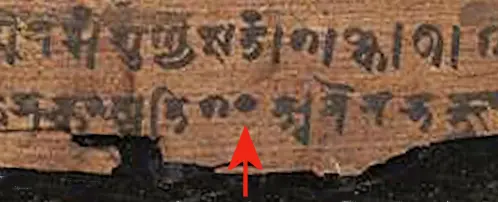
| 799–1102 | Bakhshali, now in Pakistan | a birch-bark book of arithmetic that writes zero as a dot |
The Bakhshali manuscript has a story of its own. A farmer dug it up in 1881, in a field near Mardan: 70 leaves of birch bark, full of arithmetic in Sanskrit, with a dot for zero. In 2017 Oxford’s Bodleian Library, which keeps it, announced radiocarbon dates for three leaves from three different centuries, the oldest AD 224–383, which would have made it the oldest written example of our zero. Historians of Indian mathematics criticized how the dates were made and announced, and in 2024, after a second round of tests, Oxford revised the dates to AD 799–1102. The birch bark may itself be a copy of an older book: scholars have guessed dates for that original from the 3rd century to the 7th, and they still disagree.
From India the numerals traveled west. Under Caliph al-Mansur (754–775), al-Fazari translated Brahmagupta’s texts into Arabic. In the early 800s, al-Khwarizmi, a scholar at the House of Wisdom in Baghdad, wrote a book on the Indian way of reckoning, with zero. His Arabic original is lost; its Latin translation, Algoritmi de numero Indorum (“Al-Khwarizmi on the numbers of the Indians”), gave us the word algorithm. In China, counting rods had left an empty space for zero; the round 〇 appears in a book by Qin Jiushao in 1247.
Where this is used
Questions
Write these numbers Mandeva’s way, as the values of their signs (imagine a sign for 2,000 made like the others), and count the signs: 2083 (a year of the Bikram Sambat), 560, 9.
Answer
Which of these is true for every number?
Pick an answer to see why.
The trader’s notebook says “4” on one line and “47” on the next. On her board of four columns, what is the biggest difference there could be between the two numbers? And the smallest?
Hint
Answer
In zeroless counting with X for ten, write 20, 99, 100, 200 and 1000. Then turn X5 and 1XX into our numbers.
Answer
A spreadsheet’s columns run A, B … Z, AA, AB … Which column is number 52? And what is the number of column CV?
Answer
A temple was built in 25 BC and repaired in AD 25. How many years apart were the two events? Be careful.
Answer
Using Bhaskara’s rule (multiplying by zero and dividing by zero cancel), solve: a number, multiplied by zero, with a third of itself added, multiplied by 6, then divided by zero, gives 48. Then say what today’s rules make of it.
Answer
How many whole numbers from 1 to 999 have no 0 among their digits? Use it to check that 180 of them have a 0.
Hint
Answer
Write 25 and 30 in base 5, and 10 in base 2. Then explain why base 2 could never do without its 0 in the way zeroless counting does without ours, unless it gets a new digit.
Answer
Where to go next
- How Does an Abacus Think? The beads of a soroban are place value you can hold, with an empty rod for zero.
- How Did People Multiply Before Calculators? Doubling, halving and lattices, which all lean on place value.
- Can You Solve the Puzzles of the Lilavati? More of Bhaskara’s puzzles in verse.
- How Long Is a Crore Seconds? Lakhs and crores: what a few more zeros really mean.
- What Is the Biggest Number Anyone Has Used? (Grades 9–12) When even place value takes too many digits.
- Did Poets in Ancient India Count in Binary? (Computing, Going Further) Pingala’s counting of long and short syllables. (Coming soon.)
- How Does the Mind-Reading Card Trick Work? (Computing, Going Further) Place value in base 2, as a card trick.
Where these facts come from
- Mandeva’s Changu Narayan pillar as Nepal’s first written record, year 386, written with three signs for 300, 80 and 6; Mandeva c. 464–505; the Maligaun record of year 107 with two signs; Licchavi numerals with no zero, a different sign for each digit in each place (“base ten, non-positional”), and the concept of emptiness: Eka Ratna Acharya, “Lichhavi Numeral Systems in Nepal”, J. of Ramanujan Society of Math. and Math. Sc. 6(2), 2017, pp. 69–80, read October 2026.
- The Babylonian placeholder (tablets from about 1700 BC, a space for over 1,000 years, three hooks at Kish about 700 BC, two wedges later, never at the end of a number), the Maya’s zero by 665, Aryabhata’s kha, the Gwalior inscription (187 by 270 hastas, 50 garlands), Brahmagupta’s 0 ÷ 0 = 0, Bhaskara’s “infinite quantity”, al-Khwarizmi, Qin Jiushao’s O in 1247, Fibonacci’s 0 as a “sign”: J. J. O’Connor and E. F. Robertson, “A history of Zero”, MacTutor, read October 2026.
- Base 60, its two symbols, 1 and 60 written alike, the lack of a zero, Theon’s suggestion for the choice of 60 and the doubts about it: O’Connor and Robertson, “Babylonian numerals”, MacTutor, read October 2026.
- The etymology (śūnya, ṣifr, zefiro, zevero, English zero from 1598), tablets by 300 BC, Pingala’s śūnya, the Lokavibhaga (a medieval copy), the Sambor inscription’s 605 (AD 683), the Bakhshali dot, Chinese counting rods and Qin Jiushao, al-Khwarizmi’s Algoritmi de numero Indorum, Indian–Arabic numerals predominant in Europe by the 16th century: Wikipedia, “0”, read October 2026.
- The Sambor stone found in 1891 near the Mekong and read by Cœdès in 1931, and the three Sumatran stones dated 605, 606 and 608 Shaka (683, 684 and 686) of Srivijaya: F. Swetz and Shaharir bin Mohamad Zain, “The Elusive Origin of Zero”, Scientific American, 28 July 2022, read October 2026.
- The Gwalior temple, its date (Samvat 933, AD 876), garden and garlands: Wikipedia, “Chaturbhuj Temple, Gwalior”, read October 2026.
- The Bakhshali manuscript (found 1881 near Mardan, 70 leaves of birch bark, Sanskrit, the dot, the Bodleian’s 2017 dates and their critics, the revision to 799–1102 in 2024, earlier scholars’ dates for the text from the 3rd to the 7th century): Wikipedia, “Bakhshali manuscript”, read October 2026.
- Brahmagupta (born about 598 in Bhillamala, the Brahmasphutasiddhanta of 628 at about 30, al-Fazari’s translation under al-Mansur): Wikipedia, “Brahmagupta”, read October 2026.
- Brahmagupta’s rules for cipher (chapter XVIII, §§ 31–36), Bhaskara’s rules and the puzzle with 63 (Lilavati §§ 45–46, answer 14, “of frequent use in astronomical calculation”; Ranganatha’s note that cipher is “in the utmost degree small”), Brahmagupta’s “fraction with that for denominator”, a quantity divided by cipher “termed an infinite quantity” (Vija-ganita § 15), and śūnya and kha as words for “vacuum or etherial space” and so for zero (the note to Lilavati § 45): H. T. Colebrooke, Algebra, with Arithmetic and Mensuration, from the Sanscrit of Brahmegupta and Bháscara (London, 1817), public domain, Internet Archive, read October 2026.
- Al-Khwarizmi at the House of Wisdom, the lost Arabic original, the Latin title and the word algorithm: O’Connor and Robertson, “Abu Ja’far Muhammad ibn Musa Al-Khwarizmi”, MacTutor, read October 2026.
- Fibonacci in Bugia, “the Indians’ nine symbols”, Liber abaci of 1202: O’Connor and Robertson, “Leonardo Pisano Fibonacci”, MacTutor, read October 2026. The Latin sentence Cum his itaque novem figuris, et cum hoc signo 0, quod arabice zephirum appellatur, scribitur quilibet numerus and the list of the nine figures: Wiktionary, “zephirum” and the edition quoted in the search results for it (Boncompagni, 1857), read October 2026; the translation is ours.
- Cipher: from Arabic ṣifr, its senses zero, a nobody, a code: Wiktionary, “cipher”, read October 2026.
- Zeroless counting with X for ten, spreadsheet columns as bijective base 26, Foster (1947) and later rediscoveries: Wikipedia, “Bijective numeration”, read October 2026.
- The Maya’s base 20 and shell zero, the Long Count’s zero and its oldest date (36 BC, Chiapa de Corzo): Wikipedia, “Maya numerals”, read October 2026.
- No year zero between 1 BC and AD 1, astronomers’ year 0, Cassini (1740), Kepler (1627) and de la Hire (1702): Wikipedia, “Astronomical year numbering”, read October 2026.
- Every number in this topic (the boards that write “35”, the numbers with a 0, Mandeva’s signs, the eras, base 60’s divisors, bases 5 and 2, zeroless counting checked up to 1,00,000, spreadsheet columns, dividing by taking away, Bhaskara’s puzzles, years with no year 0) computed in
checks/textbooks/math-further-6-8/32/tmp/numbers_zero.py.