
In 1950 the English mathematician Alan Turing wrote a paper asking whether machines could think, and near its end he made a suggestion. Instead of trying to build a grown-up mind, why not build a child’s and teach it? A child’s brain, he guessed, is “something like a note-book as one buys it from the stationers. Rather little mechanism, and lots of blank sheets.” Fill in the sheets by education, and you would have a mind.
He even said how the teaching might go. Build the machine so that whatever it did just before a punishment becomes less likely, and whatever it did just before a reward more likely. That is the law of effect from the animal laboratories, the rule by which Thorndike’s cats learned to open their boxes. Turing had tried it on one such machine and taught it “a few things”, though by a method too odd, he admitted, to count as a real success. But he saw the catch at once. If rewards and punishments are the only way to tell a learner anything, each one carries very little news. A child learning a poem by heart that way, he wrote, through a game of twenty questions with every “no” a blow, “would probably feel very sore indeed”.
Seventy-odd years later there are machines that learn, and some of them talk so well that people ask them for advice. So how does their learning compare with the ways animals and people learn? The short answer has three parts. Today’s learning machines borrowed a few simple ideas from brains and then went their own way. They need vastly more examples than a child does. And they can be fluent without that fluency showing that anyone is there, though it feels as if it does, for reasons that are more about us than about them.
How a machine learns
As of 2026, most learning machines are neural networks. A network is a great many simple units, each joined to others, and each joining has a strength, a number. A unit adds up the numbers coming in, each multiplied by the strength of its joining, and passes a number on. At the start the strengths are random, so the network’s answers are nonsense. Then it is shown an example with the right answer, its own answer is compared with the right one, and every strength is nudged a little in the direction that would have made it less wrong. After millions of examples the strengths have settled into a network that gives good answers to examples it has never seen.
A chatbot is built on such a network, trained on one task above all: given a stretch of text, guess what comes next. Trained on a large part of everything ever written online, a network gets very good at that guess, and a very good guess at the next word can answer a question, write a poem or explain a sum. How all this works in detail is in the books on computing, in neural networks and how language models work.
The ideas came partly from brains. In 1943 two American scientists described a nerve cell as a little unit that adds up what comes in and fires if the total passes a threshold, which is roughly what a neuron’s threshold does. One of the first machines to learn in that way was built by a psychologist. Frank Rosenblatt called his design the perceptron, and the title of his 1958 paper says where he thought it came from: a model “for information storage and organization in the brain”.
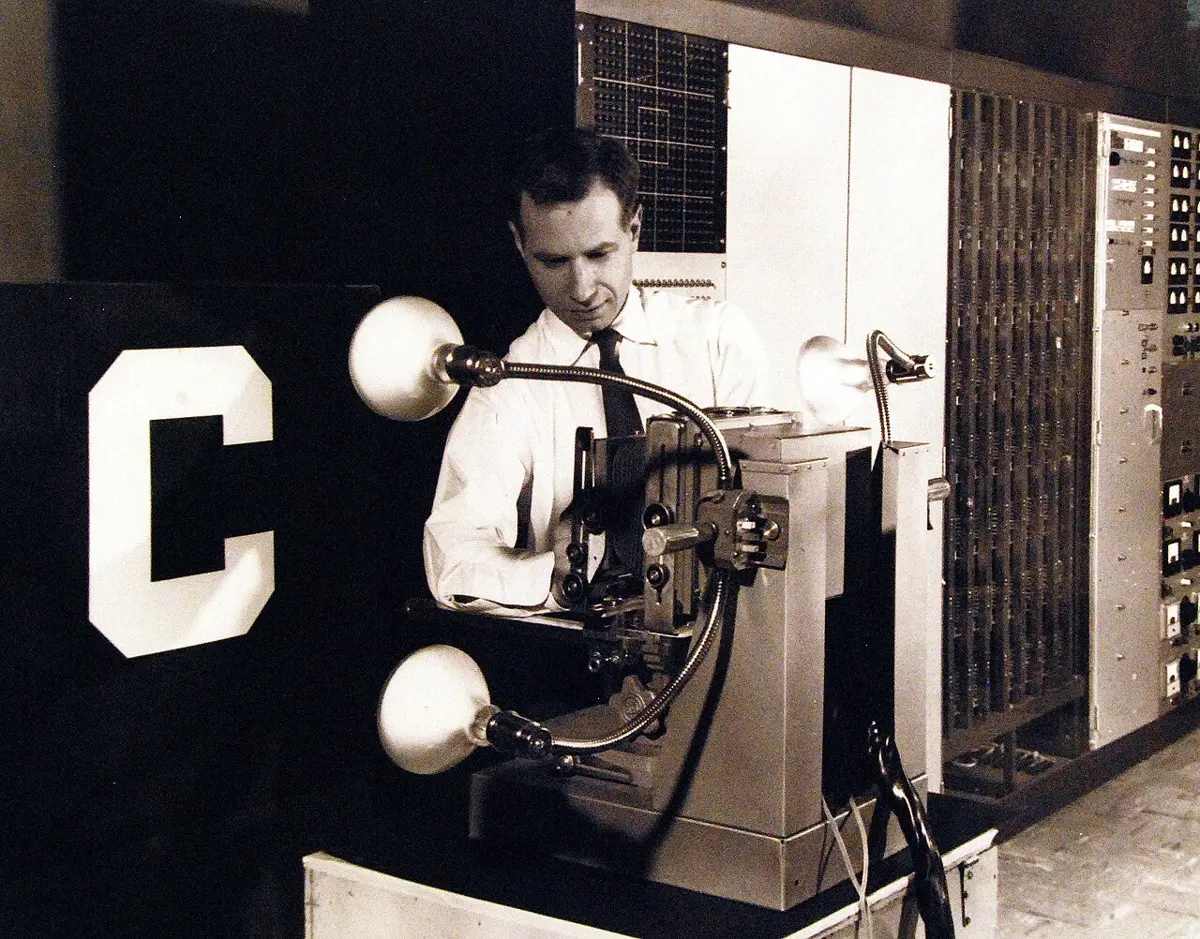
The newspapers got excited. In 1958 the New York Times reported it as “the embryo of an electronic computer” that the Navy expected “will be able to walk, talk, see, write”. The Mark I that the Navy unveiled two years later could, with training, tell simple printed letters apart. That gap between the headline and the machine has opened again and again since.
The joinings with strengths that change are borrowed too. When a brain learns, it changes its synapses, the connections between nerve cells. And in one place the two lines of work meet. People designing machines that learn from reward had worked out that what a learner most needs to know is the difference between what it expected and what it got. Then, in the 1990s, recordings from monkeys’ brains found that most of the cells that send out dopamine, a chemical messenger, seem to signal just that difference. They fire more when a reward is bigger than expected, carry on as usual when it is just as expected, and fire less when it is smaller. The signal a learning machine is built around looks very like one a brain really sends.
As of 2026, even the chatbots end their training with a dose of the law of effect. After learning to guess the next word, the models behind them are trained further on people’s ratings: people rank the model’s answers, and the network is pushed toward the kind of answer people preferred. It is Turing’s rewards and punishments again, given by the thousand.
What the machines don’t have
That is about where the borrowing ends.
A real nerve cell is not a little adder. Its branches do work of their own on what arrives. In 2021 a team tried to copy, millisecond by millisecond, a detailed computer model of one kind of nerve cell in the cortex, using an artificial network. To copy that one cell, they needed a network five to eight layers deep. So in a sense, a single neuron is a network.
The method nearly every artificial network learns by, called backpropagation, works out how much each connection was to blame for an error and sends that blame back through every layer. For decades it was thought unlikely in a brain, since nobody could see how a brain’s connections would carry such precise messages backward. Some researchers now argue that a brain may manage something roughly like it in its own way. Nobody knows yet.
Then there is power. A human brain runs on about 20 watts, less than a laptop.
And there are the examples. Here the difference is so large that it needs a scale where each step is ten times the last.
A child of five has heard somewhere between about 6 and 60 million words. The models behind chatbots a few years ago were trained on half a trillion to a trillion. That is ten thousand to a hundred thousand times as much. And networks trained on as much language as a child hears manage, at best, a muddled kind of autocomplete.
Children seem to learn some words from almost nothing. In a famous experiment of 1978 the psychologists Susan Carey and Elsa Bartlett had nursery-school teachers use a word the children didn’t know, once, in passing. Setting up for a snack, a teacher would say something like: “You see those two trays over there. Bring me the chromium one. Not the red one, the chromium one.” The chromium tray was olive green. Nobody taught the word, and nobody said it was a color. Children noticed it anyway: some repeated it, and most checked which tray was meant.
But what they learned from one hearing was a sliver. About a week later, 8 of the 19 three-year-olds in the main study picked olive when asked for “chromium”, though nearly a third of children who had never heard the word picked olive too, as the odd color out. Carey and Bartlett called the first quick guess fast mapping and wrote that it holds only a small fraction of what knowing a word takes; the rest comes slowly, over many meetings. In a later study, two-year-olds were excellent at working out which new object a new word named, and very poor at remembering it five minutes later. So a child doesn’t quite learn a word from one example. A child makes a good first guess from one example and keeps it open.
Even so, the gap is enormous, and nobody is sure why. Children may start with a good deal already built in about objects, people and how things move. Their words come with sights, sounds, touch and taste, while the models behind chatbots have learned mostly from words alone. And their words come in conversation, from people who simplify for them, point, wait for an answer and correct them. The second idea has been put to a test. In 2024 a team trained a fairly ordinary network on 61 hours of video and sound from a camera worn on the head of one child, at times between the ages of 6 and 25 months. From that slice of one child’s life it learned to link many words with the things they name, and to recognize new examples of them. So a fair amount can be learned from what one child sees and hears, by a fairly ordinary learning machine. How much of the rest a child brings, nobody yet knows.
Why it feels like someone is there
You might think nobody could mistake a machine for a mind. People do it with much less.
In 1944 two psychologists at Smith College in America, Fritz Heider and Marianne Simmel, showed 34 women students a film about two and a half minutes long: a big triangle, a small triangle and a circle moving round a rectangle with a flap that opened like a door. The students were asked only to write down what happened. All but one saw the shapes as living things, nearly always people, and more than half told it as one connected story. Only one described it almost entirely as shapes, and even she slipped, calling the big triangle “he”. When the study was repeated about 75 years later, with 32 new short films and 66 people, they did the same.
Psychologists call this anthropomorphism, seeing human minds in things that aren’t human. One theory says we do it more when we know a lot about people and little about the thing, when we badly want to make sense of what it does, and when we are lonely. Those are predictions, still being tested.
Now give the triangle words. In 1966 Joseph Weizenbaum, a computer scientist at the Massachusetts Institute of Technology (MIT), published ELIZA, a program that played a kind of counselor who mostly turns your words back into questions. It looked for key words and fitted your own phrases into stock replies. A typical conversation, as he printed it, began like this:
Men are all alike.
IN WHAT WAY
They’re always bugging us about something or other.
CAN YOU THINK OF A SPECIFIC EXAMPLE
ELIZA understood nothing, and Weizenbaum said so. Yet he wrote that some people “have been very hard to convince” that it wasn’t human. A decade later he told how his own secretary, who had watched him work on it for a long time and knew it was a machine, typed a few sentences to it and then asked him to leave the room. Who she was, or whether the story was polished in the telling, nobody has found out. He drew a warning from it: ELIZA showed, he wrote, how easy it is to create the illusion of understanding. You can build your own ELIZA and watch the trick from inside.
Turing had proposed a test of his own: an imitation game in which a judge chats by typing with a person and a machine and tries to tell which is which. He guessed that by about the year 2000 a machine would play so well that an average judge would be right no more than 70% of the time after five minutes. It took about twenty-five years longer. In a study first posted in 2025 and since published in a journal, people chatted for five minutes at once with another person and a chatbot. When the chatbot had been told to put on a humanlike character, the judges picked it as the human 73% of the time, more often than the real person. ELIZA, tested alongside, was picked 23% of the time.
Passing for human is not the same as having a mind, and psychologists have tried to look further. One test is whether a reader understands that someone else can believe something false, which young children learn as they grow. In 2023 a psychologist reported that chatbots were passing such tests. Another changed the stories in small ways that shouldn’t change the answer, and the results turned on their head. A stricter version of the first study, with matched control stories, found the newest chatbot it tested solving three-quarters of the tasks, about as well as six-year-olds had done in earlier studies. The argument about what that means hasn’t ended.
What people forget is that in human beings fluent language and thinking are not the same thing. In one study, two people who had lost most of their language after a stroke still solved problems of logic normally, and the brain’s language areas stay quiet while healthy people do the same problems. So fluency is neither necessary for thinking nor proof of it. As of 2026, chatbots are very good at the rules and patterns of a language, and patchier at using language to deal with the world, which is why the same chatbot that writes a smooth essay can state a wrong fact in the same confident tone. One explanation is plain: they were trained and tested in ways that reward a guess over “I don’t know”, like a student in an exam where wrong answers lose nothing.
Whether any machine has, or could have, something like a mind is a question philosophers and scientists still argue about, and nobody can settle it yet. What it can say is that a fluent reply isn’t evidence either way. Our minds read people into triangles. They will certainly read someone into a voice that answers back.
A chatbot is not a counselor
That feeling matters most when someone is having a hard time. More and more people turn to chatbots for emotional support, partly because they are cheap and always there, and in November 2025 the American Psychological Association issued a health advisory about it.
Its main point is plain: chatbots and wellness apps should not take the place of a qualified mental health worker, though they may help alongside one. Part of its reasoning comes from what is known about how help works. One of the most reliable signs that treatment will work is a trusting relationship between the person and the helper, and a relationship with a chatbot runs one way, whatever it feels like. Many chatbots are built to agree with what the user already thinks, while a trained counselor supports and also challenges. A counselor reads a face, a voice and a pause; a chatbot mostly gets typed words. And the advisory says that chatbots’ handling of someone in a real crisis is limited and unpredictable, and that some people trust what a chatbot says more than what they hear from parents, teachers or doctors.
Tests bear some of this out. In one study of 2025, chatbots asked to act as therapists showed prejudice toward people with some conditions and sometimes went along with false beliefs instead of gently questioning them. On the other side, a chatbot built for mental health and tuned by experts has been tested in one proper trial: 210 adults in the United States with depression, anxiety or a risk of eating disorders, half given the chatbot for four weeks and half put on a waiting list. Those with the chatbot reported their troubles easing more. It was one trial, the people judged their own symptoms, and the comparison group got nothing while they waited; its authors call for larger studies.
None of this is cause for panic. A chatbot can explain what a word means or help you plan a study timetable. What it isn’t is someone who knows you, will remember you next week, is responsible for you, and will act if you are in danger. That is a person’s job. If a heavy feeling won’t lift, tell someone you trust, and see a doctor at your health post or hospital.
So the machines that learn are a strange mirror. They took the brain’s simplest ideas, units adding up signals and connections that strengthen, and the oldest rule of learning, reward, and with enormous amounts of text and power made something that writes like a person. Children do it on 20 watts and tens of millions of words, by starting with more, learning through their senses and learning from people who talk with them. A fluent chatbot shows how good machines have become at language, and how readily we see a mind behind words. It isn’t a counselor, though it can sound like one.
In that printed conversation of 1966, ELIZA’s fourth reply was “I AM SORRY TO HEAR YOU ARE DEPRESSED”. It is the sentence a feeling would produce. In a person, the feeling would come first, with a body and a reading of the situation behind it. What that feeling is, and how it works, is the next question.
Found a mistake? Please tell us.