
Nepali has a good way of putting it. English says I am angry, as if being angry were something you were doing. Nepali can say that too, म रिसाएँ, but it can also say मलाई रिस उठ्यो: to me, anger rose. Fear works the same way, मलाई डर लाग्यो, and so does joy, मलाई खुसी लाग्यो. In these sentences you aren’t doing anything. The feeling does the work, and you are the place where it happens.
That’s close to how it feels. Nobody decides to be frightened. A dog runs at you in a dark lane and your heart is pounding before you’ve had a single thought about dogs.
So where does a feeling come from, if you didn’t make it? Psychologists argue hard over parts of the answer, but the main shape of it is simple enough to tell a friend.
What an emotion is
An emotion is your mind and body getting ready for something that matters to you. Something happens. You read what it means for you. Your body gets ready. You feel something, and you want to act. And all of it runs inside what your people have taught you.
Say you’re standing in a crowded microbus and someone shoves you hard from behind. Before you’ve even turned around, something in you has asked: is this dangerous, is it an insult, is it my fault? Psychologists call this appraisal, and mostly you don’t notice it happening. Your heart speeds up, your muscles tighten, your face moves. Out of the reading and the body comes the feeling itself, with an urge to turn and shout, get away, disappear. And all the way through runs what you’ve learned from the people around you: what counts as an insult, what the feeling is called, and whether you’re allowed to show it.
Now take the same shove and read it differently. If you decide he did it on purpose, you get anger. If you think of the money in your back pocket, you get fear. If you see that everyone fell forward because the driver braked, you get nothing at all, or a laugh. If you’re the one who tumbled into a stranger’s lap while the whole bus watched, you get लाज, shame.
One shove, four outcomes. What happens to you doesn’t hand you an emotion. Your reading of it does most of that work, usually before you know you’ve done any reading.
A strong emotion can feel like something going wrong, but it’s doing a job. It picks one thing out of everything you could be thinking about and makes it matter: on that bus you stop thinking about tomorrow’s homework. It gets you moving, with your whole body at once, before you’ve finished the thought. And it tells other people something. A red face, a shaking voice, a child’s wail all carry news.
So anger isn’t a fault in the system, and neither is fear. They can misfire, as a smoke alarm does over burnt toast, but you wouldn’t want a house without one.
How body and mind make one
Which comes first, the feeling or the body? In 1884 the American psychologist William James took on common sense. “Common sense says, we lose our fortune, are sorry and weep; we meet a bear, are frightened and run.” James thought this was backward. You see the bear, your body reacts, and the feeling of that reaction is the fear: “we feel sorry because we cry, angry because we strike, afraid because we tremble.”
Bhaktapur has few bears, but the point survives the move. Take away the pounding and the tight throat and it’s hard to say what would be left of fear.
But then each emotion should have its own changes in the body, and critics such as Walter Cannon doubted that it did. They still have a case. In 2018 a team pooled 202 laboratory studies that measured heart rate, sweat, breathing and the like while people felt things, and the patterns didn’t clearly tell one emotion from another. Fear on one occasion can look quite unlike fear on the next.
So what says which emotion you’re having? Mostly, it seems, the situation and how you read it. A racing heart outside the exam hall can be dread, and the same heart before a football match can be eagerness. The classic experiment is from 1962. Stanley Schachter and Jerome Singer gave people a shot of adrenaline, said it was a new drug being tested on eyesight, and sat them with an actor who behaved either cheerfully or angrily. Those with no good explanation for their racing hearts were reported to take on the mood in the room. It’s a lovely idea, but when others tried it again in 1979 they didn’t get the result, so the experiment can’t carry the idea by itself. Across 35 later studies, people told that a racing heart is the body getting ready did slightly better at the task in hand, though studies that found nothing may never have been published. There’s a small habit built on that.
Under all this lies the field’s biggest fight. One side says a handful of emotions are built in by evolution, each with its own machinery, like a set of organs. The other side says there’s no such fixed set: your brain builds each emotion on the spot, out of signals from the body, the situation, and the ideas of emotion it has learned. Anger, on this view, is a word covering many different things. It hasn’t been settled.
Do faces mean the same everywhere?
Nowhere is the fight plainer than on the face. Charles Darwin thought expressions were shared across humankind, and his 1872 book on them had pictures drawn from the photographs of the French doctor Duchenne, who made faces move with electricity.
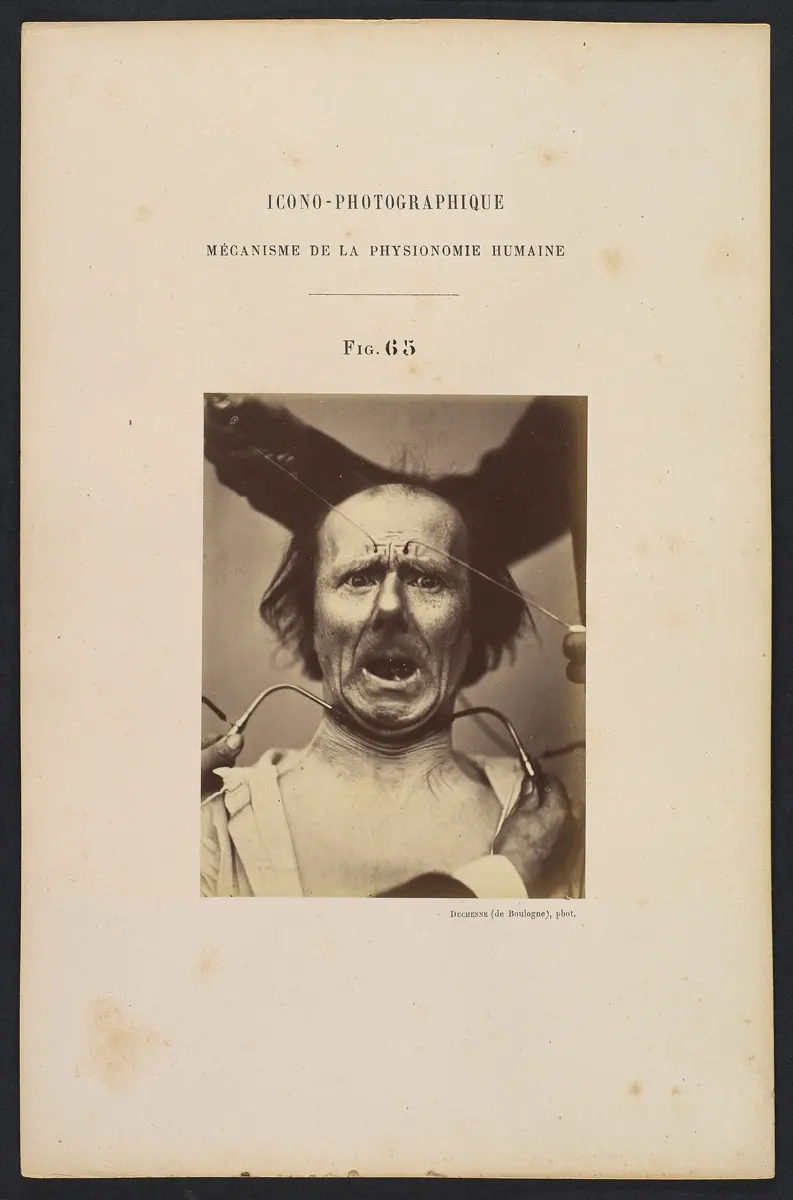
In the 1960s the American psychologist Paul Ekman carried the question to the Fore, a remote people in the highlands of Papua New Guinea. Asked to match photographs of faces to short stories of feeling, they mostly chose as he predicted. From this came a famous claim: six emotions, happiness, sadness, anger, fear, disgust and surprise, each with its own face, read the same by everyone.
In 2019 five scientists, Lisa Feldman Barrett among them, went through the evidence and came out doubtful. People do scowl when angry and smile when happy more often than chance. But when studies watched people during emotional moments, mostly in the laboratory, the expected face turned up only about one time in five. Much of the agreement across cultures, they argued, came from giving people a short list of answers to pick from. In the Trobriand Islands, also in Papua New Guinea, 78% of the teenagers asked chose the wide-eyed gasping face, the one Western books label fear, as the face that threatens. Spanish teenagers most often chose the scowl.
The other side has its evidence too. In 2021 a team set computers to watch 6 million videos from 144 countries. Sixteen kinds of expression each went with their own sorts of occasion, and about 70% of those links held across 12 regions of the world. All those people were online, though, so some of the sameness may have spread.
So both sides agree that faces carry information. Nobody has shown that a face is a printout of a feeling, or that faces are mere local custom, and how much is shared is still being fought over.
Can your face change your feeling? In 1988 a study had people hold a pen in their teeth, which forces a sort of smile, and found they rated cartoons funnier. Then in 2016, 17 teams repeated it and failed. So believers and doubters did something rather fine. They designed one test together, with the first author of the original study on the team, and ran it on 3,878 people in 19 countries.
Copying a smile, or pulling the corners of the mouth up on purpose, made people a little happier, by up to half a point. The pen did nothing clear. And the smile didn’t lower anger or anxiety. So a forced smile can lift you a little, and that’s about all.
Standing tall has had a rougher time. In 2010 a study of 42 people claimed that a “power pose” raised testosterone and lowered the stress hormone cortisol. A test with 200 people found no change in hormones or behavior, only in how powerful people said they felt. In 2016 the first paper’s lead author wrote that she didn’t believe the effect was real, though her coauthor still defends a smaller version about feelings. Pooled studies do find that posture shifts how people feel, but most compared standing tall with slumping. In the few that also tried ordinary standing, the difference came almost entirely from the slump: slumping seemed to do harm, and standing tall did little.
Learning what to feel
If what your people teach you is part of an emotion, it ought to show, and in Nepal someone went and looked.
In the 1990s the American psychologist Pamela Cole and her colleague Babu Lal Tamang, of a school in Kavre, studied children in Tamang and Brahman villages in the middle hills, a day’s walk from any road. In one study 223 schoolchildren in Grades 2, 4 and 5, Tamang, Brahman and American, heard stories of hard moments and said how they’d feel. In one story you’re doing your homework, you reach for the eraser, and your father or a friend slaps your hand.
The usual Brahman answer was that you’d be angry, because this was unfair, but you wouldn’t show it. “Father gave me life,” the children explained; you just sit quietly. The usual Tamang answer was that you’d be ashamed: “I snatched the eraser.” Asked why they wouldn’t be angry, Tamang children answered with a question: “Tilda bomo khaba?” Why be angry? It had already happened. American children were angry too, and said so: “You can have the eraser, but you don’t need to hit me.”
Across six such stories the leanings held. Tamang children chose shame more than the others, Brahman and American children chose anger, Brahman children were the most likely to keep a bad feeling to themselves, and American children talked most of doing something about the problem. Shame needs care here, since लाज and its Tamang word also mean embarrassment and shyness.
Then the team looked for where this might come from. In four villages, two of each, women from those villages sat in homes for about 45 minutes and wrote down what happened around 119 children of three to five. Fourteen elders were asked what makes a child capable.
Mostly the homes were alike. The commonest feeling seen was happiness, and the commonest answer to a child’s feeling was care. Adults in both scolded or hit an angry child about as often. The differences lay in the rest. Brahman adults were more likely to reason with an angry child, while the rare teasing of one came almost only from Tamang adults. A child who looked ashamed was ignored about three times in four in Brahman homes, and in Tamang homes was about as likely to get reasoning or care as to be ignored. Five of the seven Tamang elders said a capable child is never angry. The Brahman elders spoke of study, and of respect for teachers and adults.
The researchers linked the first pattern to an idea of the capable child as socially graceful and never angry, and the second to the privileges and duties of high caste. They also discussed what Tibetan Buddhism teaches about anger, and whether being ranked low under the old caste law might itself teach shame.
So small children seemed to be learning, from how the adults around them answered, which feeling gets you somewhere. These were leanings, not rules, in a few villages about thirty years ago, and they’re no portrait of a people. Each child was watched once, shame was seen only 62 times, and watching can’t prove what caused what. But it suggests something that matters well beyond Nepal: a child doesn’t simply have anger or shame and then learn to manage it. The reading itself may be taught. The same hard moment can be, for one child, somebody else’s wrong, and for another, something that looks bad on me.
What you can do with a strong one
An emotion is built in steps, and each is a place to step in. The psychologist James Gross laid out five, from before the feeling starts to after it’s going.
You can pick the situation, or change it: leave the room, don’t open the message tonight, sort out the cause. You can move your attention: looking at something else can take the edge off, while going over it again and again tends to make a feeling worse and keep it longer.
You can change the reading, and in experiments this has done about as well as anything tried. It doesn’t mean pretending. It means finding another reading that’s also true: he may have been shoved himself. Sometimes, of course, things really are as bad as they look, and no reading will change that.
You can calm the body. Slow breathing, relaxing the muscles, yoga and a timeout have all brought anger down in studies. The old advice to let it all out has little evidence behind it. A run may be good for your heart, but of the active things tried, jogging was the likeliest to add to anger.
Last, you can hide it. That quiets the face, but whether it eases the feeling is unclear. What it costs may depend on who you are among: in one American study, hiding feelings made a conversation go worse for people with Western European values, and less so for those with Asian values.
None of this means an emotion is a problem to be solved. Anger at something unfair may be a correct reading, and grief is the price of having loved someone. The aim is to have the feeling and still choose what to do.
This isn’t treatment, and a chapter can’t be. A heavy feeling that won’t lift isn’t a mistake in your thinking, and it isn’t yours to fix alone. If it stops you sleeping, eating or seeing friends, tell someone you trust, and see a doctor at your health post or hospital.
मलाई रिस उठ्यो, says the sentence, and it has that about right. The anger rose, and you didn’t choose it. But Nepali grammar needs a new sentence for what comes next, and in that one you’re back as the subject.
Found a mistake? Please tell us.