
Take a grain of rice and cut it in half. Cut one half in half again, and again, until the bits are too small for the knife. Then imagine a finer knife, and a finer one after that. Can you go on forever? Or do you come, at last, to something that can’t be cut?
It sounds like a question for a laboratory, and today it partly is. But people asked it long before anyone had a microscope, in Greece and in India, and they asked a bigger one along with it. What is everything made of? The tea in your glass, a brass plate, the breath you see on a winter morning, the hills, your own body. Is it all one stuff in different forms? Is it a great many tiny pieces, put together in different ways? Or is the stuff not the main thing at all, so that what makes a plate a plate is something else?
Those are the three big answers, and nearly everyone in this chapter gives one of them. The first says that everything is a single stuff that changes, the way water turns into ice and steam. The second says that everything is made of very small pieces that never change, and that things differ only in how the pieces are arranged. The third, which can sit beside either of the others, says that what a thing is depends on its form, its shape and pattern, more than on what it’s made of. Modern physics has an answer of its own, which owes something to the second and would have surprised the people who first gave it.
One stuff, changing
The first person we know of who gave an answer is Thales, who lived around 600 BCE in Miletus, a Greek city on the coast of what is now Turkey. Everything, he said, is water. He wrote no book, so we have his answer from Aristotle, about two centuries later, and even Aristotle could only guess at his reasons. Perhaps, he thought, Thales had noticed that the food of every living thing is moist, and that seeds are moist too. Thales also said that the Earth rests on water.
He was remembered for much else. Herodotus says he foretold an eclipse of the Sun, though historians doubt that anyone then could have done it. Plato tells of him falling into a well while he was looking up at the stars. And Aristotle tells a story about money. One winter, reading the stars, Thales foresaw a big olive harvest, so he paid small deposits on every olive press in Miletus and on the nearby island of Chios. When the harvest came and everyone needed a press at once, he rented them out at whatever price he liked. The point of the story, Aristotle says, is that a philosopher could easily get rich, but has other things on his mind.
Anaximander, also of Miletus, chose differently. The source of everything, he said, is neither water nor any of the other things we see. He called it the boundless, a stuff with no limits and no character of its own. Out of it came hot and cold, whose quarrel, paid back and forth as if by justice, keeps the world in order.
Then Anaximenes, the third of these thinkers from Miletus, chose air, and gave a reason anyone can test. Thin air out and it becomes fire. Squeeze it together and it becomes wind, then cloud, then water, then earth, and at last stone. A later writer remembered his evidence. Blow on your hand through tight lips and the breath feels cool. Breathe on it with your mouth wide open and it feels warm. Thickening cools; thinning warms.
All three wanted one stuff behind everything, and a way for it to change into all the rest. They didn’t keep science and philosophy apart, because nobody yet did. They measured the sky and argued about what it’s made of in the same breath. What they left behind was a puzzle. If water can become stone, what stays the same through the change?
Too small to see
The second answer goes back to the grain of rice. If you keep cutting, it says, you come to pieces that can’t be cut, and everything is made of them.
In Greece the answer belongs to Democritus, born around 460 BCE in the town of Abdera, and to his teacher Leucippus, of whom almost nothing is known. Their atoms are solid all through, too small to see, endless in number, of many shapes and sizes, always moving through empty space. They never change. When anything seems to come into being or pass away, the atoms have only been rearranged. Aristotle explained it with letters. A and N differ in shape. AN and NA differ in order. And N lying on its side is a Z. Three ways to differ, and a whole alphabet of things.
Atoms, for Democritus, have no color, no taste and no warmth. Those come from how the atoms sit and how they meet our senses, as a pigeon’s neck shimmers with different colors when it moves. Sweet and bitter, hot and cold and color exist “by convention”, he said, “but in reality atoms and void”. Ancient writers called him the laughing philosopher, and he held that cheerfulness was the good in life. His many books are all lost, and we know him only from what others reported.
In India the same answer came from the वैशेषिक (Vaiśeṣika) school, whose founder is remembered as कणाद (Kaṇāda). Its oldest book, the वैशेषिकसूत्र (Vaiśeṣika-sūtra), is a string of short sayings, and one of the first names the nine kinds of substance: earth, water, fire and air, then आकाश (ākāśa), the ether that fills the sky, then time, direction, the self and the mind. Earth, water, fire and air are made of atoms, परमाणु (paramāṇu), which have no parts and never perish. The other five have no parts either.
A later commentator on the sayings gave the argument for atoms in a form that sticks. Suppose cutting never stopped. Then Mount Meru, the great mountain of the old stories, would be made of endlessly many parts, and so would a mustard seed. How, then, could one be bigger than the other? So there must be a smallest thing with no parts. And it isn’t the smallest speck of dust you can see, because anything you can see has some size, and having size needs more than one part. The atom is beyond seeing. Atoms join in pairs, and pairs into larger groups, until something grows big enough to see. Muslim thinkers who held that the world is made of atoms used the same mountain and mustard seed centuries later, and some historians suspect they learned it from India.
The two kinds of atom are not the same. A वैशेषिक atom of water is cool, as water is, while Democritus’s atoms have no qualities at all. And वैशेषिक atoms don’t move about on their own: their motion comes from a divine source, and उदयन (Udayana), an eleventh-century philosopher, pointed to the orderly way atoms are put together as a proof that God exists. Jain thinkers had atoms of a single kind of matter. Buddhists made their smallest units into moments that flash and are gone. Whether the Greeks learned anything from India, or India from the Greeks, nobody has shown, and the claim is seldom made.
वैशेषिक went further than atoms. It sorted everything that can be named into a short list of kinds of thing.
The last row is the strangest. Is the absence of an elephant in your classroom really something? The sayings already treat absence as something that can be known, and the later teachers gave it a place of its own on the list. The sayings sort it into kinds: a thing not yet made, a thing that has been destroyed, one thing not being another (a horse is not a cow), and what never is anywhere. And the purpose of all this sorting is stated in the sayings themselves: knowing the kinds of things truly leads to the highest good, freedom from suffering. A list of what exists was meant to set people free.
The materialists of India, चार्वाक (Cārvāka), kept only the four elements and dropped the rest. The mind, they said, comes from the body, the way the power to make you drunk appears when certain ingredients are mixed, though none of them has it alone. “While life is yours, live joyously,” runs one of the verses their opponents preserved; “none can escape Death’s searching eye.”
The idea of a bed
Plato, in Athens in the fourth century BCE, gave the third answer, and it is the boldest. The most real things, he held, aren’t made of any stuff at all.
In his Republic, Socrates talks about beds. A painter paints a bed. A carpenter makes one. But the carpenter makes it by looking to something else, the idea of a bed, which isn’t any bed in particular. That one, Socrates says, is the bed made by God, and there can be only one of it, because if there were two, a third would at once appear behind them, the one both of them share. Plato called these ideas Forms. They don’t change, they aren’t anywhere in space or time, and everything we see is what it is by sharing in them.
Why believe it? Look at anything beautiful. It is beautiful in one way and plain in another, beautiful now and less so later. Two sticks look equal from here and unequal from there. Nothing we see is simply and only what we call it. Beauty itself, Plato thought, must be, and it is the Form, not any beautiful face, that the mind is really after. In his most famous image, ordinary people are like prisoners in a cave who see only shadows on a wall, and the philosopher is the one who turns round and climbs out into the sunlight.
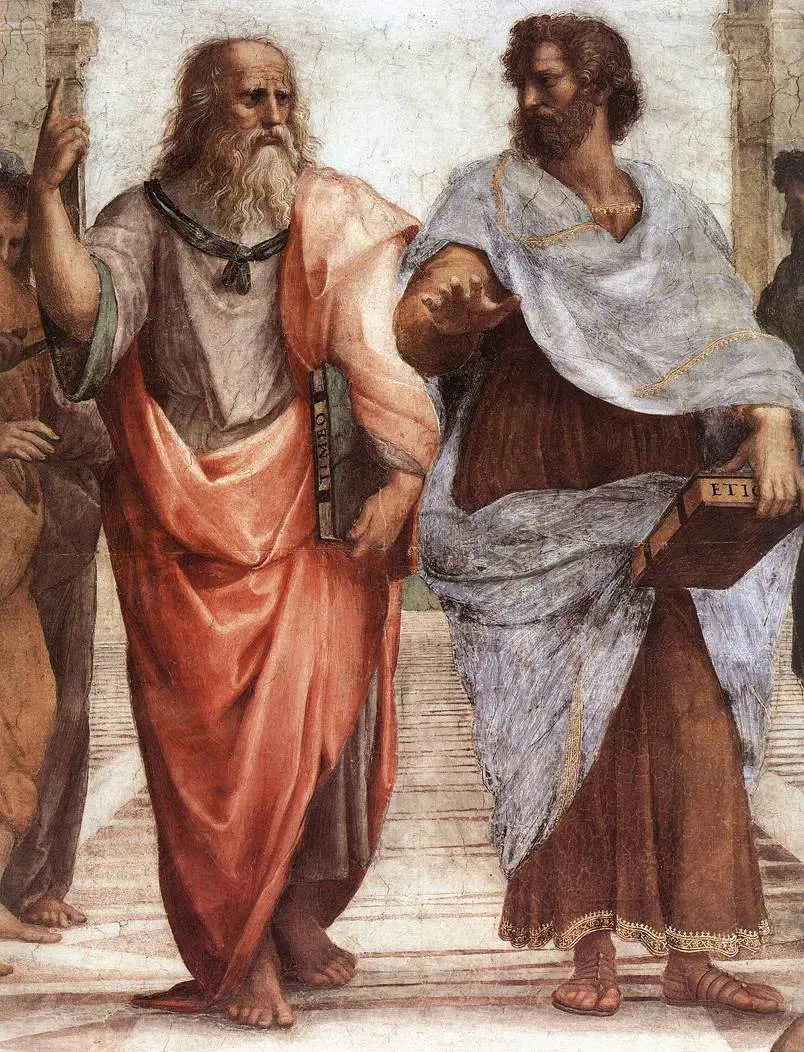
His most famous pupil didn’t agree. To say that things share in Forms, Aristotle wrote, is to use empty words and poetical metaphors. A thing’s nature can’t live apart from the thing. For Aristotle the real things are the ones in front of you: this man, that horse. Each is stuff with a form in it, the way a statue is bronze with a shape. The form is not up in some other world. It is the shape and working of the thing itself.
That let him explain change, which had puzzled everyone since Miletus. An acorn is not yet an oak, but it can become one, and an oak is what it now is. Aristotle called these two being in potential and being in actuality, and a thing changes when what it can be becomes what it is. To explain any thing fully, he said, you need four answers: what it’s made of, the bronze of the statue; its form; what made it, as a father is the cause of his child; and what it’s for, as health is what walking is for.
Aristotle tells a story from another thinker, Antiphon, which shows what was at stake. Plant a wooden bed in the ground, said Antiphon, and suppose the rotting wood puts out a shoot. What comes up is wood, not a bed. So the bed’s real nature was its wood, and the shape was an accident. Aristotle answered that the form is a thing’s nature too, and more truly than its stuff, since a thing is most what it is when it is complete.
Too blunt a sorting
Nepal’s Grade 12 Social Studies sorts world views by what they put first: some put consciousness first, some only matter, and some hold the two together. It is a useful start, and it shows how differently people of each kind live. But the thinkers in this chapter don’t sit still in it.
वैशेषिक is a theory of atoms, and so far it sounds like matter first. Yet the self and the mind are on its list of substances, its atoms are set moving by a divine source, and its whole aim is freedom from suffering. Thales said everything is water, and also, if Aristotle heard rightly, that all things are full of gods. Plato’s Forms aren’t minds, and they aren’t matter either. Aristotle puts form and stuff together in every single thing. Of all of them, Democritus and the चार्वाक thinkers fit one box best. Better questions sort them better. What are things made of? Does a whole come from its parts, or the parts from the whole? Which is more real, the stuff or the form? Is there anything besides the physical, such as a self? Each thinker answers each question in their own way.
And what do physicists say now? The atom kept the Greek name, which means uncuttable, and then it was cut. An atom has electrons around a tiny nucleus, the nucleus is made of protons and neutrons, and those are made of quarks. Today’s best theory, the Standard Model, builds matter from twelve kinds of particle, six quarks and six of the family that includes the electron, held together by forces. It leaves out gravity, and it can’t say what dark matter is. So nobody knows whether these are the last pieces. The difference from Democritus and कणाद is not that they guessed wrong. Their atoms were reasoned out, from a mountain and a mustard seed, and these were found by measuring. How that was done belongs to the science books, from atoms in Grade 9 to quarks in Grade 11 Physics.
What the old thinkers handed on is the questions. Is everything one stuff, or many pieces, or patterns that stuff takes on? Is there a smallest thing? Is the idea of a thing more real than the thing? Each of the three answers is still alive in some form, and the next chapter follows the boldest version of the first: that all of it, in the end, is one.
Found a mistake? Please tell us.