
On 20 August 1792 two armies fought at the Betrawati, a river that joins the Trishuli near Nuwakot, not far from Kathmandu. On one bank was an army sent by the emperor of China. On the other were the soldiers of Gorkha, the hill kingdom that had taken the Kathmandu Valley a generation before. Both sides wrote the fight down, and they wrote it very differently.
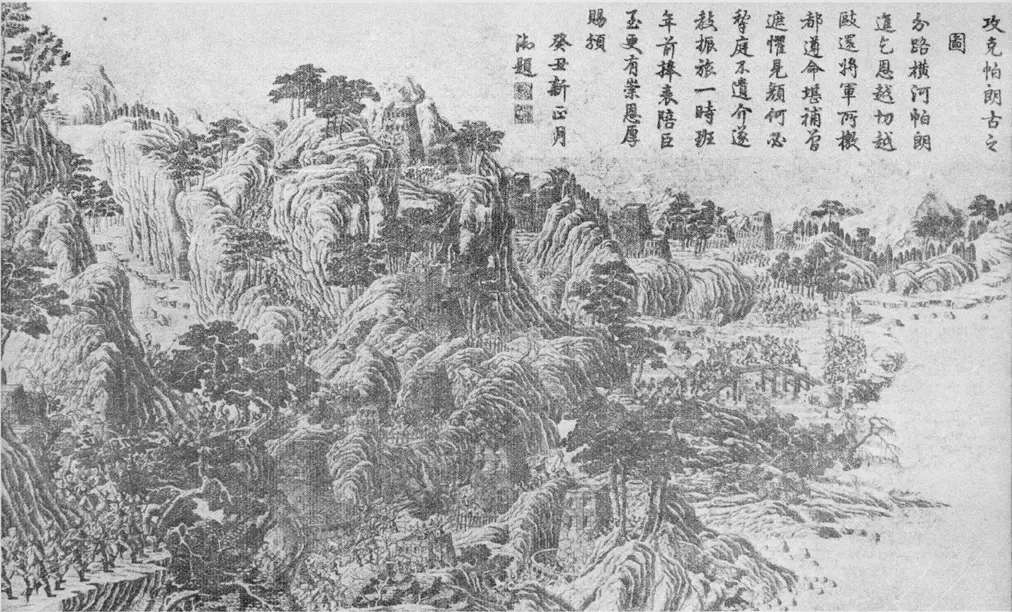
The emperor’s court had a picture made of it, one of a set celebrating the campaign, and called it The Capture of Palanggu, its name for the Betrawati. Kathmandu wrote to its generals in the west that the enemy had crossed the river and attacked at three places, been thrown back at all three, and lost a thousand or more men, many of them drowned or fallen down the hillside, while the Chinese commander cut down his own men as they ran. Each side, in other words, told the story as a win. What everyone agrees on is what happened next: within weeks the two sides made peace, and the emperor’s army marched back over the mountains to Tibet.
That army got there because of a quarrel over coins.
Bad coins and a runaway lama
For a long time Tibet had used silver coins struck in the Kathmandu Valley, and the last Malla kings had mixed so much copper into theirs that Tibet ended up holding a great many bad coins. Prithvi Narayan Shah, Gorkha’s king, struck coins of pure silver and wanted Tibet to use them. That raised a question nobody could settle. If a Tibetan trader brought in an old Malla coin, how many of them was a new, pure one worth? Kathmandu said two old for one new. Tibet, sitting on a pile of the old ones, said a coin was a coin and the two should count the same. The talks went on for years, and Kathmandu later said that trade over the passes had stopped while they argued, for three or four years in one telling, eight or ten in another.
Other things piled on top. Tibet had begun to send some of its trade with India through Sikkim, which took business away from the Valley’s roads. Gorkhali traders complained that Tibetan officials at the border took extra fees for themselves, and that the salt Tibet sent south had sand mixed into it. And then, in the 1780s, a lama arrived in Kathmandu asking for shelter.
He was the Shamarpa, the head of a line of lamas known as the Red Hats, and he was a brother of the Panchen Lama, the great lama of Tashilhunpo monastery at Shigatse in western Tibet, second in honor only to the Dalai Lama. The Panchen Lama had gone to Beijing in 1780 to visit the emperor, who gave him gifts of great value, and had died there. (Some readers will have learned that he died on the way home; historians who have read the Chinese records put his death in the capital.) His wealth went to another brother, the treasurer of Tashilhunpo. The Shamarpa felt cheated, quarreled, and fled to Nepal with about fifteen followers. Kathmandu let him stay at Swayambhu. Gorkha’s king, Ran Bahadur Shah, was still a boy, and those who ruled for him, from 1785 his uncle Bahadur Shah, gave the lama their protection. Tibet asked for him back and didn’t get him.
Chinese and Tibetan writers have blamed the Shamarpa for what followed, saying he urged Gorkha on to get even with his brother. He may have; he certainly told Gorkha a great deal about Tibet. But the coin quarrel was older than his arrival, and Gorkha had reasons of its own.
The first war and a secret deal
In the summer of 1788 Bahadur Shah sent his soldiers over the passes. One force went up the Bhote Koshi to Kuti, which Tibetans call Nyalam; another went up the Trishuli to Kerung. The Chinese records say about three thousand men took Nyalam, Kerung and Dzongka, the towns at the head of both roads, and went on to besiege Shekar, well onto the Tibetan plateau. Tibet’s own soldiers could not stop them. A few thousand troops were spread across the whole country, and many of them were far away.
Tibet was part of the empire of the Qing, the Manchu dynasty that ruled China. Two Qing officials, the ambans, lived in Lhasa to watch over the Tibetan government, and the emperor, Qianlong, by now an old man, was furious. He sent soldiers from Sichuan and an official named Bazhong, who spoke Tibetan, to sort it out. But winter came, the snow shut the passes, and the emperor let his commanders decide whether to fight on. They didn’t.
What happened instead was a deal that the emperor was not told about. Tibetan ministers, led by a young noble called Tenzin Paljor, met the Gorkhalis at Kerung in 1789, with the Shamarpa in the middle, signing for Nepal. Tibet agreed to pay Gorkha every year, and Gorkha agreed to go home. In Nepal the sum was remembered as Rs 50,000 a year; the Chinese records count it as 300 large ingots of silver. Bazhong knew and approved. He then reported to Beijing that the Gorkhalis only wanted to send a mission to pay their respects to the emperor, and that he had settled everything without losing a single soldier or spending a single tael, the Chinese ounce, of silver.
So a Gorkhali mission went to Beijing. It was received with honor, and at the New Year of 1790 the emperor gave Ran Bahadur Shah the title of king, wang, and Bahadur Shah a lower title. Kathmandu later said that its envoys spent forty-five days in Beijing and were away fourteen months. The trouble was that Tibet couldn’t afford what its ministers had promised. It paid once, for the first year, and then stopped.
The raid on Tashilhunpo
Late in 1790 Gorkha sent officers to Lhasa about the coins once again. They brought loads of new coins and asked for two old ones for each. Tenzin Paljor answered that the treaty had said one and a half. They went home with nothing.
In 1791 the two sides agreed to meet at the border, at Kuti, to talk it over. What happened there depends on who tells it. In the Nepali account, the Tibetans had come to seize the Shamarpa, so the Gorkhalis seized them instead. In the Chinese records, a thousand Gorkhali soldiers came at Kuti before any talks began, and in the fighting that followed the Tibetan party was overwhelmed. Either way, Tenzin Paljor, another minister and their men were marched off to Kathmandu as prisoners, and Gorkha’s soldiers poured back over the passes.
This time they went much further. One force went by Kuti and another by Kerung, under commanders that included Damodar Pande. They took Tingri and Sakya and, in the autumn of 1791, reached Shigatse. The amban had already taken the Panchen Lama, a boy now, away to Lhasa. In Lhasa people were frightened, and the ambans wanted the Dalai Lama to leave too, but he refused. He told the crowd from the roof of the Jokhang temple that the Gorkhalis would not come to Lhasa and that everyone should go back to work.
He was right. At Tashilhunpo the Gorkhalis found the monastery almost empty, and they stripped it: the gold, the silver and the jewels and coral set into its shrines, much of it the emperor’s own gifts to the dead Panchen Lama. Then they turned round and went home. A Chinese record gives a reason. The deal of 1789, it says, had a clause allowing Gorkha, if Tibet broke it, to go as far as Tashilhunpo to collect what it was owed and then return. If so, Gorkha thought it was collecting a debt. The way home was hard, over high passes in the snow, and men were lost on it.
At the emperor’s court Bazhong, the man who had made the secret deal, was shown the news. He admitted that he had handled things badly, asked to be sent back to make up for it, and that same night drowned himself in a river. The emperor began to learn what had been hidden, and he was not going to settle for ingots this time.
The emperor’s army
He gave the command to Fu Kang’an, one of his most trusted generals, and pulled soldiers from all over the western empire: men from Sichuan and Yunnan, Tibetan troops, and a thousand Solon and Daur horsemen from Manchuria, picked veterans of the emperor’s earlier wars. Fu Kang’an crossed the high grasslands of Qinghai in the depth of winter and reached Lhasa early in 1792. Historians who have added up the units named in the Chinese records come to between thirteen and seventeen thousand men in all. Reports that reached the British in Bengal spoke of seventy thousand; numbers like that tell you how it looked to the people facing it.
Tibetan and Qing troops had already won back Nyalam in the winter. Fu Kang’an waited for the snow to melt and in the early summer came down the Kerung road, the gorge of the Trishuli. The Chinese records describe one fight after another along the river: forts of stone on ridges above the water, bridges cut by the defenders, crossings made on rafts or, one night, on tree trunks roped together, a little further up the river than the Gorkhalis expected. Kerung fell, then the bridge at Rasuwa on the border, then Syaphru and Dhunche. Kathmandu’s own letter tells the same story from the other side: forts lost, officers killed, the river held for seven or eight days before the enemy crossed above it.
Kathmandu was in a tight place. Its best soldiers were far to the west, fighting in Garhwal, and a recall order went out to bring them home. Earlier that year Nepal had hurriedly signed a trade treaty with the East India Company, and now it asked the British in Bengal for help, guns and men. The governor-general, Lord Cornwallis, said no. The Company did a great deal of business at Canton, China’s one port open to Europeans, and wasn’t going to put that at risk for Nepal. He offered to mediate instead, and sent an officer, William Kirkpatrick, who reached Nepal only after the peace was made. The Dalai Lama had written to Cornwallis too, asking him not to help the Gorkha king, who had attacked Tibet, he wrote, “from the blackness of his heart”.
In the middle of all this the Shamarpa died. Gorkha wrote to Fu Kang’an that he had fallen ill and died; others said he had taken poison, and Tenzin Paljor believed he had killed himself. Nobody knows.
By early August the Qing army was at Dhaibung, on the last ridge above Nuwakot, and the Gorkhalis held the far side of the Betrawati below. Envoys crossed back and forth, and on 20 August the Qing army attacked. Here the two sets of reports, which had mostly agreed until now, part company. The Chinese records say the bridge was stormed, though the officer who led the charge was shot and fell into the river, and on the far side the fighting went on for two days and a night against seven or eight thousand Gorkhalis coming at them from the slopes above and along the river. They count six hundred Gorkhali dead, and admit to many of their own, a senior general among them. Nepal’s letter claims a clear repulse, with a thousand or more of the enemy dead and only fifteen or sixteen of its own men wounded. What nobody disputes is that Fu Kang’an went no further.
The peace of the Betrawati
Both armies needed to stop. The Qing soldiers had eaten the barley flour they carried, many were sick, and their generals knew that if they stayed much longer the snow would shut the passes behind them. Gorkha had lost men and forts all the way down the Trishuli, and had enemies at its other borders.
Fu Kang’an had demanded that the king or his uncle come to his camp in person. Neither went. What Kathmandu did send was what the emperor most wanted to see. Gorkha handed back the treasure taken from Tashilhunpo, in two lots, and the written agreements of 1789, and the Shamarpa’s remains, his followers and his goods. Gorkha’s envoys promised to send a mission to the emperor every five years. In early October 1792 a truce was agreed, and the Qing army began its march home. Many of its men died on the way back. Nobody has ever found the written text of the treaty itself, if there was one; what both sides agreed is known from their letters and reports.
What had Nepal agreed to? Each side read the peace in its own way. In Beijing it was a surrender. The envoy Devadatta Thapa, the Chinese record says, fell to the ground before Fu Kang’an and begged for mercy, blaming the Shamarpa and a king too young to know better. Qianlong counted the Gorkha wars among the ten great victories of his reign and had them carved in four languages on a stone set up below the Potala in Lhasa, which still stands. In Kathmandu the king’s letter to the generals in the west said the country had been kept independent, as it always had been. A letter to Damodar Pande put it more frankly: the Chinese emperor was not a small emperor but a great one; Gorkha could have driven his army out, but it would not be good to stay his enemy for the future.
Not everyone thought Nepal had needed to give way. A British account written soon afterwards passed on what some people had said at the time: that if Kathmandu had held firm a little longer, the Chinese, worn down by sickness and short of food, would have had to ask for peace themselves.
The missions to Beijing went on, every five years or so, until the early 1900s. Nepal sent gifts, and the emperors sent gifts back. What the missions meant is still told two ways. In the Qing records Nepal was from then on a tributary state, one of the lands that sent tribute to the emperor and owed him respect. Nepal’s rulers called the missions gifts between kings, went on running their own affairs, and never said they had given up their independence. Kuti and Kerung, which Gorkha’s armies had taken twice, stayed with Tibet.
The other big change was in Tibet. The emperor decided that Tibet had nearly been lost through its own ministers’ deals, and he tightened his hold. The ambans were given power over Tibet’s government and its dealings with foreigners, and Lhasa got a mint of its own, so that Tibet’s coins would no longer be struck in the Kathmandu Valley. The quarrel that had started the war was settled by taking the coins away from Nepal altogether. Even the choosing of high lamas was put under a new rule: the names were to be drawn from a golden urn. Tenzin Paljor, freed from Kathmandu, was taken to Beijing to explain himself, and his family lost much of its land.
Gorkha had gone over the mountains for a better exchange rate and a yearly payment. It came back with the treasure of Tashilhunpo and then gave it up again, along with any hope of the old coin trade, and it had learned that its northern neighbor could reach, slowly and at enormous cost, almost to the Valley. Its next great danger would come from the south, from the East India Company, which had refused it help.
Found a mistake? Please tell us.