
Nepali has a word that means two things at once. औल (aul) is malaria, the fever the mosquito brings. It is also the hot, flat land at the foot of the hills, the बेसी and the मधेस. The dictionary gives both meanings under one word, and for most of Nepal’s history they were the same thing. To go down to the औल was to go down to the fever.
So for centuries the hill people stayed up. Below about a thousand meters, nowhere in the forest belt was safe from the fever. The hills filled with farms and villages, and the long band of forest along the foot of the Chure, with valleys like Chitwan and Dang tucked behind it, was left to the people who could live there. Most of them were Tharu.
This chapter is about how that changed within a single lifetime. In the 1950s and 1960s the mosquito was beaten back, the forests came down, and hundreds of thousands of families moved from the hills onto the plains. In the early 1950s just over a third of Nepal’s people lived in the Tarai. Today more than half do. For the families who came down it was new land and a new start. For many Tharu, who had farmed there for centuries, it was the loss of their land, and for some, a life of work they couldn’t leave.
The fever and the spray
The Tharu had lived with the fever for a very long time, and they caught it far less often than their neighbors, partly thanks to a trait in the blood that most Tharu inherit. It was protection, not immunity. Tharu children caught malaria and died of it too, and one Tharu woman in Chitwan, Babana, later remembered the years before the spraying simply: “Babies would be born, and then they’d die. Be born, then die.”
The fever was not the same everywhere. It was worst in the forest belt along the Chure and in the inner valleys behind it, Chitwan and Dang among them, where one kind of mosquito, Anopheles minimus, carried the deadliest form of the disease. On the open plains of the eastern Tarai, from Bara to Morang, the forest had largely been cleared by the 1800s, much of it by farmers who had come north from the plains to the south, many of them fleeing famine, and there was far less malaria. That difference matters for what happened next. In the east, many peoples had long lived side by side. In the forest valleys of the center and west, the Tharu had the land almost to themselves.
The governments in Kathmandu knew the value of the forest. A royal order of 1807 to a Tharu priest in Chitwan told him to “cultivate and make the land populous and protect the people from the threats of elephants, tigers, evil spirits, disease and epidemics”. Under the Ranas, Chitwan was kept as forest, a hunting ground for prime ministers and their British guests. Hill people came down only in the coldest months, January and February, when the fever was quiet, and then went home.
Then came the Americans, and DDT. A few days after Christmas in 1952, an American named Paul Rose, who ran the new United States aid mission in Kathmandu, went down to Chitwan, on foot and by truck, with Nepali officials and a few foreign experts to see whether the valley could be farmed. Rose saw tall grassland and forest that looked to him “about the same as the prairie must have appeared to the frontiersmen of America when they went West”. The plan was stuck for lack of money until the great floods of 1954 struck the central hills and the Tarai, and American disaster aid opened the way. The Rapti Valley Development Project, named after Chitwan’s river, would build roads, clear the malaria and give land to settlers.
The weapon was simple. Minimus was choosy, a king among mosquitoes: it preferred human blood to an animal’s, and after feeding it rested on the inside walls of houses. So workers went from house to house spraying DDT on the walls, and every mosquito that settled there died. Chitwan came first, and within six years malaria was no longer a serious danger there. Then Nepal set up a national program to wipe out malaria everywhere, part of a worldwide campaign led by the World Health Organization and the United States, and its sprayers worked through every part of the country below 1,200 meters. By the end of the 1960s the lowlands were almost free of the disease.
It never vanished. In the early 1970s malaria came back to parts of the Tarai, carried by another mosquito that DDT no longer killed, and in 1978 Nepal gave up the goal of wiping it out and settled for keeping it down. But the wall was gone. The forest was no longer a place to die in. It was land.
Down from the hills
For hill families short of land, there was now flat, fertile land a few days’ walk away, and soon a road to it: the East-West Highway along the foot of the hills.
Some of the settlers came through government schemes. The Rapti project settled 5,233 households in Chitwan. The government set up a Resettlement Company of its own, which opened settlements in Nawalparasi, at Khajura in Banke and in the far west. By 1980, government programs had resettled more than 45,000 households in fifteen districts of the Tarai.
Far more simply came. By the 1970s about 7,000 families a year were settling in the Tarai on their own, most of them on government land, clearing a patch of forest and staying. Officials couldn’t keep up.
The census shows where the newcomers came from. In 1971, of all the people who had moved into the Tarai from elsewhere in Nepal, nine in ten had come from the hills.
Chitwan shows the change in one valley. In the mid-1950s, most of the district was forest and grassland, with only about 1,700 hectares farmed. Thirty years later more than 27,000 hectares were farmed, and Chitwan had lost about seven-tenths of its forest. What was left became the Royal Chitwan National Park, and its rules shut the Tharu out of forests they had used all their lives. By the census of 1971 Chitwan had about 184,000 people, and only about one in seven was Tharu. Today it has over 700,000, and one in ten.
The Tharu were not the plains’ only people. Across the eastern and central Tarai lived peoples who speak Maithili, Bhojpuri or Awadhi, the languages of the plains on both sides of the border. Some of their families had farmed there for many centuries; others had come north in the 1700s and 1800s, when famine drove people out of the plains to the south and Nepal’s rulers gave land to settlers. Many now call themselves Madhesi, after the Madhes, the plains. Nepal’s first citizenship law had made it fairly easy for someone who had lived in Nepal for five years to become a citizen. The Panchayat’s law of 1964 made it hard. To become a citizen that way, a person now had to be able to speak and write Nepali, among other conditions, and many Madhesi families never got the certificate that said they were Nepali. The argument over who belonged grew for decades. Only after a new citizenship law in 2006, and a campaign across the country the next year, did some 2.6 million people get certificates, and the rest of that story waits for the chapters ahead.
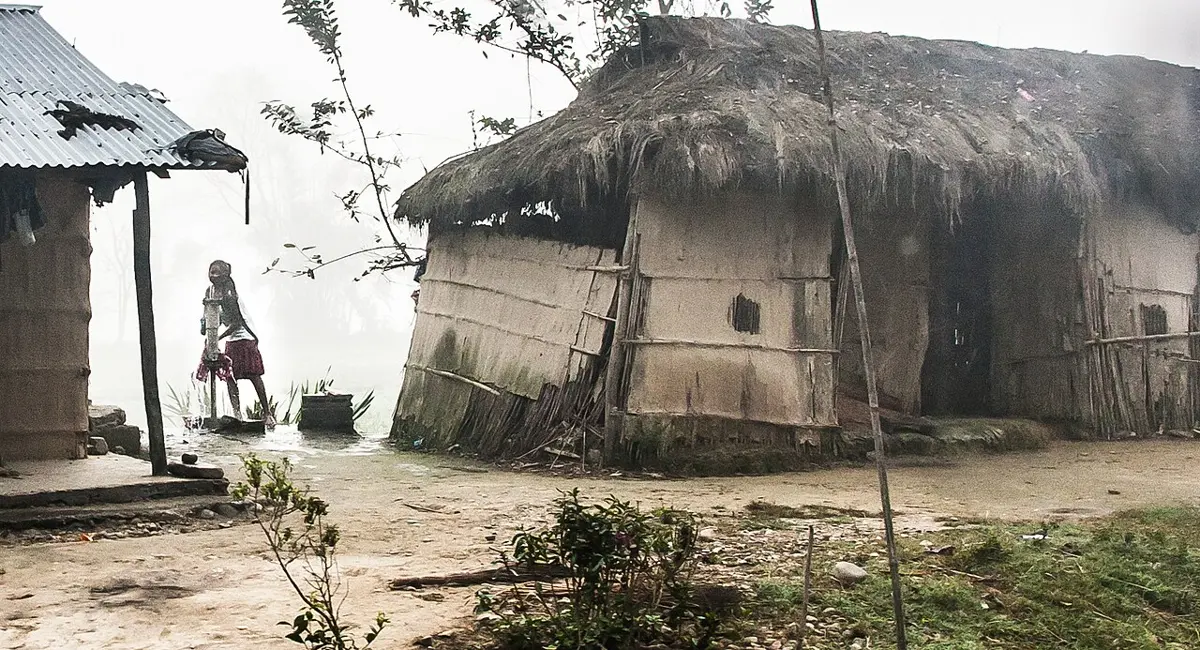
Who held the papers
In the old Tarai, land wasn’t the scarce thing. People were. Land was almost unlimited: a family could clear a new field if it had the hands to work it. So in Chitwan many Tharu chose to farm someone else’s land rather than take on the tax and the duties of an owner. They were landless by choice.
Then, almost overnight, land was the most valuable thing in the valley, and what counted was a name on a paper in a government office. The Tharu landholding families, who could read and knew their way around the offices, registered their land, and some did well. The Rapti project meant to give land to Tharu tenants too. One Tharu man remembered the project’s director, Krishna Bam Malla, saying, “Send your people. I’ll give the Tharu land first.” Some did get land. A twenty-eight-year-old tenant, Issor Man Mahato, and his brother were given three hectares each, and he later said that, next to his wedding day, it was the happiest day of his life. But only a few Tharu got land this way, and too many big holdings went to politicians in Kathmandu.
The Tharu remember it in a few words. “The Nepalis came,” one old woman said, meaning the hill people. Another said, “By the time we got awareness about the import of land, it was all gone.” A third: “Now we don’t have even a spot to plant a walking stick.” Babana, the woman who remembered the babies dying, put both sides together. Malaria control had helped, she said, and so had the project’s health programs and schools. “We were in the dark before,” she said, but through the project “we got to see a little light.” Then she added: “Of course, most of it was in other people’s hands.”
West of Chitwan, in the Dang valley, the land had been slipping away for longer. Early in the 1900s most of the valley’s landlords were Tharu. Toward the end of the 1800s the government had begun naming tax collectors for the villages, the jimidars, mostly hill men, and by the time the post was abolished almost none in the valley were Tharu. Then the end of malaria brought hill families into the valley faster than ever. By the late 1960s the great majority of landlords were पहाडी (pahāḍī), hill people, and about four in five Tharu families were tenants.
The land reform of 1964 was meant to help tenants. In Dang, at first, it did the opposite. Many of the older, larger landlords sold land, and the buyers were nearly all newcomers from the hills; the Tharu didn’t have the money. Landlords also pushed up the rent. Where a Tharu tenant had once given the landlord a fifth or a quarter of the harvest, by the late 1960s many were giving half. In one village the Tharu tenants refused, and left the whole harvest on the threshing ground while the dispute went to the courts in Kathmandu. They were pressed by the police and by beatings and threats, and in the end they had to accept half, or in some cases a third.
So the Tharu of Dang began to leave. For years a few families a year had moved west, to the forests of Bardiya and Kailali, where land could still be cleared. In the late 1960s and early 1970s it became a flood. Families walked west along the trails after the rice harvest, carrying what they owned, and sometimes a whole village went and hill families took its place. A group of young Tharu in Dang printed a magazine in their own language, Gotchali, with a song whose refrain begged, “Oh my friends, do not leave.” The government banned it after one issue and jailed some of its editors.
A year’s work at Maghi
The Tharu who went west often found that the hill settlers had come too. Many of them, and many who stayed in Dang, ended up as कमैया (kamaiyā), laborers bound to a landlord.
The arrangement was made each year at माघी (Māghī), the Tharu new year in mid-January. A kamaiya agreed to work for a landlord for the year in return for a fixed amount of grain. The grain was seldom enough, so during the year he borrowed: when the food ran out, when his wife fell sick, when a daughter married. A kamaiya who couldn’t pay the debt couldn’t leave, unless another landlord took it over, and so bought him and his family. Debts passed from fathers to sons. His wife and children often worked for the landlord too. Some of the landlords were Tharu themselves; most, by then, were hill families.
How old the system is, is argued. It is often called a leftover from Nepal’s feudal past, and working off a debt to a landlord was nothing new. But the memories of more than fifty Tharu in Dang, gathered by an American historian, tell another story. In them, the kamaiya system as it was in the late 1900s grew mostly from modern soil: from the end of malaria, the new landlords and the scramble for land. Both may be partly true. Bonded work was old, but the number of Tharu families caught in it grew as their land went.
By one count of the 1990s, about 300,000 people lived in kamaiya families in the mid- and far-west, nearly all of them Tharu, most in five districts: Dang, Banke, Bardiya, Kailali and Kanchanpur. They freed themselves, with help. In May 2000, kamaiyas began filing petitions for their freedom at government offices, starting in Geta, a village in Kailali, and others followed across the west. An organization of Tharu activists called BASE, led by its founder Dilli Bahadur Chaudhary, held a rally of more than 10,000 people in Dhangadhi. About 120 kamaiyas came to Kathmandu, slept in a pilgrims’ rest house and sat in protest at Bhadrakali, in the middle of the city. On the fifth day of their sit-in, 17 July 2000 (2 Saun 2057 by Nepal’s calendar), the minister for land reform, Siddharaj Ojha, told parliament that the kamaiyas were free. A law against bonded labor followed in 2002, which also wiped out the kamaiyas’ debts.
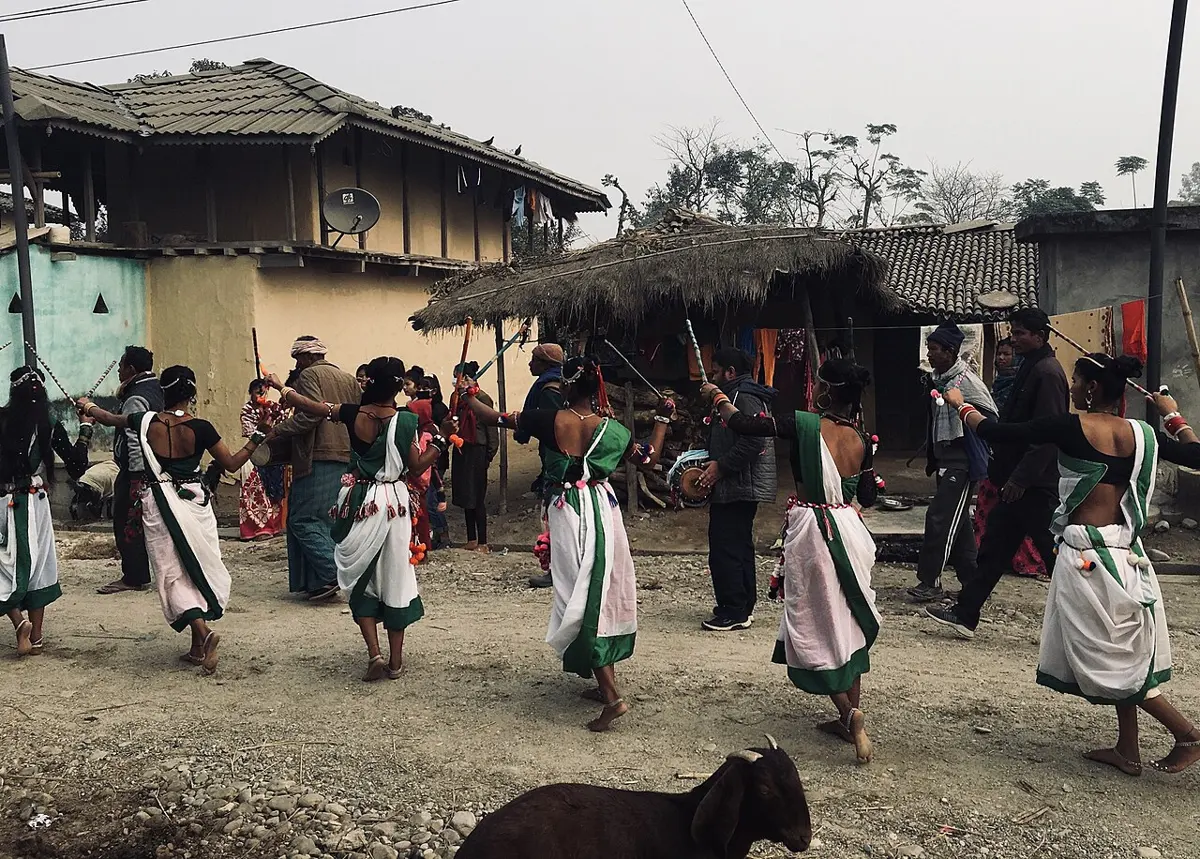
Freedom came with nothing else. Many landlords threw their kamaiyas out of the houses they lived in, and within a week about 800 people had nowhere to go. By September there were 37 camps of them in Kailali and Kanchanpur. The kamaiyas asked for ten kattha of land per family, about a third of a hectare; the government at first offered one. Over the next fifteen years most families were given small plots, many of them on riverbanks that flood. Two and a half years on, a reporter who visited the camps summed it up: “Previously, the kamaiya were oppressed by their owners, now they are oppressed by the government.” In time, others did well. Asturni Dagoura, whose family was given land on the bank of the Chaudhar River in Kanchanpur, where it floods in the rains, said, “After we got the land, we decided to live.”
What happened in the Tarai after 1950 was one of the biggest changes in Nepal’s history, and it came from a mosquito. Killing it saved many lives, Tharu lives among them, and gave hundreds of thousands of hill families land and a new start. But land without the fever went to whoever could get a paper for it, and the people who had lived there longest were least ready for that. The Tharu lost much of their land, many became tenants or bonded workers, and many Madhesi were left without a paper saying they were Nepali. Both of those wrongs fed the demands that Tharu and Madhesi people would bring into Nepal’s politics in the decades that followed.
Found a mistake? Please tell us.