
On 2 May 1980, Nepalis were handed a small square of paper, about four inches each way, with a line down the middle. One half was yellow and the other sky blue. Yellow meant keeping the Panchayat, the system of councils under the king that had ruled the country without political parties for almost twenty years, and reforming it. Blue meant a multiparty system, with parties free to form and compete for votes. Nearly five million people voted, and yellow won, by about 55 votes in every hundred.
Ten years later the Panchayat was gone. In the spring of 1990 crowds filled the streets of Kathmandu and the towns for fifty days, the police fired on them again and again, and on the night of 8 April King Birendra lifted the ban on political parties. In November he gave Nepal a new constitution, which said that the country belonged to its people and that the king would reign but not rule.
How a system that had just won a national vote could fall so fast is this chapter’s story. The short answer comes in a few steps. The vote of 1980 was close enough to show that nearly half the country wanted something else. The reforms that followed it changed less than they promised. Then in 1989 a quarrel with India squeezed Nepal’s supplies of fuel and goods, and the hardship fell on everyone. And in 1990 the Nepali Congress and most of the communist parties, rivals for forty years, joined forces for the first time. When the police shot at the crowds, more people came out, not fewer.
Jhapa and the students
The first sign of trouble came from the far east, and from a direction nobody in Kathmandu expected. Jhapa is the last flat, green corner of the Tarai before India, where the Mechi River marks the border. After the land reform of 1964, its fields were the scene of bitter quarrels between landlords and the tenants who farmed for them, over who would keep the land and how much of the crop the landlord could take.
Just across the border, peasants at Naxalbari in India had risen against their landlords, and a young Indian communist movement named after the village, the Naxalites, was spreading. Its leader, Charu Majumdar, taught that a revolution could begin with the killing of “class enemies”, landlords and moneylenders, one by one. A group of young Nepali communists in Jhapa took up the idea. From about 1971 their small squads attacked and killed several men they counted as enemies of the poor. One of them was Bishnu Prasad Bimali, beaten to death in July 1972 together with Ishwari Prasad Chudal. His son remembers it as murder and nothing more.
The government’s answer was hard. In March 1973 five young men of the movement were shot dead by the police in the forest at Sukhani, in Ilam. The movement has always said they were prisoners, taken from the jail at Chandragadhi on the pretext of moving them to another jail, and that the shooting was a fake encounter, a killing made to look like a fight; Nepal’s school books call it the सुखानी हत्याकाण्ड (Sukhānī hatyākāṇḍa), the Sukhani killings. No police account of it has been published. In 2016 the government named the five martyrs. Within a year or two the revolt was crushed, its leaders in jail; one of them, K. P. Sharma Oli, who would later be prime minister, spent fourteen years there. The two sides still remember Jhapa differently. For the left, it was the first uprising of the Panchayat years, the one that “shook the country awake”, even if, as some of its own members now say, the killings were a wrong turn. For the families of the men killed, it was simply murder. Out of the jailed rebels grew a party, the Communist Party of Nepal (Marxist-Leninist), founded in 1978, which would one day be among the largest in the country.
Meanwhile the new king was trying to shore up his father’s system. King Birendra, who came to the throne in 1972, changed the constitution in 1975. The National Panchayat was made larger, the seats elected by university graduates were abolished, and the Back to the Village campaign, the Panchayat’s own organization of loyal workers, was written into the constitution and given the say over who could stand for election.
At the end of 1976 B. P. Koirala, leader of the banned Nepali Congress and Nepal’s first elected prime minister, came home from exile in India. He came, he said, for national reconciliation, to make peace between the king and the people. He was arrested on arrival. He was released in 1977, tried on charges of treason the next year, and acquitted.
What broke the calm came from far away. In April 1979, Pakistan hanged its former prime minister, Zulfikar Ali Bhutto. Two days later students from the colleges in Kathmandu marched to the Pakistani embassy at Lainchaur with a letter of protest, and the police beat them back. The march grew into a movement. The students wanted back their unions, which had been banned, and the colleges’ old freedoms, and they soon wanted more. Campuses closed, the protests spread across the country, and in the riots of May the offices of the government newspaper, Gorkhapatra, were smashed and buildings burned on New Road. B. P. himself did not back the students at first.
A vote on the Panchayat
On the morning of 24 May 1979, King Birendra spoke on Radio Nepal. There would be a referendum, a vote of the whole people on one question. Every adult would choose between the Panchayat, kept and reformed as needed, and a multiparty system. In Nepali a referendum is a जनमत सङ्ग्रह (janmat sangraha), a gathering of the people’s opinion, and this one is known as २०३६ सालको जनमत सङ्ग्रह (2036 sāl ko janmat sangraha), the referendum of 2036, after the year in Nepal’s calendar when it was announced. The vote itself came in the first weeks of 2037.
The campaign lasted almost a year, and both sides argued openly for the first time since 1960. The Panchayat’s defenders, known as Panchas, said that parties had divided the country before, that they would let foreigners meddle in Nepal’s affairs, and that the Panchayat had given the country stability, development and its king. The multiparty side said the Panchayat had made Nepalis subjects instead of citizens, that it ran on corruption, prison and the misuse of public money, and that a government elected by votes would govern by law. The American embassy watched closely and thought that many people saw the vote simply as a verdict on twenty years of the Panchayat.
Each side had its troubles. The Panchas, split into rival groups, closed ranks once the vote was called. The prime minister who had faced the riots resigned, and Surya Bahadur Thapa, who replaced him, threw himself into winning. The government’s machinery worked for the yellow side, and critics said later that money was raised for it from officials and traders, and forests cut and sold to pay for the campaign. The communists couldn’t agree whether to take part at all. Some campaigned for blue, and some, including Jhapa’s new party, called the whole thing a secret deal between the king, India and the Congress. B. P. trusted the king’s promise of a fair vote, and some of his critics thought him far too trusting.
When the votes were counted, 67 in every hundred voters on the rolls had voted. The Panchayat had 2,433,452 votes, 54.8 percent, and the multiparty side 2,007,965, 45.2 percent. Multiparty won in 19 of the country’s 75 districts, among them all three districts of the Kathmandu Valley, several in the Tarai and a few in the hills.
Ganesh Man Singh and others in the Congress wanted to reject the result, saying it had been rigged. B. P. accepted it. That choice is still argued over: whether accepting a vote he had asked for kept Nepal’s politics peaceful, or gave the Panchayat ten more years.
The people who chose yellow are easy to forget. More than half the voters did, most of them outside the towns, and the Panchas’ arguments, stability, the king and the fear of quarreling parties, were the ones that won them. In 1980 the Panchayat was not a system nobody wanted. It won.
Reformed, and stuck
The king kept his word on reform, up to a point. His third amendment to the constitution, in December 1980, let every adult elect the National Panchayat directly. Its members would put forward a prime minister for the king’s approval, and the ministers would answer to them, not to the palace. The Back to the Village campaign was wound up and a new committee took its place. But parties stayed banned.
In the elections of May 1981 only about half the voters turned out, and more than seven in ten of the candidates the king was known to favor lost. B. P. Koirala died the next year, in July 1982. Prime ministers came and went as the Panchas’ groups fought among themselves. Surya Bahadur Thapa fell in 1983 after a shortage of food, and Lokendra Bahadur Chand took his place. In 1985 the Congress began a campaign of peaceful disobedience. That June bombs went off in Kathmandu, and the leader of a small group and others with him were blamed and sentenced to death. In 1986 there were elections again, and Marich Man Singh Shrestha became prime minister.
Under the reforms the old laws stayed. People could still be held for months without a trial, newspapers closed, and party workers arrested. Amnesty International, the London-based human rights group, reported on Nepal in the late 1980s, and in 1988 a group of Nepalis founded the country’s own human rights organization.
Then came the trouble with India. Nepal has no coast. Most of its fuel and factory goods came across the Indian border, under two treaties, one for trade and one for transit, the right to bring goods from other countries through India. Both ran out on 23 March 1989, India didn’t renew them, and that day it closed all but two of the crossings, or nineteen of twenty-one, by another count. In Nepal this is remembered as the blockade; India said only that the treaties had lapsed.
Why India did it is argued, but its complaints had been building for years. In 1988 Nepal had bought weapons from China, among them anti-aircraft guns. It had begun to require work permits for Indians working in Nepal, and put high taxes on some Indian goods.
The effect was felt in every kitchen. Kerosene, the fuel many families cooked and lit their homes with, was rationed by coupon. The economy, which had grown by almost ten percent the year before, grew by one and a half. Hardship had been building for years, and the quarrel made it worse; it became one of the causes of what came next. The trouble wasn’t over until June 1990, when the new government in Kathmandu and India’s agreed to go back to the old arrangements.
Fifty days in 1990
In January 1990 the Nepali Congress held its first national conference in thirty years, at Chaksibari in Kathmandu, with Ganesh Man Singh among its leaders. Delegates came from every district, and guests too, among them the Indian politician Chandra Shekhar, who later became India’s prime minister. On its last day the party’s acting president, Krishna Prasad Bhattarai, announced a People’s Movement, the जनआन्दोलन (jana andolan), to end the Panchayat, starting on 18 February. It was to be, he said, the party’s final movement. The date was Democracy Day, the anniversary of King Tribhuvan’s promise of democracy in 1951.
This time the Congress was not alone. Seven communist parties came together as the United Left Front, and the two old rivals agreed to fight the Panchayat together. The movement of 2046, named for the year in Nepal’s calendar, had begun.
On 18 February there were processions in about forty district towns. Hundreds were arrested, many before it began. Within days the police had fired on crowds and killed people in Chitwan, in Janakpur and in Bhaktapur. The king, in a message to the nation, said the Panchayat would go on improving, that nothing was gained by acting outside the constitution, and that Nepal’s future was for Nepalis to decide.
The movement grew in the way the Panchayat’s leaders least expected, by drawing in people who had never marched before. Lawyers gathered at the Supreme Court. Doctors protested when wounded marchers were brought in with injuries they said came from bullets meant to cause the worst harm. Teachers joined, and bank workers and others put down their pens for an hour a day. Writers who met at Tri-Chandra College in Kathmandu were arrested together, and others at the university soon after. At the end of March the people of Patan put up barricades and declared their city free of the government, and Kirtipur did the same a few days later.
Abroad, too, the Panchayat was losing friends. Indian members of parliament spoke up for the movement, the United States criticized the government, Japan cut its aid and Germany said it would stop. Across Eastern Europe, one-party governments had fallen one after another the year before, and the leaders of the movement told their followers that the world was on their side.
The worst day was 6 April. Early that morning the king dismissed Marich Man Singh Shrestha’s government on the radio and asked Lokendra Bahadur Chand to form a new one. Ganesh Man Singh, under arrest and in hospital, called it putting one Rame in place of another Shyame, the Nepali way of saying one ordinary name for another. In the afternoon an enormous crowd gathered at Khula Manch, the open ground in the middle of Kathmandu, and part of it marched up Durbar Marg toward the palace. Some of the marchers damaged the statue of King Mahendra there, and the police opened fire; whether soldiers fired too was never established. A doctor at Bir Hospital remembered the dead and wounded arriving about every twenty seconds, until there was nowhere left on the floor to step.
How many died that day, and in the whole movement, has never been settled. The new government set up an inquiry, led by a judge, Janardan Lal Mallik, and it found about 45 dead and 2,300 injured; but its report was never published in full, and its count is known only from those who read it. That November the Home Ministry was reported to have listed 63 dead, and their families are believed to have been paid compensation. Nepal’s own human rights organization counted 70 and thought there were more, and some estimates ran to 500. The bodies of those shot had been taken by the police for their own examinations before families could claim them, so the exact number may never be known. In the streets people spoke of thousands; that number has never been shown. Police died too: at least six were killed by crowds in late April.
Two days after the shooting, late on the night of 8 April, the king met the leaders of the Congress and the Left Front and agreed to lift the ban on political parties. Crowds poured out to celebrate, and in some places police who had not heard the news fired on them. The next day thousands gathered at Khula Manch for the victory rally.
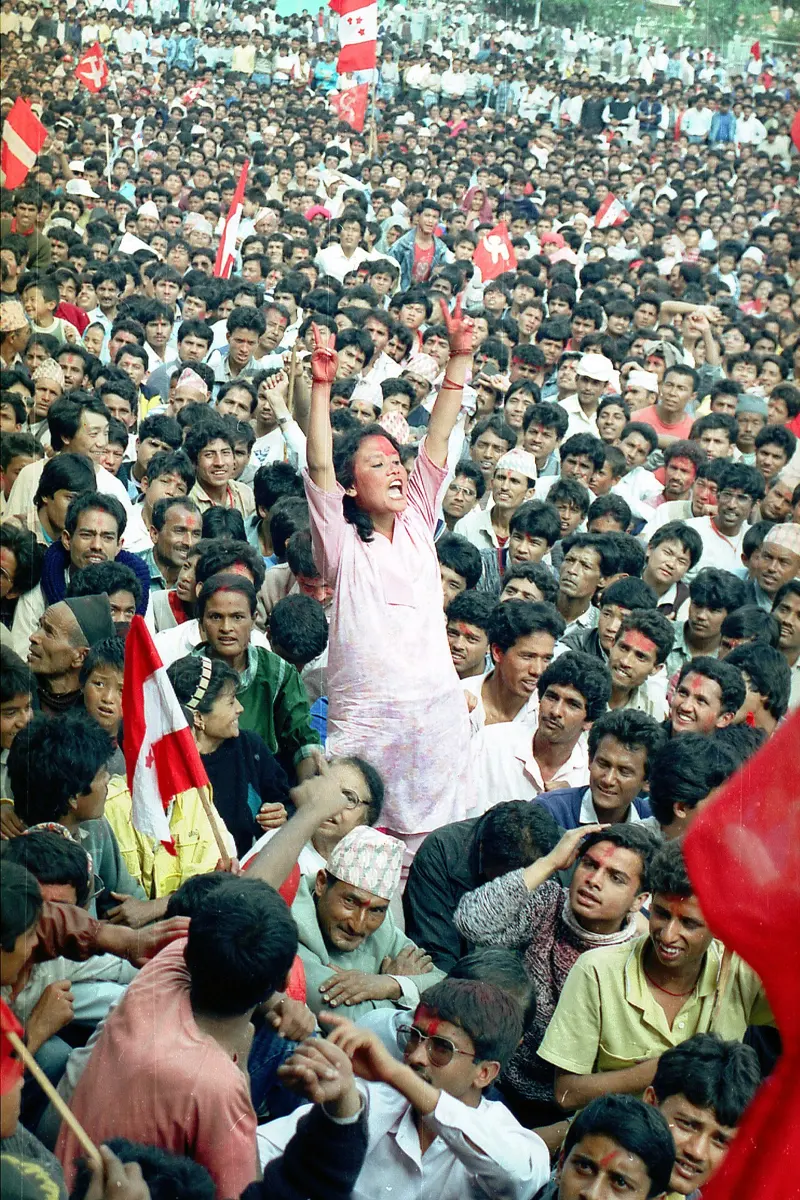
The agreement of 8 April did not dissolve the National Panchayat or remove Chand’s government, and many on the left felt the Congress had settled too soon. One of the movement’s leaders said the people had wanted to win and had lost in the bargain. The protests went on. On 16 April the king dissolved the National Panchayat, and a few days later Krishna Prasad Bhattarai, who had spent fourteen years of his life in prison, became prime minister of an interim government, one meant to hold office only until a constitution was written and an election held. Ganesh Man Singh had turned the post down. Bhattarai’s cabinet of eleven had four members from the Congress, three from the Left Front, two human rights campaigners and two named by the king. Two of the left’s ministers took their oath without naming God.
The Panchayat’s local councils, in every village and town, were dissolved that month. Many of its old leaders soon offered to work with the new order.
The constitution of 1990
The new constitution was written by a commission chosen to represent the parties of the movement and chaired by a Supreme Court judge, Bishwanath Upadhyaya. It gave its draft to the king in September, and the cabinet went over it at length. The hardest arguments were about the king. One draft would have let parliament, by a large enough majority, vote away the monarchy or the multiparty system itself; that line was taken out. The army’s control and the king’s place in it were argued over until the last days. On 9 November 1990 King Birendra proclaimed the constitution, and the constitution of 1962 was gone.
It said, in its third article, that the sovereignty of Nepal, its final authority, was vested in the Nepali people. The king remained head of state and the symbol of the nation’s unity, but he was now a constitutional monarch, bound by the constitution, and a government elected by a parliament would rule. Parties were free to form, and any law that set up a one-party system was void. Every citizen had the right to speak, to meet and to form associations; the press was free; no law could make death a punishment; and treating anyone as untouchable was a crime.
It also kept a good deal of the old Nepal. Article 4 called Nepal “multiethnic, multilingual, democratic, independent, indivisible, sovereign, Hindu and Constitutional Monarchical”. Nepali in the Devanagari script was the language of the nation and of government, and every mother tongue spoken in Nepal was named a national language. But the state stayed Hindu, the king had to be a Hindu, and no one was allowed to convert another person from one religion to another. That summer Buddhists had asked for a secular state, one with no religion of its own, and Christians and others with them; on 30 June thousands marched through Kathmandu for it, behind Buddhist associations. They lost. Whether these lines were a fair picture of the country, or a door left shut, was the argument of the next decade.
In May 1991 Nepalis voted for a parliament, with parties, for the first time in thirty-two years. That election, and what the parties did with their freedom, is the next chapter.
The plain lesson of these years is that the Panchayat fell when the people who had kept it going stopped believing in it. In 1980 more than half the voters still chose it, and the reforms it offered were real but small. By 1990 years of hardship, a quarrel with India it couldn’t settle, the shootings in the streets and a Congress and a left that were for once on the same side had brought out people who had never marched before. In the end the king gave way, and the new constitution put the people above him, while keeping Nepal Hindu, Nepali-speaking and a kingdom.
Meanwhile, in the world: in 1989 the one-party governments of Eastern Europe fell one after another, and movements for democracy rose in parts of the Soviet Union and in several Asian countries. Nepal’s movement leaders took heart from them.
Found a mistake? Please tell us.