
In January 2022 the assembly of Province 2, the one province that lies wholly in the Tarai, met in Janakpur to choose a name. Since 2015 it had been known only by its number. Three names were put forward. One was Janaki, a name of Sita, who in the old story was born at Janakpur. Another was Mithila-Bhojpura, for two of the plains’ great language regions. The third was Madhes, the old word for the middle land that the movements of 2007 and 2015 had carried through the streets. Madhes won the two-thirds vote it needed, and Janakpur became the capital. The word the movements had carried was now the name of a province, often spelled Madhesh.
This chapter is different from the others. Everything in it happened within the lifetime of the people it names, most of whom are still alive and still arguing, and some of it is not finished. It tells what is on the record from the elections of 2017 to November 2026, when it was written, and it says who claims what where people disagree. It doesn’t say who was right. It will be rewritten as the story goes on.
Each province had to name itself the same way, by two-thirds of its own assembly. Five took the names of rivers, places or directions: Bagmati, Gandaki, Lumbini, Karnali and Sudurpashchim, the far west. Province 1, in the east, waited until 2023. The UML’s leader, Oli, had argued for Koshi, after the river: it carried an old civilization and tradition, he said, and a name of civilization rather than of one people would be common to all. On 1 March 2023 (17 Phagun 2079) its assembly chose Koshi by 82 votes to 4, with the Congress, the UML, the Maoist Centre and the Rastriya Prajatantra Party voting for it; two smaller parties had backed Kirat-Limbuwan-Sagarmatha. Limbu, Rai and other groups had wanted a name drawn from the history of the peoples whose old homeland the east was, Kirat-Limbuwan or Limbuwan-Kirat, a name they expected would respect their identity. It was the old argument of identity, which had split the first Constituent Assembly, fought again over the province’s name. A general strike stopped much of the province. At a protest in Biratnagar on 19 March, Padam Limbu Lajehang, a 42-year-old man from Dharan, was hit on the head when the police charged with batons, and died five days later. The name was kept, and its opponents went on asking for another.
Governments that came and went
The elections of 2017 gave Nepal something it had rarely had: a government with a large majority. The UML and the Maoists had campaigned together, and in May 2018 they joined into one party, the Nepal Communist Party, with KP Sharma Oli as prime minister. Between them they held almost two-thirds of the House.
It didn’t last. The new party quarreled within. Oli’s rivals in it, led by Pushpa Kamal Dahal, said he ran the government without following the party’s guidance, and asked him to give up his posts; Oli called their charges “a bunch of allegations”. On 20 December 2020 Oli asked the president to dissolve the House and call an early election. He said the quarrels in his own party made it impossible to govern, that no other government could be formed, and that the country needed a fresh mandate. His opponents, many of them from his own party, said the constitution allowed no such thing while another government could still be formed, and they went to the Supreme Court. Its five judges agreed with them, all five, and on 23 February 2021 the House came back. Twelve days later another bench of the court decided a different case: the name Nepal Communist Party had already been registered by someone else, a man named Rishiram Kattel, so the merger was void, and the UML and the Maoist Centre were two parties again. In May 2021, with the second wave of Covid-19 surging, Oli had the House dissolved a second time. In July the court restored it again and ordered that Sher Bahadur Deuba of the Nepali Congress be made prime minister within two days.
Nepalis voted again in November 2022 (Mangsir 2079). The Congress came first, with 89 of the 275 seats, and the UML second, with 78. A party five months old came fourth with about twenty: the Rastriya Swatantra Party, founded by Rabi Lamichhane, the host of a popular television program, on a promise to fight corruption. Six months earlier Kathmandu had elected as its mayor Balendra Shah, a rapper and engineer standing for no party. Both had drawn voters away from the established parties, though no one could yet say how many.
Governments went on changing inside parliament. Dahal, whose Maoist Centre had come third, became prime minister in December 2022 and stayed eighteen months, with partners that changed under him. In July 2024, after the UML left Dahal’s coalition and he lost a vote of confidence, Oli came back as prime minister for the fourth time, now with the Congress, his party’s old rival; the two agreed that Oli would hand over to Deuba later in the term. By one count, made in early 2025, Nepal had had thirteen governments since the monarchy ended in 2008.
A line on the map
In the far northwest corner of Nepal, where it meets India and Tibet, the Mahakali River comes down from the mountains. Under the Treaty of Sugauli of 1816, which ended the war with the East India Company, the land east of the Kali was Nepal’s. Nepal’s case is that the river begins at Limpiyadhura, far to the northwest, so the land between, including Kalapani and the Lipulekh pass on the old pilgrims’ road to Mount Kailash and Lake Mansarovar in Tibet, is Nepali. India holds the area and says the river begins near Kalapani, so the land is India’s.
The quarrel was old, but in these years it came into the open. In November 2019 India published a new map that showed Kalapani inside India, and in May 2020 India’s defense minister opened a new road, about eighty kilometers long, up to Lipulekh. Nepal answered with a map of its own, which by its officials’ figures added about 335 square kilometers to the country, and in June 2020 both houses of its parliament voted to put that map in the constitution and in the national emblem: the House of Representatives on 13 June, the National Assembly on 18 June. Every member present voted for it, in both houses: it was one of the few things on which every party agreed. India’s foreign ministry called it an “artificial enlargement” of claims, not based on historical fact or evidence and “not tenable”. China’s foreign ministry had said that May that “the issue of Kalapani is between Nepal and India”, and hoped the two would settle it by friendly talks.
In August 2025 India and China agreed to reopen border trade through Lipulekh. Nepal objected to both, and asked them to do nothing there without its consent. India replied that trade through the pass had gone on since 1954, that Nepal’s claims were neither justified nor based on historical facts and evidence, and that it was open to talks on the boundary. The maps on this site draw Nepal’s outline as Nepal’s government draws it, with the three places inside; India’s maps put them inside India. Where the line runs on the ground is still for the two countries to settle.
Going abroad
While governments came and went, the biggest change in many families had nothing to do with Kathmandu. The census of 2021 counted 2,190,592 Nepalis living abroad, from almost a quarter of all households, and more than eight in ten of them men. Ten years earlier it had counted about 1.9 million. Between 2008 and 2024 Nepal’s labor ministry gave out 5.7 million new permits to work abroad. Four in five of the latest went to the Gulf countries and Malaysia, though more and more workers were going to Croatia, Poland, Romania and other countries in Europe. The permits leave out India, where no permit is needed across the open border: the census found over half a million Nepalis working there, and it misses the many who go for a season.
The money they send home keeps growing. In the year to mid-July 2026 it came to about 2.36 trillion rupees, Nepal Rastra Bank reported, and the National Statistics Office expected it to equal about a third of everything Nepal’s economy produced that year, up from just over a quarter the year before. In 2023 more than a third of households received some, the labor ministry reported, and its report also counted over 1,200 Nepali workers who died abroad in each of its last two years. By 2021, almost a third of the households at home were headed by women, up from about a quarter ten years before.
A king’s supporters, and Gen Z
In March 2025, about ten thousand people met the former king, Gyanendra Shah, at Kathmandu’s airport as he came back from a tour of the west, and called for the monarchy and the Hindu state to be brought back. Their case, as the Rastriya Prajatantra Party put it, was that the system of the republic had failed. The party wanted the provinces scrapped as a burden, and a king restored as “guardian of the state”, a “parental institution, bounded by the constitution”, in its chairman’s words. Others saw no such future: the political scientist Lok Raj Baral, asked about the rally, saw no chance of a return and called the monarchy “a source of instability”. Gyanendra said nothing about the calls at the time. In his New Year message that April he spoke of “multiparty democracy under a constitutional monarchy”, and in February 2026, as the monarchist leader Kamal Thapa reported his words, he said the coming election should wait until the nation’s problems were solved, and asked politicians to stop using his name to win votes.
On 28 March a monarchist rally at Tinkune, in the east of Kathmandu, turned violent. Dozens of buildings and vehicles were set on fire, seven people were treated for bullet wounds, and two people died: Sabin Maharjan, a 29-year-old protester from Kirtipur, and Suresh Rajak, a television journalist who was filming the protest when the building he was in was set alight and he was trapped inside. The home ministry held the rally’s organizers fully responsible. The RPP said the state’s own agencies had provoked the crowd, and asked for an independent inquiry led by a former Supreme Court judge.
Five months later came a far larger movement, from people who wanted neither the parties in power nor a king. On 4 September 2025 the government blocked 26 social media sites, among them Facebook, YouTube and X, because they had not registered under a new rule. Four days later, on 8 September (23 Bhadau 2082), thousands of young people, calling themselves Gen Z, marched on the parliament building in Kathmandu. Their anger, as they told reporters, went well beyond the apps: against corruption, and against the children of politicians showing off rich lives online while young people at home looked for work. Some broke through a barricade into the parliament grounds, a local official told Al Jazeera, and the police fired tear gas, rubber bullets and live rounds. Human Rights Watch said footage showed police shooting peaceful protesters, some in school or college uniforms. At least nineteen people were killed that day, seventeen of them in Kathmandu.
The next day the ban was lifted, but the crowds came back larger. The parliament building, Singha Durbar, where the ministries sit, and the homes of several leaders were set on fire, and a newspaper group’s offices were burned too. Deuba and his wife, the foreign minister Arzu Rana Deuba, were attacked and badly hurt by a crowd in their home, and three police officers were killed by a crowd in Kathmandu. The groups that had called the protest said it had been hijacked by opportunists. Prisoners broke out of jails across the country. Oli resigned the same day. After two days of talks between the president, the army chief and young people from the protests, Sushila Karki, a former chief justice, became the interim prime minister on 12 September, the first woman to lead a Nepali government. The House was dissolved and an election set for 5 March 2026. Congress and UML lawmakers went to the Supreme Court, calling the dissolution unconstitutional; in the months before the election the court declined to make any order on them. At least 76 people died in the two days, by the count of the National Human Rights Commission, 21 of them in the fires of the second day.
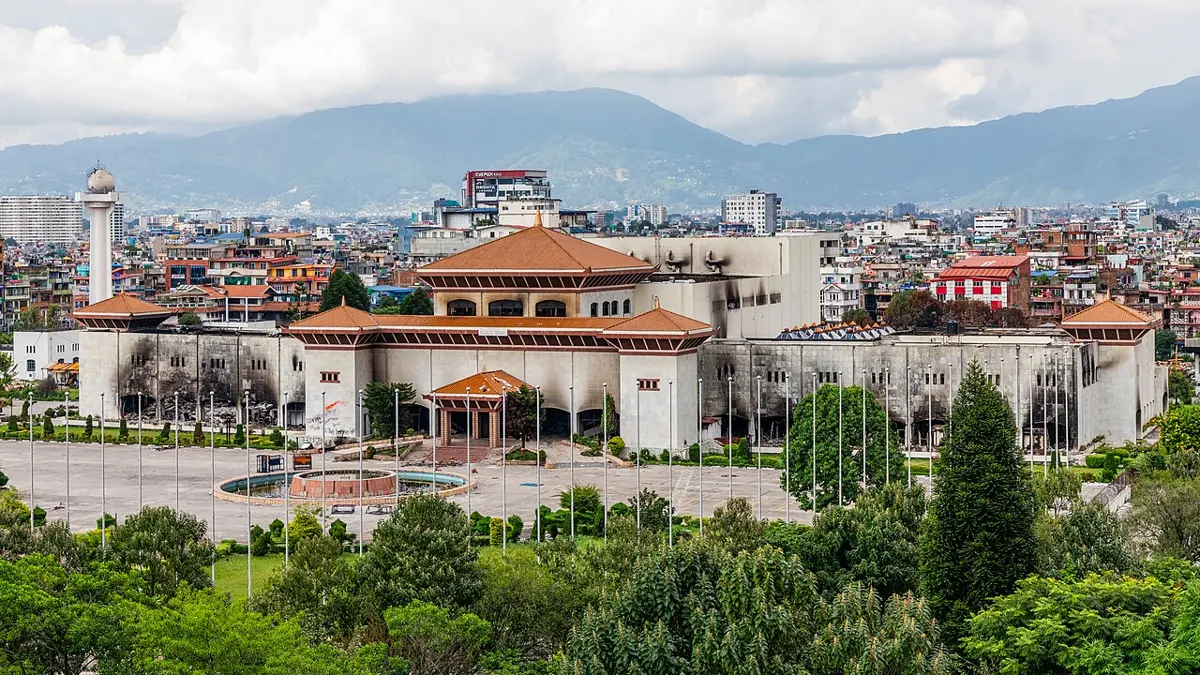
Who answers for those deaths is still being argued. A commission set up by the interim government, under a retired judge, Gauri Bahadur Karki, recommended charging Oli, his home minister, Ramesh Lekhak, and the police chief with criminal negligence for the shooting of the first day; its report reached the press in March 2026, and the government said it would make it public, but by June, a scholar noted, it still had not been officially released. In May the Human Rights Commission held Oli primarily responsible too, with two of his ministers and the heads of the security forces, and asked that nearly four dozen others be investigated, among them organizers who had failed to keep the protest peaceful, the interim prime minister and her home minister, and the commission’s own chair. Oli has said the government never ordered the police to shoot, and that the protest was taken over by others, some with guns the police didn’t have. In March 2026 he and his former home minister were arrested so that the police could investigate; the Supreme Court had them released on 9 April, on condition that they appear when called.
The election of March 2026
Six in ten voters came out on 5 March 2026 (21 Phagun 2082), the fewest in any election since 1991. The Rastriya Swatantra Party, which Balendra Shah had joined at the end of 2025, won 182 of the 275 seats, by the Election Commission’s final count, two short of two-thirds. The Congress fell to 38 and the UML to 25, and the Nepali Communist Party, which the Maoist Centre, the Unified Socialists and smaller left parties had formed in November 2025 under Dahal’s leadership, won 17. Two smaller parties crossed the line for national status: a new one, the Shram Sanskriti Party, with 7, and the Rastriya Prajatantra Party, the monarchists, with 5, down from 14. Women won 96 seats, about a third. Shah, 35, beat Oli himself for his seat, and on 27 March he became prime minister, the first from a Madhesi family.
As this chapter was written, in November 2026, his government had been in office eight months, and he was about to visit India, where the line on the map might come up. Whether it does what its voters hoped is not history yet.
These nine years leave a reader with several things to hold, not a single story. The provinces got their names, and in the east the old argument over identity came back with one of them. Governments rose and fell inside parliament, the Supreme Court twice undid a prime minister’s decision, and three leaders, Oli, Deuba and Dahal, held the post in turn. Nepal put Limpiyadhura, Lipulekh and Kalapani into its constitution, India called the claim untenable, and the land is still argued over. Millions of Nepalis earned their living abroad, and their money kept many families going at home. Then, in 2025, came two very different protests, one for the king and one against everyone in power; seventy-six deaths in two days, over which two inquiries differ; and an election that gave power to a party not four years old. How all this will be told in twenty years nobody knows yet, and why that is so is the subject of the last chapter.
Found a mistake? Please tell us.