
In 1877 Cambridge University Press printed a History of Nepal, and the name on it was Daniel Wright’s. Wright was a British doctor who had spent ten years at the Residency in Kathmandu, the house where Britain’s representative lived. But his preface says plainly that he wasn’t a scholar of the languages and had only revised the book for printing. The history itself was a वंशावली (vaṃśāvalī), a chronicle of the Valley’s kings, put into English by the Residency’s chief clerk, Shew Shunker Singh, with help from a pandit of Patan, Gunanand, whose family, Wright wrote, had been compiling it for many generations. It was, he added, the Buddhist version. There was another, honored by the Gorkhali rulers and the country’s Hindus, that told the same past in its own way.
The chronicle runs from the days when the Valley was a lake down to the birth of Surendra, who was king when the book was printed. There, the book says, the original manuscript ends. And then the printed book goes on for two more chapters, the family trees of the two men who held Nepal: first that of Jung Bahadur Rana, the prime minister who really ruled, tracing his family back to the Rajput princes of Chittor in India, and only after it the king’s. Footnotes say only that neither is in the chronicle and that both come “from another source”. Who added them, and why, the book doesn’t say.
One book, then, with a family of chroniclers, a clerk, a pandit, a British doctor and a ruling family all inside it. That is the question this last chapter asks of the whole book: who writes history? The plain answer is that every history is written by somebody, at some time, for somebody, and so every age writes its past again. New evidence turns up. People who were never asked get to write. Each generation brings its own questions. None of that is lying. A historian who rewrites shows the evidence and lets anyone check it; a liar hides it, bends it or makes it up. And a good deal of Nepal’s history hasn’t been written by anyone yet.
Chroniclers and the people they wrote for
The oldest of Nepal’s chronicles, the palm-leaf गोपालराजवंशावली (Gopālarājavaṃśāvalī), seems to have been put together in the 1380s by someone close to the court of Jayasthiti Malla (Chapters 1 and 10). Its writer muddled the Licchavi kings, as the pillar of मानदेव (Mānadeva) shows, and gave the Kirat kings reigns of up to ninety years that nobody can check (Chapter 4). But for his own century he wrote like a careful diarist, down to the beer at a canal feast. A chronicle could be both a record and a court’s idea of its own past.
The Gorkha campaign has its own writers, and each stood somewhere. A poet at Prithvi Narayan Shah’s court praised the king’s victories, noses cut at Kirtipur among them. An Italian priest in Patan, whose mission fell with the Malla kings, wrote one of the fullest accounts, printed in English for British readers. The story of Ranajit Malla singing his lament on Chandragiri comes from an account of the Gorkhali rulers gathered about seventy years later, in the 1840s, under a Gorkhali general, and kept among the papers of a British Resident (Chapter 17). Every one of them tells us something true, and every one has a reason to tell it his way.
Sometimes nearly all the writers stand on one side. Of the night at the Kot, when Jung Bahadur took power, almost every account was written or told by his own people, by British officials whose informants were his men, or by the queen defending herself, and under his rule speaking against him could mean exile or death (Chapter 22). Where the losers left no papers, a historian can only say so.
For a long time, most of what the outside world read about Nepal’s past came from a short shelf of books, mostly in English, several of them by men at that same Residency. A historian of Nepal once warned about such a shelf: books that are often quoted and seldom read closely stop being questioned. They become “the sources”, and their makers’ politics fade from view.
One story for a whole country
The story most Nepalis learned at school wasn’t written in Kathmandu at first. It was written in Darjeeling and Banaras, in the 1930s and 1940s, by Nepalis living under British rule in India, who wanted a shared language and a shared past for people of many hill peoples (Chapters 21 and 25). Surya Bikram Gyawali wrote the lives of Prithvi Narayan Shah, Amar Singh Thapa and Balbhadra Kunwar, the captain who held the fort of Nalapani against the British (Chapter 20).
After the Ranas fell, Nepal’s own schools took that story up. A national commission on education, reporting in 1955, wrote: “Our isolation has made us proud and nationalistic, and we wish to remain so.” Education, it said, must restore the nation’s pride and heroism after centuries of “darkness”. Nepali was to be the one language of the classroom; the commission hoped the others would fade away. In the 1960s the Nepali readers for every grade were renamed Mahendra Mala, after the king, and through the 1970s, school by school and district by district, the government’s own books replaced the rest.
What did those books do to a generation? One October morning in 1994 the historian Pratyoush Onta climbed a hill outside Kathmandu with ten other young Nepalis, all in their twenties or early thirties, and asked which history lesson from school they remembered best. Everyone who had gone to school in Nepal gave the same answer: Balbhadra at Nalapani. Onta wasn’t surprised. In Grade 5 he had read about Balbhadra twice, in a poem and in an essay, and the Grade 4 reader of a few years before had told the story as a play. The poem had Nepali soldiers at Nalapani swinging their khukuris and cutting the enemy down like radishes.
Onta called what those books taught राष्ट्रिय इतिहास (rāṣṭriya itihās), national history, and he noticed its shape. A brave age ran from Prithvi Narayan’s first campaigns in the 1740s to the treaty of 1816, a parade of warriors from Prithvi Narayan to Bahadur Shah, Amar Singh Thapa, Bhakti Thapa and Balbhadra. Then came a long darkness under the Ranas. Then, after 1951, development. He called it the story from बीर (bīr), brave, to बिकास (bikās), development.
He also noticed what had been cut. Gyawali’s own life of Balbhadra, printed in 1940, said things the school books later left out: that Balbhadra was a close relative of the Rana family, which the books cast as darkness; that many of his soldiers were Magars, and men from Garhwal in today’s India; and that after the war he went to the Punjab to serve the Sikh king Ranjit Singh and was killed fighting the Afghans. Gyawali had even said that this was a brave death, but would have been finer in his own country’s service. The Grade 5 essay said simply that Balbhadra was born in a brave family, fought bravely for his country and died fighting in a war. Every word of that is true. It just doesn’t say whose war. Gaje Ghale, a Gurkha who won Britain’s highest medal for bravery in Burma, had been in a Nepali reader of the 1950s and was dropped from the national ones: a Nepali winning medals in a foreign army didn’t fit (Chapter 21).
Onta’s word for this was pruning, the way a gardener cuts off whatever spoils a plant’s shape. Nothing in the story was invented. Things were chosen, and the rest trimmed, until the story was simple, proud and smooth. The same years gave Nepal “one language, one dress, one country” (Chapter 30). Imagining a nation, Onta wrote, borrowing a famous idea about nations, isn’t making things up. It is making something. A nation needs a shared story. The question is who gets to be in it.
The people the books left out
CDC’s own Grade 10 इतिहास book says it plainly in its last unit. In Nepal, it says, history was long written only about the center and the people at the top, kings, great rulers and high officials, and that kept history in a narrow ring. It should be written about everyone who made the country, every person, place, class, gender and caste, from the local level to the center, and many people and places have been left in the shade.
Many of the people left in the shade wrote back long before the book said so. A Limbu history was written in Limbu in 1843, and in 1952 the Limbu historian Iman Singh Chemjong printed the royal order of 1774 that the Limbu remember as a treaty (Chapters 18 and 21). Magar writers retold the Gorkha campaign as the work of their ancestors, who did the fighting and got little thanks for it (Chapter 21). Madhesi writers such as Ram Manohar Sah, in The Middle Country, told the plains’ history as a land taken over by hill rulers, a reading that others dispute (Chapter 21).
The Tharu of Dang tried to speak for themselves while they were losing their land. A group of young Tharu printed a magazine in their own language, Gotchali, with a song begging their people not to leave; the government banned it after one issue and jailed some of its editors (Chapter 31). Years later, when a historian came to Dang to ask, more than fifty Tharu told how the kamaiya system of bonded labor had grown up in their own lifetimes.
Dalits left even fewer papers, and for a simple reason: for centuries most Dalits were kept poor and unschooled, and out of the offices where papers were made and kept. Scholars who study Nepal’s Dalits say that this lack of written papers has held Dalit history back, and that it comes from the same exclusion. So Dalit history is being built from other things: memory and the stories people tell of their own lives, photographs, and the answers Dalit writers have given to the law that ranked them (Chapter 23). A book of photographs, Dalit: A Quest for Dignity (2018), gathers pictures of Dalit lives, with verses by the Dalit poet and thinker Aahuti, who has called for an accounting of a humiliated history.
Women have had to write themselves in too. Mangala Devi Singh, who led the women’s association against the Ranas, wrote her own memoir, and this book used it (Chapter 26). In 2023 photo.circle published The Public Life of Women, built from the photographs of more than a hundred contributors, from a school in Kathmandu in 1935 to the women who founded the Nepal Women’s Association in 1947. Its makers wanted the everyday history that a story of rulers leaves out.
These histories get asked the same questions as all the others. Their writers have causes too, and say so. Some activists’ account of how किपट (kipat), the Limbu’s clan land, was lost has been called too simple, and the Limbu fought on both sides in the 1770s (Chapter 21). Being left out doesn’t make a history right; it makes it necessary. A reader holds each one up beside the others and the evidence, as with the king’s pillar and the chronicle.
Rewriting isn’t lying
So every age rewrites its past. Sometimes the ground simply gives up something new. One house trench at Maligaon in 1992 turned up a statue that pushed the Valley’s written history back by centuries, and a trench across a fault agreed with a palm-leaf chronicle about an earthquake (Chapter 1). Sometimes someone opens papers nobody had read. Mahesh Chandra Regmi gathered copies of old government papers, royal orders, tax rules and land grants, by the volume, printed many of them in English in a research series of his own, and from them told Nepal’s history as a story of land, taxes and the farmers who paid them, not only of kings and battles (Chapter 24). And sometimes new people get to write, and ask questions their grandparents’ historians never asked.
Pruning sits in between. Every history leaves things out, because no book can hold everything, and this one has left out a great deal. What matters is whether the cutting hides something that would change the reader’s mind, and whether anyone may go and look.
Lying is something else. In the 1930s a photographer took a picture of Stalin, who ruled the Soviet Union, walking beside a canal with men of his government. One was Nikolai Yezhov, head of the secret police. Not long after, Yezhov himself was arrested and shot. In later prints of the photograph he is gone, and water fills the place where he stood. No new evidence had turned up. The past was simply made to fit the present, and the means of checking it were taken away. The forged gift of Rome, exposed by Lorenzo Valla, was the same kind of thing, and he exposed it by asking whether its words fitted its time (Chapter 1).
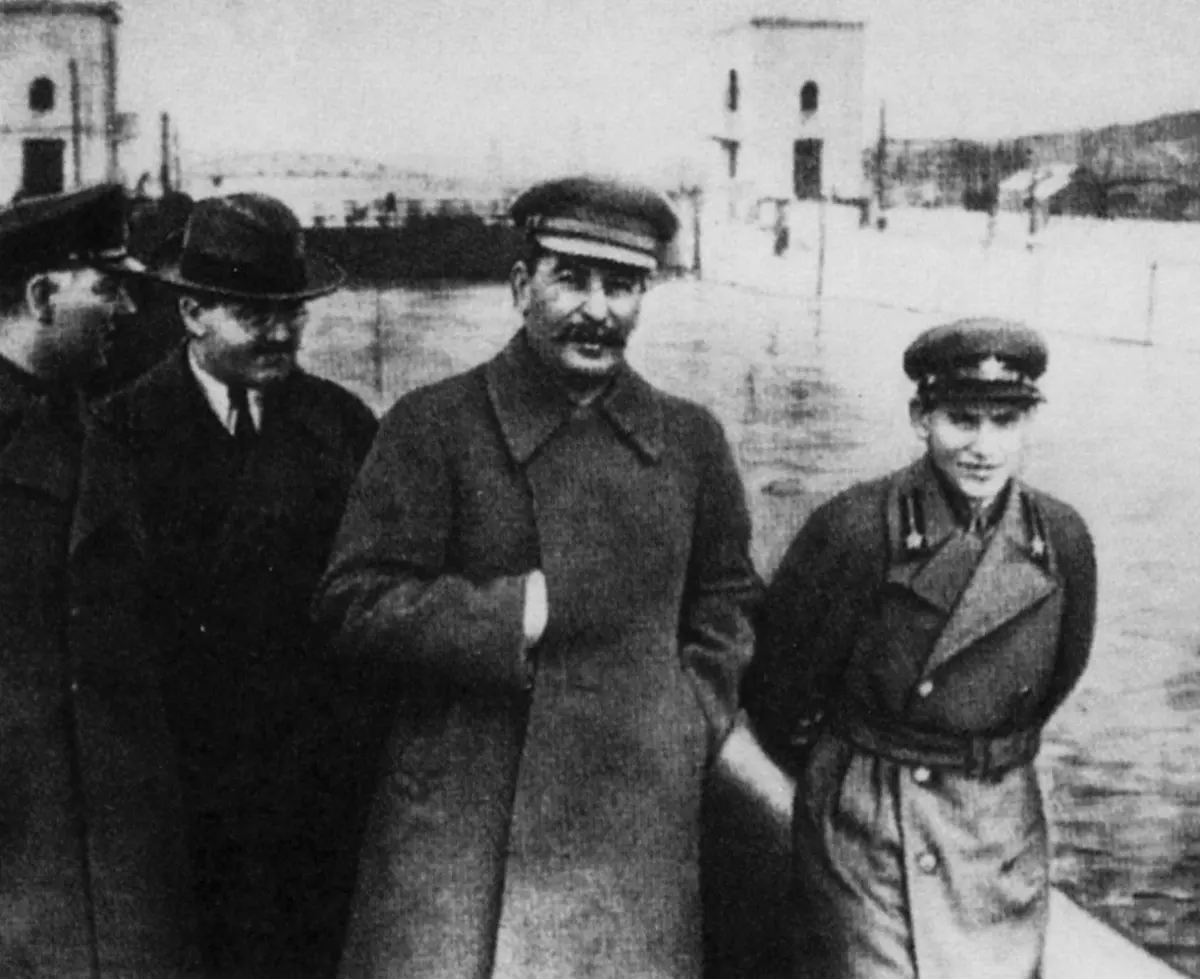
So the line between rewriting and lying isn’t whether a history changes. It is how. A rewriting shows its evidence, says what it is unsure of, and can be checked by someone who disagrees; Valla was right even though his employer was at war with the pope, because anyone could test his argument. A lie hides its evidence, destroys what contradicts it, or punishes the people who ask. The questions that catch it are the ones this book has asked from the start: who wrote this, when, for whom, and what do the others say?
They apply to this book too. It was written in the 2020s, in English, for students, and it has its own choices. That’s why each chapter ends with where its facts come from and what is still uncertain, and why the chapter on the years since 2017 is meant to be revised every year (Chapter 37). If someone finds better evidence, this book should change.
The history nobody has written yet
The same Grade 10 unit turns all this into work for the student. Find one or two historical things in your own area, a temple, an old water spout, a bridge, a festival, and write a report on each, step by step: a title, the background, what you want to find out, the limits of your study, how you will gather information, what you found, and what it means. Take an event that happened where you live and set down its date, its causes, what happened, what came of it, and where your information came from. And ask your grandparents and parents to help you draw your family’s वंशावली.
That last one is the oldest kind of history in Nepal, the same word as the chronicle Gunanand’s family kept in Patan. Many of Nepal’s villages have no written history at all. Their past is in the memory of the oldest people living there, in old family papers, and in the names of fields and wells. When the oldest people go, much of it goes with them. So the place to start is close to home. Sit with the oldest person you know and ask what they remember, and write down when each thing happened, where, and how they know it. Put your place’s events in order on a timeline, which is the same unit’s third lesson. And if your family keeps an old paper, a land deed or a letter, ask it what this book has asked of kings’ pillars: who made it, when, for whom, and what it can’t tell you.
So who writes history? Court chroniclers and foreign priests, British doctors and Nepali exiles, government textbook writers and the peoples they left out, and historians who go back to the evidence and say what they find. Every age rewrites its past, and it should, as long as the evidence stays open to anyone who wants to check. A history that changes because of better evidence or new voices is doing its job. One that changes because the evidence has been hidden is lying. And the next page of Nepal’s history can be written by a student with a notebook, asking an old neighbor what she remembers.
Found a mistake? Please tell us.