
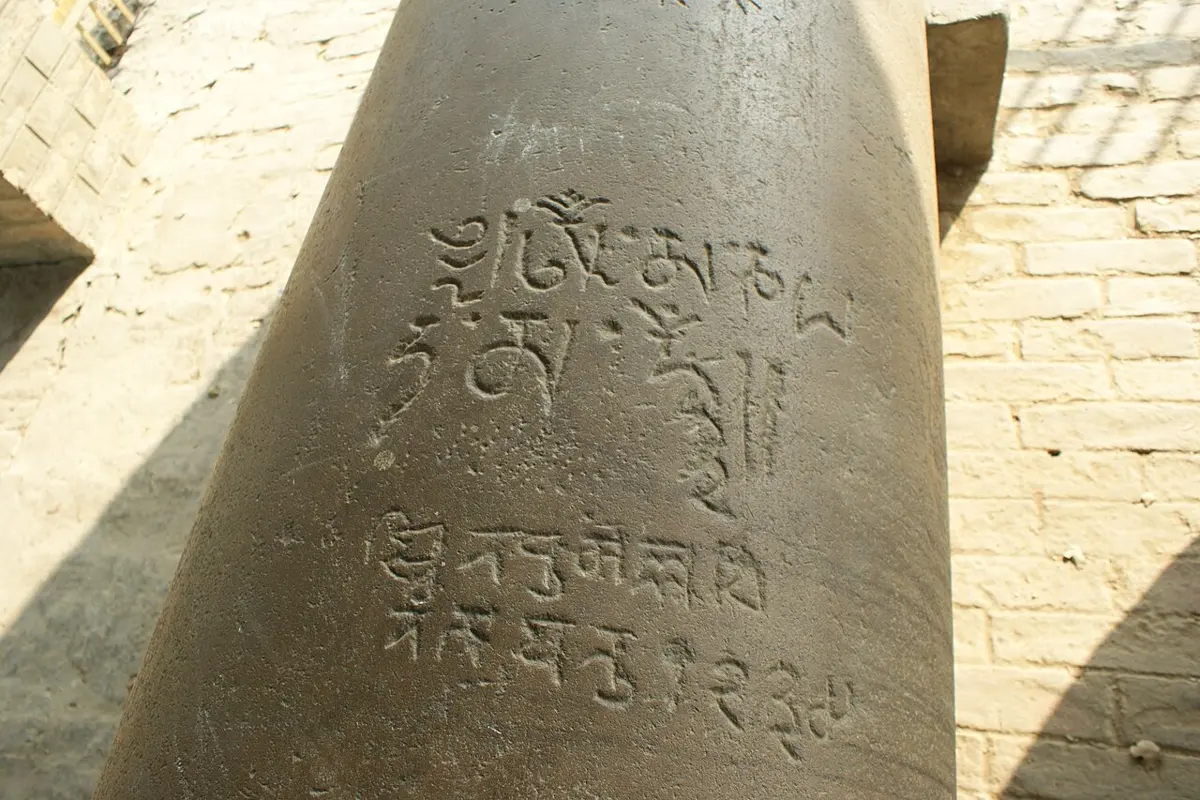
On the Ashoka pillar at Nigali Sagar, in the Tarai west of Lumbini, a few short lines were cut into the stone in the year 1312. First comes the Buddhist prayer ओं मणि पद्मे हुँ (om maṇi padme hũ). Then, in letters close to the Devanagari we write today, comes a wish: श्री रिपुमल्ल चिरं जयतु, “may Shri Ripu Malla be victorious for long”, and a number, १२३४. The number is a year in the Shaka count, which began in 78 CE, so it is 1312 CE.
The pillar was already old: Ashoka had set it up more than fifteen centuries before, and by 1312 nobody could read his letters any more. On Lumbini’s pillar, a few hours’ walk away, the same wish for Ripu Malla’s long victory was cut too, this time without a date and with a second name after it, Sangrama Malla, his son. And early in 1313, says the Valley’s old chronicle, the गोपालराजवंशावली (Gopālarājavaṃśāvalī), “Khasiya King Ripumalla” came to the Kathmandu Valley, worshipped the god of Bunga and gave him treasure and a horse, worshipped at Pashupati and Swayambhu, and went home after eighteen days. The same year a Buddhist book was copied at Surkhet, in the far west, and its last page names him as king of kings.
So who was this king, who had his name carved on Ashoka’s pillars and made a pilgrimage to the Valley, and whose scribes were at work in Surkhet? He ruled from Sinja, a high valley on a branch of the Karnali in today’s Jumla. For about two and a half centuries, from the 1100s to the late 1300s, kings at Sinja ruled the hills of what is now western Nepal, and at times a great deal more: western Tibet to the north, Kumaon and Garhwal, now in India, to the west. Their stones call it the country of the Khas, the people whose speech grew into Nepali. Their kingdom is the reason the oldest Nepali we can read was written in the far west, not in Kathmandu.
A kingdom found on stones
For a long time this kingdom was almost forgotten. The Valley’s chronicles mention the Khasiyas only when they came raiding or visiting, and the later chronicles of the west begin with the small kingdoms that came after. What brought it back was a search for inscriptions in the 1950s, by two men working separately.
One was Yogi Naraharinath, a Nepali scholar and wandering ascetic who walked the west copying stones and copper plates and published them. The other was the Italian scholar Giuseppe Tucci, who in 1954 walked from Pokhara to Jumla and on to Dullu and Surkhet, looking for the same things. At Dullu, in Dailekh, stands a tall stone pillar, a कीर्तिस्तम्भ (kīrtistambha), a pillar of fame, set up in 1357. It carries a list of the kings, father to son and brother to brother, back to the founder, and it calls its own king Prithvi Malla. Tucci called him “a king unknown so far”. Yet the same kings turned up in Tibetan histories, which knew their capital as Ya-tse, the Tibetan name for Sinja. Two traces made by different people, for their own reasons, in two languages, agreed on the names. That is as good as evidence gets for a place with no written history of its own.
The Dullu pillar says the first king, Nagaraja, came from Khari, which most read as Ngari, the western corner of Tibet around Mount Kailash, to Semja, which is Sinja. Nobody knows his date. Counting back from the later kings at about twenty years a reign puts him early in the 1100s, which is the date usually given.
Who the kings were is still argued. Their people were Khas, and the kings’ own stones call their land the Khas country. But the pillar brings Nagaraja from the Tibetan side, the Tibetan histories list the kings of Ya-tse beside their own western kings, as rulers they knew, and a later king came to the throne from Purang, in Tibet. So Tucci took the kings to be Khas themselves, a warrior class ruling the hill peoples, while others read the family as a Tibetan house that came to rule Khas subjects and grew more Indian in its ways over the generations. The stones can be read either way, and nothing found yet settles it. Their title is a puzzle too. The later kings called themselves Malla, the same name as the Valley’s kings of the same years. Nothing shows the two families were related, and why both took the name, a word for a wrestler or a champion, nobody can say for certain.
The kings of Sinja
The stones name more kings than anyone needs to remember, but a handful stand out because of what they left.
The first one we can date is Krachalla. A copper plate of the Baleshwar temple in Kumaon says he conquered that country in 1223, in the sixteenth year of his reign. His son Ashoka Challa left inscriptions between the 1250s and 1270s on tridents at Gopeshwar and Barahat, in the Garhwal hills, and at Bodh Gaya, where the Buddha found enlightenment, far away on the plains of Bihar. At Bodh Gaya he is called king of the Khas country in the hills, and he set up an image of the Buddha there and arranged for regular worship at the great temple. A king from the far west of Nepal paying for worship at the Buddhist world’s holiest site is a fair measure of how rich and far-reaching his kingdom was.
The next king, Jitari Malla, was the first to take the name Malla, and the first the Valley remembered with fear. The chronicle says he came in 1288, in 1289 and in 1290, burning villages, making offerings at Swayambhu and Pashupati, and the third time besieging Patan for a month. Ripu Malla’s visit of 1313 was a peaceful one, but the raids began again under Aditya Malla, who had been a Buddhist monk in a Tibetan monastery before he came home to rule. In 1328 he came himself and, the chronicle says, set fire to the Valley’s three towns. Then the throne passed to Punya Malla, from another family, by one account Aditya Malla’s son-in-law, and in 1334, in his reign, a Khas army came into the Valley in late summer and left in early spring, about six months later, only after taking a ransom. You may have read five months; the chronicle gives the months it came and went. What the raids did to the Valley belongs to the Valley’s own story. From Sinja they look like what powerful hill kingdoms did to rich neighbors: they came for treasure and tribute, and to worship at famous shrines while they were there, not to stay.
Punya Malla’s son was Prithvi Malla, the king of the Dullu pillar, who came to the throne about 1338 and ruled for some twenty years. A gold plate of 1356, written at Semjanagara, the city of Sinja, praises him at length. His records run from Guge and Purang in Tibet to Kaskikot, above Pokhara, and Tucci thought the kingdom was at its widest under him. He also seems to have been its last strong king.
Life in the Khas kingdom
Sinja was a capital, but not a court that ran every village. The stones and plates show a king who granted land and gave orders through ministers and officers, while local chiefs ran their own valleys and sent him tribute. The officers’ names on the plates include family names still common in Nepal today, such as Thapa, Bhandari and Joshi. In 1354 one of Prithvi Malla’s ministers, Devavarma, built a stone water tank at Dullu, with small stupas on it, for travelers. At Dailekh’s Padukasthan a stone pillar names Ashoka Challa as the king of the day and then a temple built by Sauka, a कर्क्यानी (karkyānī), the wife of a Karki, with her husband.
The kingdom lived by its roads as much as its fields. The main route ran from Surkhet up through Dullu and Sinja to Taklakot, just over the border in Tibet. Salt, wool and borax came down it from Tibet, and goods from the south went up. The hill people were the go-betweens, and Jumla’s horses were prized. That is why a king of Sinja could hold land on both sides of the mountains: the road joined them.
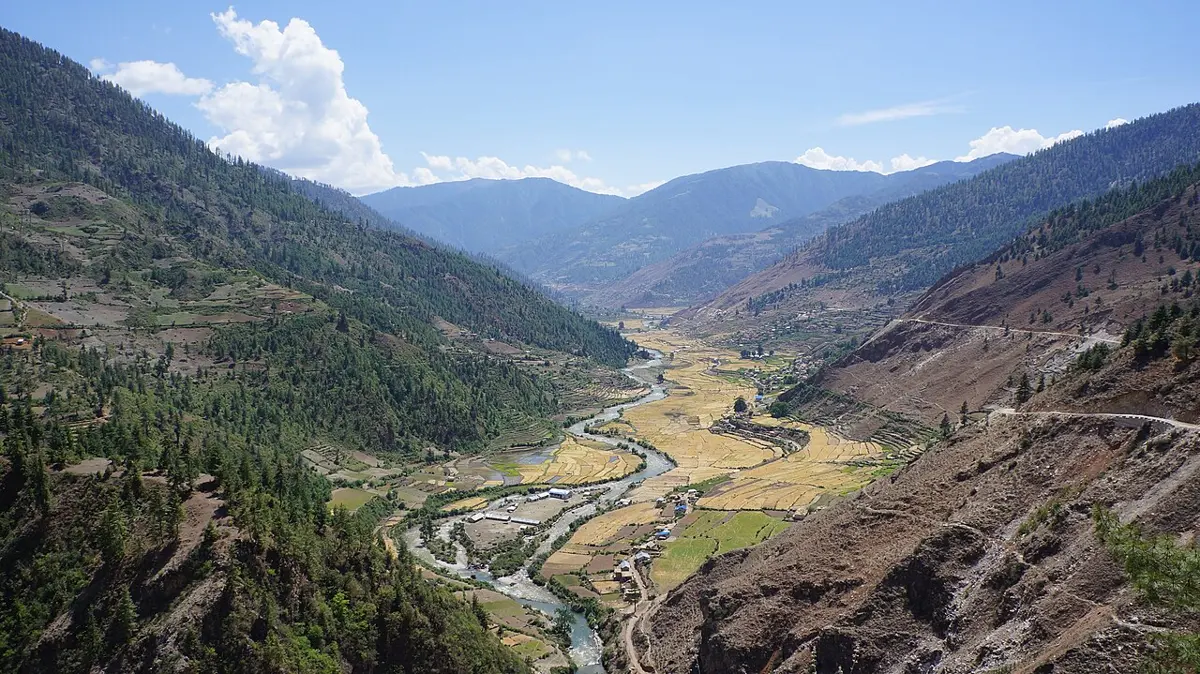
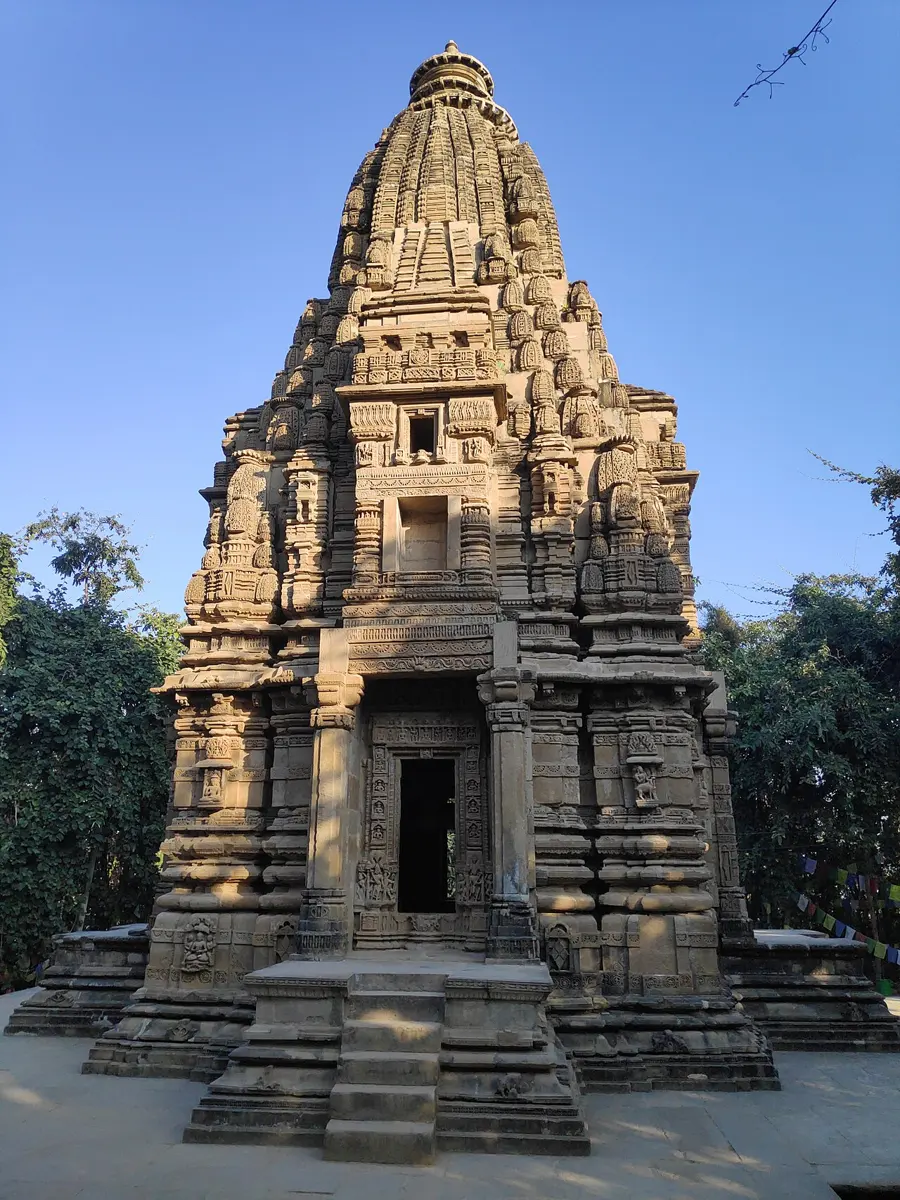
Religion was mixed in a way that surprises people who expect hill kings to be one thing or the other. The Nigali Sagar line begins with a Buddhist prayer. Many of the kings’ stones open with the same prayer, and the Dullu pillar carries a carved stupa. Ashoka Challa paid for work at Bodh Gaya, and Aditya Malla had been a monk. Yet Ashoka Challa also set up tridents, Shiva’s weapon, in Garhwal, and the gold plate of 1356 ends with the duties of a king as Hindu law sets them out. The stone temple of Kakre Bihar, outside Birendranagar in Surkhet, is honored by Buddhists and Hindus alike to this day. It fell into ruins centuries ago and was rebuilt from the stones found when its site was dug; the work was finished in 2021.
The capital itself has been dug only once, briefly. In October 2000 a small team of British and Nepali archaeologists worked on a ridge at Sinja that Naraharinath had long ago named the kings’ summer palace. Earlier surveys there had found stone lions and old channels for water. The team found a compound some 40 by 50 meters, cut off by deep ditches, around the rise where the Kanaksundari temple stands, what seems to be the gateway to a palace, and broken glass bangles. A radiocarbon test dated one early wall to somewhere between 1270 and 1420. The ruins standing above the ground are later. The season was cut short because of the Maoist war. The team’s careful conclusion was that the ridge can reasonably be called the Mallas’ palace.
The language on the plates
The kings of Sinja wrote their grand openings in Sanskrit, the learned language of the whole region. But when a plate had to say plainly who got what, and what the king’s men must or must not do, it switched to the language people spoke. The gold plate of 1356 is like that: its opening and ending are flowery Sanskrit, but the middle, which grants land and tells the officers of Jumla, Dullu and Kaskikot what to do, is in the hill speech. That speech was the Khas language, and it is the ancestor of Nepali.
The Padukasthan pillar of Ashoka Challa’s time ends with the words …कर्क्यानिको देवल, “the temple of … Karkyani”, using the same को that every Nepali speaker uses today to say whose something is. Some scholars count it as the oldest Nepali writing found so far; it carries no date, but Ashoka Challa’s reign places it in the 1200s. Others give that place to a few broken lines cut beside a pillar at Dullu, called the Damupal inscription and often dated to 981. Its date is one of the most argued in Nepali: readers have put it anywhere from the 1000s to the 1300s, and one finds neither a date nor the name Damupal in it. A copper plate of Aditya Malla, dated 1321 and kept at a monastery north of Gorkha, is written twice, in the Khas speech and in Tibetan. Its Khas half is hard going, with old spellings, but a Nepali reader today picks out words like हामि (we), हाम्रा (our), आउदा जादा (coming and going) and गुम्वा (a monastery, गुम्बा now). That is Nepali written more than seven hundred years ago, and recognizably so.
These plates answered part of an old argument. It used to be said that Nepali came into the hills with Rajput families fleeing the plains of India after the Muslim conquests there. The plates show the language already written in the far west in the 1200s and 1300s, as the everyday speech of a kingdom’s officers and subjects, so it was no newcomer brought by refugees. Where it came from before that is less certain. The usual view is that the Khas brought their speech from the north-west, long before, and that it later mixed with the languages of the plains. The Khas kingdom is where it was first written down, which is not the same thing as where it began.
When the kingdom broke up, its speech did not. Its people spread east along the hills into the small kingdoms that followed, and their language went with them, picking up words from Maithili, Awadhi and Bhojpuri along the way. In the east it was called Khaskura, the Khas speech, or Parbatiya, the hill speech. Under the Shah kings it became Gorkhali, the speech of Gorkha, and in the end Nepali, the language that most people in Nepal now share, as a mother tongue or as a second one.
How it came apart
Prithvi Malla’s pillar of 1357 is the high point, and almost the last word. The Tibetan histories stop with him. The kingdom had always depended on far-off lands paying tribute, and in the middle of the 1300s they stopped. Doti, in the far west of Nepal, had its own independent king by the early 1350s. In Tibet, a strong new ruler, Changchub Gyaltsen, took control of the country around 1350, and the western Tibetan lands no longer answered to Sinja.
After Prithvi Malla the line is hard to follow. He seems to have had no son. A plate of 1367 names a king called Surya Malla, and from 1376 plates name Abhaya Malla, usually counted the last king of the line, but how either was related to Prithvi Malla nobody knows. By the 1390s the power had passed to a family of ministers, the Varmas. One of them, Malaya Varma, called himself king of kings by 1389 and took Sinja a few years later, and his sons divided the land between them. Around 1400, a chief named Baliraja became king of Jumla and soon shared rule at Sinja too. His line, the Kalyal kings, ruled from Jumla for centuries, and Sinja’s days as the seat of a great kingdom were over. The end is usually put somewhere between the late 1300s and the early 1400s, and every date for it is argued, because the sources for these years are later chronicles that mix memory with legend.
What took the kingdom’s place was a patchwork. The governors and chiefs who had sent tribute to Sinja kept their valleys and called themselves kings. In time the Karnali basin held some twenty-two small kingdoms, the Baise, and the hills of the Gandaki further east about twenty-four more, the Chaubise. Among their neighbors was a small hill kingdom called Gorkha (Chapter 13 tells why the lists don’t agree whether it counts as one of the twenty-four).
So the kingdom of Sinja left two things to the country that came after it. One is a habit of rule: a king at the center, local chiefs who did much as they liked, and a road that joined the hills to Tibet. The other is a language. When the kings of Gorkha brought the hills under one rule nearly four centuries later, the speech their officers wrote and spoke was the same Khas speech first set down on stone and copper in the Khas kingdom, and that is why a student in Kathmandu, in Jhapa or in Jumla can still pick out words on Aditya Malla’s plate today.
Meanwhile, in the world: while Ripu Malla’s wish was being cut into Ashoka’s pillar, Dante was writing his Divine Comedy in Italy. In Prithvi Malla’s years, the Black Death killed somewhere between a third and more than half of Europe’s people.
Found a mistake? Please tell us.