
In the spring of 1959, the year 2015 by Nepal’s own calendar, Nepalis across the whole country did something they had never done before: they voted for the people who would make their country’s laws. There was no ballot paper with a list of names. Inside each polling booth stood a row of boxes, one for every candidate, and on each box was a picture, because most voters couldn’t read. The Nepali Congress had a tree, the Gorkha Parishad a hut, the Communist Party three ears of maize and a sickle, one wing of the Praja Parishad a plow. The voter was given a slip of paper and dropped it into the box with the right picture. Some voters left their slips outside the boxes and walked away. The Congress printed leaflets that said simply कल्पवृक्षको फोटो नबिर्सनोस्, “Don’t forget the picture of the wishing tree.”
It took eight years to get to those boxes. When the Ranas fell in February 1951, the king had promised an assembly elected by the people, to write a constitution. The election that finally came was for something smaller, a parliament under a constitution the king himself had given, and by then Nepal had had nine governments, counting the times the king ruled without a prime minister. This chapter is about those years: why the governments kept changing, what opened up in the country while they did, who was still left outside, and what the first elected government did with the eighteen months it had.
A government that kept changing
The short answer to why governments came and went so fast is that none of them was chosen by voters. Under the interim constitution of March 1951, meant to last only until the elected assembly met, the king held the government’s power and commanded the army. He named the prime minister and could dismiss him. So a cabinet lasted as long as it kept the king’s confidence and held itself together, and in those years that was rarely long.
The first was the coalition the Delhi deal had made, five Ranas and five Congress ministers under the Rana prime minister, Mohan Shumsher, with B. P. Koirala of the Congress as home minister. It never worked as one government. Within weeks some of the Ranas’ men had formed a militant group, the Gorkha Dal. In April 1951 B. P. had its young leader, Bharat Shumsher, arrested, and the next day a crowd from it broke him out of jail and attacked B. P.’s house. B. P. himself fired at one of the attackers. The group was banned, and later remade as a political party, the Gorkha Parishad. In November, when the police fired on a students’ march in Kathmandu and a student was killed, the Congress ministers resigned, and the coalition fell with them.
Next the king chose Matrika Prasad Koirala, B. P.’s half-brother and the Congress’s president, to form a government. It lasted nine months. In January 1952 the Raksha Dal, an armed police force close to the Congress, rose in Kathmandu and let K. I. Singh out of jail; Singh was the Congress commander who had refused the Delhi deal and attacked Bhairahawa. The rising was put down, Singh escaped to Tibet, and the government, on India’s advice, banned the Communist Party too. Matrika quarreled with his own party, and in August 1952 King Tribhuvan dismissed the government and ruled for ten months through a council of advisers. Matrika came back in 1953, now at the head of a small party of his own.
The parties’ quarrels were one reason for all this. Another was India. By 1952 its government seems to have decided that the throne, not the quarreling parties, was the one thing in Nepal it could build on. The palace had its reasons too. In 1954 a royal proclamation said plainly that all authority rested with the king.
Tribhuvan didn’t see the assembly he had promised. He fell ill and died in a hospital in Zurich, Switzerland, in March 1955, at forty-eight. His son Mahendra became king. He ruled through advisers until January 1956, then gave the government to Tanka Prasad Acharya of the Praja Parishad, one of the founders spared by the Ranas in 1941. Nepal had opened relations with China the year before. In Tanka Prasad’s eighteen months its first five-year plan began, in 1956, and so did its own central bank, the Nepal Rastra Bank, at a time when Indian rupees were still the money many people used. But when Tanka Prasad lost the king’s support he was let go, and in July 1957 Mahendra turned to an unexpected man, K. I. Singh, back in Nepal and now the leader of a party of his own. He lasted less than four months.
By then the election promised for 1957 had been put off again, and the parties had had enough. The Congress, the Praja Parishad and the Nepali National Congress joined in a Democratic Front and, in December 1957, began a campaign of civil disobedience. Within days the king named a date: the election would be held on 18 February 1959.
What opened up, and who was still outside
It would be easy to see only the changing cabinets, but the country itself was changing faster. Under the Ranas the government had spent less than one rupee in a hundred on schools and health together. In 1951 there were six high schools in the whole country, four of them in the Kathmandu Valley, one small college, and perhaps a hundred primary schools. By 1954, by the count of an American adviser who worked on them, there were about 1,200 primary schools, 83 high schools and 14 colleges, most of them started by villages and towns themselves, with little money and no one to guide them. “There was a great thirst for knowledge,” as one learned Nepali put it to him. A national commission planned a school system for the whole country.
Other things the Ranas had never allowed came within a few years: parties meeting openly, a radio station, a Public Service Commission to choose government officials by examination instead of by family, and a Supreme Court. In 1953 Kathmandu elected a municipal council, the first election most of its people had seen, and a woman, Sadhana Pradhan Adhikari, was elected to it. At the end of 1956 the first motor road over the hills into the Valley, the Tribhuvan Rajpath, was open to trucks and buses: about 120 kilometers by way of Daman, built by eight thousand Nepali workers and a few hundred Indian army engineers, with Indian money. The same month the old rule that Nepalis needed a permit to travel inside their own country was lifted, except for women under forty-five.
That last line is a reminder of who was still outside. Women had marched against the Ranas and had won the vote, but very few stood for office. In 1959 only one woman, Dwarika Devi Thakurani, was elected to the parliament, against 108 men. Most Nepalis still couldn’t read. Peasants in Bhaktapur, in the far west and in the Tarai organized against rents and old debts. The Land Act of 1957 limited a tenant’s rent to half the harvest.
Language was another line. The education commission’s report of 1956 wanted Nepali as the only language of teaching, even for children who spoke Maithili, Bhojpuri, Newar, Tamang or Limbu at home, and the government took it up. In the Tarai, where many schools taught in Hindi and many people wanted it, that brought protests. In Biratnagar in January 1958 a crowd demanding Hindi surrounded the governor’s office, and men came in from Dharan and Itahari, armed, to face them; the town was calmed, without bloodshed, by a meeting of its leaders. The constitution that came the next year named Nepali in the Devanagari script as the national language.
A constitution given, and an election
The question that hung over all these years was who would make the constitution. The king had promised in 1951 that an assembly elected by the people would write it. That is what the Congress expected. In February 1958 Mahendra announced that there would be no such assembly. He would give the country a constitution himself, and the election would be for a parliament working under it.
The palace had its case, and its advisers made it. Hora Prasad Joshi, one of the men who drafted the constitution, argued that elected assemblies elsewhere had taken ten years and more to agree on a constitution, that Nepal couldn’t wait that long with so many outside powers taking an interest in it, and that the king alone could stand above the parties as a symbol of the country’s unity. All the large parties except the Communists accepted the king’s way, in order to get the election.
The draft was made by a committee of Nepalis with the help of a British expert, Sir Ivor Jennings, who had advised on the constitution of Ceylon (now Sri Lanka). B. P. later recalled warning the king that “the person who had drafted Ceylon’s constitution would not give us a document that would help finish off democratic rights.” Jennings himself wrote plainly what he had done: “Since there is nobody, apart from the King, around whose authority the Constitution could be built, the draft gives the King unusually wide powers.”
The constitution was announced on 12 February 1959, six days before polling began. It gave Nepalis rights they had never had in law, such as free speech and the right to form associations, a cabinet answerable to an elected house of 109 members, and an upper house of 36, half of them named by the king. It also said that the king must be a follower of the Hindu religion, and its Article 55 let the king, if he judged that a grave emergency existed, take any of parliament’s powers to himself and suspend all or part of the constitution. B. P. called it “an instrument which can prove to be of gradual assistance in the development of democracy, but which can also be used successfully against democracy.”
Then came the boxes. Voting went on in stages from February to April, district by district, on foot across a country with few roads. Nine parties and many independents put up 786 candidates. A little over four in ten of the 4.2 million people on the rolls voted. The Nepali Congress won 74 of the 109 seats with about 37 percent of the votes. The Gorkha Parishad, the party of the Ranas who had stayed in politics, came second with 19 seats and about 17 percent. It had reached well beyond the old families, with a president, Randhir Subba, who wasn’t a Rana, and big promises: two hundred hospitals, two thousand bridges. The United Democratic Party, which K. I. Singh had founded, won 5; the Communists 4; the two wings of the Praja Parishad 3 between them. The Tarai Congress, which stood for Hindi and the Tarai’s own rights, won none.
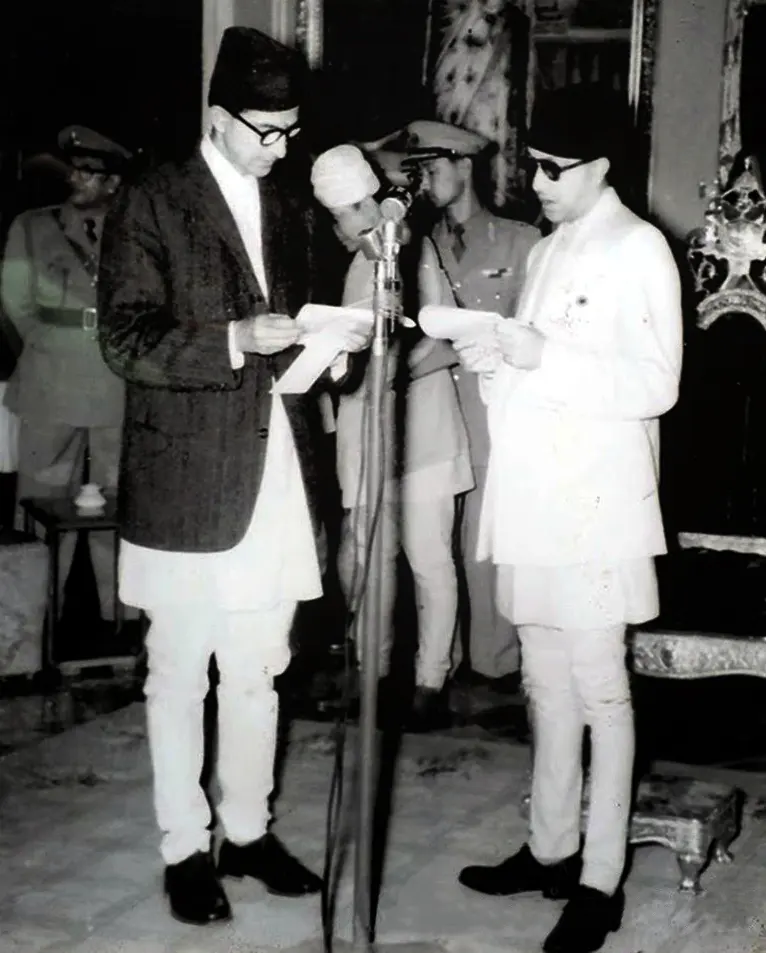
Some famous men lost. K. I. Singh lost his own seat, and so did Tanka Prasad. B. P. won in Morang. The king had not expected any party to win a majority. The Congress had one, and on 27 May 1959 B. P. Koirala became Nepal’s first elected prime minister.
Eighteen months of an elected government
B. P.’s government had a large majority and a program it had promised: land reform, an end to old privileges, schools, and roads. Its ministers included men from the Tarai and from the Gurung, Thakali, Rai and Limbu peoples, and Dwarika Devi Thakurani, the one woman elected, served in the government’s health ministry. The ministers cut their own pay; the prime minister’s fell from 2,500 rupees a month to 1,500.
The largest change was to land. For a century and more, Nepal’s rulers had given land to favored families as बिर्ता (birta), land that paid no tax, and the Ranas and their friends had been the chief gainers. By one count, about a third of the country’s farmland was held this way at the start of the 1950s. In October 1959 parliament passed a law abolishing birta without compensation: the land would pay tax like any other. The finance minister, Subarna Shumsher, a Rana in the Congress who had given the party much of its money, is said to have been the first to give up his own birta, some 12,000 bigha. The government also took away the courts of the रजौटा (rajauta), the old hill rulers of the west, petty kings who had kept their little states by paying the government a fixed tribute.
But laws don’t change the land on their own. Most of the work of carrying out the birta law came later, after this government was gone, and even then many birta owners simply registered their land as ordinary land in their own or relatives’ names, while the tenants who worked it went on as before. In parts of the hills the rajas and the old landed families resisted, encouraged by a religious organization, the Karmavir Mandal, and in October 1960 there was trouble in Gorkha.
There was more. The government raised taxes on the rich, opened 1,624 schools in a single year, and in 1959 Nepal’s first university, Tribhuvan University, was founded. Abroad, Nehru visited Kathmandu in June 1959, Nepal signed an agreement with India on the waters of the Gandak river, and in 1960 a treaty of peace and friendship with China.
Each change made someone uneasy. The landowners and the families who had lost their birta felt robbed. Many officers of the army didn’t like it either. The Gorkha Parishad opposed the government in parliament and outside it, and the Communists, who had called the revolution of 1951 a “bourgeois” one, the work of the well-off, stood apart from it. In the palace was a king who had given the constitution himself, facing a prime minister with a majority in parliament and a program of his own. The two men even played on opposite sides in a football match at the National Stadium. But the constitution had left both of them with a claim to lead the country. How Mahendra settled that question at the end of 1960 is a story of its own.
The plain lesson of this decade is that democracy in Nepal didn’t arrive in one day in 1951. It came slowly, and in pieces. Schools, a radio station, roads and a court came faster than the elected assembly that had been promised, and when an election came, it was for a parliament under the king’s own constitution. The people who argue about these years still argue about the same things: whether the parties wasted the decade in quarrels, whether the palace held the election back to keep power for itself, and how much India’s hand guided both. What is clear is that in the spring of 1959 about 1.8 million Nepalis dropped a slip of paper into a box, and for eighteen months a government chosen by voters tried to change the country.
Found a mistake? Please tell us.