
Near the end of a list of thirty-two kings, the oldest chronicle of the Kathmandu Valley stops for a moment to speak about its own day. These Kirats, it says, now live in the land between the Tamakoshi and the Arun. The chronicle was written in the 1380s, probably at Bhaktapur, and its writer was pointing east, to the valleys where Rai and Limbu families live today, people who still call themselves Kirat.
That one line holds the puzzle of this chapter. Every Nepali student learns the Valley’s first three lines of kings in order: the Gopals, who kept cows, the Mahishpals, who kept buffaloes, and then the Kirats. So it’s worth knowing, from the start, how we know about them at all.
Here is the plain answer. Everything about these kings comes from chronicles, lists of rulers written down more than a thousand years after the kings they name. No stone carved by any of them has been found, no coin, no document. The lists don’t agree with each other, and the later the list, the more stories it holds. So none of these kings can be checked. But the stories aren’t empty either. Real clues show that people were living in the Kathmandu Valley before its first firm dates, and that many of them spoke languages from the same family as Newar, Rai and Limbu. And today’s Kirat peoples keep their own memory of those times.
Cowherds and buffalo-herders
The chronicle is the palm-leaf गोपालराजवंशावली (Gopālarājavaṃśāvalī) of Chapter 1, and where its surviving leaves begin, it tells how a cowherd named Nepa followed his cow to the place where Pashupati was found. Then come the kings: Bhumigupta, the first of eight Gopals, each with a name ending in “-gupta” and a reign of many decades; then three Mahishpal kings; then the Kirats.
That is the whole of it in the oldest chronicle: a cow, a god, eleven names and their years. The longer stories, in which the Bodhisattva Manjushri cuts the hill at Chobhar with his sword and lets out the lake that once filled the Valley, or a sage makes a cowherd’s son king (Chapter 2), are told only in later chronicles. They are sacred stories, not records of what happened.
The cowherds weren’t invented out of nothing, though. Herding peoples called आभीर (Ābhīra) appear in India’s inscriptions from about 1,800 years ago. In the Valley itself, Licchavi stones of the 500s and 600s name a powerful family of nobles with “-gupta” names, Bhaumagupta, Vishnugupta and others, who rose high beside the Licchavi kings for well over a century. And families who call themselves Gwala and Nanda Gopal Shrestha still live around Matatirtha, Thankot, Balambu and Pharping, where the later chronicles place the Gopals.
What doesn’t fit is the order. The chronicle puts the cowherds at the very beginning, before the Kirats. Then, in the middle of its list of Licchavi kings, it says the Gopals beat the Licchavis and ruled for three reigns, before the Licchavis took the throne back. Two of those three, Vishnugupta and Bhumigupta, carry names from its first list too. So the chronicle remembers cowherd kings twice: once at the dawn of time, and once among the Licchavis, where the stones show “-gupta” nobles really did hold power. Historians trust the second memory and doubt the first, because nothing in the stones or in what is known of the Valley’s peoples puts herders there before the Kirats.
Thirty-two Kirat kings
After the Mahishpals, the chronicle says, the Kirats came and defeated them. King Elam, 90 years. King Pelam, 81 years. King Melam, 89 years. The list runs on like that for thirty-two names, and ends with the line about the Tamakoshi and the Arun.
Start with the numbers. The thirty-two reigns run from 31 years to 90, and average about 61. Add them up and you get nearly two thousand years. For one king after another to rule that long is impossible. मानदेव (Mānadeva), the Licchavi king whose pillar of 464 begins the Valley’s firm dates (Chapter 1), ruled about 41 years, and that was a long reign. The chronicle begins its story at the coming of the Kali Yuga, the present age in Hindu reckoning, and a story that starts so far back needs long reigns to fill it. The names, on the other hand, are odd enough that nobody seems to have made them up. Most aren’t Sanskrit, and a writer filling a gap in a Sanskrit text would have reached for Sanskrit names.
Then compare the lists. Nepal has several chronicles, copied and recopied for centuries, and they don’t even agree on how many Kirat kings there were. The palm-leaf chronicle has 32. A British officer who collected a list in Kathmandu in 1793 wrote down 27. A chronicle written in the 1800s, translated into English and printed in 1877, has 29. Watch one name travel. The first Kirat king is Elam on the palm leaf, ruling 90 years. The officer of 1793 wrote “Yellung”, 90 years and 3 months. In the chronicle of the 1800s he is Yalambar, and rules for 13. A king called Dasti is twelfth in the oldest list, and a Jitedasti is seventh in the later one, perhaps the same man.
The later chronicle has also grown stories. Under a Kirat king named Humati, it says, the hero Arjuna of the Mahabharata fought the god Shiva, who had taken the shape of a Kirat. In Jitedasti’s reign the Buddha came from Kapilavastu, visited Swayambhu and taught in the Valley, while Jitedasti himself went off to fight in the Mahabharata war. In the reign of a later Kirat king, Sthunko, the emperor Ashoka came on pilgrimage with his daughter Charumati. She liked the Valley and stayed, married, founded Deopatan beside Pashupati, and built a monastery at Chabahil, where she died as a nun.
None of this is in the palm-leaf chronicle, written some 450 years earlier. Between the two, a bare list became a story full of famous visitors. That is how chronicles grow. Each copyist knew the great stories of his day, the Mahabharata, the Buddha, Ashoka, and found a place for them in the Valley’s past.
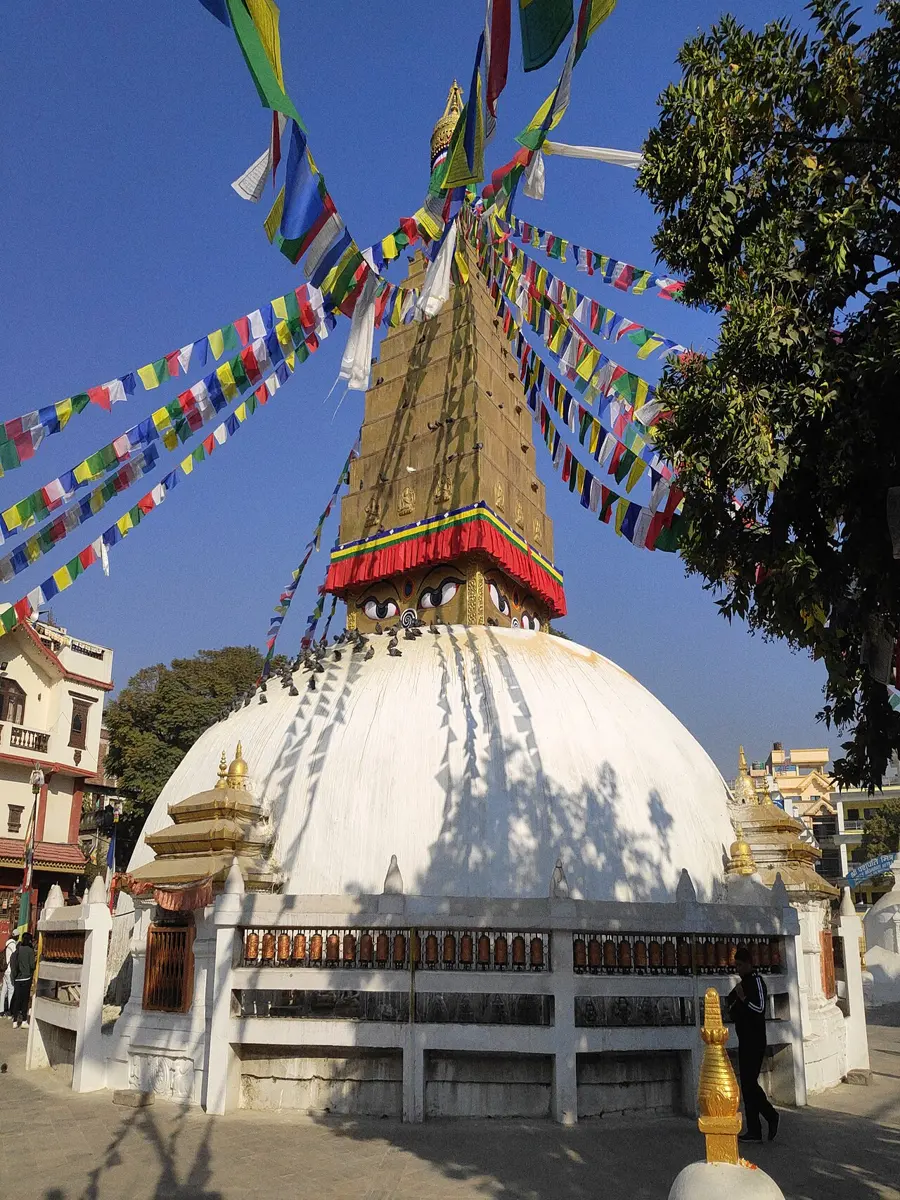
Ashoka really did come to Nepal’s Tarai: his pillar at Lumbini, the subject of Chapter 6, says so in his own words. Whether he came to the Valley is another matter. When the Chabahil stupa was being repaired in 2002 and 2003, workers cleaning the old bricks of its spire found one with two words in an old script, read as “Charuvati’s stupa”. One historian dates the letters to Ashoka’s time. If he is right, the name Charumati at Chabahil is very old indeed. But it is one scholar’s reading, and a name on a brick isn’t proof of an emperor’s visit.
The school books tell these stories as part of the Kirat age: the Buddha in Jitedasti’s time, Ashoka and Charumati in Sthunko’s, the Kirats ruling for about eight hundred years. The names and stories come from the later chronicles. The same figure was already suggested in 1793: the British officer added up his 27 reigns, found them twice as long as nature allows, and proposed halving the total, to about eight centuries. The oldest chronicle has the list and nothing more.
What the stones and books say
So much for the lists. Is there anything from the time itself?
The Valley’s firm dates begin with मानदेव’s pillar at Changu Narayan and with the stone inscriptions the Licchavi kings set up over the next four centuries (Chapter 7). These are written in fine Sanskrit, in the style of India’s great Gupta emperors. But when they name a village, a river, a canal, a hillock or a tax office, the names mostly aren’t Sanskrit at all. Well over four in five of the place names in them come from languages of the Tibeto-Burman family, the family that Newar, Rai, Limbu, Magar and Tamang belong to. Some of the offices that collected taxes carried such names too, कुथेर (kuther) and माप्चोक (māpchok) among them.
The kings wrote in Sanskrit, but the land already had names, given by people who spoke something else. Those people were there first. That is the strongest evidence that the chronicles are right about something real: a long time when the Valley belonged to speakers of Tibeto-Burman languages, before the Licchavis. What the stones can’t tell us is what those people called themselves, or whether their chiefs were the kings in the lists.
Only one Licchavi stone found so far uses the word Kirat at all: a broken inscription at Hanuman Dhoka, probably from the 600s, about repairing a palace, with the word किरातवेषधर (kirātaveṣadhara), “dressed as a Kirat”. So little of the stone is left that nobody knows who was dressed that way, or why. It could be people, or it could be Shiva, who in the old stories takes a Kirat’s shape.
Older than any of this are a few lines in a book from the plains. A hymn against snakebite in the Atharvaveda, put together roughly three thousand years ago, though nobody can date it exactly, pictures a little Kirat girl digging up the cure with golden spades on the mountain’s back. In old Sanskrit, किरात (Kirāta) meant the peoples of the hills and forests along the Himalaya and to the east, a word for many peoples rather than the name of one.
And the oldest dated thing found in the Valley, the statue of King Jayavarma from about 185 CE (Chapter 1), already carries a Sanskrit name. The oldest chronicle lists a Jayavarma among the early Licchavi kings, long after its Kirats. So by the chronicle’s own order, the Kirat kings, if they ruled at all, ruled before then.
The Kirat peoples’ own memory
Today the Rai, Limbu, Yakkha and Sunuwar peoples of eastern Nepal call themselves Kirat. Their history wasn’t written on palm leaves at Bhaktapur. Much of it lives in the Mundhum (Chapter 1), the Kirat peoples’ sacred tradition, chanted at rituals by priests and elders and passed down by mouth for generations before any of it was written down.
The Kirat memory of where they came from points in more than one direction. Rai tradition tells of ancestors who came up from the Tarai along the Sapta Koshi, hunting and clearing fields, and settled on the hill slopes. Limbu tradition, as it was written down over a century ago, says that five of their clans came from Lhasa in the north and five from Kashi, Banaras, in the south, and that the Limbus have held the valley of the Tamor for as long as anyone remembers. Other tellings recorded at the same time differ: in one, ten brothers set out together from Kashi, five of them by way of Tibet.
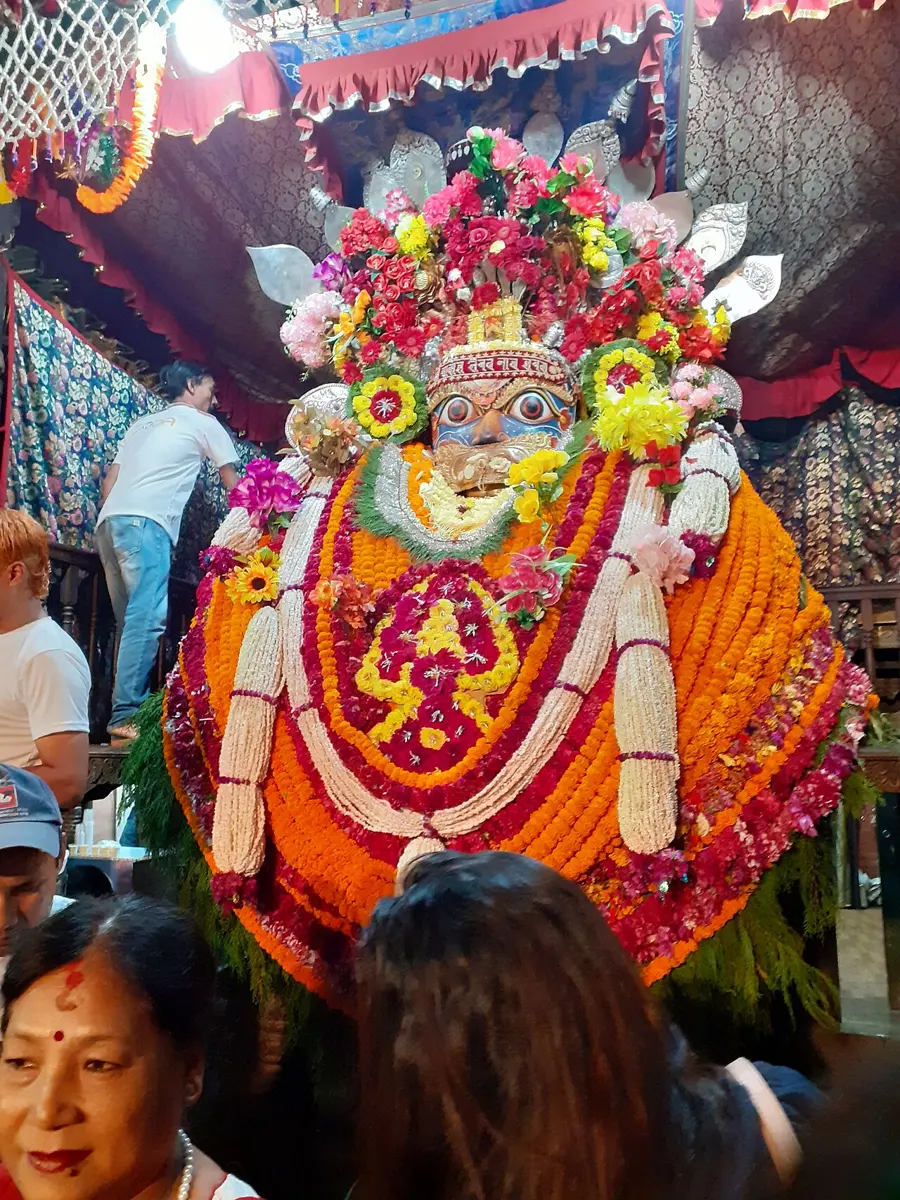
In the 1900s Kirat writers set out to write their people’s history themselves. The best known, the Limbu scholar Iman Singh Chemjong, gathered chronicle lists, Sanskrit books and Kirat tradition into a single story. In his history, Yalambar was a Kirat king from Yalung in the east who won the Valley and ruled a kingdom stretching from the Tista to the Trisuli, until the Licchavis drove out the last Kirat king, Gasti. He also wrote that the face of Akash Bhairab, worshipped in Kathmandu, is a Kirat prince’s. For many Rai and Limbu people the Kirat kings of the Valley are their own ancestors, and the oldest chronicle seems to agree, when it says that the Kirats of its day lived between the Tamakoshi and the Arun. An English scholar of the 1800s, Brian Hodgson, also wrote down a tradition that the Kirats had been driven out of the Valley, though he put it much later, under the Mallas.
Others read the same evidence differently. Because किरात was a broad word for hill peoples, a “Kirat king” in a chronicle needn’t have belonged to any one people living today. The Valley’s old place names could have been given by the ancestors of the Newars, whose language is also Tibeto-Burman, as easily as by ancestors of the Rai or Limbu, and most likely by several peoples who lived there over a long time. Some scholars think the Kirat, Newar and Magar peoples all come from one older layer of the hills’ population. On this view, the link between today’s Kirats and the Valley’s kings can’t be shown from the evidence we have.
Both views can be put fairly, and the evidence doesn’t choose between them. What both accept is the larger point: before the Licchavis, the Valley was already home to people who spoke languages of the hills, whose names for its rivers and hills the Sanskrit-writing kings went on using.
So, what can a story written a thousand years later tell us? Not the names of real kings, or how long they ruled, or which famous visitors came. Those grew as the story was copied. But it can carry a memory: that the Valley had rulers before its first dated stones, that some were herders, and that many of its people spoke the languages of the hills. The place names on the Licchavi stones say the same thing, in a way no copyist could change. And the Kirat peoples’ own tradition, told by them, is part of that history too, as a memory kept for a long time by the people it belongs to.
Found a mistake? Please tell us.