
In mid-October 2026 Nepal’s banks, development banks and finance companies were looking after 64,370,098 deposit accounts between them. The census of 2021 had counted about 29 million people, so that is more than two accounts for every man, woman and child in the country. Yet when the World Bank asked Nepali adults in 2024 whether they had an account of any kind, at a bank or on a phone, only about six in ten said yes. Both numbers are true. Some people hold several accounts, at several banks, and a great many hold none.
For most people who do have one, an account is the first piece of the money system they own. It is where pay arrives, where a fund for surprises waits, and where a cheque, a card or a QR code reaches into. So it is worth knowing what the bank is doing with the money, why it pays anything at all, and what all the forms and statements are for.
The first thing to know is that a deposit is a loan. When Sabina, who is made up, puts Rs. 10,000 into her account, she is lending it to the bank, which promises to give it back whenever the account’s rules say she may ask. The bank then lends most of it to someone else, a shop that needs stock or a family building a house, at a higher rate of interest than it pays her. In mid-October 2026 Nepal’s commercial banks paid depositors 3.07% a year on average and charged borrowers 6.31%. The gap between the two pays for the staff, the branches, the loans that are never repaid, and the bank’s profit. A bank can lend most of what it holds because, on any one day, only a few depositors want their money back; it keeps a slice ready, about 11 rupees of every 100 deposited as cash or in its own accounts at the central bank and other banks. What this lending does to the whole country’s money is the subject of Chapter 15 of Economics, for the Curious. For one person, the plain point is this: the interest a bank pays is its side of a loan you have made to it.
Four kinds of account
Banks in Nepal offer four kinds of deposit account, and the difference between them comes down to one question: how sure can the bank be about when the money will leave?
A current account (चल्ती खाता) is for money that comes and goes all day. A shop, a firm or an office pays in and takes out as often as it likes, writes cheques against it, and earns no interest at all. The bank can’t count on any of it staying, so it pays nothing for it.
A savings account (बचत खाता) is the one most people have. Money can be put in at any time and taken out when it is needed, though the bank may set limits on how much or how often. It pays a little interest: 2.81% a year on average in October 2026. A savings account is many small depositors, and they rarely all take their money out on the same day, so the bank can lend part of it out with some confidence.
A fixed deposit (मुद्दती खाता) is money promised to the bank for a set time, from three months to five years or so. It is meant to stay for the whole term. A saver who needs it sooner can usually borrow against the deposit, paying more interest on that loan than the deposit earns. Because the bank knows exactly how long it can lend the money, it pays the most, 4.74% on average that October. The longer the promise, the more a bank usually offers for it.
A call account is the odd one. Like a savings account, its money can be taken out at any moment, “on call”, but it is used mostly by firms and institutions parking large sums for a short while. One depositor can take out crores in a day, so the bank can do little with the money, and it paid only 0.42% in October 2026.
Put together, the rates line up neatly with certainty. Nothing for money that may leave this afternoon, a little for money that probably won’t, more for money promised for a year. Of every 100 rupees deposited at the commercial banks that month, about 49 sat in savings accounts, 34 in fixed deposits, and about 8 each in current and call accounts.
Opening one
To open an account, a person fills in a form, gives a photo and a sample signature, and shows a document that proves who they are: a citizenship certificate, and now often the national identity card. The bank wants more than a name. It asks for family details down to a father’s and grandfather’s names, an address, an occupation, where the money will come from, and roughly how much will pass through the account. This set of questions is called KYC, for “know your customer”, and it can feel like being questioned for wanting to save.
The reason is that bank accounts are one of the main roads for dirty money. Money from theft, bribes, drugs or smuggling is only useful once it looks clean, and the usual way to make it look clean is to pass it through accounts until nobody can tell where it began. Laws all over the world make banks find out who their customers really are, and what is normal for each one, so that a sudden flood of money through a student’s account stands out. Countries that do this badly are named. Since February 2025 Nepal has been on the Financial Action Task Force’s “gray list” of countries under closer watch for money laundering, and in June 2026 it was still there. So the long form is partly about the country’s good name, not only the customer’s.
The national identity card has been the main argument of the last two years. Nepal Rastra Bank first told banks to open new accounts only with the card’s details, then softened that after complaints and a Supreme Court order that the card can’t be the only proof, and in July 2026 it set a date, the end of Asoj 2083, for older customers to add their card’s details. It also said a bank may not freeze an account only because its owner doesn’t yet have a card. Rules like these keep changing, and the box at the end of the chapter has the latest we found.
For someone under 18, the law draws two lines. A person under 16 is a minor under the Citizenship Act, and the Children’s Act counts everyone under 18 as a child. So a child’s account is opened by a guardian, usually a parent, with the guardian’s own citizenship certificate, photo and signature, and the guardian runs it. Children under 16 don’t need a national identity card for it. At 16 a young person can apply for a citizenship certificate, and with it comes their own identity on paper. What a bank then lets a 16- or 17-year-old do alone is the bank’s own rule, and banks differ, so it is a question to ask at the counter.
Reading a statement
Once there is an account, there is a statement: the bank’s list of everything that went in and out, with the balance after each one. It used to be printed in a small book called a passbook; now it is more often on a phone. Most people never read theirs. That is a pity, because a statement is the one place where the bank’s record and yours meet, and banks, shops and payment systems do make mistakes.
Here is a made-up month of Sabina’s, at 19, the month after Chapter 9 had her saving first.
Reading it means doing three things. First, every line should be something you did. The salary, the move of Rs. 2,000 to her savings, the cash from the ATM, the cheque for the rent and the top-up are all hers. Second, the arithmetic should work: each balance is the one before it, less what went out, plus what came in. Banks’ computers rarely get this wrong, but checking it is how you learn to read the page. Third, look for what shouldn’t be there: a line twice, a charge you don’t recognize, an amount slightly different from the receipt. On the 8th the same shop took Rs. 1,350 twice. It may be right, if she really bought twice; or the payment may have gone through twice. Only Sabina knows, and only if she looks.
A wrong line should go to the bank quickly and in writing, with the date, the amount and any receipt, and with a copy kept. If the bank doesn’t put it right, Nepal Rastra Bank takes complaints about the banks it licenses, through its online grievance portal. A line you don’t recognize at all may also be the first sign that someone else has got into the account, which is Chapter 30’s subject, and that is a reason to call the bank the same day.
Cheques and other paper
A cheque is a written order. The account holder, called the drawer, tells their bank, the drawee, to pay a sum to someone, the payee. One of the oldest that survives was written by hand on a firm of bankers in London, and dated 16 February 1659; printed forms came later. A modern one is a printed leaf from a chequebook with a date, the payee’s name, the amount in words and in figures, and a signature that must match the one the bank keeps. If any of these is wrong, or the cheque is too old, the bank can refuse it, and a correction must be signed.
What the cheque says about who may be paid decides how safe it is. A bearer cheque pays whoever brings it to the counter; lose it and anyone can cash it. An order cheque pays only the named person, or someone they sign it over to on the back. A crossed cheque has two parallel lines drawn across its top-left corner, and it can’t be cashed at all: its money can only go into a bank account, which leaves a record of whose. Write “A/C Payee Only” between the lines and it can go only into the named payee’s own account. For anything sent by post or handed to a stranger, the crossing is the cheap insurance.
A cheque bounces when the bank refuses to pay it, most often because the drawer’s account doesn’t hold enough. For the payee that is an unpleasant surprise, which is why a cheque has always been a matter of trust. In Nepal it is also a crime. Since May 2025 a bounced cheque is handled only as a banking offense, through the police: the holder complains to them within a year, the police investigate, and the punishment is reported to run from a month in jail for a cheque of up to Rs. 15 lakh to as long as four years for one above Rs. 10 crore, on top of paying the amount back with interest and a fine of 5% of it. The person who wrote it can also be put on Nepal’s blacklist of bad debtors, the कालोसूची that Chapter 16 comes to, which closes the door to loans at every bank. Writing a cheque is promising that the money will be there.
A bank draft is a cheque the bank writes itself. The customer pays the bank first, and the bank issues an order on its own account, so a draft can’t bounce: the money has already left. That is why it is asked for when someone must be sure of being paid.
Three other papers belong to the same family and get a line each. A promissory note is a written promise to pay someone a sum, by the person who owes it; Chapter 17’s तमसुक is its plain everyday form. A bill of exchange is an order from a seller to a buyer to pay a sum by a date, which the buyer accepts by signing; traders use it to give credit and still have a paper that can be passed on. And a certificate of deposit is a fixed deposit written as a paper, which in some countries can be sold to someone else before it falls due. All of them are negotiable instruments, papers that carry a right to money and can be handed on.
Nepal’s banks and the bank behind them
Nepal came late to banking. The first step was a government office, the तेजारथ अड्डा (Tejarath Adda), set up around 1877 under Prime Minister Ranodip Singh. It lent money but didn’t take deposits, so it wasn’t yet a bank. Before banks, people kept their savings in bags and boxes at home, and merchants did the lending. The first modern bank opened on 15 November 1937, on a proposal of Prime Minister Juddha Shumsher, with ten private investors and the government as shareholders.
For years it was nearly alone. In the early 1950s Nepal had one commercial bank, and two currencies in its markets, its own and India’s, with the rate between them jumping about. The government office that kept the state’s accounts had issued Nepal’s first notes in 1945, but it had no way to look after a banking system. So on 26 April 1956 the country set up a central bank, Nepal Rastra Bank, to spread the Nepali rupee, steady its price against India’s and grow the banks.
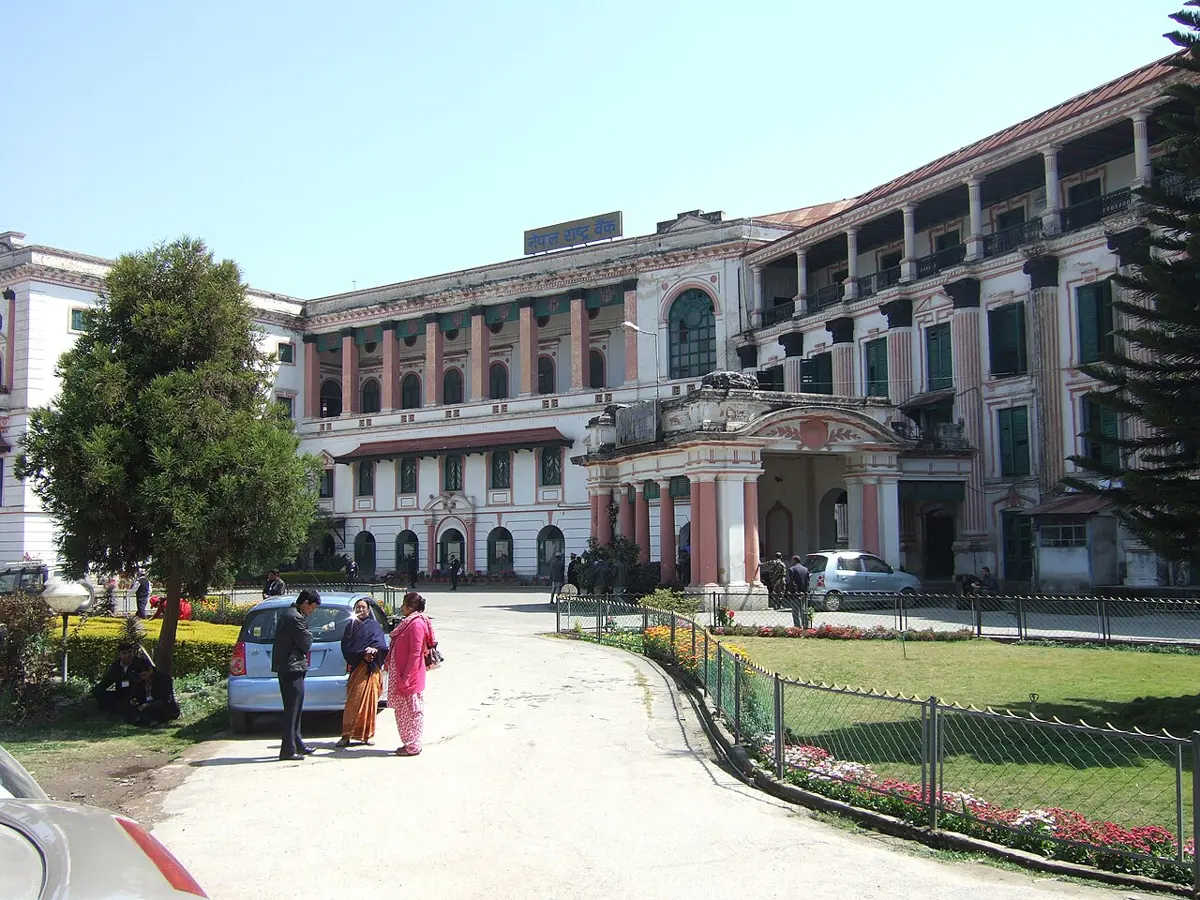
An ordinary person can’t open an account there. To a customer, the central bank is the body behind every bank, and it does three things that reach your pocket. It issues the notes, so every rupee in a wallet is its promise. It licenses the banks and finance companies, inspects them and can close them, sorting them into classes A to D: commercial banks, development banks, finance companies and microfinance companies, a list Chapter 12 starts from. And it writes many of the rules a customer meets: the KYC questions, the blacklist, and how complaints must be handled. Its law today, the Nepal Rastra Bank Act of 2002, gives it two more jobs, keeping prices and the money system steady, which Economics, for the Curious takes up. By October 2026 it licensed 20 commercial banks, 17 development banks, 16 finance companies and 50 microfinance companies.
A bank sells more than accounts and loans. It will rent a locker for gold and papers, for a yearly fee, in a vault it guards. For a trader buying from abroad it opens a letter of credit (प्रतीतपत्र), its written promise, through a bank in the seller’s country, to pay the seller a set sum. It will give a guarantee, a promise to pay a supplier or the government if its customer doesn’t, which a contractor may need before winning a job. It receives money sent from abroad, which Chapter 28 follows. It issues debit and credit cards, which Chapter 13 takes up. And it acts as its customers’ agent, collecting a dividend, paying a bill or holding shares for them. Each of these is the same trade underneath: people trust the bank with something because it is watched and because it has been there a long time.
The plain thing to take from this chapter is that an account is a loan you make to a bank, and the interest is the bank’s side of the deal, paid from the higher rate it charges the people it lends to. The kinds of account differ in how sure the bank can be of keeping the money: nothing for a current account, a little for savings, most for a fixed deposit. The questions asked when an account is opened are there to keep stolen money out of the system, and a child’s account is opened and run by a guardian. A statement is worth reading line by line, because it is where mistakes and thefts first show. A cheque is a written order that is only as good as the money behind it, and in Nepal a bounced one is a crime, handled by the police. Behind every bank stands Nepal Rastra Bank, which prints the notes, licenses the banks and writes the rules a customer meets.
Try this
- Ask a parent to show you a bank statement or a passbook. Find one line of each kind, money in and money out, and check one balance by working it out from the line above.
- Look at a blank cheque leaf. Find where the payee’s name, the amount in words and in figures, and the signature go, and where you would draw the lines to cross it.
- Before anyone in your family opens an account, write down four questions to ask: the smallest balance it must keep, the fees, how often interest is added, and what a person under 18 may do with it alone.
- Find the latest Banking and Financial Statistics on Nepal Rastra Bank’s website and look up the average rates on deposits and on loans. Take one from the other: that is the gap the banks live on.
Found a mistake? Please tell us.