
It is the Dashain holidays, and the cousins at Hajurama’s house in Bhaktapur have found the two dice from an old Ludo box. Sunil makes up a game. Everyone picks a total. Each turn, someone rolls both dice and adds them, and if the total is yours, your coin moves one step up a staircase drawn in chalk. The first to the top wins.
Riya picks 12, “because it’s the biggest”. Sunil picks 7. Little Ashok picks 1, his lucky number. Who has the best chance? Make your own guess before anyone rolls.
Guess first. Roll two dice and add them. Which total comes up most often?
Pick an answer to see why.
Roll the dice below a hundred times, then a thousand. Which bars grow fastest?
Try it
One die first
Start smaller. Roll one die. A fair die has no favorite face: each comes up about one time in six. Roll it 60 times and each face comes up about 10 times, though not exactly: one face might get 7 and another 13.
So it is natural to think two dice are the same: eleven totals, 2 to 12, each about one time in eleven. The widget says otherwise. After a few hundred rolls the bars stand in a rough triangle, tall in the middle and short at the ends, and the more you roll, the neater it gets.
A hundred rolls
In 100 rolls, 7 usually comes up somewhere near 17 times and 12 about 3 times. But press Start again and roll 100 a few times: sometimes 6 or 8 beats 7, and now and then 12 doesn’t come up at all.
How sure can you be? Our script played 100 rolls 100,000 times. After 100 rolls, 7 was on top by itself only about 46 times in 100, because 6 and 8 often caught it. But 12 came up as often as 7 in only about 4 runs in 10,000. So a hundred rolls is plenty to show that 7 beats 12, but not to be sure it beats 6 and 8. After 1,000 rolls, 7 was alone on top about 9 times in 10.
Sunil rolls the two dice 360 times. About how many times would you expect a total of 12?
Pick an answer to see why.
Counting the ways
Why should 7 be the favorite? Riya starts a list. “12 is 6 + 6, the only way. 7 can be 1 + 6, 2 + 5 or 3 + 4: three ways. So 7 is three times as likely as 12.” A good start, but the widget shows 7 coming up about six times as often as 12. What has she missed?
Imagine one die is red and the other blue. Red 1 with blue 6 is a different landing from red 6 with blue 1: the same total, but two different things the dice can do. Ordinary dice look alike, but they are still two separate dice, each landing on its own face; painting one red just lets you see it. So list every way the pair can land, the red die’s face and then the blue die’s.
Each of the red die’s 6 faces can go with each of the blue die’s 6: 6 × 6 = 36 ways in all (the multiplying of How Many Number Plates Can a Province Make?). Now count the ways for each total.
| Total | 2 | 3 | 4 | 5 | 6 | 7 | 8 | 9 | 10 | 11 | 12 |
|---|---|---|---|---|---|---|---|---|---|---|---|
| Ways, out of 36 | 1 | 2 | 3 | 4 | 5 | 6 | 5 | 4 | 3 | 2 | 1 |
Riya’s three ways for 7 become six once 1 + 6 and 6 + 1 count as two. But 6 + 6 is still one way: swapping the dice gives the same landing. So 7 beats 12 six to one, not three.
How many of the 36 ways give a total of 9?
Pick an answer to see why.
What’s going on
Outcomes, events and probability
Now the proper words. Each of the 36 ways the dice can land (red 3 and blue 5, say) is an outcome, and the list of them all is the sample space. What you are waiting for, “a total of 7”, is an event: a set of outcomes, here the six on the slanting line through the middle of the table.
The 36 outcomes are equally likely: none comes up more often than another. When outcomes are equally likely, the probability of an event, how likely it is, is
So the probability of 7 is , and of 12, .
| Total | 2 | 3 | 4 | 5 | 6 | 7 | 8 | 9 | 10 | 11 | 12 |
|---|---|---|---|---|---|---|---|---|---|---|---|
| Probability | 1/36 | 2/36 | 3/36 | 4/36 | 5/36 | 6/36 | 5/36 | 4/36 | 3/36 | 2/36 | 1/36 |
| As a percent | 2.8% | 5.6% | 8.3% | 11.1% | 13.9% | 16.7% | 13.9% | 11.1% | 8.3% | 5.6% | 2.8% |
| In 100 rolls, about | 3 | 6 | 8 | 11 | 14 | 17 | 14 | 11 | 8 | 6 | 3 |
What does “the probability of 7 is 1/6” mean? Not that every sixth roll is a 7: the rolls don’t take turns. Over many rolls, 7 comes up about one roll in six. A probability of 0 means it can never happen (Ashok’s 1); 1 means it always happens (a total from 2 to 12). The last row is the expected number, the rolls times the probability: 100 × 6/36 ≈ 17 sevens. It is what to expect on average, not a promise.
Why the 36 are equally likely
The two dice don’t affect each other: whatever the red die does, the blue die still lands on each face about one time in six. Events like these, where one tells you nothing about the other, are independent. The red die lands on 3 about one roll in 6, and in those rolls the blue die lands on 5 about one time in 6, so red 3 with blue 5 comes up about one roll in 6 × 6 = 36. The same goes for every pair: each of the 36 has probability . (As a tree diagram, the red die is 6 branches, each splitting into 6 for the blue: 36 ends, each , as Grade 10’s tree diagrams multiply along the branches.)
Why the totals make a triangle
In the table, squares with the same total lie on a slanting line, and the line for 7 runs from corner to corner, one square in each row. The line for 8 is one shorter, since a red 1 would need a blue 7. Each step away from 7, either way, the line loses a square, until 2 and 12 are single squares in opposite corners. That is the triangle.
There is a neat reason why its two sides match. On an ordinary die, opposite faces add up to 7: 1 is opposite 6, 2 opposite 5, 3 opposite 4. Turn both dice upside down after a roll: each face f becomes 7 − f, so a total t becomes 14 − t. A roll of 6 becomes an 8, a 12 becomes a 2. Upside-down rolls are just as likely as the right way up, so 6 and 8 are equally likely, and so are 2 and 12.
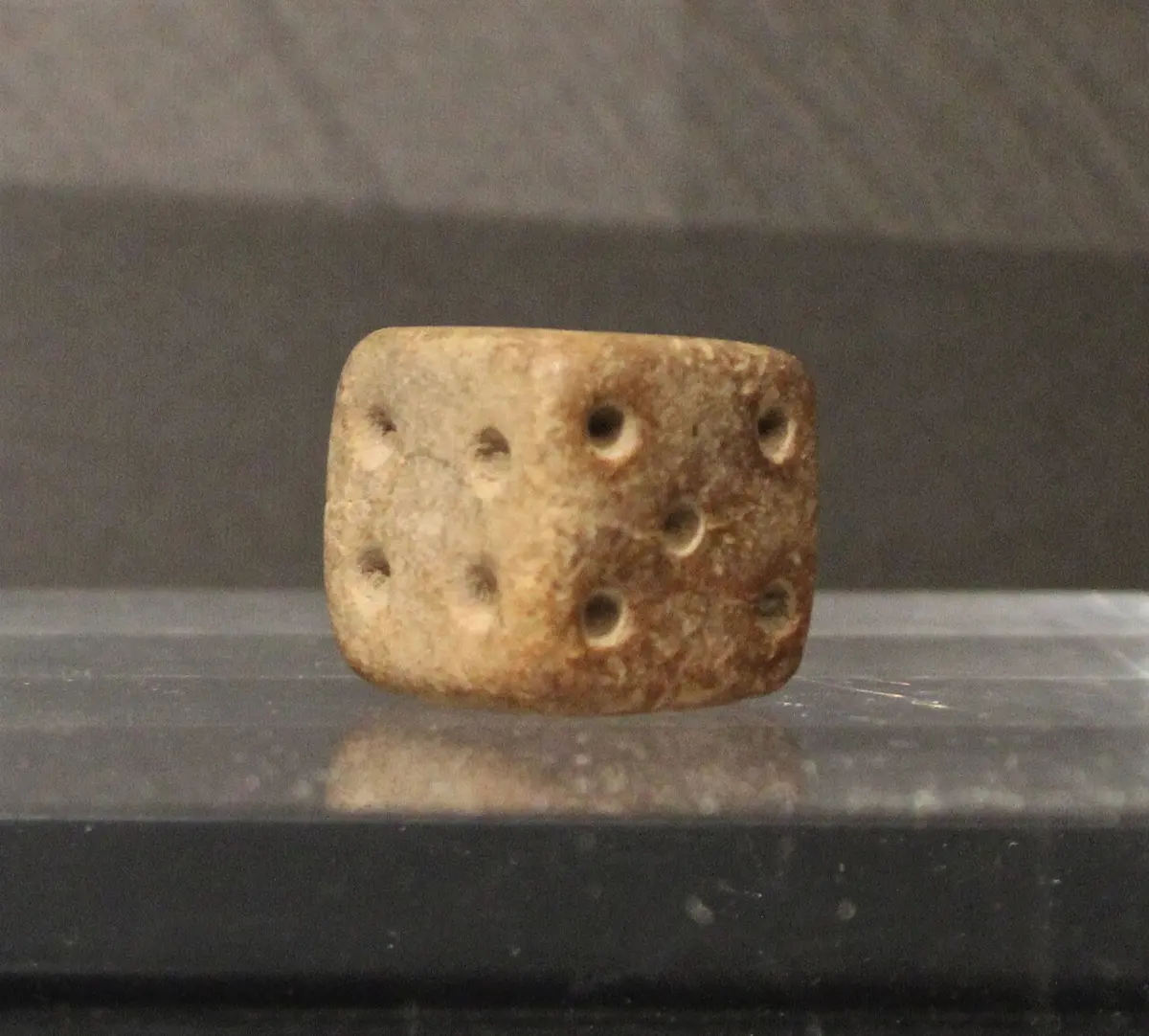
Dice are very old. Terracotta dice have been dug up at Mohenjo-daro, a city of the Indus Valley civilization, from about 2600–1900 BCE. Most Indus dice are numbered in other ways, but at least one, the die in the photo, already has its opposite faces adding to seven, like modern dice. People in South Asia rolled dice for thousands of years before anyone counted the 36 outcomes.
Rolling against counting
There are two ways to find how often 7 comes up. Roll and count: 172 sevens in 1,000 rolls is a relative frequency of 17.2%, sometimes called the experimental probability. Or count outcomes: 6 of 36, 16.7%, the theoretical probability. How do they compare? Our script worked out the range the number of 7s falls in, 19 runs in 20:
| Rolls | 7s expected | 7s in 19 runs out of 20 | As a percent of the rolls |
|---|---|---|---|
| 100 | about 17 | 10 to 24 | 10% to 24% |
| 1,000 | about 167 | 144 to 190 | 14.4% to 19.0% |
| 10,000 | about 1,667 | 1,594 to 1,740 | 15.9% to 17.4% |
The number of 7s wanders further from the expected one as you roll more, by up to about 7 in 100 rolls but about 73 in 10,000. Yet the percent closes in on 16.7%. This is the law of large numbers: the more times a chance event is repeated, the closer its relative frequency comes to its probability. It is why a casino playing millions of games can be almost sure of its takings, and a player playing ten can’t be sure of anything.
Which roll is more likely: red 6 and blue 6, or red 2 and blue 5?
Pick an answer to see why.
Shortcuts: “not” and “or”
Not. The outcomes that aren’t a 7 are the other 36 − 6 = 30, so the probability of not rolling 7 is , which is 1 − . The probability that something doesn’t happen is 1 minus the probability that it does.
Or. “A 7 or an 11” is the 6 outcomes for 7 and the 2 for 11: . Adding works because no roll is both: the two events are mutually exclusive. When two events can happen together, don’t count the shared outcomes twice: “a double or a total of 8” is 6 doubles and 5 eights, but 4 + 4 is in both, so 6 + 5 − 1 = 10 outcomes.
Roll two dice. What is the probability that at least one shows a 6?
Pick an answer to see why.
Harder puzzles
The difference of two dice
Now take the smaller number from the bigger. The difference can be 0 to 5.
Guess before you count. Which difference comes up most often?
Pick an answer to see why.
The lit squares lie on slanting lines the other way now. A difference of 0 is one diagonal, six squares, but every other difference has two lines, one on each side of it: 1 has two lines of 5. That is why 1 wins.
Galileo’s three dice
About 400 years ago, someone asked the scientist Galileo Galilei to explain a puzzle from Italian dice players, who played with three dice. (Galileo calls him only “him who has ordered me”, and doesn’t say who he was.) A total of 9 can be made from three numbers in six ways: 1 + 2 + 6, 1 + 3 + 5, 1 + 4 + 4, 2 + 2 + 5, 2 + 3 + 4 and 3 + 3 + 3. So can 10: 1 + 3 + 6, 1 + 4 + 5, 2 + 2 + 6, 2 + 3 + 5, 2 + 4 + 4 and 3 + 3 + 4. Yet long experience at the tables said 10 came up a little more often than 9, and 11 more often than 12. Were they imagining it? Roll, into the thousands.
A few hundred rolls won’t tell them apart. In our script, 10 was ahead after 100 rolls in only 53 runs of 100, after 1,000 rolls in 71, and after 10,000 rolls in 97. The gamblers must have watched an enormous number of games.
Galileo did what you did with the red and blue dice: he counted every way the three dice can land, 6 × 6 × 6 = 216 equally likely outcomes. The six sums are not equally likely, because they come in different numbers of orders:
- three different numbers, like 1 + 2 + 6, in 6 orders (any of the three on the red die, either of the other two on the blue, the last on the green: 3 × 2 × 1);
- two the same, like 1 + 4 + 4, in 3 (the odd one out on the red, blue or green die);
- all the same, 3 + 3 + 3, in 1.
| Total 9 | 1+2+6 | 1+3+5 | 1+4+4 | 2+2+5 | 2+3+4 | 3+3+3 | In all |
|---|---|---|---|---|---|---|---|
| Orders | 6 | 6 | 3 | 3 | 6 | 1 | 25 |
| Total 10 | 1+3+6 | 1+4+5 | 2+2+6 | 2+3+5 | 2+4+4 | 3+3+4 | In all |
|---|---|---|---|---|---|---|---|
| Orders | 6 | 6 | 3 | 6 | 3 | 3 | 27 |
So 10 comes up in 27 of the 216 outcomes and 9 in 25: the gamblers were right, by a whisker. The difference is the 3 + 3 + 3 that 9 needs, which can only be rolled one way.
Where the counting goes wrong
The rule “count the equally likely outcomes” is simple; being sure they really are equally likely is the hard part, and great minds have slipped. Gottfried Wilhelm Leibniz, who invented calculus at about the same time as Newton, wrote that with two dice a total of 11 is as likely as 12, since each can be made in only one way, 5 + 6 and 6 + 6. You can see his slip: 5 + 6 and 6 + 5 are two outcomes, so 11 is twice as likely.
Jean d’Alembert wrote in 1754 that if you toss a coin twice, the chance of at least one head is 2/3: a head first (and you needn’t toss again), a tail then a head, or two tails, and two of the three have a head. But “a head first” is half of all games by itself. List both tosses, like the red and blue dice: HH, HT, TH, TT, four equally likely outcomes, three with a head. The answer is 3/4.
When the dice aren’t fair
Everything so far assumes fair dice, each face exactly one time in six. Real dice are never quite perfect. In 1894 the English biologist Walter Weldon threw 12 dice at once 26,306 times and counted the 5s and 6s. For fair dice, 5 or 6 should come up one time in three, 33.33%; his gave 33.77%. That sounds like nothing, but over 315,672 dice it was far too much to be luck: his dice favored 5 and 6 a little. In 2009 Zacariah Labby built a machine that rolled and photographed 12 dice 26,306 times. His dice showed 1 and 6 slightly more often (16.86% and 16.88% instead of 16.67%), and when he measured them, they were about 0.2% shorter between the 1 and the 6 than across the other faces.
So 1/36 for a double six is a model of perfect dice. It fits ordinary dice so well that it takes tens of thousands of throws to catch them out; when rolls and model disagree by more than luck can explain, as Weldon’s did, the dice are not quite fair.
More dice, a rounder hill
One die gives six equal bars. Two dice give a triangle, peaked at 7. Three give a hill with a rounded top at 10 and 11; four, a rounder hill peaked at 14 (146 of the 1,296 outcomes). The more dice you add, the more the shape becomes a smooth bell, as at Science Playground’s Galton Board, where each ball bounces left or right at random at every peg: there are far more ways to end up in the middle than at the edges.
Where this is used
Questions
Roll two dice. What is the probability of a total of 10 or more?
Pick an answer to see why.
Roll two dice. What is the probability of a double? In 300 rolls, about how many doubles would you expect?
Answer
Is an odd total or an even total more likely with two dice?
Answer
Riya (12) and Sunil (7) play a new game: roll until one of their totals comes up, and whoever’s comes first wins. What is Riya’s chance?
Pick an answer to see why.
Multiply the two dice instead of adding. Which product comes up most often, and how many different products are there?
Hint
Answer
The red die has landed on 6 and the blue die is still rolling. Now what is the probability that the total is 12? That it is 7?
Answer
Sunil rolls two dice behind a book and says, “The total is 8.” What is the probability that he rolled a double?
Pick an answer to see why.
Ashok says: “4 is 1 + 3 or 2 + 2, and 5 is 1 + 4 or 2 + 3. Two ways each, so 4 and 5 are equally likely.” What is wrong?
Pick an answer to see why.
Find two dice, not numbered 1 to 6 but with six faces of positive whole numbers each (faces may repeat), whose totals come up exactly as often as ordinary dice’s. One of them is 1, 2, 2, 3, 3, 4. What is the other?
Hint
Answer
Galileo counted 27 outcomes for 10 and 25 for 9 with three dice. Without counting all 216, explain why 11 has as many as 10.
Answer
Pema rolls two dice 36 times. Is it likely that 12 doesn’t come up at all?
Hint
Answer
Where to go next
- Is This Game Fair? A fairground game that looks generous, played a thousand times on paper to see who really wins.
- How Many Ways Can You Walk to School? Counting routes, and a triangle of numbers that also says where the Galton Board’s balls land.
- Should You Switch Doors? (Grades 9–12) A game-show puzzle where counting the equally likely outcomes beats almost everyone’s instinct.
- What Is a Game Worth on Average? (Grades 9–12) Expected numbers turned into prizes.
- How Can Throwing Rice Find π? (Computing, Going Further 6–8) Chance put to work: rice thrown at random on a square drawing finds a famous number.
- In the grade books: Grade 10’s probability, with the addition and multiplication laws behind “or” and the red-and-blue table.
Where these facts come from
- Galileo’s note on three dice: written “to oblige him who has ordered me”, the dice players’ observation that 10 and 11 are more advantageous than 9 and 12, though each can be made of six combinations, and his count of the 216 throws, 27 for 10 and 25 for 9: Galileo, “Sopra le scoperte dei dadi”, in Le Opere di Galileo Galilei, vol. 8 (Barbera, Florence, 1898), pp. 591–594, as given on the University of York’s history of statistics page and Leiden University’s copy, read October 2026 (retold in our words).
- Galileo’s dice problem between 1613 and 1623; Cardano’s work in the 1560s; Pascal and Fermat’s letters of 1654, prompted by Antoine Gombaud’s questions: Wikipedia, “History of probability”, read October 2026. Gombaud a French writer: Wikipedia, “Antoine Gombaud”, read October 2026.
- Cardano’s Liber de ludo aleae, written about 1564, published 1663, the first systematic treatment of probability, with a section on cheating; his gambling and chess: Wikipedia, “Gerolamo Cardano”, read October 2026.
- Leibniz’s claim that 11 and 12 are equally likely with two dice (in his Opera Omnia), and d’Alembert’s 2/3 for at least one head in two tosses in “Croix ou Pile” (1754): Dennis Sun, The Art of Chance, “Classical Definition of Probability”, read October 2026.
- Opposite faces of modern dice add to seven; dice in the Rigveda, Atharvaveda and Mahabharata; casinos’ precision dice, cut square, their pips filled with paint or epoxy of the same density: Wikipedia, “Dice”, read October 2026. The Mohenjo-daro die, about 2600–1900 BCE, in the Ashmolean Museum, “unusual in that its opposite sides add up to seven as in modern dice”: its photo’s description on Wikimedia Commons, read October 2026.
- Rituparna’s count of the vibhitaka tree, Vahuka cutting it down, “Know that I am proficient at dice besides being versed in numbers”, and the trade of dice for horse-lore: The Mahabharata, Vana Parva, Section LXXII, translated by K. M. Ganguli (1883–1896; public domain), SriPedia’s copy, read October 2026. The disguised Nala as Rituparna’s charioteer: Wikipedia, “Nala”, read October 2026.
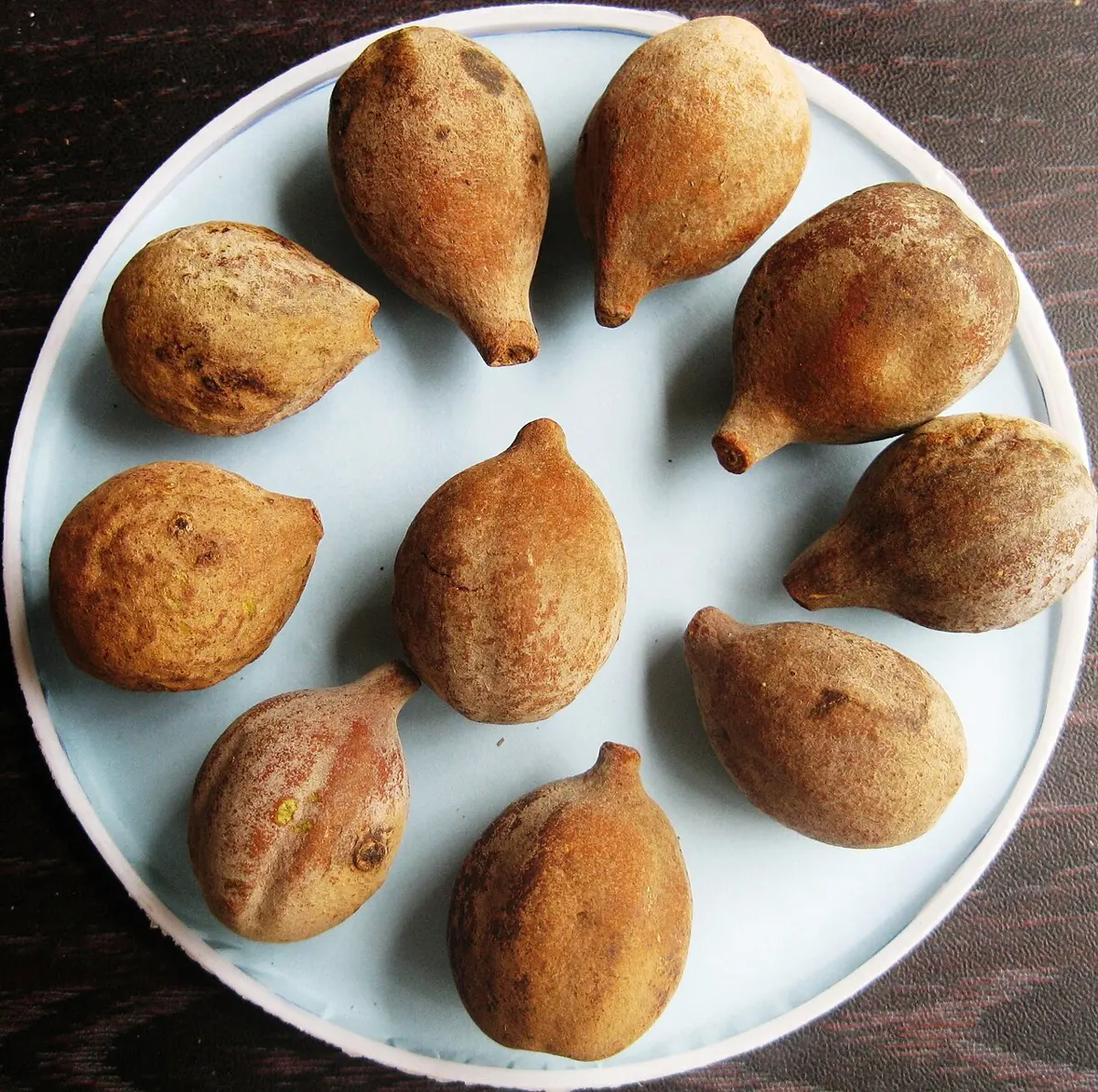
- The vibhitaka (Terminalia bellirica), its Nepali name barro (बर्रो), its fruit in triphala, its nuts as dice in the Mahabharata and Rigveda 10.34 and the odd-or-even call (after Deborah Bennett’s Randomness, 1999): Wikipedia, “Terminalia bellirica”, read October 2026. Its Nepali name, barro (बर्रो), as on the center’s own plant list.
- Weldon’s 26,306 throws of 12 dice (1894, reported to Galton), 5 or 6 a success, the observed 33.77%; Labby’s machine (2009), its 26,306 throws, the faces’ probabilities (1: 0.1686, 6: 0.1688), the 1–6 axis about 0.2% shorter; Weldon’s data first published in Karl Pearson’s 1900 paper introducing the χ² goodness-of-fit test, taught in introductory statistics courses: Zacariah Labby, “Weldon’s Dice, Automated”, CHANCE 22(4), 2009, read October 2026.
- Catan’s number tokens: one 2 and one 12, no 7, the dots under each number, 6 and 8 in red with 5 dots “because there are 5 ways to roll these numbers on the 2 dice”, the robber on a 7: Catan, 5th edition rules and almanac (Catan GmbH, 2015), a retailer’s copy of the rulebook, read October 2026. First published in 1995: Wikipedia, “Catan”, read October 2026.
- The Punnett square, devised by Reginald Punnett in 1905; a Bb × Bb cross gives BB, Bb, bb with 25%, 50%, 25%: Wikipedia, “Punnett square”, read October 2026.
- The Sicherman dice (1, 2, 2, 3, 3, 4 and 1, 3, 4, 5, 6, 8), George Sicherman, 1978, reported by Martin Gardner, the only other such pair: Wikipedia, “Sicherman dice”, read October 2026.
- Every count, probability, table and answer in this topic (the 36 and 216 outcomes and their totals, the difference and product tables, “or” and “not”, the 9 and 10 orders, four dice’s 146 of 1,296, Sicherman’s totals, the ranges of 7s in 100, 1,000 and 10,000 rolls, ten rolls without a 7, no 12 in 36 or 100 rolls, Riya’s 1/7) was computed, and how often 7 leads after 100 and 1,000 rolls and 10 leads 9 after 100, 1,000 and 10,000 rolls simulated, in
checks/textbooks/math-further-6-8/13/tmp/dice_numbers.py.
