
You are on a game show, filmed in a studio in Kathmandu. In front of you are three closed doors. Behind one of them is a new car. Behind each of the other two is a goat. (A goat is a fine thing to take home before Dashain, but you want the car.) Everyone who watches the show knows its rules: after you pick, the host always opens one of the other doors, always one with a goat behind it (choosing either one at random if both hide goats), and always offers you the swap. You pick door 1. The host, who knows what is behind every door, walks over to door 3 and opens it: a goat. Then he smiles and asks, “Do you want to stay with door 1, or switch to door 2?”
Two doors are left, and the car is behind one of them. It looks like fifty-fifty. Does it matter what you do?
Guess first. If you switch to door 2, what is your chance of winning the car?
Pick an answer to see why.
Don’t take the answer on trust. Play the game, many times, both ways.
Count every game
Playing gives you a feeling for the answer: after a few hundred games, the switchers have won about two games in three, and the stayers about one in three. (In 100 games of switching you will usually win somewhere between 57 and 76; in 100 games of staying, between 24 and 43. A short run can mislead, which is why the tallies need many games.) But a feeling isn’t a reason. Counting is.
Suppose you always pick door 1; by symmetry, any other door works the same way. The car is equally likely to be behind any of the three doors, so there are three equally likely games:
| The car is behind | The host opens | If you stay | If you switch |
|---|---|---|---|
| door 1 | door 2 or door 3 (both are goats) | car | goat |
| door 2 | door 3 (he can’t open the car’s door) | goat | car |
| door 3 | door 2 | goat | car |
Staying wins in one of the three games. Switching wins in two. So the chance of winning by staying is and by switching, .
Look at the table again and you’ll see the whole puzzle in one line: switching wins exactly when your first pick was wrong. If you first picked a goat, the host has to open the other goat (he never shows the car), so the closed door he leaves is the car, and switching takes it. Your first pick is wrong two times in three. So switching wins two times in three.
That also explains why “two doors left, so fifty-fifty” fails. The two closed doors didn’t get to be closed in the same way. You chose yours before you knew anything, at random. The host chose which of the other two to leave closed knowing where the car was, and he was never allowed to open the car’s door. Your door is just a guess; the other door has been through a filter.
You always switch. In which games do you lose?
Pick an answer to see why.
A hundred doors
If two in three still feels wrong, make the game bigger, as Marilyn vos Savant did in the magazine column that made the puzzle famous. There are 100 doors and one car. You pick door 37. The host, who knows where the car is, opens 98 of the other 99 doors: goats, every one. Only door 37 and, say, door 58 are left closed.
Would you stay with door 37? You chose it from 100 doors with no information: it is the car one time in 100. Door 58 is the one door, out of 99, that the host carefully didn’t open. Unless your first wild guess happened to be right, the car must be behind door 58. Switching wins 99 times in 100. Try it in the game above with 100 doors.
With 3 doors the same thing happens, only less loudly. In general, with n doors, where the host opens all but one of the doors you didn’t pick, switching wins of the time.
What the host’s door tells you
There is a more careful question hiding here, and answering it is the mathematics of this page. Before the game, the chance that the car is behind door 2 was . Then you saw something: the host opened door 3. What is the chance that the car is behind door 2 now, given what you saw?
One way to answer is to imagine the game played a lot of times, say 300 times, and count. (England’s school course calls this “expected frequencies”.) You always pick door 1.
- In about 100 of the 300 games the car is behind door 1. The host can open either goat door, and picks one at random: door 2 in about 50 games, door 3 in about 50.
- In about 100 games the car is behind door 2. The host must open door 3.
- In about 100 games the car is behind door 3. The host must open door 2.
Now throw away every game that didn’t look like yours, the 150 in which the host opened door 2. You are left with 150 games in which he opened door 3. In 50 of them the car is behind door 1, and in 100 it is behind door 2. So, given that the host opened door 3,
This is a conditional probability: the chance of one thing given that another has happened. Mathematicians write it with a straight bar meaning “given”: is “the probability of A given B”. And the counting you just did is the definition. To find , keep only the outcomes in which B happened, and ask what share of them also have A:
Here A is “the car is behind door 2” and B is “the host opens door 3”. In a whole game, (whenever the car is behind door 2, he opens door 3), and (he opens door 3 in half the games), so
The tree diagram from Grade 10 shows the same thing at a glance, each path’s chance the product of the chances along it (the multiplication principle): the car behind door 1, then door 3 opened, is .
Read Figure 13.1 as a race between two stories that both end with door 3 open. In the first, the car is behind your door and the host happened to pick door 3 out of two choices: chance . In the second, the car is behind door 2 and the host was forced to open door 3: chance . The forced story is twice as likely as the chosen one. That is the 2 to 1 in favor of switching.
So seeing door 3 opened left your own door’s chance where it was: , the same as before. When knowing that B happened leaves the chance of A unchanged, , the two events are called independent. Then also P(A and B) = P(A) × P(B), and here indeed . “The car is behind door 2” and “door 3 opened” are not independent: is not .
In the 300 imagined games, why are the games where the host opened door 2 thrown away?
Pick an answer to see why.
When the host doesn’t know
Now the twist. Change one thing: the host doesn’t know where the car is. You pick door 1, and he opens door 2 or door 3 at random. Jeffrey Rosenthal called this version “Monty Fall”: the host slips on a banana peel and accidentally pushes open one of the other doors. Suppose it is door 3, and there is a goat behind it. Everything you see is exactly the same as before. Should you switch?
Count 300 games again. You pick door 1; the car is behind each door in about 100 games; in each of those, the falling host opens door 2 in about 50 and door 3 in about 50. Keep only the games that look like yours: door 3 opened, a goat behind it.
- Car behind door 1, door 3 opened: 50 games. A goat behind door 3: kept.
- Car behind door 2, door 3 opened: 50 games. A goat behind door 3: kept.
- Car behind door 3, door 3 opened: 50 games. But the car is behind it, and you saw a goat: thrown away.
That leaves 100 games, 50 of each. Staying wins 50, switching wins 50: one in two. This time the fifty-fifty answer is right, and what you saw has changed your own door’s chance, from to : here your door and the opened goat door are not independent.
Why the difference, when the stage looks the same? A host who knows protects the car: he can never open its door, so when the car is behind door 2, he is forced to point you to it. A host who doesn’t know can stumble onto the car, and the games thrown out for that are all games in which your first pick was wrong: exactly the games that a host who knows turns into wins for switching. What a door being opened tells you depends on how it came to be opened, not just on what is behind it.
The third host in the widget is the one Monty Hall, the real host, said he could be. On his show, Let’s Make a Deal, nothing forced him to open a goat door or offer a swap. Suppose a host offers a switch only when your first pick is the car, and otherwise just opens your door and hands you your goat. Then every game in which you are offered a switch is a game you have already won, and switching always loses. A host who offers it only when you picked a goat makes switching always win.
So the honest answer to “Should you switch?” is: it depends on the rules the host follows. If he must always open a goat door and always offer a switch, switch, and you win two times in three. If you don’t know his rules, you can’t work out the chance at all.
More puzzles of the same kind
Three boxes of coins. This one is from 1889, from the French mathematician Joseph Bertrand’s Calcul des probabilités. There are three boxes. One holds two gold coins, one two silver coins, and one a gold coin and a silver coin. You choose a box at random and take out one coin without looking: it is gold. What is the chance that the other coin in the box is gold too?
“The box is either gold-gold or gold-silver, so one in two”, says your gut. Count the coins instead. Each of the six coins was equally likely to be the one you drew. Three of them are gold: the two in the gold-gold box and the one in the mixed box. In two of those three draws, the coin left in the box is gold. So the answer is . The gold-gold box is twice as likely as the mixed one to give you gold, so seeing gold makes it twice as likely.
The scholarship. Three Grade 12 students, Asha, Bikash and Chandra, have applied for one scholarship, and the committee has chosen one of them at random; the letters come next week. Asha asks the teacher, who knows: “At least one of Bikash and Chandra hasn’t got it. Tell me one name, it can’t harm me.” The teacher agrees to name one of the others who hasn’t won (choosing at random if both haven’t) and says, “Bikash hasn’t.” Asha is pleased: her chance has risen from 1 in 3 to 1 in 2. Has it?
No. This is the three-door game in different clothes (Martin Gardner told it with three prisoners in Scientific American in 1959, warning that “in no other branch of mathematics is it so easy for experts to blunder as in probability theory”). Asha is “your door”, the teacher is the host who knows. Count, as with the doors. If Asha has won (1 time in 3), the teacher names Bikash only half the time. If Chandra has won (1 time in 3), the teacher must name Bikash. So “Bikash hasn’t” is twice as likely to come from Chandra winning as from Asha winning: Asha’s chance is still , and Chandra’s has risen to . Chandra is the door the teacher could have named and didn’t.
A story from maths
Where this is used
Conditional probability is how any new fact changes a chance: a test result, a clue, a search that found nothing.
The twist of this page is a lesson for every day: before working out a chance from what you have been shown, ask how it came to be shown to you. A shopkeeper who shows you only his happy customers has, like the host, filtered what you see.
Questions
★ Five doors, one car. You pick one, and the host, who knows, opens three goat doors, leaving yours and one other closed. What is your chance of winning if you switch?
Pick an answer to see why.
Three cards are in a bag: one is red on both sides, one black on both sides, and one red on one side and black on the other. A friend pulls one out without looking and lays it flat on the table. The side facing up is red. What is the chance that the other side is red too?
Hint
Answer
There are four doors and one car. You pick one; the host, who knows, opens one goat door and offers you a switch to either of the other two closed doors. Should you switch? If you do, and pick one of the two at random, what is your chance of winning?
Hint
Answer
A tired host always opens door 2 when he has a choice of two goat doors (Rosenthal calls this “Monty Crawl”). You pick door 1. Use 300 imagined games to find your chance of winning by switching (i) if he opens door 3, (ii) if he opens door 2.
Hint
Answer
A host who has a choice of two goat doors opens door 3 with chance q and door 2 with chance 1 − q. You picked door 1 and he opened door 3. Use to show that your chance of winning by switching is . What is it when ? Can it ever be worse than one in two?
Hint
Answer
A host always offers a switch when your first pick is the car, but only half the time when your first pick is a goat. You are offered a switch. What is your chance of winning if you take it?
Hint
Answer
Where to go next
- Will Two People in Your Class Share a Birthday? Another chance that everyone’s gut gets wrong, found by counting.
- Is a Positive Test Result Bad News? Conditional probability at work in medical tests, and the base rates that make a positive result much less alarming than it sounds.
- What Is a Game Worth on Average? Expected value: how much a game pays in the long run, and why that decides whether to play.
- Is This Game Fair? (Grades 6–8) Counting outcomes to see who a game favors.
- Which Total Comes Up Most with Two Dice? (Grades 6–8) Listing equally likely outcomes, as the table of games did here.
- Grade 10 Math: Tree diagram The tree of Figure 13.1, and the multiplication principle that gives each path’s chance.
- Computing, Going Further: How Does a Computer Roll a Die? Random numbers, like those the door game uses to hide the car. (Coming soon.)
Where these facts come from
- The Parade question (Craig F. Whitaker’s letter), vos Savant’s answer and her million doors and door #777,777, the letters quoted (Robert Sachs, E. Ray Bobo, Glenn Calkins’s “You are the goat!”), the 92% and 65% against her, the paper cups and penny experiment of 200 games each way, and the teachers’ replies (Jane Griffith’s “Oh my gosh. She was right!”): Marilyn vos Savant, “Game Show Problem”, her site’s reprint of the 1990–1991 Parade columns, read through the Wayback Machine, October 2026.
- About 10,000 letters and close to 1,000 of the critical ones signed by PhDs, the September 1990 column, Monty Hall’s dining-room games (4 cars of 10 staying, 8 of 10 switching), his demonstration of a host who chooses when to offer, his words “If the host is required…” and “beware”, Sachs’s “eating humble pie”, 1963–1990 and 4,500 programs, Gardner’s “in no other branch of mathematics…”: John Tierney, “Behind Monty Hall’s Doors: Puzzle, Debate and Answer?”, The New York Times, 21 July 1991, read through the Wayback Machine, October 2026.
- Selvin’s two letters of 1975 and the name “Monty Hall problem”, Gardner’s three prisoners of October 1959, the standard assumptions about the host, the host who offers only when you picked the car or only when you didn’t, the host who offers always when right and half the time when wrong (one in two), Bertrand’s box paradox of 1889 and his argument against one half, the formula (from Morgan and others, 1991): Wikipedia, “Monty Hall problem”, “Bertrand’s box paradox” and “Three prisoners problem”, read October 2026. Selvin’s first letter’s date (February 1975, vol. 29, no. 1) also from Crossref’s record of it (doi:10.1080/00031305.1975.10479121); Tierney’s article gives 1976. Selvin’s letters and Bertrand’s book were not opened.
- The “shaky solution”, Monty Fall and Monty Crawl, the three-card puzzle: Jeffrey S. Rosenthal, “Monty Hall, Monty Fall, Monty Crawl”, Math Horizons, September 2008, read October 2026.
- Erdős and the computer simulation (1995, “No, that is impossible…”, 100,000 runs, Ron Graham’s explanation): Andrew Vazsonyi, “Which Door Has the Cadillac?”, Decision Line, December 1998/January 1999, read October 2026.
- The pigeons (six birds, 30 days, 36.33% to 96.33% switching, 63.83% of games won) and the undergraduates (200 trials, 56.67% to 65.67% switching), the title: W. T. Herbranson and J. Schroeder, “Are Birds Smarter Than Mathematicians? Pigeons (Columba livia) Perform Optimally on a Version of the Monty Hall Dilemma”, Journal of Comparative Psychology 124 (2010), 1–13, read October 2026. Whitman College and up to 100 trials a day from the paper.
- Air France 447 (1 June 2009, 228 people, two years of searching, the Bayesian posterior that accounted for failed searches, found within one week of undersea search in 2011, the wreck in an area covered by the 2009 passive acoustic search, the beacon that gave no signal, the delay of up to a year): L. D. Stone, C. M. Keller, T. M. Kratzke and J. P. Strumpfer, “Search for the Wreckage of Air France Flight AF 447”, Statistical Science 29 (2014), 69–80, read October 2026.
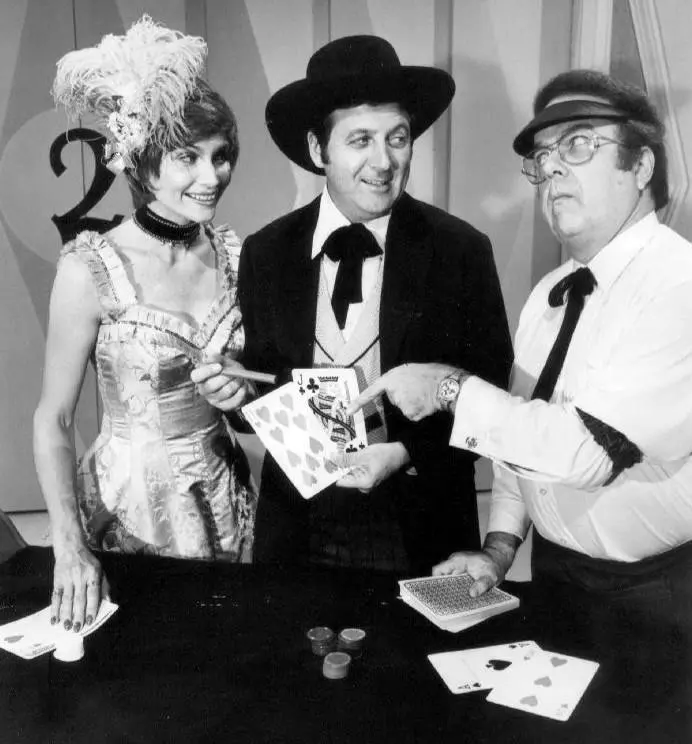
- The photo of Monty Hall: File:Lets make a deal 1974.JPG, Wikimedia Commons (ABC Television publicity photo, public domain), read October 2026.
- Every number on this page (1/3 and 2/3, the 300 games and 150 and 100 left, and 9 in 10, the tree’s 1/6 and 1/3, Monty Fall’s one in two, Monty Crawl, the hosts who choose when to offer, Bertrand’s 2/3, the scholarship’s 1/3 and 2/3, the 57 to 76 and 24 to 43 wins in 100 games, and every answer to the questions) was computed by a script (
checks/textbooks/math-further-9-12/13/tmp/answers.py), which also checks the standard game and Monty Fall by simulating 200,000 games each, and again, with the independence check , by a second script (checks/textbooks/math-further-9-12/13/tmp/review/recompute.py).
