
Your friend Asmita says she can multiply any two numbers without knowing her times tables. “All I need is to halve, to double and to add,” she says. “Give me two numbers.” You say 37 and 24.
She writes 37 at the top of one column and 24 beside it. Down the first column she halves, throwing away any half: 37, 18, 9, 4, 2, 1. Down the second she doubles: 24, 48, 96, 192, 384, 768. Then she crosses out every row with an even number on the left, adds up what is left in the right column, and says “888”. You check on a calculator: 37 × 24 is 888.
Is it a lucky trick that worked once, or does it always work? Try it with your own numbers.
Try a few pairs in the widget. Then guess: does the trick work for every pair of whole numbers?
Pick an answer to see why.
Playing with the trick
Before looking for a reason, look for patterns. Small cases first.
Which of these first numbers leaves only one row standing after the crossing out?
Pick an answer to see why.
Now swap the numbers. With 24 on the left and 37 on the right, the left column goes 24, 12, 6, 3, 1, and the rows kept are 296 and 592, which add to 888 again. Different rows, the same answer.
What’s going on
A sum that never changes
Here is a way to see why the trick can’t fail. At every step, write down what is still to be multiplied, plus what has been kept so far. For 37 × 24:
| Kept so far | Still to multiply | Total |
|---|---|---|
| 0 | 37 × 24 | 888 |
| 24 | 36 × 24 | 888 |
| 24 | 18 × 48 | 888 |
| 24 | 9 × 96 | 888 |
| 24 + 96 = 120 | 8 × 96 | 888 |
| 120 | 4 × 192 | 888 |
| 120 | 2 × 384 | 888 |
| 120 | 1 × 768 | 888 |
Two kinds of step happen, and neither changes the total:
- The left number is even. Halving one number and doubling the other doesn’t change the product: 18 × 48 is the same as 36 × 24, because 18 is half of 36 and 48 is twice 24. Think of 36 rows of 24 chairs rearranged as 18 rows of 48.
- The left number is odd. Then it can’t be halved exactly. So take one lot of the right number away and keep it: 37 × 24 is 24 + 36 × 24. That is why odd rows are kept. Now the left number is even, and halving is exact again.
Dropping the half when you halve an odd number is the same as taking that one lot away first: half of 37, without the half, is 18, which is half of 36. At the end the left number is 1, so the last row is kept too, and everything kept adds up to the whole product. The total was 888 at the start and is never changed, so the kept numbers must add to 888.
The doubles of 1
There is a second way to see it, and it explains the patterns you found. Look at which rows are kept for 37: the 1st, the 3rd and the 6th. In those rows the right column holds 24, then 24 doubled twice, then 24 doubled five times, which is 1 × 24, 4 × 24 and 32 × 24. And 1 + 4 + 32 = 37.
So the trick splits 37 into doubles of 1 (1, 2, 4, 8, 16, 32…), and multiplies 24 by each piece by doubling.
Read the odd-or-even column from the bottom up for 37 and you get 100101. That is 37 in binary, the base-two place value of Grade 8, where the places are worth 1, 2, 4, 8, 16, 32 instead of 1, 10, 100, 1000: 37 = 1 × 32 + 0 × 16 + 0 × 8 + 1 × 4 + 0 × 2 + 1 × 1.
Why does halving find the binary digits? In our tens system, a number’s last digit is what is left after taking out all the tens, and dividing by 10 (dropping the remainder) chops that digit off: 375 becomes 37. In binary it is the same with 2. A number’s last binary digit is 1 if it is odd and 0 if it is even, and halving it (dropping the half) chops that digit off: 100101 becomes 10010, which is 18. So each row’s “odd or even” is the next binary digit, from the right.
Every whole number can be written in binary in exactly one way, so every whole number is a sum of different doubles of 1 in exactly one way. That is why the trick works for every pair. It also explains your patterns: 32 is 100000 in binary, a single 1, so one row is kept; 63 is 111111, all 1s, so no row is crossed out.
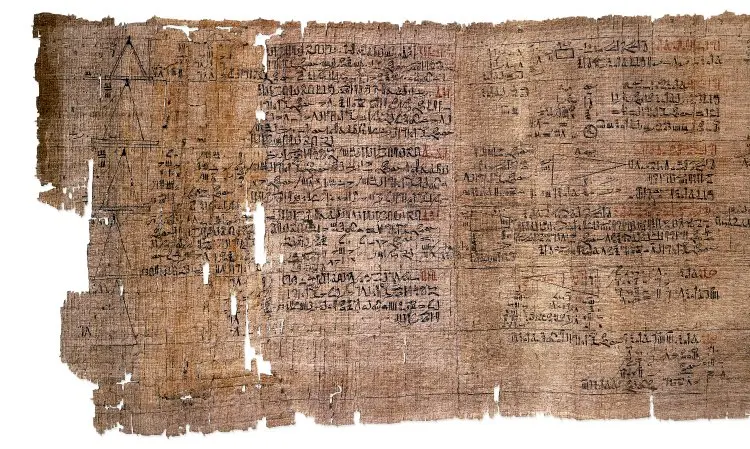
The trick goes by several names: doubling and halving, Egyptian multiplication, and Russian peasant multiplication. The Egyptian version, the oldest written down, didn’t halve at all. A scribe wrote a column of doubles of 1 beside a column of doubles of 24, then ticked the rows whose doubles of 1 added up to 37 (32, 4 and 1) and added their partners. Same rows, same answer.
The lattice
Doubling and halving needs many rows for big numbers. Another old way needs a grid. Here it is for 347 × 28.
- Write one number across the top, one digit to a column, and the other down the right side.
- In each cell, write the product of its two digits, the tens above the slanting line and the ones below it (3 × 2 = 6 is written 0 and 6).
- Add along each slanting strip, starting at the bottom right. If a strip adds to 10 or more, write the ones and carry the tens to the next strip.
In Figure 31.2 the strips, from the right, give 6; then 4 + 2 + 5 = 11, so 1 carry 1; then 8 + 1 + 4 + 3 = 16 and 1 carried, 17, so 7 carry 1; then 6 + 0 + 2 = 8 and 1 carried, 9; then 0. Read from the top left, 9,716.
Why the strips work
The slanting strips are place values. The 4 in 347 is worth 4 tens and the 2 in 28 is worth 2 tens, so their product, 8, is worth 8 hundreds. Every cell on that slanting strip is a product of two digits whose places, together, make hundreds: tens times tens, or ones times hundreds. Move one cell left or one cell up and the place goes up by ten times; move one cell down-left along the strip and one digit goes up a place while the other goes down a place, so the place stays the same.
So the lattice is long multiplication, the way you learned it at school, with every small product written down first and all the adding and carrying done at the end. That makes it hard to lose a carry in the middle, which is why people liked it.
In a lattice for 46 × 73, the cell for the 6 of 46 and the 3 of 73 holds 1 and 8. What is that 1 worth?
Pick an answer to see why.
Rods of bone
In 1617 the Scottish mathematician John Napier published a way to carry the lattice in your pocket. Take a lattice’s column for one digit, with all nine of its products written out (the digit times 1, 2, 3, … 9), and put it on a rod. Make a rod for every digit. To multiply, lay the rods for the digits of your number side by side and read across one row. Many sets were carved from ivory or bone, so they came to be called Napier’s bones.
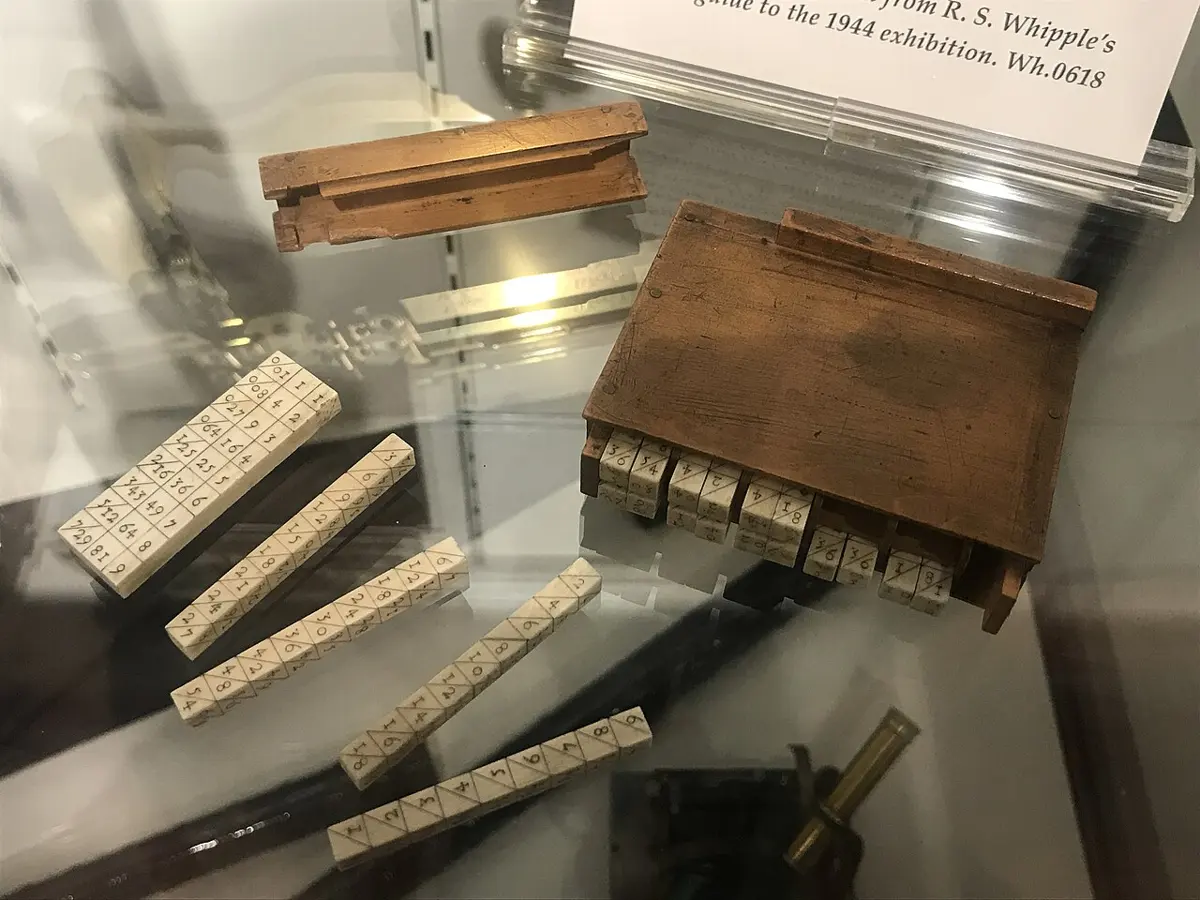
With the rods for 4, 2 and 5, row 6 reads 2|4, 1|2, 3|0, and its strips give 2,550: so 425 × 6 = 2,550.
To multiply by a two-digit number, read two rows and add. For 425 × 36, row 3 gives 1,275 and row 6 gives 2,550. The 3 of 36 is worth 3 tens, so its row is worth ten times as much: 12,750 + 2,550 = 15,300. The rods have done all the multiplying; you only add.
With the rods for 2, 5, 7 and 3 laid out, which single row gives 2,573 × 8 straight away?
Pick an answer to see why.
Can you do it with fewer products?
The lattice for a two-digit number times a two-digit number has 4 cells: 4 small products. For two four-digit numbers it has 16, and for two numbers of 1,000 digits, a million. For thousands of years nobody found a way round this, and in 1960 the great Russian mathematician Andrey Kolmogorov suggested at a seminar in Moscow that there was none.
Within a week, a 23-year-old student in the seminar, Anatoly Karatsuba, proved him wrong. Here is his trick on 23 × 47. Split each number into its tens digit and its ones digit: 2 and 3, 4 and 7. The four cells of the lattice are 2 × 4, 2 × 7, 3 × 4 and 3 × 7. But we never need the two middle products on their own, only their total, which goes in the tens place. Karatsuba got it with one multiplication:
- 2 × 4 = 8 (the hundreds)
- 3 × 7 = 21 (the ones)
- (2 + 3) × (4 + 7) = 5 × 11 = 55, which holds all four products at once. Take away the two you already have: 55 − 8 − 21 = 26, the tens.
So 23 × 47 = 800 + 260 + 21 = 1,081, with three multiplications instead of four.
For two-digit numbers that saves almost nothing. But the trick works on halves of any length: split two 4-digit numbers into 2-digit halves, use three half-sized products instead of four, and do each of those by the trick again. Two four-digit numbers then need 9 small products instead of 16, and two 1,024-digit numbers need 59,049 instead of 1,048,576. A few more additions are needed, but for long numbers the saving soon outweighs them.
Where this is used
The same trick, with multiplying in place of adding, makes big powers quick. To work out 3¹³, write 13 as 8 + 4 + 1, square 3 three times (3², 3⁴, 3⁸) and multiply the right ones together: 5 multiplications instead of 12. This is called square and multiply, and it is used in the cryptography that keeps messages and payments secret, where the powers are hundreds of digits long.
Karatsuba’s trick is used too. GMP, a free program library that many computer programs use to multiply very long numbers, switches from the school method to Karatsuba’s once the numbers are long enough, sometimes as short as 10 of the pieces a computer handles in one go.
Questions
★ Multiply 19 × 31 by halving and doubling. Which right-hand numbers are kept?
Pick an answer to see why.
Use a lattice to multiply 46 × 73.
Answer
Ahmes could divide by doubling too. Find 1,288 ÷ 56 using only the doubles of 56.
Hint
Answer
With Napier’s bones for 2, 5, 7 and 3, row 6 reads 1|2, 3|0, 4|2, 1|8 and row 8 reads 1|6, 4|0, 5|6, 2|4. Use them to find 2,573 × 86.
Answer
★★ A number’s left column is crossed out in every row except the last. What can it be?
Pick an answer to see why.
Use Karatsuba’s trick to multiply 31 × 52 with only three multiplications. Say which three.
Answer
Work out 3¹³ by square and multiply. How many multiplications did you need, and how many would multiplying by 3 again and again need?
Hint
Answer
Where to go next
- How Much Rice Is on the Chessboard? Doubling again and again, and how fast it grows.
- How Can You Multiply 98 × 97 in Your Head? Tricks for multiplying near 100, and the Lilavati’s own shortcuts.
- How Does an Abacus Think? Beads as place value, and calculating on a frame and then in your head.
- Can You Solve the Puzzles of the Lilavati? Bhaskara’s problems for Lilavati, in verse.
- How Did a Book of Numbers Make Multiplying Easy? (Math, Going Further 9–12) Napier’s other invention, logarithms, which turned every multiplication into an addition.
- Did Poets in Ancient India Count in Binary? (Computing, Going Further 6–8) Pingala’s rhythms and the binary numbers behind them. (Coming soon.)
Where these facts come from
- The doubling method: a table of doubles of one number, the matching rows chosen to make the other, added, using only doubling and adding; the halving variant called “Russian peasant” multiplication; the method’s link to binary and its use in binary multiplier circuits: Wikipedia, “Ancient Egyptian multiplication”, read October 2026.
- Ahmes and multiplication by doubling and adding, and division by doubling: MacTutor, “Mathematics in Egyptian Papyri”, University of St Andrews, read October 2026.
- The Rhind papyrus: copied by Ahmes in year 33 of Apophis, about 1550 BC, from an older text of Amenemhat III’s reign; bought by Henry Rhind in Luxor in 1858, in the British Museum since 1865; its two sections 295.5 cm and 199.5 cm long: Wikipedia, “Rhind Mathematical Papyrus”, read October 2026. Its multiplying by 10 by repeated doubling and adding (Problem 4), and the date of about 1650 BC some give: Alexander Bogomolny, “Rhind Papyrus”, Cut the Knot, read October 2026. Since the dates given differ by a century, the topic says “about 3,600 years ago”.
- The lattice, how it is worked, its appearances (Ibn al-Banna, late 13th century; an English treatise c. 1300; Wu Jing, 1450; al-Kashi, 1427; the Treviso Arithmetic, 1478; Pacioli, 1494), the words gelosia and shabakh, and that its origin is unknown: Wikipedia, “Lattice multiplication”, read October 2026.
- The Lilavati’s rule of multiplication, its example of 135 × 12 = 1,620 worked six ways, and Colebrooke’s note on the commentators (the kapata-sandhi, “door-junction”, which by Ganesha’s explanation “proceeds obliquely, joining products along compartments”): Lilavati §§ 14–16 in H. T. Colebrooke, Algebra, with Arithmetic and Mensuration, from the Sanscrit of Brahmegupta and Bhascara (London, 1817; public domain), pages 5–7, Internet Archive, read October 2026. The Lilavati’s verse is quoted in Colebrooke’s translation.
- Bhaskara born in 1114, his Siddhanta Shiromani (of which the Lilavati is the first part) finished in 1150: Wikipedia, “Bhāskara II”, read October 2026.
- Brahmagupta’s (628) ways of multiplying, and that the “door-junction” (kapata-sandhi, which they spell kavāṭa-sandhi) method was a layout worked step by step, not clearly a lattice: Agathe Keller and Catherine Morice-Singh, “Multiplying Integers: on the diverse practices of medieval Sanskrit authors” (draft, 2014), read October 2026.
- Napier’s bones: published in Rabdologiae, Edinburgh, 1617; rods for each digit’s products, read along a row and added along the slanting strips; based on lattice multiplication: Wikipedia, “Napier’s bones”. Napier’s dates, Merchiston, logarithms in 1614, rods of ivory, and his dedication saying the rods were already used abroad: MacTutor, “John Napier”, both read October 2026.
- The ivory set of about 1700 in the Whipple Museum (inventory Wh.0838): Wikidata Q87717844; the photo by Marsupium, Wikimedia Commons, public domain. The papyrus photo: Wikimedia Commons, public domain.
- Kolmogorov’s conjecture (1960, at a seminar at Moscow State University), Karatsuba, aged 23, finding his method within a week, three multiplications instead of four, published in 1962: Wikipedia, “Karatsuba algorithm”, read October 2026.
- Computers multiplying binary numbers by shifting and adding, minicomputers without a multiply instruction until the late 1970s and their “multiply routines”, and today’s circuits adding the partial products at once: Wikipedia, “Binary multiplier”, read October 2026.
- Square and multiply (exponentiation by squaring), its number of multiplications and its use in cryptography: Wikipedia, “Exponentiation by squaring”, read October 2026.
- GMP switching to Karatsuba’s method, its threshold as low as 10 limbs: GMP manual, “Karatsuba Multiplication”, read October 2026.
- Every number in the topic (each halving table, the rows kept and their binary digits, the trick checked for every first number up to 999, the wrong 2,184 from rounding up, every lattice and its strips and carries, the rods’ rows, 425 × 36, 2,573 × 86, the division 1,288 ÷ 56, Karatsuba’s 23 × 47 and 31 × 52, the counts 9 against 16 and 59,049 against 1,048,576, 3¹³ and its 5 multiplications) was computed by a program of our own.

